

What is an AI visibility audit?
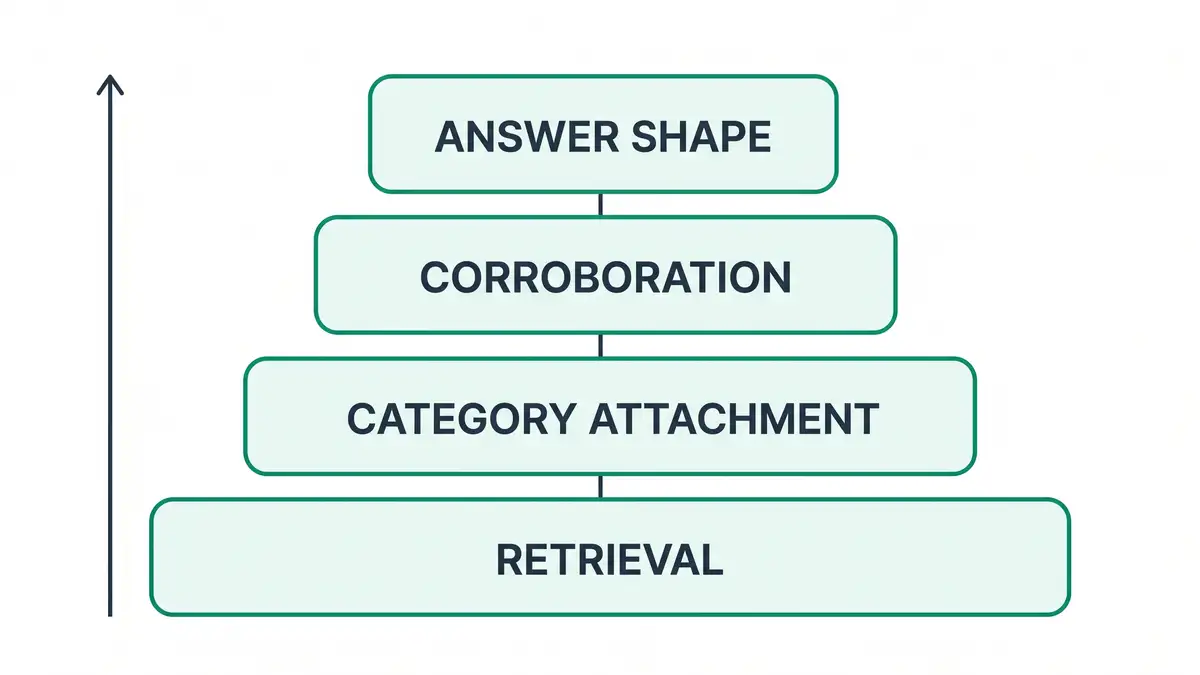
An AI visibility audit tests whether an answer engine can assemble your brand into the two to four names it returns when a buyer asks about your category. It is not a score of your website. It is a test of four things in sequence: whether an engine can retrieve your words, whether anything attaches those words to the category, whether the claim exists anywhere you do not own, and whether a passage on your page can survive being lifted out of it.
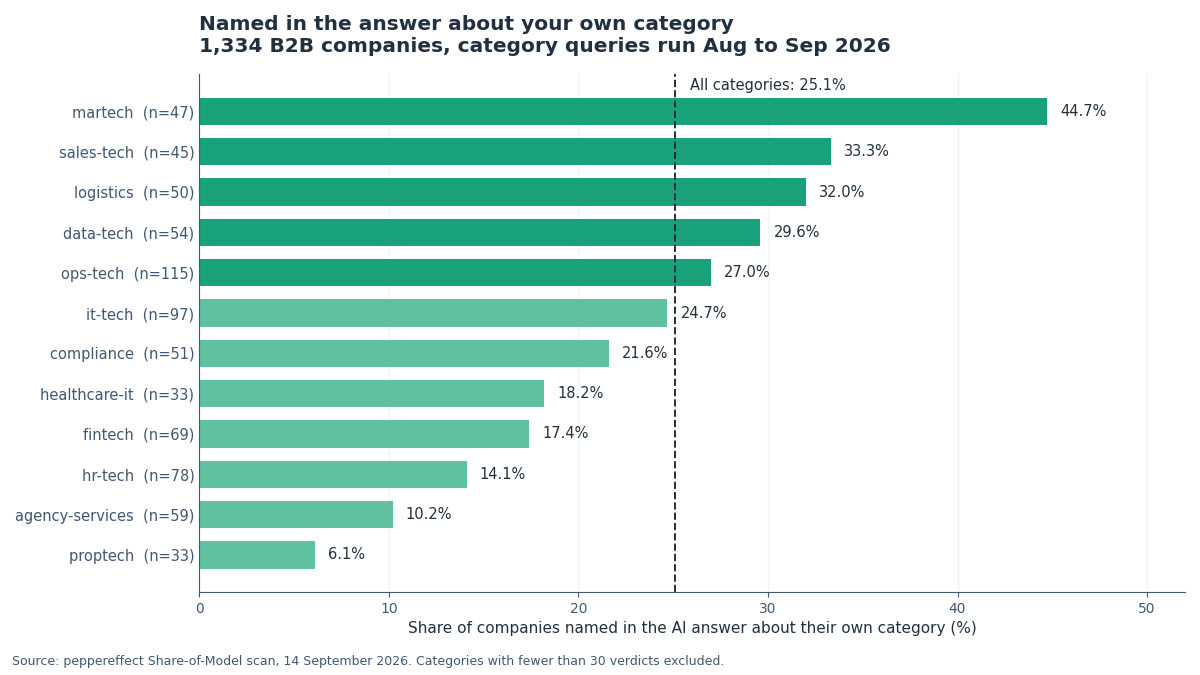
Between August and September 2026 we ran a category query for each of 1,334 B2B companies, using the pipeline behind our Share-of-Model scan, which has now verified 3,629 live domains. In 335 cases the company was named in the answer about its own category. In 999 it was not. Three in four B2B companies are absent from the answer their buyer reads when they ask about the category, and no analytics package reports an absence.
What you will get from this piece:
- The finding that changes what an audit should look for: there is no fixed AI shortlist to break into
- Why auditing for schema and rankings first wastes the budget, in Google's own words
- The four layers an audit has to test, in the order that makes them compound
- Twelve checks with pass thresholds you can run this week, plus the scoring bands
- The three questions an audit cannot answer, and what you need instead
Key Takeaway
The answer engine is stable in what it says and unstable in who it credits. Ahrefs found consecutive AI Overviews score 0.95 cosine similarity on substance while 45.5% of cited URLs are entirely new. Audit for assemblability, not for fame.
Why most AI visibility audits measure the wrong thing
The audits we get asked to review count mentions. They run a prompt set, tally how often the brand appears, and hand over a percentage. That is a measurement, and a useful one, but it is an outcome rather than a diagnosis. It tells you that you are not in the answer. It does not tell you which of the four failure points put you outside it, so it cannot tell you what to fix first.
The second failure is ordering. Most audit templates open with structured data. Google's own documentation closes that line of inquiry: "You don't need to create new machine readable files, AI text files, or markup to appear in these features. There's also no special schema.org structured data that you need to add." Eligibility, in Google's words, is that "a page must be indexed and eligible to be shown in Google Search with a snippet." Schema still earns its place for entity disambiguation and for rich results. It is not the lever that gets you named, and putting it first in an audit buries the layer that actually decides the outcome.
The third failure is treating search rank as a proxy. Ahrefs compared AI citations against Google results for 15,000 long-tail queries in August 2025 and found that 12% of links cited by ChatGPT, Gemini and Copilot appeared in Google's top 10 for the same prompt. Four in five of those citations did not rank anywhere in Google for the original query.
| Assistant | Cited URLs also in Google's top 10 | What it implies for an audit |
| Perplexity | 28.6% | Closest to classic search. Rank work partially transfers. |
| Gemini | 8.6% | Rank is a weak signal. Audit retrieval and corroboration. |
| Copilot | 8.2% | Same. Position tracking will mislead you here. |
| ChatGPT (in-text) | 8.0% | Where most B2B AI referrals originate. Rank explains almost nothing. |
| ChatGPT (references) | 6.1% | The reference list diverges further still. |
Source: Ahrefs, 11 August 2025, 15,000 long-tail queries compared across Google, Bing and five assistants.
Google AI Overviews are the partial exception, and even there the ground is moving. Ahrefs re-ran the analysis across 863,000 keyword SERPs and 4 million AI Overview URLs in March 2026: the share of AI Overview citations drawn from the top 10 had fallen from roughly 76% in July 2025 to 38%. If your audit is a rank report with a new cover page, it is measuring a signal that halved in eight months.
What 1,334 category queries told us about being named
Category matters more than effort. Across the twelve categories with at least 30 verdicts, the named rate ran from 44.7% in martech down to 6.1% in proptech. A proptech marketing team doing everything right will still look like a failure next to a martech team doing very little. We have not measured the cause, and we are not going to pretend otherwise; the likeliest explanation is how much third-party writing exists in each category for an engine to draw on. Either way, benchmark inside your category or the number means nothing.

The answer is short, and it is always short. Of the 1,305 answers that returned a vendor list, every one named between two and four companies. The median was three. There is no page two. Whatever the engine believes about your category, it compresses into three names, and the fourth-best vendor and the four-hundredth are in the same position: absent.
That compression is why the audit has to be diagnostic rather than comparative. Knowing you are not in the three tells you nothing you did not already suspect. Knowing that an AI crawler has fetched only your homepage for six months, or that your central claim exists on no domain you do not own, tells you what to do on Monday.
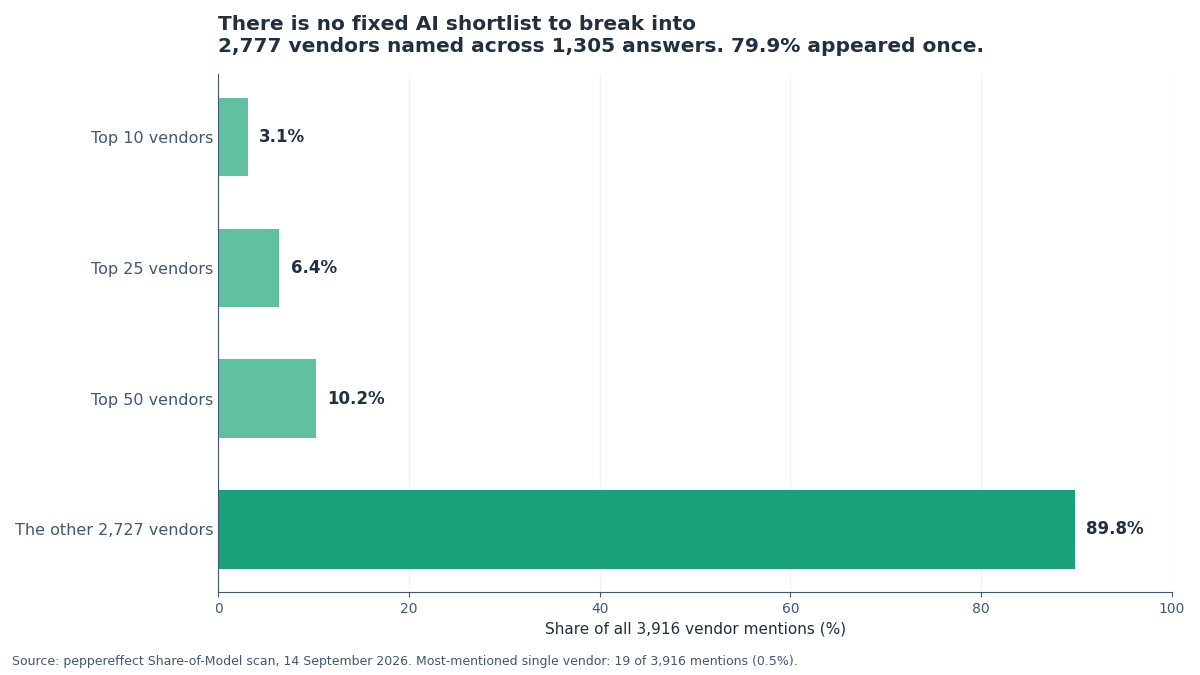
We expected concentration. The prevailing story in AEO is that a handful of incumbents own the AI answer and everyone else is locked out. Our data says the opposite. Across 3,916 vendor mentions we counted 2,777 distinct vendors. The top ten held 3.1% of all mentions. The top fifty held 10.2%. The single most-mentioned vendor in the entire scan appeared 19 times out of 3,916, which is 0.5%. And 2,220 vendors, 79.9% of the total, were named exactly once.
A tail that long is not a club with a waiting list. It is a list that gets rebuilt from scratch for every query. Ahrefs observed the same churn from the other direction, tracking 43,000 keywords with at least sixteen recorded AI Overviews each: an AI Overview has a 70% chance of changing between observations, changes every 2.15 days on average, and 45.5% of the URLs it cites are entirely new between consecutive responses. The substance holds steady at 0.95 cosine similarity. The credits do not.
Key Takeaway
You are not trying to displace an incumbent from a fixed list. You are trying to be the kind of source that gets assembled when the list is redrawn, which happens roughly every two days. That is a different and far more winnable problem.
The four layers an AI visibility audit has to test
The layers are ordered because they compound. Work at layer three does nothing if layer one is broken, and every audit we have run that started in the middle produced a report nobody acted on.
Retrieval
Can an engine get your words? Orbit Media's analysis of 560,695 AI crawl requests across 74 sites found homepages draw roughly fifteen times more AI attention than any other page type, pages four folders deep generate close to zero referrals, and 47% of all pages produced no referral at all. Homepage-only crawling reads as healthy on a dashboard and means your commercial pages are invisible.
Category attachment
Does anything connect you to the category rather than to your own name? Most B2B sites are written in product language and describe a thing the buyer has no word for. An engine asked about the category has no route from the buyer's noun to your page.
Corroboration
Does the claim exist off your domain? Pew found that Wikipedia, YouTube and Reddit together accounted for 15% of the sources listed in Google's AI summaries. A claim that lives only on your own site has nothing holding it up when the model assembles an answer.
Answer shape
Can a passage survive being lifted? The engine is building a three-name list, not summarising your page. A paragraph that needs the paragraph before it cannot be used, however good it is.
Sources: Orbit Media Studios, 8 July 2026; Pew Research Center, 22 July 2025.
Avoid This Mistake
Running one prompt on one engine on one day and treating the result as your visibility. A preprint by Ronald Sielinski, sampling three generative search platforms daily over nine days and again at ten-minute intervals, found citation distributions follow a power law with substantial variability across repeated samples, and that many apparent differences between domains sit inside measurement noise. A single run is a sample of one.
The audit: twelve checks and their pass thresholds
Each check has a threshold, because a check without one becomes an opinion. Run them in order. If a layer fails, stop and fix it before spending anything on the layer above.
| # | Check | How to run it | Pass threshold |
| R1 | AI agents fetch more than your homepage | Grep server or CDN logs for GPTBot, OAI-SearchBot, ChatGPT-User, PerplexityBot and ClaudeBot. Exclude the homepage. | At least one fetch of a deeper page in 30 days |
| R2 | Your key claim is in the raw HTML | curl the page and grep for the sentence you want quoted. No browser, no rendering. | The sentence comes back |
| R3 | robots.txt rules are deliberate | Read your robots.txt line by line. Note, per agent, whether the rule was a decision or inherited from a template. Google-Extended belongs in this check, not in R1: it is a robots.txt token that governs Gemini grounding, not a user agent that appears in your logs. | Every rule is a decision |
| R4 | The buyer's page is shallow | Click from homepage to the page you most want cited. Count clicks and folder depth. | Two clicks or fewer |
| C1 | You appear on the brandless category query | Ask five engines the buyer's query with your company name removed. Repeat on a second day. | Named in 1 of 5, on both runs |
| C2 | Engines place you in the right category | Ask each engine what your company does. Read only the first sentence. | Right category named, no wrong one |
| C3 | A page is titled in the buyer's words | Scan your page titles for the buyer's category noun, not your product name. | One non-homepage page, title and first paragraph |
| O1 | The claim exists off your domain | Search the exact phrasing. Count distinct domains you do not own or control. | Three or more, each dated |
| O2 | One source is a type engines lean on | Check whether one of the three is a reference site, forum, video platform, review platform or trade title. | At least one |
| O3 | A recent third-party comparison names you | Find listicles and comparison pages in your category. Check the date and the list. | One within 12 months, not paid for |
| A1 | A passage stands alone | Paste the passage into an empty document. Read it cold with no heading and no preceding text. | 40 to 80 words that still answer |
| A2 | The passage carries a checkable fact | Underline every claim. Strike anything an adjective is doing the work for. | One number, date, constraint or price survives |
Thresholds set from the peppereffect Share-of-Model scan (3,629 verified domains, 1,334 category-query verdicts, 14 September 2026) and the published research cited throughout this article.
Work through the twelve checks with a live score and a printable result: the interactive AI Visibility Audit. Nothing is sent anywhere.
Open the audit toolHow to score the audit
Count the checks you pass. The band tells you where your constraint is, which is the only part of a score that matters.
| Score | Band | Your constraint |
| 0 to 3 | Invisible | Retrieval. The engine cannot reach your argument. Nothing above this layer compounds until it is fixed. |
| 4 to 6 | Retrievable, not selectable | Category attachment. Your words are reachable and nothing ties them to the buyer's noun. |
| 7 to 9 | In the running | Corroboration and passage shape. You get named sometimes. These two decide how often. |
| 10 to 12 | Citable | Measurement. You can be assembled. Now find out how often you actually are. |
Scoring bands: peppereffect, September 2026. Bands describe the binding constraint, not a quality rating.
Most B2B teams we audit land between 4 and 6, and the pattern is consistent: the technical work was done years ago, the content was written in product language, and nothing outside the domain repeats the claim. That is a fixable position. A mention report cannot see it, because a count of appearances has no way to express the reason for a zero.

What an AI visibility audit cannot tell you
It cannot give you a rate. The audit is a test of capability. Whether you are named 4% of the time or 40% is an empirical question that needs repeated sampling across engines, which is exactly what Share of Model measures and what a twelve-check audit deliberately does not attempt.
It cannot tell you what the engine says about you. Being named and being recommended are different outcomes. A sentence that places you in the category and then qualifies you out of it still scores as a mention in any tool that counts appearances, so read the sentences, not the tally.
It cannot tell you what it is worth. AI referral volume stays small: Orbit Media put AI at 0.5% of sessions across 97 B2B sites and 28.9 million sessions. The value is in who those visitors are. The same study found AI referrals converted to leads at 1.91% against 0.50% for organic search, with ChatGPT at 2.08%. Small traffic, different buyer. Our own work with Helium42 moved AI-sourced visits by a factor of 83 to 250 visits a quarter, and the method behind that number is published in full.
Key Takeaway
Audit to find the constraint. Measure to find the rate. A team that scores 11 of 12 and never measures is guessing, and a team that measures weekly without fixing layer one is paying for a thermometer in a burning building.
Frequently Asked Questions
What is an AI visibility audit?
It is a structured test of whether an answer engine can assemble your brand into the short list it returns for your category. It works through four layers in order: retrieval, category attachment, corroboration and answer shape. Unlike a mention report, which counts outcomes, an audit identifies which layer is blocking you, so the output is a fix list rather than a percentage. In our scan of 1,334 B2B companies, 74.9% were not named in the answer about their own category.
How is an AI visibility audit different from an AEO or GEO audit?
In practice the labels overlap, and most AEO audits on the market are technical SEO audits with new section headings. The distinction worth keeping is scope. An answer engine optimization programme covers the work; an audit covers the diagnosis that comes before it. If the document you are handed opens with structured data and closes with a content calendar, it is a content plan, not an audit.
Do I need an AI visibility checker tool to run this?
No. Nine of the twelve need nothing but your own logs, your own site and a handful of prompts typed by hand. Only the three corroboration checks send you off your own domain, and a search box covers those. Commercial checkers are useful for the part an audit deliberately leaves out, which is repeated measurement over time. They are not useful for diagnosis, because they report that you are absent without reporting why. Start with the twelve checks, then buy measurement once you have something worth tracking.
How often should I re-run the audit?
Quarterly for the audit, continuously for measurement. The audit tests structural properties that change when you ship, not daily. Measurement is a different cadence, because the source set moves fast: Ahrefs recorded a 70% chance of an AI Overview changing between observations and 45.5% of cited URLs being new each time. Anything you sample once a quarter will tell you nothing about that churn.
Does schema markup get my brand cited by AI?
Not on its own, and Google says so directly: there is no special schema.org structured data required to appear in AI Overviews or AI Mode, and eligibility is simply being indexed and eligible for a snippet. Schema helps an engine disambiguate your entity, which supports the category attachment layer, and it earns rich results in classic search. Treat it as hygiene at layer two rather than the lever, and read how LLMs actually decide what to cite before reallocating budget to markup.
My rankings are fine. Why would I fail an AI visibility audit?
Because rank is a weak proxy. Only 12% of the URLs cited by ChatGPT, Gemini and Copilot rank in Google's top 10 for the same prompt, and four in five of those citations do not rank anywhere for the original query. Even for AI Overviews, the share of citations pulled from the top 10 fell from roughly 76% in July 2025 to 38% by March 2026. Strong rankings alongside falling clicks is the standard presentation, and it is worth separating that from a genuine traffic diagnosis before you act.
Which engine should I audit first?
ChatGPT, if you are B2B. It accounted for 82.3% of AI referral visits in Orbit Media's 97-site dataset, and it is also the engine where search rank explains least, at 8.0% overlap with Google's top 10. Audit it first and use the seven ChatGPT-specific checks alongside the twelve here. Do not stop there: only 14% of the top 50 most-mentioned sources are shared across ChatGPT, Perplexity and Google AI Overviews, so a single-engine pass is not a result.
Find out how often you are actually named
The audit tells you whether an engine can assemble you. Our free measurement tells you the rate: how often your brand appears across the engines your buyers use, benchmarked against your category from a scan of 3,629 verified B2B domains.
Get your free AI visibility measurementResources
- Pew Research Center, 22 July 2025: Google users are less likely to click on links when an AI summary appears
- Ahrefs, 11 August 2025: Only 12% of AI-cited URLs rank in Google's top 10 for the original prompt
- Ahrefs, 12 June 2025: 86% of top mentioned sources are not shared across ChatGPT, Perplexity and AI Overviews
- Ahrefs, 11 November 2025: AI Overviews change every 2 days but never change their mind
- Ahrefs, 2 March 2026: Update on how many AI Overview citations pull from the top 10
- Google Search Central: AI features and your website
- Orbit Media Studios, 22 July 2026: AI traffic conversion rates across 97 B2B websites
- Orbit Media Studios, 8 July 2026: AI crawls versus AI traffic, 560,695 requests analysed
- Sielinski, R., arXiv preprint, revised 26 August 2026: Quantifying uncertainty in AI visibility