

Your organic traffic is dropping because search has gone zero-click. Google AI Overviews and AI answer engines now resolve most queries on the results page, so your rankings still earn impressions but no longer earn the click. In early 2026, 68% of Google searches ended without a click, and AI Overviews cut the top result's click-through rate by up to 58%. The fix is earning citations inside AI answers.
Why is my organic traffic dropping?
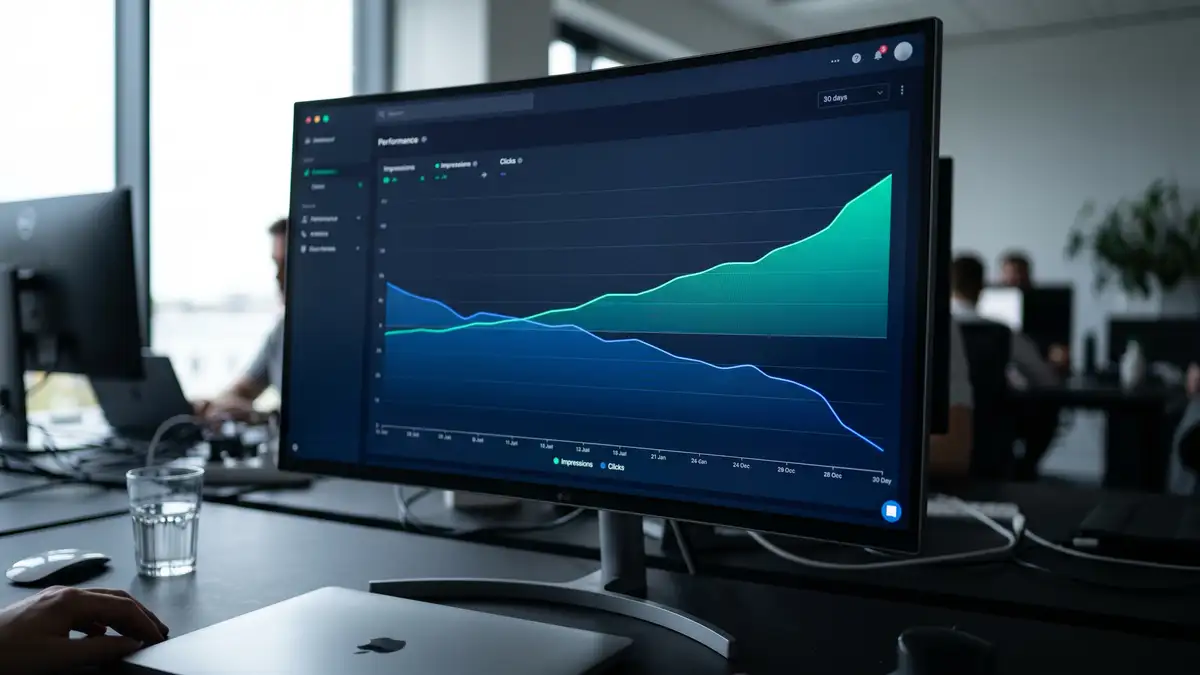
If your impressions look stable while clicks and sessions slide, you are not imagining it and you have not necessarily been penalized. You are watching the structural collapse of organic search traffic in the AI era show up in your own analytics. The query still happens, your page still ranks, but the answer is now delivered on the results page before anyone needs to click.
The numbers are unambiguous. SparkToro measured that 68.01% of Google searches ended without a click in early 2026, up from 60.45% in 2024. Ahrefs found that an AI Overview now reduces the position-one click-through rate by 58%. And Google's March 2026 core update pruned thin and templated pages by a further 30% to 50%. Three forces, one symptom: your traffic is leaking.
What you'll learn in this guide:
- What zero-click search is and how far it has spread.
- Exactly how much traffic Google's AI Overviews are taking, across independent studies.
- How to diagnose whether your drop is AI Overviews, a core update, a technical issue, or shifting demand.
- What actually restores visibility when the click is no longer guaranteed.
Key Takeaway
A traffic drop with stable impressions but falling clicks is the signature of zero-click search, not a penalty. The response is not to rewrite everything in a panic. It is to diagnose the precise cause, then optimize to be cited inside the AI answer.
What is zero-click search, and why does it matter now?
A zero-click search is a query that ends without the user visiting any external site, because the answer is delivered directly on the results page through an AI Overview, featured snippet, or knowledge panel. It is now the majority outcome. Similarweb data shows zero-click behavior jumped from 56% to 69% in the year after AI Overviews launched in May 2024, while organic traffic to news sites fell from over 2.3 billion monthly visits to under 1.7 billion across the same period.
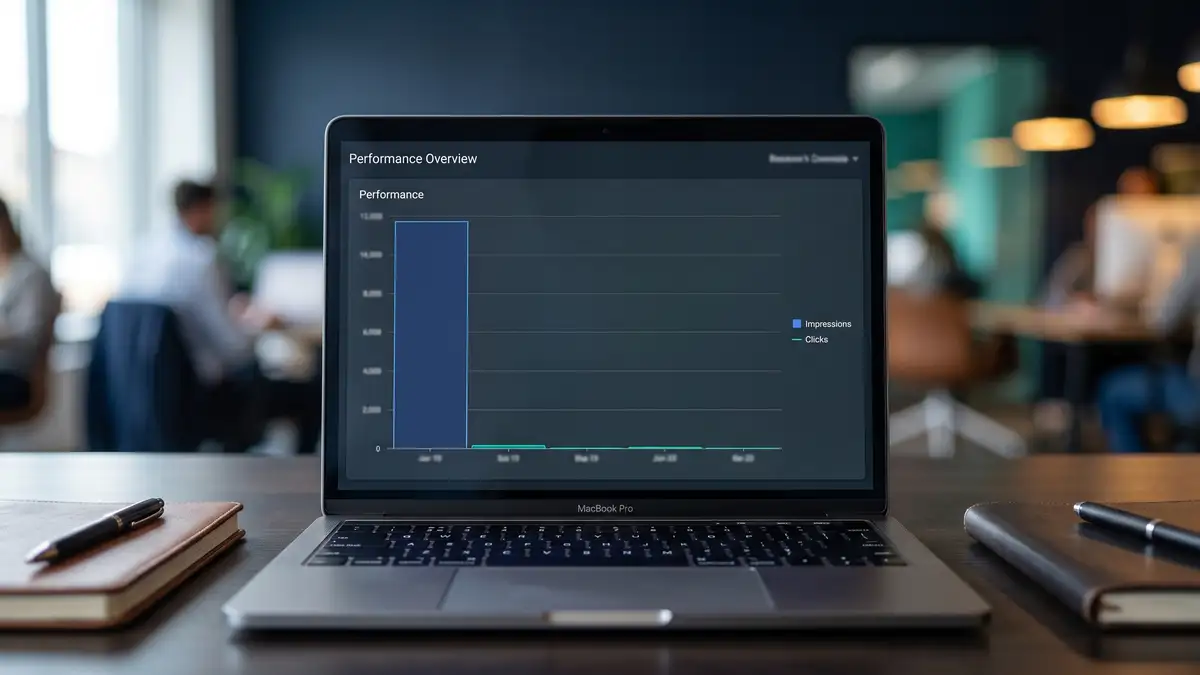
This is the pattern practitioners call the Great Decoupling: impressions hold steady while clicks evaporate. Google has effectively acknowledged it, rolling out dedicated generative AI performance reports in Search Console in June 2026 so owners can see where their content is surfaced inside AI features without earning a visit. The behavior is most extreme on mobile and on informational queries, exactly the top-of-funnel keywords most B2B content targets. If you want to quantify it for your own domain, our guide on measuring zero-click visibility walks through the method.
How much traffic are Google's AI Overviews actually taking?
Every independent study converges on the same range: AI Overviews cut organic clicks by roughly half or more. Seer Interactive, tracking 3,119 informational queries, found organic CTR on AI Overview queries fell from 1.76% to 0.61%, a 61% decline, with paid CTR down 68%. Tellingly, even queries without an AI Overview lost 41% of their CTR year over year, which means users are simply clicking less everywhere.
There is one lifeline, and it defines the whole strategy. Seer found that brands cited inside an AI Overview earn 35% higher organic CTR than those left out of it. Presence in the answer, not position beneath it, now decides whether any traffic flows. That is the mechanic behind getting cited by ChatGPT and AI search.
| Study | Organic CTR impact when AI Overview present | Source / date |
| Ahrefs | -58% (position 1) | December 2025 |
| Seer Interactive | -61% organic, -68% paid | 2024-2025, 3,119 queries |
| Authoritas | -47.5% desktop, -37.7% mobile | 2024, UK publishers |
| Cited inside the AI Overview | +35% organic CTR | Seer Interactive, 2025 |
Sources: Ahrefs, 2025, Seer Interactive, 2025, Authoritas via Press Gazette, 2024.

Is it AI Overviews, a core update, or something else?
Not every traffic drop has the same cause, and the wrong diagnosis leads to the wrong fix. Before you rewrite a single page, isolate which of the four common causes is actually hitting you. Each leaves a different fingerprint in Google Search Console.

Run the diagnosis in this order, because the cheapest checks rule out the most common causes first. The decoupling signature, impressions steady and CTR falling, points to AI Overviews. A simultaneous drop in impressions and rankings around a known update date points to a core update. Losses confined to one section point to a technical issue. And a quiet fade in branded or early-stage queries points to demand migrating into AI chats.
Compare impressions to clicks in Search Console
If impressions are flat or rising while clicks and CTR fall, the cause is zero-click and AI Overviews, not a ranking loss.
Check whether AI Overviews appear on your queries
Spot-check your top informational keywords. If an AI Overview sits above the results, expect the CTR collapse the studies describe.
Align the drop date with Google updates
If impressions and rankings fell together around a confirmed core update, and thin or templated pages were hit hardest, it is a quality issue, not AI Overviews.
Rule out technical and demand causes
Section-specific losses signal crawl, canonical, or indexing faults. A fade in branded queries signals buyers researching inside AI chats instead. For the technical and structural foundations, see our HubSpot SEO and AEO visibility guide.
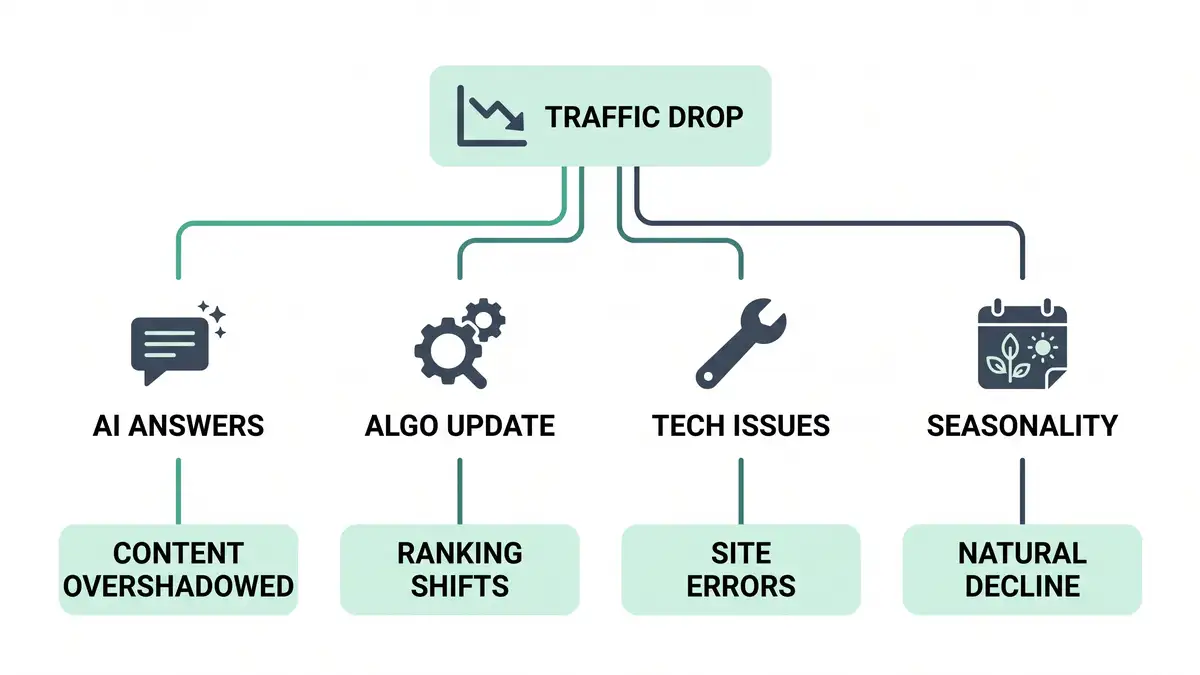
| Likely cause | Signature in your data | First move |
| AI Overviews / zero-click | Impressions stable or up, CTR and clicks down, AI Overview shows on your queries | Optimize to be cited (AEO / GEO) |
| Google core update | Impressions and rankings drop together near an update date; thin pages hit hardest | Deepen content, strengthen E-E-A-T, prune thin pages |
| Technical / indexing | Losses confined to specific sections or templates; crawl or index errors in GSC | Fix crawl, canonical, and indexing faults |
| Demand shift to AI chats | Branded and early-stage queries quieter; AI assistant referrals appearing | Build presence inside AI answers |
Sources: Semrush, 2025, Search Engine Land, 2024.
Avoid This Mistake
Do not respond to a zero-click drop by mass-rewriting pages or chasing more keywords. If impressions are healthy, your content is not the problem and more of it feeds the same machine that is harvesting your clicks. Diagnose first, then fix the actual cause.
Want to know whether ChatGPT, Gemini, and Claude cite you or your competitors? The AI Visibility Check maps your Share of Model and the exact gaps draining your pipeline.
Run Your Free AI Visibility CheckWhat does a traffic drop mean for B2B pipeline?
For B2B, this is a pipeline problem disguised as a traffic problem. The queries losing the most clicks are generic and informational, precisely the top-of-funnel keywords most content strategies target. Semrush found AI Overviews are also spreading into commercial and navigational queries, so even branded search is no longer a safe harbor. Meanwhile, early-stage research is migrating into AI assistants, where your buyers form a vendor shortlist before they ever touch your site.
The encouraging part is that the traffic AI does send converts. Similarweb measured an 11.4% conversion rate from ChatGPT referrals versus 5.3% from organic search. The play is not to win back generic clicks. It is to become the source AI cites, then capture the high-intent visitor who does arrive. That means benchmarking where you stand with an AEO readiness assessment, then structuring content with quotable answers, statistics, schema, and the kind of authority that earns citations, the same discipline covered in GEO vs SEO vs AEO, generative engine optimization, and our answer engine optimization strategy.
Key Takeaway
A decline in organic sessions is not necessarily a decline in demand. It is demand moving into zero-click and AI-chat interactions that still shape who gets shortlisted. Measure Share of Model, not just pageviews, and optimize to be cited where buyers now research.
Frequently Asked Questions
Why is my organic traffic dropping if my rankings are stable?
Because ranking and traffic have decoupled. Your page still ranks and still earns impressions, but the click no longer follows when an AI Overview or snippet answers the query on the results page. SparkToro measured 68% of searches ending without a click in early 2026, and Ahrefs found AI Overviews cut position-one CTR by 58%. Stable impressions with falling clicks is the clearest sign your loss is zero-click behavior, not a penalty or a ranking drop. The fix is earning citations inside the AI answer rather than chasing the lost click.
Why is my website traffic dropping all of a sudden?
A sudden drop usually has one of four causes: a Google AI Overview now answering your queries, a confirmed core algorithm update, a technical or indexing fault, or demand shifting into AI chat tools. Check the timing first. A simultaneous fall in impressions and rankings around a known update date points to a core update, which hit thin and templated content by 30 to 50% in March 2026. Impressions that stay flat while clicks fall point to AI Overviews. Diagnose the signature before you change anything.
What is zero-click search?
Zero-click search is any query resolved on the results page without the user visiting an external site, because Google delivers the answer through an AI Overview, featured snippet, or knowledge panel. It now accounts for roughly 68% of Google searches and even more on mobile. Zero-click is the structural reason organic traffic is falling across nearly every industry, and it is why visibility inside the answer now matters more than a ranking position beneath it.
How do I check if AI Overviews are taking my clicks?
Open Google Search Console and sort pages by impressions. Any page with high impressions and a near-zero click-through rate, well below the rate expected for its position, is likely being intercepted by an AI Overview. Cross-check by searching your top keywords and seeing whether an AI Overview appears. Google's new generative AI performance reports also show where your content surfaces inside AI features. This high-impression, low-CTR pattern is the fingerprint of an AI-driven loss.
How do I recover organic traffic lost to AI Overviews?
You recover it by getting cited inside the AI answer, not by reclaiming the old blue-link click. Lead pages with a concise, quotable answer, back claims with specific statistics and sources, add FAQ and Article schema, and build the third-party authority that AI systems trust. Brands cited inside an AI Overview earn 35% higher click-through than those left out. Start by benchmarking your current citation rate, codify the wins with AEO best practices, then prioritize the queries that drive real pipeline.
See Exactly Why Your Traffic Is Dropping
peppereffect diagnoses whether AI Overviews, a core update, or a technical issue is draining your organic traffic, then installs the answer engine optimization system that gets you cited by ChatGPT, Gemini, and Claude. Measured in Share of Model and pipeline, not vanity pageviews.
Run Your Free AI Visibility CheckGet your AI Visibility Value Report → a five-minute AI visibility self-diagnosis
Resources
- SparkToro — In 2026, Less Than One Third of Google Searches Still Send a Click
- Ahrefs — AI Overviews Reduce Clicks by 58%
- Seer Interactive — AI Overview Impact on Google CTR
- Press Gazette — Publishers Lose Up to 50% of CTR to AI Overviews (Authoritas)
- Semrush — AI Overviews' Impact on Search in 2025
- DigitalApplied — March 2026 Core Update: Content Quality Winners and Losers
- Search Engine Land — SEO's Great Normalization Has Begun
- Google Search Central — Generative AI Performance Reports in Search Console