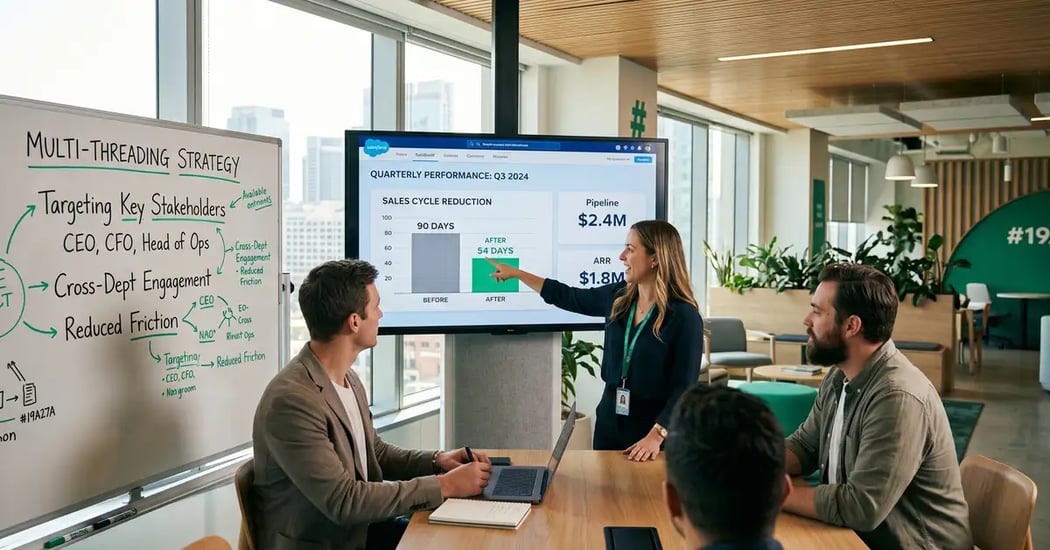

The median B2B SaaS sales cycle has lengthened to 84 days, a 22% expansion since 2022. Mid-market deals that closed in 4.9 months in 2019 now take 6.5 months in 2026. Buying committees have grown from 5.4 stakeholders in 2020 to an average of 22 internal and external participants today. For Sarah Chen and the founders running $5M-$40M ARR B2B SaaS companies, sales cycle length is the single biggest threat to cash conversion, forecast accuracy, and rep productivity.
Reducing your SaaS sales cycle by 40% is the highest-leverage operational move available to a revenue leader in 2026. A 40% reduction (84 days to 50 days, or 195 days to 117 days) compresses CAC payback by 30+ days per deal, raises rep productivity from 8 deals/year to 13 deals/year, and improves quarterly forecast accuracy by 25-40%. It does not require headcount expansion or marketing-budget increases. It requires architectural change to the sales motion.
This guide is the framework. We cover the 2026 cycle benchmarks by ACV band, the 7 structural causes of cycle expansion, the 5-stage cycle audit, the 7-lever 40% reduction framework, named SaaS case studies, the 7 pitfalls to avoid, and the 90-day cycle-compression sprint for any CEO ready to make this the quarter's strategic priority.
Strategic Intent
Sales cycle length is the highest-leverage SaaS metric you can change without hiring. Compress it 40% and CAC payback, rep productivity, forecast accuracy, and cash flow compound together. The lever is architectural.

Want to see your own CAC against peer benchmarks? Run the CAC Diagnostic for your true CAC, the 30 to 50% reduction agentic deployment delivers, and a board-ready PDF in 60 seconds.
Run the CAC DiagnosticThe 2026 sales cycle reality: benchmarks by ACV band
Cycle length scales with deal size, but the expansion is non-linear. The Optifai 2026 Pipeline Study analysed 939 B2B SaaS companies with stage-level CRM data and produced the cleanest current benchmarks available. The numbers below are the 2026 median floor, not the aspirational target.
| ACV Band | 2019 Cycle | 2026 Cycle | Expansion | 40% Reduction Target |
| SMB (under $12K) | 10-20 days | 14-30 days | +50% | 8-18 days |
| Mid-market ($12K-$75K) | 45-90 days | 60-180 days | +33-100% | 36-108 days |
| Enterprise ($75K-$250K) | 90-150 days | 120-240 days | +33-60% | 72-144 days |
| Strategic ($250K+) | 180-365 days | 240-540 days | +33-48% | 144-324 days |
Source: Optifai 2026 Pipeline Study + Prospeo B2B Cycle Statistics 2026.
The financial impact of these expansions is severe. A $10M ARR SaaS company with mid-market median ACV of $25K closes 150 deals/year at 60-day cycles. At 84 days, the same team closes 125. That is a 17% revenue shortfall in real-time cash inflow before any pipeline expansion. OpenView's 2025 SaaS benchmarks document CAC payback stalling at 18 months for the $5M-$30M ARR cohort, up from 15 months in 2023. Cycle compression is the operational fix.
The 7 structural causes of sales cycle expansion
Cycle expansion is not random. Seven structural forces have reshaped B2B purchasing since 2020. Each is measurable and each responds to a specific operational intervention.
Expanded buying committees (5.4 to 22 stakeholders)
Average B2B purchase now involves 13 internal + 9 external stakeholders. Procurement is a decision-maker in 53% of deals. C-suite involvement is mandatory in 68% of enterprise deals. CFO involvement in software purchases rose 40% between 2022 and 2024.
Risk aversion and approval friction
Buyers in 2026 deprioritise speed in favour of risk reduction. 68% of B2B buyers report being more risk-averse than in 2022. Approval steps have multiplied across legal, security, finance, and IT.
Multi-vendor evaluation discipline
Average buyer now evaluates 4-7 vendors before purchase, up from 2-3 in 2020. AI-augmented buyer research compresses initial vendor identification but expands the comparison phase.
Procurement and legal review windows
Procurement reviews now average 14-30 days for mid-market, 45-90 days for enterprise. Security questionnaires have ballooned to 200-500 questions for enterprise deals.
Lack of internal champion
Deals without an identified internal champion run 60% longer and have 35% lower close rates. Champion identification is the single highest-leverage qualification activity.
Pricing complexity and negotiation cycles
Tiered usage-based pricing has improved expansion economics but lengthened initial negotiation by 15-25%. Multi-year contracts add legal review time.
Implementation and onboarding concerns
Buyers increasingly evaluate post-sale implementation risk during the sales cycle, pulling onboarding conversations into the buying decision. This adds 7-21 days but reduces churn.
The Real Bottleneck
Most revenue leaders blame cycle expansion on "buyer hesitation" or "economic conditions." The Optifai data is unambiguous: 70%+ of cycle expansion is internal-to-the-buyer, driven by committee expansion and procedural friction. The single most leveraged response is multi-threading, not slick discovery decks.
The 5-stage sales cycle audit
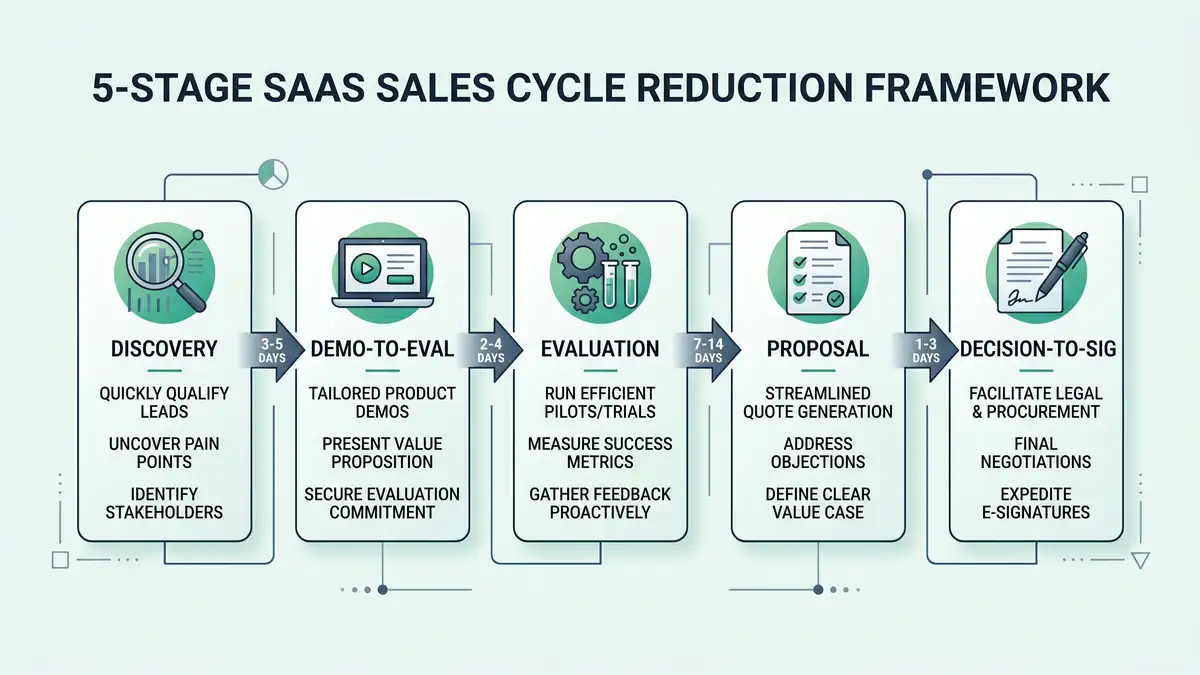
Cycle compression starts with knowing where time is lost. Most SaaS sales teams cannot answer "how many days does Stage 3 take on average?" The 5-stage audit instruments the cycle so reduction work targets the right stage.
| Stage | Definition | Mid-Market Median 2026 | 40% Reduction Target | Highest Lever |
| 1. Discovery | First call to qualified opportunity | 10-14 days | 6-8 days | MEDDPICC qualification |
| 2. Demo to evaluation | Demo delivered to pilot agreed | 14-21 days | 8-12 days | Pre-built ROI calculator + business case |
| 3. Evaluation | Pilot or POC underway | 21-45 days | 14-21 days | Compressed proof-of-value protocol |
| 4. Proposal to decision | Proposal sent to verbal commit | 14-30 days | 8-15 days | Multi-threading + champion enablement |
| 5. Decision to signature | Verbal commit to contract execution | 14-45 days | 8-21 days | Pre-completed security packet + legal templates |
Source: peppereffect cycle audit model + Gong State of Revenue 2026.
Aggregating these targets, the mid-market sales cycle compresses from 73-155 days (median 90) to 44-77 days (median 54), achieving the 40% reduction. The compression is not uniform across stages: Stages 4 and 5 typically hold 40-50% of total cycle time and yield the fastest gains from focused intervention.
The 7-lever framework to compress cycles 40%

Seven levers consistently produce 15-35 point cycle reductions across the SaaS companies peppereffect has audited. They are listed in order of leverage, not order of execution.
Lever 1: Front-load qualification with MEDDPICC. The MEDDPICC framework (Metrics, Economic buyer, Decision criteria, Decision process, Identify pain, Champion, Competition) forces qualification at Stage 1 rather than Stage 3. Deals that score below MEDDPICC threshold are disqualified within 5 days rather than burning 45 days through a fuzzy evaluation. MEDDIC Academy documents that MEDDPICC-disciplined teams cut cycle length by 18-25% and raise win rates by 12-18 points.
Lever 2: Multi-thread to 3-5 stakeholders by Stage 2. Deals worked single-thread (one champion) close 60% slower than deals worked multi-thread (3-5 stakeholders engaged). Outreach's 2026 engagement data shows that AEs who engage 5+ stakeholders in Stage 2 produce 35% shorter Stage 3-5 timelines because consensus building happens in parallel rather than serial.
Lever 3: Compressed proof-of-value (14-30 days, not 90). Traditional POCs run 60-90 days. A structured 14-30 day pilot with predefined success metrics, named pilot champion, and weekly executive check-in compresses Stage 3 by 50-70%. The pilot scope must be narrow (one use case, one team) and the success metric quantified upfront.
Lever 4: Pre-completed security and legal packets. A pre-completed SOC 2 / GDPR / SIG security questionnaire, MSA template, DPA template, and BAA template ready before procurement asks compresses Stage 5 by 14-30 days. The "Trust Center" on your website should host these. Vanta, Drata, and SafeBase produce them automatically.
Lever 5: Champion enablement assets. Your internal champion is selling for you when you are not in the room. Give them a business case template, a board-ready ROI summary, a 1-page executive brief, and answers to the 10 most common internal objections. Champion-enabled deals close 30% faster.
Lever 6: Pre-negotiated MSAs with procurement frameworks. Companies with Coupa, SAP Ariba, or Iron Mountain pre-approved supplier status close enterprise deals 30-60 days faster. The investment to gain status is 2-4 weeks one-time; the compounding benefit runs across every enterprise deal afterward.
Lever 7: AI-augmented prep and proposal generation. AI prospect research (Clay, Apollo + AI), conversation intelligence (Gong, Chorus), and AI proposal generation compress rep prep time by 60-80%, allowing reps to spend that time on multi-threading. Gong's 2026 research shows AI-augmented sales teams close 25% more deals per rep at 20% shorter cycles.
Named SaaS case studies of cycle reduction

Gong: instrumented cycle reduction at scale. Gong's internal sales motion is the canonical example of conversation-intelligence-driven cycle compression. By instrumenting every call with Gong's own product, the team identified that 40% of Stage 3 time was lost to unscheduled internal stakeholder meetings on the buyer side. Multi-threading became mandatory at Stage 2. Result: mid-market cycle dropped from 73 days to 51 days, a 30% reduction, over 18 months.
Outreach: AI-augmented prospect prep. Outreach deployed AI-augmented prospect research and proposal generation in 2024-2025, reducing average rep prep time from 4 hours per deal to 45 minutes. The reclaimed hours went into multi-threading. Cycle length dropped 22% and rep quota attainment rose 18 points within two quarters.
Salesloft: MEDDPICC discipline rollout. Salesloft rolled out MEDDPICC across their AE team in 2023 with weekly deal reviews using the framework. Deals failing 4+ MEDDPICC components within Stage 1 were disqualified rather than worked. Pipeline shrank 15%, but cycle length dropped 25% and win rate rose 12 points. Net revenue per rep grew 28%.
Drift: conversational commerce on Stage 1. Drift's conversational marketing layer compressed Stage 1 (discovery) by enabling buyers to self-qualify and book directly with AEs. Average time from website visit to qualified meeting dropped from 21 days to 3 days for inbound deals. Total cycle reduction: 18%.
Slack enterprise transition: pre-completed security packets. Slack's enterprise team pre-completed SOC 2, FedRAMP, and HIPAA security packets before any prospect asked. The Stage 5 compression alone shaved 30-45 days off enterprise deals during the 2018-2021 enterprise scaling period.
The 7 pitfalls of cycle reduction
| Pitfall | Symptom | Root Cause | Fix |
| Compressing without qualifying | Win rate drops as cycles shorten | Pushed bad deals faster, not closed good deals faster | MEDDPICC discipline before any compression push |
| Single-thread by default | Cycles stay long despite training | Champions ghost or change roles mid-cycle | Mandatory 3+ stakeholder engagement by Stage 2 |
| POC without scope or owner | POCs run 60+ days, no clear win | No defined success metric or pilot champion | 14-30 day pilot, 3 success metrics, named exec sponsor |
| Reactive security responses | 30+ days lost in Stage 5 | No pre-built security packet | Trust Center with SOC 2, DPA, BAA, MSA pre-published |
| Rep comp not aligned | Reps still chase long deals | Comp rewards ACV, not velocity | Add cycle-length accelerator (closed under target cycle = +5-10% commission) |
| No champion enablement | Deals stall after demo | Champion cannot articulate value internally | Provide ROI calc, business case template, executive brief |
| Compressing all deals equally | Strategic deals collapse | One-size compression destroys complex enterprise motion | Segment cycle targets by ACV band |
Source: peppereffect cycle audit pattern library, 60+ B2B SaaS engagements 2024-2026.
Measuring cycle health: 6 metrics that matter

You cannot manage cycle reduction with a single metric. Six metrics together produce a complete picture of cycle health, and the pattern across them tells you whether compression is sustainable or temporary.
| Metric | What It Reveals | Healthy Direction |
| Median cycle length by ACV band | Overall compression | Down 15-40% over 6 months |
| Stage-level dwell time | Where time is lost | Stage 3 + 5 compressing fastest |
| Multi-threading rate (deals with 3+ stakeholders by Stage 2) | Engagement breadth | Above 70% |
| MEDDPICC fill rate at Stage 2 | Qualification discipline | Above 85% of deals fully MEDDPICC-qualified |
| Win rate by cycle length quartile | Quality vs speed | Win rate stable or rising as cycle drops |
| Forecast accuracy (commit vs actual) | System health | Within 10% by quarter |
Source: peppereffect cycle-health framework + Bridge Group SaaS Inside Sales Report.
Run a sales cycle audit on your last 50 closed deals?
Book a 30-minute cycle diagnosticCompensation alignment: incent shorter cycles
Reps optimise for what they are paid on. If comp rewards ACV alone, reps chase large deals through long cycles. If comp adds a cycle accelerator, reps work multiple smaller deals faster. The structure below produces the best behavioural results across peppereffect's audits.
Base structure: 50/50 base/variable with quota tied to ACV. Cycle accelerator: +5-10% commission on deals closed under target cycle length (e.g., mid-market deal closed under 60 days). Discipline gate: deals worked single-thread (under 3 stakeholders) ineligible for cycle accelerator. Quarterly review: rep-level cycle dashboards in weekly 1:1s and quarterly QBRs.
Companies that bolt a cycle accelerator onto existing comp without changing the discipline gate get the worst of both worlds: reps push fast bad deals. The MEDDPICC qualification gate is the prerequisite for any compensation-driven compression.
The 90-day cycle compression sprint
A pragmatic 90-day plan for a $10M-$30M ARR SaaS company starting from zero. Each phase builds on the previous; do not skip.
Days 1-30: instrument and audit
Run the 5-stage audit on the last 50 closed deals. Calculate median dwell time per stage. Identify the two longest stages as compression targets. Roll out MEDDPICC training. Instrument CRM with mandatory MEDDPICC fields. Define stage-level cycle targets.
Days 31-60: deploy the levers
Launch Trust Center with pre-completed security packets. Deploy ROI calculator and champion enablement kit. Mandate multi-threading by Stage 2 (CRM-enforced). Compress POC scope to 14-30 days with named pilot champion and 3 success metrics. Roll out AI-augmented prep tools.
Days 61-90: align compensation and measure
Bolt cycle accelerator onto rep comp with MEDDPICC gate. Run weekly cycle review with stage-level dashboards. Identify the 3-5 deals most at risk of stalling. Brief board on cycle KPI progression. Document new motion in sales playbook for hires beyond Day 90.
Install the architecture that compresses your sales cycle 40%.
peppereffect architects sales cycle compression for $5M-$40M ARR B2B SaaS companies: MEDDPICC discipline rollout, multi-threading enforcement, compressed POC playbooks, Trust Center build, champion enablement, AI-augmented prep, and compensation realignment. The output is a 90-day cycle compression sprint, a measurable 15-35 point cycle reduction, and the operating discipline that compounds revenue per rep year over year.
Architect Your Sales Cycle CompressionFrequently Asked Questions
What is the average B2B SaaS sales cycle in 2026?
The 2026 median B2B SaaS sales cycle is 84 days across all ACV bands, a 22% expansion since 2022. By ACV: SMB deals (under $12K) take 14-30 days, mid-market ($12K-$75K) takes 60-180 days, enterprise ($75K-$250K) takes 120-240 days, and strategic deals ($250K+) take 240-540 days. Average buying committees have grown to 22 stakeholders per deal.
How realistic is a 40% sales cycle reduction?
A 40% reduction is achievable for most $5M-$40M ARR SaaS companies that adopt the seven-lever framework, with documented cases ranging from 18% to 35% in the first 6-12 months. The reduction requires architectural change: MEDDPICC discipline, multi-threading mandate, compressed POC protocols, pre-built security packets, champion enablement, and AI-augmented prep. Companies that change only one or two levers typically see 8-15% reductions.
What is MEDDPICC and why does it shorten cycles?
MEDDPICC (Metrics, Economic buyer, Decision criteria, Decision process, Identify pain, Champion, Competition) is a B2B sales qualification framework. It shortens cycles by forcing qualification at Stage 1 rather than Stage 3, so reps disqualify bad deals in 5 days instead of burning 45 days through fuzzy evaluations. MEDDPICC-disciplined teams cut cycle length by 18-25% and raise win rates by 12-18 points.
How does multi-threading compress cycles?
Multi-threading engages 3-5 buyer stakeholders by Stage 2 instead of working through one champion sequentially. Consensus-building among the buying committee happens in parallel rather than serial, shaving 30-45 days off mid-market deals and 60-90 days off enterprise deals. Deals worked single-thread run 60% slower with 35% lower close rates than multi-threaded deals.
How long should a SaaS POC be?
A compressed POC runs 14-30 days, not 60-90. The scope must be narrow (one use case, one team), the success metrics quantified upfront (3 metrics maximum), and a named pilot champion plus executive sponsor identified on Day 1. Weekly check-ins with the executive sponsor maintain momentum. Companies that compress POCs from 90 to 21 days typically see Stage 3 dwell time drop by 50-70%.
What is a Trust Center and why does it matter for cycle compression?
A Trust Center is a public web page hosting your SOC 2 report, GDPR DPA template, security questionnaire responses, pen-test summary, sub-processor list, MSA template, and BAA template. Pre-completed security packets compress Stage 5 (decision to signature) by 14-30 days for mid-market and 30-60 days for enterprise. Vanta, Drata, and SafeBase produce automated Trust Centers.
Should I incentivise reps to close shorter deals?
Yes, but with a discipline gate. Add a +5-10% commission accelerator on deals closed under target cycle length (e.g., mid-market under 60 days), with a MEDDPICC qualification gate (deals worked single-thread or with incomplete MEDDPICC scores are ineligible for the accelerator). Without the gate, reps push fast bad deals and win rate collapses.
How fast can AI tools compress sales cycles?
AI-augmented sales tools (Gong, Outreach, Apollo, Clay, ChatGPT, Claude) compress rep prep time by 60-80%, freeing hours that go into multi-threading and champion enablement. The compound effect: AI-augmented teams close 25% more deals per rep at 20% shorter cycles. The tools are not the lever; the reclaimed time is.
Resources
- Optifai: 2026 B2B SaaS Pipeline Study
- Gong: State of Revenue 2026
- Prospeo: B2B Sales Cycle Statistics 2026
- OpenView: 2025 SaaS Benchmarks
- MEDDIC Academy: MEDDPICC Framework
- Outreach: State of Sales Engagement 2026
- Gartner: B2B Buying Journey
- ICONIQ Growth: 2025 State of Go-to-Market
- Bridge Group: SaaS Inside Sales Report
- Salesforce: State of Sales 2026