

How Much Does SEO Cost? The Real Numbers Behind Organic Growth
How much does SEO cost? The honest answer: between $1,500 and $10,000+ per month for professional services, depending on your industry, competition, and growth objectives. But the more important question is what that investment returns — and the data is unambiguous: SEO delivers $31 cost per lead versus $181 for PPC and $811 for trade shows, with 700%+ ROI over three years.
Most B2B companies ask the wrong question. They compare SEO pricing line items instead of evaluating the revenue architecture behind those costs. A $2,000/month SEO investment that generates 50 qualified leads is infinitely cheaper than a $500/month service that generates zero. Price is what you pay; value is what you get.
This guide breaks down the complete SEO pricing landscape:
- Current SEO service pricing by business size and scope
- The four pricing models agencies use — and which one protects your investment
- ROI benchmarks that justify (or disqualify) any SEO expenditure
- Red flags that signal an SEO provider will waste your budget
- How to evaluate proposals and select the right partner
SEO Pricing by Business Size: What to Expect in 2026
SEO costs vary dramatically based on scope, competition, and the provider's expertise level. The following benchmarks reflect current market rates across the US and European markets:
| Business Size | Monthly SEO Investment | Typical Scope |
| Small business (local) | $500–$2,000/mo | Local SEO, Google Business Profile, 5–10 target keywords, basic content |
| Small business (national) | $2,000–$5,000/mo | Technical SEO, content strategy, 20–50 keywords, link building |
| Mid-market B2B | $5,000–$10,000/mo | Full-stack SEO, content production, topic clusters, analytics, reporting |
| Enterprise | $10,000–$30,000+/mo | Enterprise technical SEO, international targeting, large-scale content, dedicated team |
| SEO freelancer | $75–$200/hr | Specialized tasks: audits, content optimization, technical fixes |
| SEO agency | $150–$350/hr | Full-service: strategy, execution, reporting, account management |
These ranges represent the professional tier — agencies and consultants with demonstrated track records, documented case studies, and transparent reporting. Services priced below $500/month typically lack the depth to produce measurable results for any competitive market.

The Four SEO Pricing Models Explained
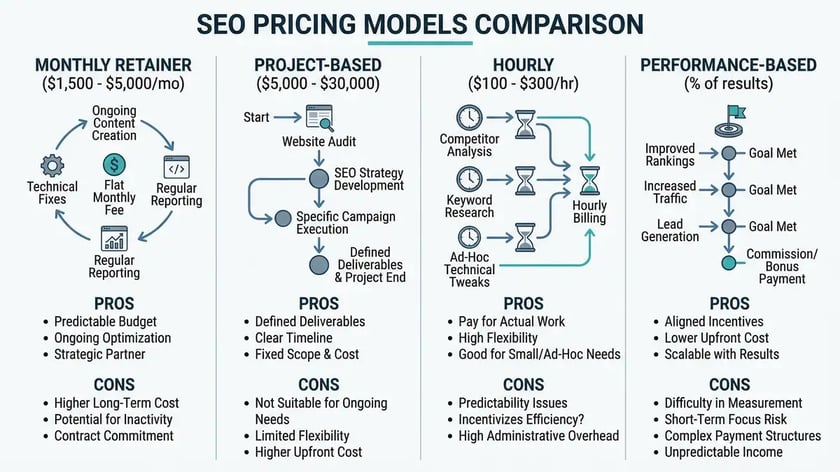
How an SEO provider structures their pricing tells you as much about their approach as the work itself. Each model has structural advantages and risks:
1. Monthly Retainer (Most Common)
The monthly retainer is the industry standard for ongoing SEO services. You pay a fixed monthly fee for a defined scope of work — typically including technical optimization, content creation, link building, and performance reporting.
- Typical range: $1,500–$10,000/month
- Best for: Companies seeking sustained organic growth over 12+ months
- Advantage: Predictable budgeting, aligned incentives for long-term results, consistent execution
- Risk: Requires trust that the provider delivers value month-over-month. Always demand transparent reporting
2. Project-Based Pricing
One-time engagements with defined deliverables and timelines. Common for technical audits, site migrations, content strategies, or specific optimization campaigns.
- Typical range: $5,000–$30,000 per project
- Best for: Companies with internal SEO capacity that need specialist expertise for specific initiatives
- Advantage: Clear scope, defined deliverables, fixed budget
- Risk: SEO requires ongoing optimization — a one-time project without follow-through typically decays within 6–12 months
3. Hourly Consulting
Pay-per-hour engagement for advisory, training, or specialized technical work.
- Typical range: $100–$350/hour (freelancers: $75–$200, agencies: $150–$350)
- Best for: Companies with SEO teams that need strategic guidance or specialized expertise on demand
- Advantage: Maximum flexibility, pay only for hours used
- Risk: Costs can escalate quickly without clear scope boundaries. Difficult to predict total investment
4. Performance-Based Pricing
The provider's compensation is tied to specific outcomes — rankings achieved, traffic generated, or leads delivered.
- Typical structure: Base fee + performance bonus, or purely results-based
- Best for: Companies with clear, measurable SEO goals and established baselines
- Advantage: Provider's incentives are aligned with your business outcomes
- Risk: Can incentivize short-term tactics over sustainable growth. Ensure contracts define quality metrics, not just volume
SEO ROI: Why the Cheapest Option Is Usually the Most Expensive
The fundamental question is not "how much does SEO cost" but "what does SEO return?" The data makes the case:
| Channel | Average Cost Per Lead | 3-Year ROI | Lead Quality |
| SEO / Organic content | $31 | 700%+ | High (intent-driven) |
| PPC / Google Ads | $181 | 200% | Medium (ad-driven) |
| LinkedIn Ads | $250–$500 | 150% | Medium-High (targeted) |
| Trade shows / Events | $811 | 50–100% | Variable |
| Cold outbound | $300–$600 | 100–200% | Low (interruptive) |
The structural advantage of SEO over every other channel is compounding returns. A PPC campaign stops generating leads the moment you stop paying. A well-optimized blog post published today continues generating traffic and leads 12, 24, and 36 months from now at zero incremental cost. According to First Page Sage, this compounding effect drives the 700%+ ROI that makes SEO the highest-return marketing investment available.
Organic search drives 53% of all website traffic — more than paid search, social media, and direct traffic combined. Companies that invest in professional SEO don't just reduce cost per lead; they build an appreciating asset. — BrightEdge Research
What Factors Determine SEO Pricing?
Understanding why SEO costs vary helps you evaluate whether a quote is fair, inflated, or suspiciously cheap. Seven factors drive pricing:
- Competitive landscape. Ranking for "personal injury lawyer" costs 5–10x more than ranking for "industrial valve manufacturer." Competition density directly determines the investment required
- Current website condition. A technically sound site with existing content needs optimization. A site with 404 errors, slow load times, and no content needs construction. The latter costs more
- Geographic scope. Local SEO (one city) costs less than national SEO, which costs less than international multi-language SEO
- Content requirements. SEO without content is like a car without fuel. If you need 4+ articles per month plus pillar pages, expect content production to represent 40–60% of your monthly investment
- Link building needs. Competitive industries require active link acquisition strategies. Quality link building (not spam) adds $1,000–$5,000/month to base SEO costs
- Reporting and analytics depth. Basic ranking reports cost less than full-funnel attribution modeling connecting content → leads → revenue
- Provider expertise. A junior freelancer and a senior GEO-optimized content strategist charge differently — and deliver different results

Red Flags in SEO Pricing: What to Avoid
The SEO industry has a trust problem. Low barriers to entry mean anyone can claim expertise. These red flags should disqualify a provider immediately:
| Red Flag | Why It's Dangerous |
| "Guaranteed #1 rankings" | No one controls Google's algorithm. Guaranteed rankings are either a lie or achieved through black-hat tactics that risk penalties |
| Pricing under $500/month | Professional SEO requires 20+ hours/month minimum. At $500, the math does not support quality work |
| No clear reporting or KPIs | If a provider cannot explain what they will measure and how, they cannot prove ROI |
| Long-term contracts with no exit clause | Reputable providers earn retention through results, not contract lock-in |
| "We have a special relationship with Google" | Google does not sell ranking positions. No agency has special access or influence |
| Proprietary techniques they won't explain | Secrecy about methodology usually masks low-quality or black-hat practices |
| Focus on vanity metrics only | Rankings and traffic without lead attribution reporting means no accountability for business results |
How to Evaluate an SEO Proposal
When comparing SEO proposals, evaluate these five dimensions — not just price:
- Strategy specificity. Does the proposal include specific keyword targets, content plans, and technical recommendations? Generic proposals indicate generic execution
- Timeline and milestones. As Moz research confirms, professional SEO takes 4–6 months to show measurable results. Any provider promising faster results for competitive terms is either lying or using risky tactics
- Reporting cadence. Expect monthly reporting with clear KPIs: organic traffic, keyword rankings, leads generated, and revenue attributed to SEO
- Case studies and references. Request documented results from similar industries or business models. Verify claims independently where possible
- Team and expertise. Who will actually work on your account? Ensure the proposal identifies the strategist, content creators, and technical specialists assigned to your project
SEO vs PPC: Where to Allocate Your Budget
SEO and PPC are not competing strategies — they are complementary. But if budget forces a choice, the data favors SEO for long-term B2B lead generation:
- SEO delivers compounding returns. Year 1 builds the foundation. Year 2 compounds. Year 3 delivers the 700%+ ROI benchmark. The investment creates an appreciating asset — your content library
- PPC delivers immediate traffic at linear cost. Every click costs money. Stop paying, traffic stops. PPC is ideal for short-term campaigns, product launches, or while SEO gains traction
- Optimal allocation for B2B: 60–70% SEO/content, 20–30% PPC, 10% testing and experimentation. Shift more budget to SEO as organic traffic compounds
The companies that win long-term invest in SEO content that compounds — then use PPC to amplify high-converting pages while the organic engine builds momentum.
What Professional SEO Services Should Include
At a minimum, any SEO engagement above $2,000/month should deliver these core services:
- Technical SEO audit and ongoing optimization: Site speed, crawlability, indexation, structured data, Core Web Vitals
- Keyword research and strategy: Target keyword portfolio, search intent mapping, competitive gap analysis
- Content strategy and production: Topic cluster architecture, pillar pages, GEO-optimized articles, content calendar
- On-page optimization: Title tags, meta descriptions, heading structure, internal linking, schema markup
- Performance reporting: Monthly reports with organic traffic, rankings, leads, and revenue attribution
- Strategic consultation: Ongoing recommendations based on data, algorithm updates, and competitive shifts
At $5,000+/month, expect additional services: link building and digital PR, conversion rate optimization, sales enablement content, and advanced analytics with full-funnel attribution modeling.
FAQ
How much does SEO cost per month?
Professional SEO services typically cost $1,500–$10,000 per month depending on business size, industry competition, and scope. Small businesses targeting local markets can expect $500–$2,000/month, while mid-market B2B companies typically invest $5,000–$10,000/month for full-stack SEO including content production, technical optimization, and link building.
Is SEO worth the investment for B2B companies?
SEO is the highest-ROI marketing channel available to B2B companies. Organic search delivers an average cost per lead of $31 versus $181 for PPC, and content marketing through SEO generates 700%+ ROI over three years. Unlike paid advertising, SEO creates compounding returns — each published piece of content continues generating leads indefinitely at zero incremental cost.
How long does SEO take to show results?
Professional SEO typically produces measurable organic traffic increases within 3–6 months. Competitive keyword rankings may take 6–12 months to stabilize. Full compound ROI materializes over a 12–36 month horizon. Any provider promising significant results in under 3 months for competitive markets is likely using unsustainable tactics.
What is the difference between cheap and professional SEO?
SEO services under $500/month typically rely on automated tools, templated reports, and minimal human strategy. Professional SEO ($2,000+/month) includes dedicated strategists, custom content production, manual technical optimization, and transparent performance reporting tied to business KPIs. The price difference reflects the difference between checking boxes and generating revenue.
Should I hire an SEO freelancer or an agency?
Freelancers ($75–$200/hour) are cost-effective for specialized tasks like technical audits or content optimization. Agencies ($150–$350/hour or $2,000–$10,000+/month retainer) provide integrated teams covering strategy, content, technical SEO, link building, and reporting. Choose a freelancer for specific expertise gaps; choose an agency for comprehensive, ongoing SEO management.
What SEO pricing model is best for B2B?
The monthly retainer model is optimal for B2B companies because SEO requires sustained, consistent effort over 12+ months to compound. Retainers provide predictable budgeting, aligned long-term incentives, and continuous optimization. Project-based pricing works for specific initiatives (site migrations, audits), but should complement — not replace — ongoing retainer work.
Conclusion: Invest in the Channel That Compounds
SEO pricing is not an expense — it is an investment in a revenue-generating asset. The companies that dominate organic search did not find the cheapest provider. They found the right partner, invested consistently for 12+ months, and built content libraries that now generate leads 24/7 at near-zero marginal cost.
The question is not whether you can afford professional SEO. It is whether you can afford to let competitors claim the organic traffic that should be driving your pipeline. Book your Growth Mapping Call to architect an SEO investment strategy that delivers measurable, compounding returns.