

Why Generative generative engine optimization services Engine Optimization Is the New Front Door to B2B Discovery
AI search engines now generate 45 billion monthly sessions globally — 56% of traditional search engine volume. ChatGPT, Perplexity, Google AI Overviews, and Gemini are rewriting how B2B buyers find, evaluate, and choose vendors. If your brand isn't optimized for generative engine optimization, you're invisible to the fastest-growing discovery channel in B2B. answer engine optimization strategy SEO content marketing systems
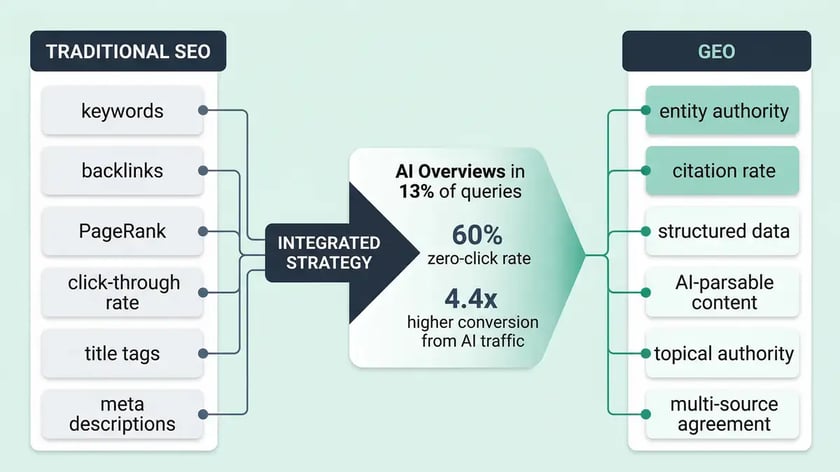
Traditional SEO still matters. But it's no longer enough. AI Overviews now appear in 13% of Google queries — up 102% in the last year — and 60% of all searches end without a click. The buyers who do click through from AI-generated answers convert at 4.4x higher value than traditional organic visitors. The question isn't whether to optimize for AI search. It's how fast you can deploy a generative engine optimization strategy before your competitors do.
47%
AI Search Usage
Use AI weekly for search
25.2%
AI Overview Queries
Google queries with AIO
40%
Visibility Boost
GEO-optimised vs standard
390%
AEO Market Growth
2024–2029 CAGR
This guide covers everything a B2B brand needs to architect a GEO strategy:
- What generative engine optimization is and how it differs from SEO
- The data behind AI search adoption and its impact on organic traffic
- A complete GEO vs SEO comparison framework
- The 8-pillar GEO implementation system for B2B brands
- How to optimize content for AI citations and answer engine visibility
- KPIs to measure GEO performance
What Is Generative Engine Optimization?
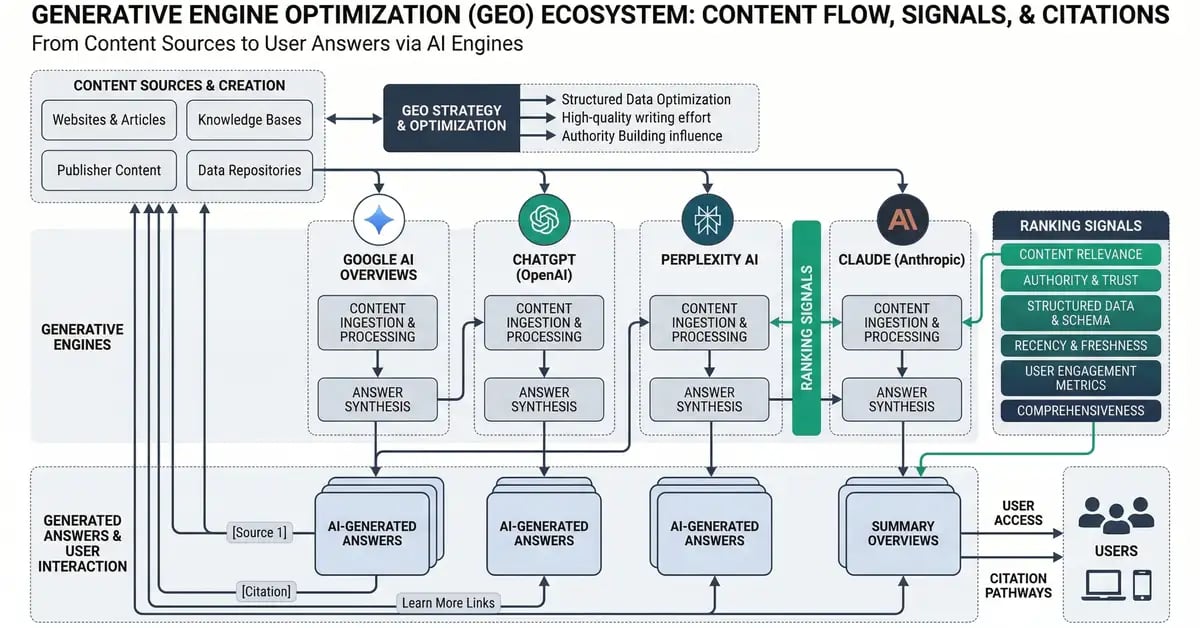
Key Takeaway
GEO is not a replacement for traditional SEO — it is a complementary discipline that ensures your content surfaces in AI-generated answers. The 47% of users now querying AI weekly expect direct, sourced answers — content structured for AI citation captures this traffic.
Generative engine optimization (GEO) is the practice of optimizing your content, structured data, and brand authority to earn citations and visibility in AI-powered search engines. Where traditional SEO converts impressions into clicks, GEO converts impressions into citations — getting your brand mentioned, quoted, and linked in AI-generated answers.
The term emerged from a 2023 research paper from Princeton, Georgia Tech, IIT Delhi, and the Allen Institute that demonstrated how specific content optimization strategies could increase visibility in generative search results by 30-40%.
GEO targets the AI engines that now mediate B2B discovery: Google AI Overviews, ChatGPT Search, Perplexity, Gemini, and Copilot. These systems don't rank pages — they synthesize answers from multiple sources and cite the ones they trust. Your goal is to become one of those cited sources.
For B2B brands, GEO is particularly high-leverage. 82% of B2B purchases are now influenced by AI-generated answers, and AI-referred visitors spend 67.7% more time on your site than traditional organic visitors — averaging 9 minutes 19 seconds per session versus 5 minutes 33 seconds from standard search.
The AI Search Landscape: Data Every B2B Leader Needs
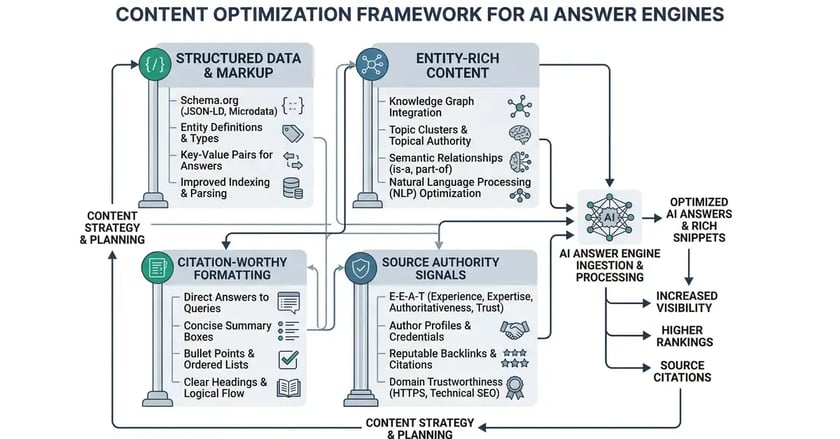
Before deploying a GEO strategy, understand the scale of the shift. The numbers are unambiguous:
| Metric | Value | Source |
| Global AI search market (2025) | $18.5 billion, growing to $66.2B by 2035 | Future Market Insights |
| AI sessions vs search volume | 45B monthly — 56% of search engine volume | Search Engine Land |
| Google AI Overview trigger rate | 13.14% of queries (up 102% YoY) | The Digital Bloom |
| Zero-click search rate (2025) | 60% (77% on mobile) | The Digital Bloom |
| CTR drop with AI Overview present | 47% lower (8% vs 15% without) | Pew Research |
| AI chatbot market leader | ChatGPT: 64.5-80% market share | First Page Sage |
| Conversion value from AI traffic | 4.4x higher than organic search | ABM Agency |
| B2B purchases influenced by AI answers | 82% | ABM Agency |
$750 billion in revenue could be impacted by AI-powered search by 2028. Half of consumers already use AI search today. — McKinsey
The organic traffic crisis is real. Retailers, news publications, and marketing agencies have seen traffic drops of 20-40%. Informational content — the backbone of most B2B content strategies — has been hit hardest, with some sectors experiencing 15-64% organic traffic declines since AI Overviews launched. But total search volume has actually grown to 9.1-13.6 billion daily queries — the pie is bigger, but the slices are distributed differently.

Avoid This Mistake
Optimising for AI engines at the expense of traditional SEO fundamentals. AI search engines preferentially cite content that already ranks well in traditional search. GEO amplifies existing authority — it does not replace the need for keyword targeting, technical SEO, and backlink profiles.
GEO vs SEO: What B2B Marketers Need to Understand
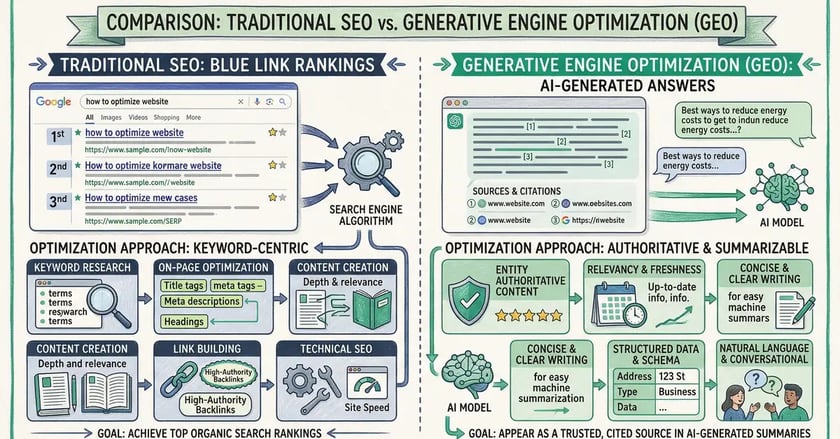
Generative engine optimization doesn't replace SEO. It extends it. But the signals, content structures, and success metrics differ fundamentally. Here's how they compare:
| Dimension | Traditional SEO | Generative Engine Optimization (GEO) |
| Primary goal | Impressions → Clicks → Traffic | Impressions → Citations → Authority |
| Key signals | Backlinks, domain authority, keyword density | Entity clarity, factual consistency, multi-source agreement |
| Content format | Long-form pages (1,500+ words) | Concise, structured answers; first 50 words critical |
| Technical focus | Title tags, sitemaps, Core Web Vitals | Schema markup, entity linking, JSON-LD, machine-readable responses |
| Success metrics | CTR, sessions, rankings | Citation rate, AI presence, brand trust lift |
| Content types that win | Comprehensive guides, listicles | Vendor blogs (17% citation rate), how-tos, comparisons |
| Authority model | PageRank, backlink profile | Topical authority, E-E-A-T, multi-platform consistency |
The integrated approach is what separates AI-native growth agencies from traditional digital agencies. Traditional SEO practices — backlinks, E-E-A-T signals, technical optimization — still feed into how AI engines evaluate your authority. But GEO adds a new layer: making your content parsable, citable, and trustworthy for machines that synthesize rather than rank.
Where GEO and Answer Engine Optimization (AEO) Overlap
You'll see the terms GEO, AEO (answer engine optimization), and AI SEO used interchangeably. The distinctions are subtle: AEO focuses specifically on getting featured in AI-generated answers. GEO is the broader discipline that includes AEO, citation optimization, entity management, and structured data strategy. For practical purposes, a B2B brand deploying GEO is also deploying AEO.
Key Takeaway
The three pillars of GEO success are structured data markup, direct-answer formatting, and authoritative sourcing. Content with FAQPage schema, concise 40–80 word answers after question headings, and named statistics from credible sources gets cited 40% more frequently by AI engines.
The 8-Pillar GEO Framework for B2B Brands

Deploy generative engine optimization with this systems-first framework. Each pillar addresses a specific dimension of AI visibility:
- Entity clarity and brand authority. AI engines need to understand what your brand is, what it does, and why it's authoritative. Create a comprehensive "About" entity — consistent name, description, and expertise signals across your website, LinkedIn LinkedIn lead generation, Crunchbase, Wikipedia (if eligible), and industry directories. Schema.org Organization markup is non-negotiable. The goal: when an AI engine encounters your brand name, it instantly maps you to your domain of expertise.
- Structured data architecture. Deploy JSON-LD schema markup across every page: Article, FAQPage, HowTo, Organization, Person, BreadcrumbList, and Product schemas where applicable. 85% of enterprises plan to increase structured data investment specifically for AI visibility. Schema markup is the language AI engines use to understand your content's structure, authority, and relationships. This is the technical foundation of any marketing infrastructure.
- Citation-optimized content. AI engines cite content that contains unique data points, original statistics, sourced evidence, and formal language. The KDD 2024 research confirmed that citation-focused optimization methods yield 37-40% visibility improvements. Structure your content to be quotable: lead every section with a clear, data-backed claim. Include specific dollar figures, percentages, and timeframes. Make it easy for an AI to extract and attribute a finding to your brand.
- Concise, machine-parsable formatting. AI engines don't read like humans. They extract. Your content needs to answer the query in the first 50 words, then provide supporting context. Use bullet points, numbered lists, tables, and clear H2/H3 heading structures that signal topic hierarchy. The goal: an AI engine can pull a complete answer from a single section of your page without needing to process the entire article.
- Topical authority clusters. Don't publish isolated articles. Build interconnected topic clusters that demonstrate deep expertise. Link pillar pages to supporting articles. Cross-reference related content. Create a knowledge graph your AI crawler can traverse. This mirrors the same content strategy architecture that powers traditional SEO, but with added emphasis on entity relationships and factual consistency across pages.
- Multi-source agreement signals. AI engines cross-reference claims across multiple sources. If your website says one thing and your LinkedIn, press releases, and industry citations say another, you lose trust. Ensure factual consistency across all digital properties. Align PR, demand gen, and content marketing to tell the same story with the same data points.
- Technical AI-readiness. Ensure your site is crawlable by AI agents — not just Googlebot. Don't block AI crawlers (ChatGPT-User, PerplexityBot, ClaudeBot) in robots.txt unless you have a strategic reason. Serve content that loads fast and renders clean HTML. Minimize JavaScript-dependent content that AI crawlers can't parse. Implement agentic workflow principles in your technical stack — your site should be machine-readable first, human-readable second.
- Monitoring and iteration. Track your AI presence: are you being cited? By which engines? For which queries? Tools like Profound, Semrush's AI Visibility reports, and manual queries across ChatGPT, Perplexity, and Google AI Overviews give you baseline data. Iterate monthly: update content with fresh data points, expand topic clusters, and fix factual inconsistencies. GEO is not a one-time project — it's an ongoing system.

Want your content cited by ChatGPT, Google AI Overviews, and Perplexity? See how peppereffect engineers AI-visible content architecture.
View Content ServicesHow to Optimize Content for AI Search: Tactical Playbook
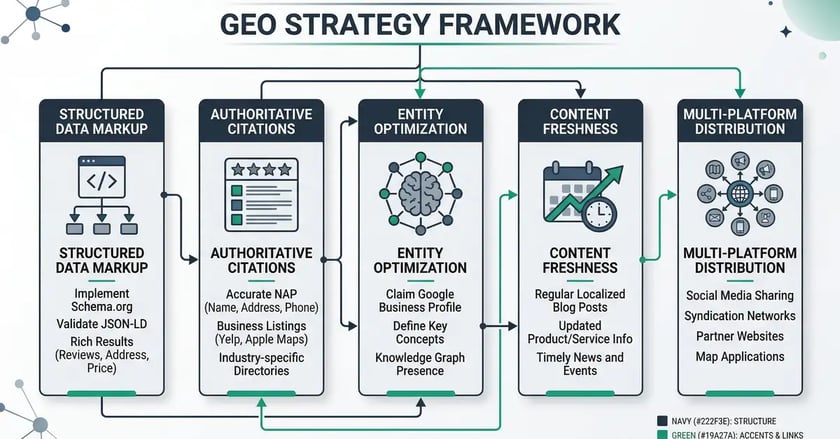
Tactical execution separates GEO theory from GEO results. Apply these rules to every piece of B2B content you publish:
Content Structure for AI Citations
- Answer first, explain second. Put your definitive answer in the first paragraph. AI engines extract early content disproportionately. Don't bury the lead.
- One section, one topic. Each H2 section should address a single, specific question or subtopic. This makes it easy for AI to extract and cite a complete answer from one section.
- Include unique data. Original statistics, proprietary benchmarks, and first-party research are citation magnets. AI engines prefer citing specific data points over generic statements.
- Formal language wins. The Princeton GEO research found that formal, authoritative language increases citation probability. Write like an expert briefing a board — not a blogger chasing engagement.
- Tables and structured comparisons. AI engines love extractable data. Comparison tables, feature matrices, and data summaries get cited at higher rates than flowing prose.
Schema Markup for GEO
Deploy these schema types to maximize AI parsability across your entire digital infrastructure:
| Schema Type | Use Case | GEO Impact |
| Article | Every blog post and guide | Signals content type, author, date — enables AI attribution |
| FAQPage | FAQ sections in articles | Direct answer extraction for AI question-answering |
| HowTo | Step-by-step guides | Structured process extraction for procedural queries |
| Organization | Homepage and About page | Entity clarity — helps AI map your brand to your domain |
| Person | Author pages | Author authority signals — strengthens E-E-A-T for AI |
| BreadcrumbList | Every page | Site structure signal — helps AI understand content hierarchy |
Key Takeaway
The compound advantage of GEO-optimised content is clear: pages that earn AI citations generate additional organic visibility at zero incremental cost, creating a flywheel where traditional SEO rankings and AI citations reinforce each other.
Measuring GEO Success: KPIs That Matter
Traditional SEO metrics — rankings, CTR, sessions — don't capture GEO performance. Track these instead:
| KPI | Definition | How to Measure | Target |
| AI citation rate | % of relevant queries where your brand is cited | Manual queries + AI monitoring tools | Top 3 citations for core queries |
| AI traffic volume | Sessions from AI referral sources | GA4 referral reports (chatgpt.com, perplexity.ai) | Month-over-month growth |
| AI traffic engagement | Time on site from AI visitors | GA4 engagement metrics by source | 9+ minutes (industry benchmark) |
| Citation sentiment | Whether AI mentions are positive, neutral, or negative | Manual review of AI-generated responses | 90%+ positive or neutral |
| Entity coverage | % of your topic cluster cited by AI engines | Systematic query testing across topics | 60%+ of core topics cited |
| Share of voice in AI | Your citations vs competitors for target queries | Competitive AI query analysis | Leading position for pillar topics |
FAQ: Generative Engine Optimization for B2B
What is GEO in marketing?
GEO stands for Generative Engine Optimization. In marketing, it's the practice of optimizing your brand's content, structured data, and authority signals to earn citations and visibility in AI-powered search engines like ChatGPT, Perplexity, Google AI Overviews, and Gemini. Unlike traditional SEO which focuses on ranking in search results, GEO focuses on being cited as an authoritative source in AI-generated answers.
What is GEO in SEO?
GEO is the evolution of SEO for the AI search era. Traditional SEO optimizes for search engine rankings and click-through rates. GEO extends that by optimizing for AI citation rates, entity authority, and machine-parsable content. The two disciplines are complementary — strong SEO fundamentals (backlinks, E-E-A-T, technical optimization) feed into GEO performance, but GEO adds structured data, concise answer formatting, and multi-source consistency as additional requirements.
How do you optimize content for AI search?
Optimize for AI search by structuring content for extraction: answer the core question in the first 50 words, use clear H2/H3 headings for each subtopic, include unique data points and statistics with sources, deploy JSON-LD schema markup (Article, FAQPage, HowTo), and ensure factual consistency across all your digital properties. Formal, authoritative language increases citation probability by 30-40% according to research published at KDD 2024.
What is the difference between AEO and GEO?
Answer Engine Optimization (AEO) is a subset of GEO. AEO focuses specifically on getting your content featured in AI-generated answers — the direct response a user sees. GEO is the broader discipline that includes AEO plus entity management, structured data architecture, citation optimization, brand authority orchestration, and AI-readiness across your entire digital infrastructure. For B2B brands, deploying GEO automatically covers AEO.
How to appear in AI search results?
To appear in AI search results: build entity clarity (consistent brand information across all platforms), deploy structured data markup on every page, publish content with unique data points and original research, structure content for machine extraction (concise answers, tables, lists), build topical authority through interconnected content clusters, and ensure your site is crawlable by AI agents (don't block ChatGPT-User or PerplexityBot in robots.txt). Early movers achieve 10x faster discovery by generative engines.
How long does GEO take to show results?
Initial AI visibility improvements can appear within 30-60 days of implementing structured data and content optimization. Full GEO ROI — including citation rate improvements, AI traffic growth, and brand authority lift — typically materializes over 6-12 months. The ABM Agency reports enterprise organizations achieving 733% ROI within six months of comprehensive GEO deployment. The key is consistent execution: monthly content updates, expanding topic clusters, and monitoring citation performance.
Conclusion: Build the Search Visibility System for the AI Era
Generative engine optimization isn't a trend. It's a structural shift in how B2B buyers discover vendors, evaluate options, and make purchasing decisions.
The data is definitive: 45 billion monthly AI sessions, 60% zero-click rates, 4.4x higher conversion values from AI traffic. The brands that architect their GEO systems now — entity clarity, structured data, citation-optimized content, topical authority clusters — will own the AI discovery channel. The brands that wait will find themselves invisible to the growing majority of buyers who start their research in an AI engine.
Deploy the 8-pillar framework above. Start with structured data and entity clarity — these are the foundation. Then systematically optimize your content engine for citation-worthiness. Build topic clusters. Monitor AI presence. Iterate monthly.
This is how you decouple your lead generation from the declining economics of traditional organic search. This is how you install the search visibility system for the Agentic Era.
Ready to architect your GEO strategy? Book your Growth Mapping Call to diagnose your current AI search visibility and map the path to citation dominance.
Resources
- McKinsey: New Front Door to the Internet — Winning in the Age of AI Search
- Search Engine Land: AI Assistants Now Equal 56% of Global Search Volume
- Search Engine Land: Organic Search Is Fundamentally Disrupted
- ABM Agency: The Primary Drivers of B2B GEO Success
- Princeton/Georgia Tech: GEO — Generative Engine Optimization (Research Paper)
- Client Onboarding Automation: From Paper Flood to Frictionless Journey
- Sales Administration: Systems for Revenue Execution
- Operations & Management: Scaling Delivery Without Headcount
what generative engine optimization actually means
optimizing for AI search platforms best practices for answer engine optimization
choosing an AEO services partner
answer engine optimization strategy
JSON-LD schema for AI citation
zero-click visibility measurement SEO copywriting fundamentals customer acquisition cost in SaaS best AI search optimization tools AEO vs GEO vs LLM SEO AI search engine optimization why organic traffic is falling in the AI era Share of Model AEO vs SEO