

Generative engine optimization services get your company named and cited when a buyer asks ChatGPT, Gemini, Perplexity, Claude or Google's AI Overviews a question in your category. A real engagement has four parts: a measured baseline, content built on evidence only you hold, presence on the third-party sources the engines draw from, and a re-measurement on a fixed date. Most of what's sold under the label skips the first and the last.
This page is written for the marketing leader deciding whether to hire a GEO provider. It covers what GEO is and how a B2B company does it, what a provider should hand over, which tactics have evidence behind them, how results get measured, and a ten-question scorecard you can run against any proposal on your desk.
Why do generative engine optimization services exist now?
Because the research phase of a B2B purchase has moved inside AI answers, and the click that used to follow a search often doesn't happen anymore. ChatGPT reached 900 million weekly users in February 2026, up from 800 million four months earlier (TechCrunch, 2026). In the US, 68.01% of Google searches between January and April 2026 ended without a click, on Similarweb panel data that excludes the Google app (SparkToro, 2026). Where an AI Overview shows, the top-ranked page gets a click-through rate about 58% lower than forecast, a correlation measured on 300,000 keywords, desktop only (Ahrefs, 2026). Pew watched 900 US adults search and found a click on a result in 8% of visits with an AI summary against 15% without (Pew Research, 2025).
Now the number vendors leave out. Across 97 B2B and lead-generation sites and 29 million visits, AI sources sent about 0.5% of all traffic (Orbit Media, 2026). Those visitors turned into leads roughly three times as often as visitors from other sources, but the volume is tiny. Traffic is the wrong reason to buy GEO. The reason that holds up: the shortlist is being written inside the answer, and your name is either on it or missing.
Key Takeaway
A GEO service is worth paying for when it can show you, before and after, how often the engines name you on the questions your buyers ask. Everything else in the proposal is a means to that number. If the number isn't in the proposal, you're buying activity.
What is generative engine optimization, and how do B2B brands do it?
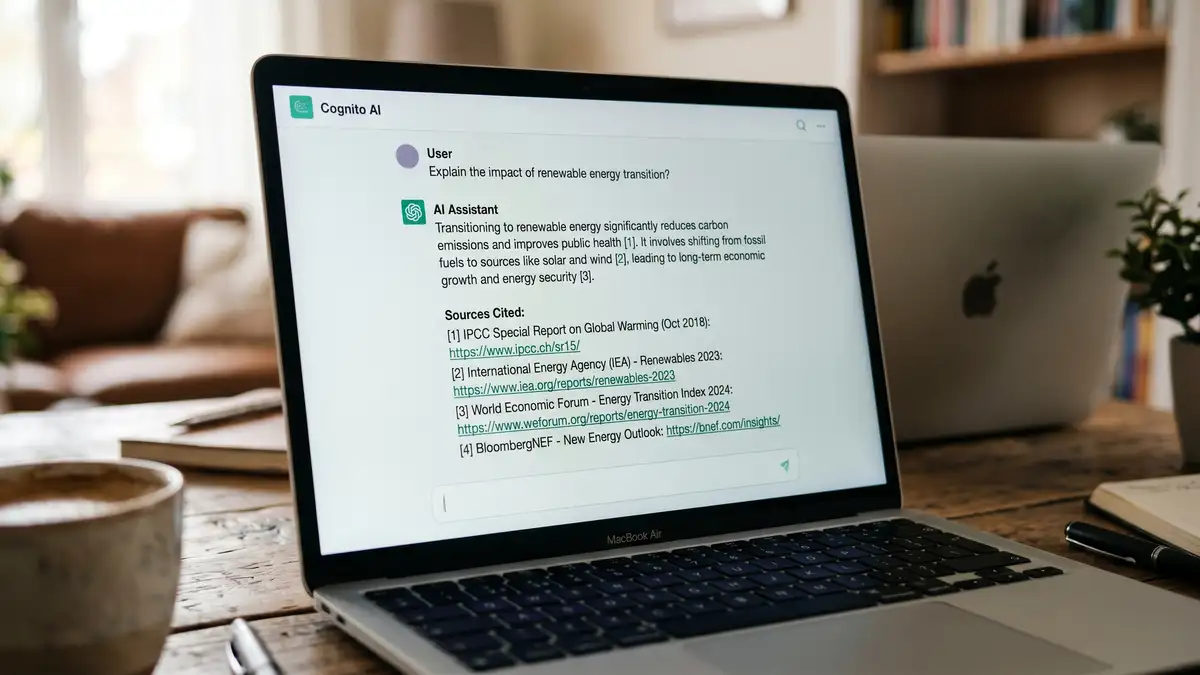
Generative engine optimization (GEO) is the work of getting your content quoted and attributed by AI systems that write an answer instead of listing links. The term comes from a 2023 paper by researchers at Princeton, Georgia Tech, the Allen Institute for AI and IIT Delhi, later presented at KDD 2024 (Aggarwal et al., 2023). SEO tries to rank a page. GEO tries to put your company's name and your facts into the paragraph the buyer reads.
For a B2B company the method is short. It's also where most programs go wrong, because teams start at step three.
Write down the buying questions
Pull 15 to 30 questions from sales calls and lost-deal notes: "best X for Y", "X vs Z", "alternatives to Z", "how much does X cost". These are your prompts. Keyword tools won't give them to you, because buyers type full sentences into an assistant.
Measure who gets named today
Run every prompt several times on each engine. Record which vendors are named and which pages are cited. That record is your baseline and your competitor map in one file.
Publish what only you can publish
Your own data, your pricing logic, named-author verdicts, honest comparison pages. An engine has no reason to cite your rewrite of a page it already has.
Get corroborated off your own site
Engines lean on review platforms, communities and industry lists. Step two tells you which ones they cite in your category. Be present and accurate there.
Re-measure on a date you set in advance
Same prompts, same engines, 60 to 90 days later. If the share didn't move, change the plan or stop paying.
How the engines pick sources is its own subject, covered in how LLMs decide what to cite. The metric from step two has a name, share of model, and it's the one number this whole page keeps returning to.
How is GEO different from SEO and AEO?
SEO earns a ranking and a click, AEO earns the direct answer on a search results page, and GEO earns a citation inside an answer written by a model. The three overlap heavily in practice. Where they part ways is in what gets measured (Yext, 2025).
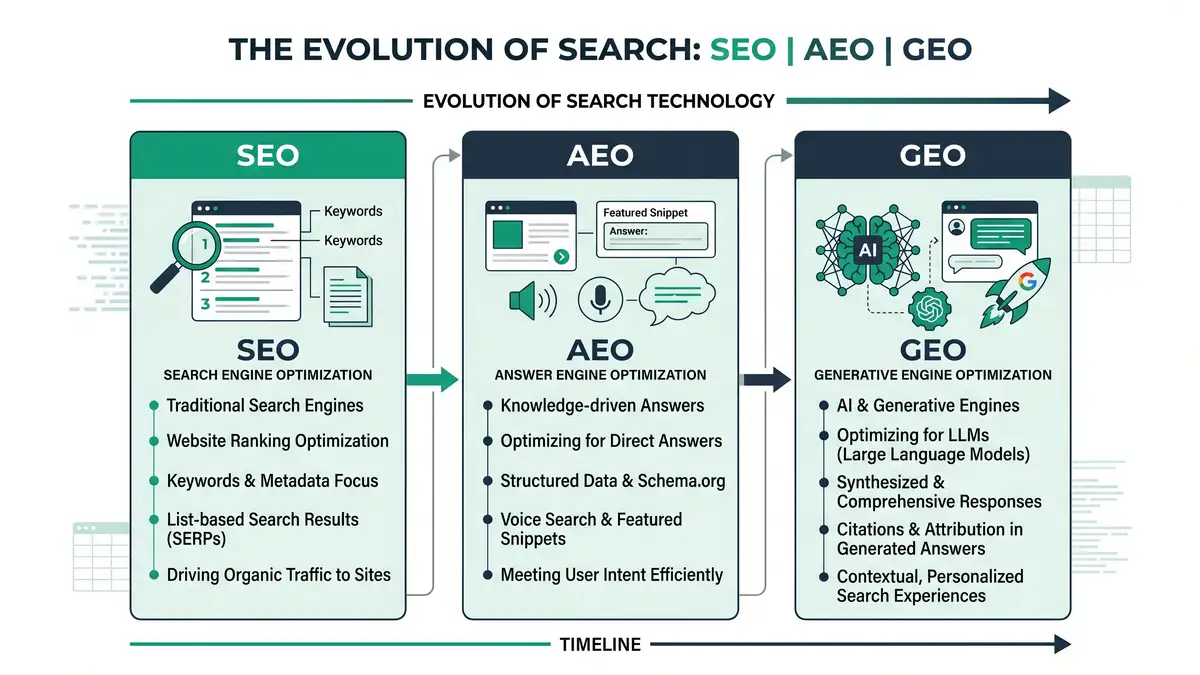
| Discipline | Goal | What you measure |
| SEO | Rank a page, earn the click | Position, clicks, sessions |
| AEO | Be the direct answer on the results page | Inclusion in AI Overviews and snippets |
| GEO | Be named and cited inside AI answers | Share of model per engine |
Google disagrees that this is a separate discipline, and a buyer should know that before a sales call. Its May 2026 guide says optimizing for generative AI search is optimizing for search, and that you don't need llms.txt files, special markup, Markdown copies or content chopped into small chunks to appear in its AI features (Google Search Central, 2026; Search Engine Journal, 2026). Any provider whose first deliverable is an llms.txt file should be asked what evidence they have.
Google speaks for Google, though. One GA4 study of ten sites found the ten best organic pages took 55% of organic sessions and only 29% of sessions referred by LLMs, and 49 of the top 100 organic pages received no LLM traffic at all (Search Engine Land, 2026). It's a small sample over a single month. It matches what CXL argues: if this were rebranded SEO, the pages ranking first would be the pages quoted most, and they aren't (CXL, 2026). We go deeper on the split in GEO vs SEO and on the vocabulary in AEO vs GEO vs LLM SEO. The AEO side has its own guide: answer engine optimization.
What does a GEO service deliver?
Five things, and each one should be a line in the statement of work with a date next to it. If a proposal names tactics and no deliverables, ask for this list.

A baseline report
Your share of model on an agreed prompt set, per engine, with the competitors named in your place and the sources the engines cited. Delivered before any content is written.
Technical access
AI crawlers can reach and parse your pages: no accidental robots.txt blocks, and content in the HTML instead of behind scripts. Usually a small job. It should never be the bulk of the invoice.
Content built for citation
Answer-first pages carrying original data, sourced statistics and quotable statements from named experts. This is the layer the research supports most strongly, and the one that takes real effort.
Off-site presence
A named list of the third-party sources engines cite in your category, with a plan for each: a review profile to correct, a comparison page to get onto, a community where your people should be answering.
Re-measurement
The same prompt set, run again on a fixed date, reported next to the baseline. This is the deliverable that tells you whether the other four did anything.
We publish the checks our own content has to pass before it goes live in the 23-check citation standard. Hold any provider's content to something equally specific.
Want the baseline before you talk to any provider? We run your buying questions through the major assistants and report who gets named.
Get your AI visibility measuredWhich GEO tactics have evidence behind them?
Adding quotations, adding statistics and citing sources. Those three won in the only peer-reviewed benchmark so far, and keyword stuffing lost. The Aggarwal paper tested nine methods on GEO-bench, a set of 10,000 queries. On its position-adjusted visibility metric, quotation addition improved on the baseline by 41%, statistics addition by about 31% and citing sources by about 27%. Keyword stuffing scored below the untouched baseline, 17.7 against 19.3. A separate test on Perplexity showed gains of up to 37% (Aggarwal et al., 2023).

Read those figures with their limits. The headline "up to 40%" is a ceiling. The benchmark dates from 2023, it measures how much of an answer's text and position a source wins, and it says nothing about leads. The authors also found that results vary by topic: quotations did best on explanatory and people-focused questions, statistics on law, government and opinion questions. A provider running one template across every page is ignoring the paper they're quoting at you.
Field data points the same way. In the ten-site study above, trend and analysis posts earned LLM citations 78% of the time and educational how-to posts 12%, with interactive tools showing the highest citation rate per page. The study infers citations from referral traffic, so read the percentages as rough (Search Engine Land, 2026). The how-to article explaining what everyone already knows is the weakest asset you can commission. That's most of what content retainers produce.
Key Takeaway
Ask a provider what in their plan is original evidence: a dataset, a benchmark, a tool, a verdict with a name on it. If the answer is a keyword list and a publishing calendar, you're being sold 2015 SEO.
How are GEO results measured?
By share of model: the percentage of runs in which an engine names your company, across a fixed set of buying questions, reported per engine and against competitors. Analytics can't see this, because the mention happens before any click.
The detail that separates real measurement from a slide is repetition. SparkToro and Gumshoe ran 12 recommendation prompts 60 to 100 times each on ChatGPT, Claude and Google's AI results, 2,961 runs in total. The same list of brands came back less than 1% of the time, and the same list in the same order less than 0.1% (SparkToro, 2026). A single screenshot of you in an answer proves nothing. Neither does an "AI ranking position". What held up in that study was how often a brand appeared across many runs, so that's what a report should show.

| What to measure | How | What it tells you |
| Share of model | Each buying question run many times per engine | Whether you're on the shortlist |
| Per-engine split | ChatGPT, Gemini, Perplexity, Claude and AI Overviews reported separately | Where the gap is, since engines cite different sources |
| Competitors named instead | Vendor names counted across the same runs | Who's taking your place |
| Sources cited | URLs the engines link in those answers | Which third-party pages to get onto |
| AI referral sessions | Analytics segment for assistant referrers | A floor only, since many AI visits arrive untagged |
Sources: SparkToro and Gumshoe, Orbit Media.
One public example from our own work. Helium42 went from close to zero to 250 AI visits per quarter, a factor of 83, within 90 days of the publishing program starting. We print the multiple and the absolute number together because 83x on its own flatters a small base, and we describe it as a correlation. The method is in the Helium42 case study. For category context, our AI visibility benchmarks cover 3,011 verified B2B domains. The share of companies named for their category's buying question runs from 6.1% in proptech to 44.7% in marketing tech, so "normal" depends heavily on where you compete.
Should you buy a tool, hire an agency or build it in-house?
Buy measurement first, because it costs little next to a retainer and tells you whether you have a problem. Hire a service only if you can't produce original evidence with the people you have. Buyers keep comparing options that don't do the same job, a monitoring platform against an agency for instance, so here is what each one covers.
| Option | What you get | What's still on you |
| Monitoring platform (Profound, Otterly, Semrush AI Visibility Toolkit, Ahrefs Brand Radar, Bluefish) | Tracking of brand mentions and citations across engines, some with content briefs | Deciding what to publish, producing it, and the off-site work |
| GEO agency or service | Baseline, content production, off-site work and re-measurement, if the contract says so | Access to your experts and data, and approval of the prompt set |
| In-house | Full control and the fastest access to your own evidence | A writer who can handle data and someone who owns the re-measurement |
Enterprise platforms are typically sold through a demo and a written quote. Onboarding and advisory hours, where a vendor offers them, show up as lines in that quote, so get the scope in writing before you assume the software comes with a strategist. And a dashboard doesn't change your share of model. Someone still has to publish something worth citing.
If you're leaning toward an agency, our GEO and AEO agency comparison and the piece on what a GEO agency does cover selection. The build-or-buy logic is the same one we lay out for agency vs in-house decisions.
The GEO provider scorecard: ten questions before you sign
Score the written proposal. Tick a box only if the commitment is in the written proposal or statement of work. Things said on a call don't count. The weights reflect where we've seen engagements fail: mostly at measurement, then at originality.
GEO provider scorecard
0 / 100
Tick the commitments you can find in writing.
Reading the total: 80 or more is worth a paid pilot. 55 to 79 means negotiate the unticked items into the statement of work before signing. Below 55, pass. One override: if the baseline box is unticked, the total doesn't matter, because you'd have no way to tell whether anything worked.
Use it on us too. For the wider checklist on judging AI vendors, see how to evaluate an AI agency. If you'd like to check your own site before talking to anyone, the AI visibility audit walks through it.
What do GEO services cost, and when should you not buy them?
Pricing isn't standardized. Most providers sell a monthly retainer, some a scoped audit first, and a quote given before a baseline exists is a guess. In a market this young, filter on whether results can be measured before you filter on price.
There are also cases where the right call is to hold the budget:
- You can't list your buying questions. If sales and marketing can't agree on 15 questions a buyer asks before shortlisting, no provider can measure anything useful. Do that work first. It costs an afternoon.
- You have nothing original to say and won't invest in getting it. No data, and no named expert willing to take a position. A GEO retainer will then produce rewrites, and rewrites don't get cited.
- Your site has basic indexing problems. Pages that Google can't crawl are usually pages AI crawlers can't read either. Fix that with ordinary technical SEO before paying GEO rates for it.
- The baseline shows you already lead. It happens. Then the job is defending the position with a quarterly re-measurement, which is a much smaller contract.
Avoid This Mistake
Don't sign a GEO retainer that has no baseline and no re-measurement date. Without both, you can't tell a working program from an idle one until the budget is gone.
Frequently Asked Questions
What is generative engine optimization?
Generative engine optimization (GEO) is the work of getting your content quoted and attributed by AI systems such as ChatGPT, Gemini, Perplexity, Claude and Google's AI Overviews. SEO aims to rank a page and earn a click. GEO aims to put your company's name and facts inside the answer the buyer reads. The term comes from a 2023 research paper by Aggarwal and colleagues, which tested nine methods on 10,000 queries.
What do generative engine optimization services include?
Five deliverables: a baseline of your share of model on an agreed prompt set, technical access for AI crawlers, content built on original evidence, work on the third-party sources engines cite in your category, and a re-measurement on a fixed date. The baseline and the re-measurement are what make the rest accountable. Proposals that leave them out are selling activity.
How do B2B brands do generative engine optimization?
They collect 15 to 30 buying questions from sales conversations, run those questions repeatedly through each AI engine to see who gets named, publish material only they can publish, such as their own data and expert verdicts, get listed accurately on the third-party sources the engines cite, and measure again after 60 to 90 days. Most teams skip the first two steps and start by producing content, which is why they can't tell later whether it worked.
What is the difference between GEO and AEO?
Answer engine optimization (AEO) targets the direct answer on a search results page, such as AI Overviews and featured snippets. GEO targets citations inside answers written by assistants like ChatGPT, Perplexity and Gemini. The tactics overlap heavily and are best run as one program. The measurement differs: AEO tracks answer inclusion on the results page, GEO tracks share of model across engines.
Do GEO tactics work?
Some do, in a lab. In the Aggarwal paper, adding quotations improved a source's visibility by 41% on the study's main metric, adding statistics by about 31% and citing sources by about 27%, while keyword stuffing scored below the baseline. That benchmark dates from 2023 and measures visibility inside answers, not leads. Treat it as direction for what to publish, and measure your own result.
How do you measure GEO success?
With share of model: how often an engine names your company across a fixed set of buying questions, reported per engine and against competitors. Each question has to be run many times, because the same prompt returns the same brand list less than 1% of the time according to SparkToro and Gumshoe. AI referral sessions in analytics are a useful floor but undercount, since many AI visits arrive without a referrer.
Should I buy a GEO tool or hire a GEO agency?
Start with measurement, which a tool or a one-off baseline gives you. Platforms such as Profound, Otterly, the Semrush AI Visibility Toolkit and Ahrefs Brand Radar track mentions and citations. They don't write or publish. Hire an agency or service if your team can't produce original evidence and place it on third-party sources. Stay in-house if you have a writer who handles data and someone who'll run the re-measurement.
How much do generative engine optimization services cost?
There's no standard price. Monthly retainers are the common model, sometimes preceded by a scoped audit. A number quoted before anyone has measured your baseline is a guess, so ask for the baseline first and judge the proposal on what it commits to measuring. The scorecard on this page gives you ten written commitments to look for.
Find out whether the answer engines name your company
We run the buying questions your customers ask through the major assistants and report who gets named, how often, and which sources the engines cited. It's the same method described on this page.
Get your AI visibility measuredResources
- Aggarwal et al., GEO: Generative Engine Optimization (2023): the benchmark of nine methods on 10,000 queries
- Google Search Central, optimizing for generative AI features (2026): Google's own position, including on llms.txt
- SparkToro and Gumshoe, AI recommendation consistency (2026): why single runs can't be trusted
- SparkToro, zero-click search study (2026): 68.01% of US Google searches ended without a click
- Ahrefs, AI Overviews and click-through rate (2026): the 58% figure and its limits
- Orbit Media, AI traffic conversion rates (2026): 97 B2B sites, 29 million visits
- Pew Research, AI summaries and clicks (2025): observed browsing of 900 US adults
- Search Engine Land, the SEO and GEO gap (2026): which page types earn LLM traffic
- CXL, AEO, GEO and SEO reality check (2026): the case that this isn't rebranded SEO