
What is answer engine optimization?
Answer engine optimization (AEO) is the practice of structuring content, entities and third-party evidence so that AI answer engines select your brand as a source when they write an answer. Traditional SEO competes for a position in a list of links. AEO competes for a sentence inside the answer that replaces the list. the Helium42 case study
The distinction is not academic. It changes what you build, what you measure, and who you compete against. A page can rank fourth on Google and be cited by nothing. A page that ranks nowhere can be the sentence ChatGPT reads out loud when a buyer asks who the serious vendors are in your category. At peppereffect we treat AEO as a separate discipline from SEO with its own scope, its own tooling and its own scorecard, because the evidence says the two do not move together.
What this guide covers:
- Why AEO is worth funding while AI referral traffic is still a rounding error
- How each engine actually picks its sources, with the correlation data per engine
- The six layers of an AEO program, and what breaks when you skip one
- What to change on the page itself, in the order that matters
- The measurement stack that replaces rank tracking
- How to tell a real AEO partner from a rebranded SEO retainer
Key Takeaway
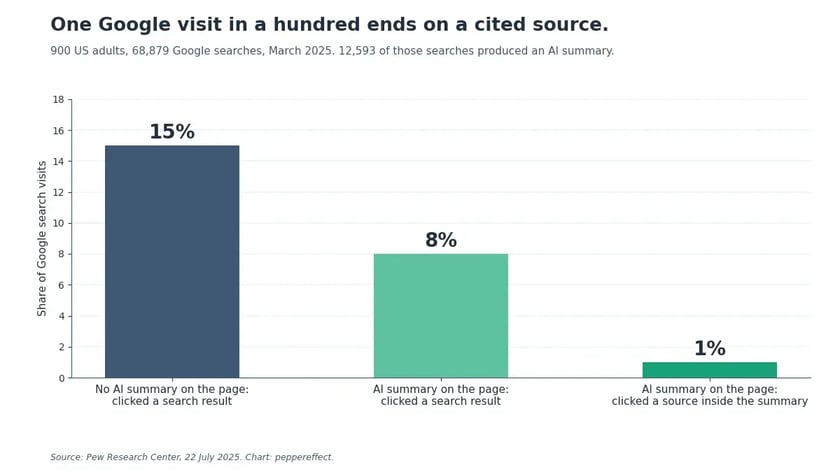
AEO optimizes for the mention. The visit is a byproduct, and most of the time it never happens. Pew Research found that when a Google search returns an AI summary, users click a source inside that summary on 1% of visits. The value sits in being named in the answer your buyer reads, which is a share, and share is zero-sum.
Why does AEO matter when AI referral traffic is still tiny?
Because the traffic number and the influence number stopped moving together. AI sources send very little traffic and carry disproportionate weight in the decision, so measuring AEO by session volume reads the wrong instrument.
Orbit Media's study of 97 B2B and lead-generation websites across 28.9 million sessions between July 2025 and June 2026 found AI sources accounted for roughly 0.5% of all traffic, about 140,000 sessions. Those same visitors converted at 2.08% from ChatGPT against 0.50% from Google Search. Orbit's own summary: visitors arriving from AI are three times more likely to convert into leads.
The clicking side of the equation is shrinking at the same time. Pew Research Center tracked 68,879 Google searches from 900 US adults in March 2025. With an AI summary on the page, users clicked a traditional search result on 8% of visits. Without one, 15%. They clicked a source cited inside the summary on 1% of visits. Ahrefs, working from Google Search Console data across 300,000 keywords, measured a 34.5% reduction in desktop clickthrough rate on informational queries where an AI Overview appears, comparing March 2024 with March 2025.
Put those together and the strategy writes itself. What you are paying for is a place on the shortlist that gets read aloud before anyone visits a website. The click is optional. We wrote the full version of that argument in why your buyer disagrees that AI is only 2% of your traffic, and the measurement side in measuring zero-click visibility.
How do AI answer engines choose which sources to cite?
Every engine runs a two-stage process. First it retrieves a candidate set from an index. Then it discards most of what it retrieved and cites the handful of passages that are fresh, extractable and trustworthy enough to quote. Optimizing only for stage one is the most expensive mistake in this category, and the one we see most often.
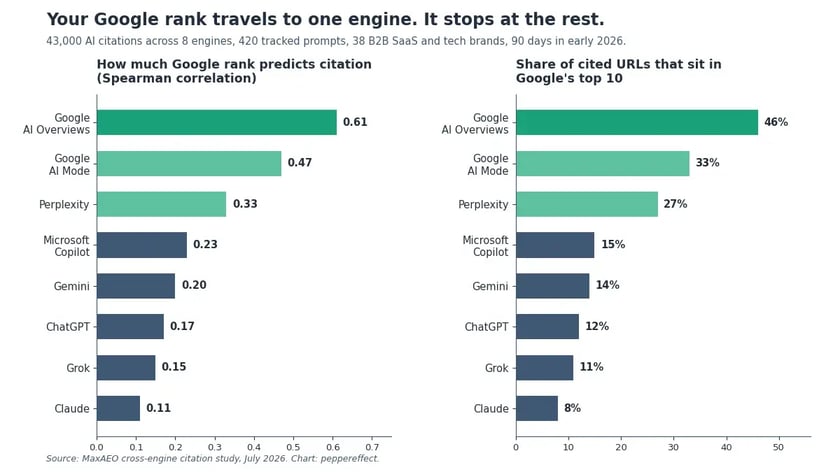
What differs between engines is which index feeds stage one. That single fact decides whether your existing search equity carries over or dies at the door. MaxAEO paired 43,000 AI citations with the Google organic position of each citing URL, across eight engines, 420 tracked prompts and 38 B2B SaaS and tech brands, over 90 days in early 2026.
Which engine are you actually losing?
Pick an engine. The panel shows how far your Google rank carries, what moves citation there instead, and what to stop paying for.
Google AI Overviews
0.61 rank correlation / 46% of cited URLs in Google's top 10
Your rank carries. This is the one engine where classic SEO equity converts almost directly into citations. Ahrefs, analyzing 863,000 keywords and 4 million AI Overview URLs in March 2026, still found 38% of cited pages ranking in the top 10, with 31.2% at positions 11 to 100 and 31.0% beyond position 100. Ranking helps and no longer suffices.
What moves it, in our experience: depth on the page that answers the sub-questions Google fans out from the main query, plus schema hygiene.
What to stop: treating a top-three position as the finish line.
Google AI Mode
0.47 rank correlation / 33% of cited URLs in Google's top 10
Your rank carries about half as far. A third of cited URLs sit in Google's top 10, so existing rankings still help, and two thirds of the citations are going somewhere your rank report does not show you.
What moves it, in our experience: coverage breadth. A page that answers eight related sub-questions competently beats a page that answers one perfectly.
What to stop: writing one page per keyword.
Perplexity
0.33 rank correlation / 27% of cited URLs in Google's top 10
Weak carry-over. Perplexity runs its own retrieval on each query instead of reading Google's ranking, which is what the 0.33 reflects.
What moves it, in our experience: earned media on publications it already pulls from, and pages that are genuinely updated rather than pages with a refreshed timestamp.
What to stop: assuming a page published two years ago is still in the running.
Gemini
0.20 rank correlation / 14% of cited URLs in Google's top 10
Almost no carry-over, despite the Google name. At 0.20, Gemini behaves far more like an independent assistant than like Google Search.
What moves it, in our experience: a clean, consistent entity. One canonical description of who you are, repeated identically across your site, your Organization schema, your sameAs links and third-party profiles.
What to stop: describing the company differently on every page.
ChatGPT
0.17 rank correlation / 12% of cited URLs in Google's top 10
Your Google rank is close to irrelevant here. ChatGPT retrieves from its own index rather than Google's, which is why only 12% of its citations sit in Google's top 10. It is also the biggest room in the building: OpenAI reported 900 million weekly users in February 2026.
What moves it, in our experience: being in the index it actually reads, then putting the answer at the top of the page instead of the middle.
What to stop: reporting Google positions as evidence of ChatGPT visibility.
Claude
0.11 rank correlation / 8% of cited URLs in Google's top 10
No meaningful carry-over at all. The lowest rank dependence of the eight engines measured.
What moves it, in our experience: structure. Tables with real numbers, labeled comparisons, and claims that survive being lifted out of the paragraph they sit in.
What to stop: burying the number in prose.
Correlation and top-10 figures: MaxAEO cross-engine citation study (43,000 citations, 420 prompts, 38 B2B brands, early 2026). AI Overview citation distribution: Ahrefs analysis of 863,000 keywords, March 2026. Vendor research, not peer-reviewed. Sample sizes stated so you can weigh them yourself.
Key Takeaway
There is no single AI search channel. Rank dependence runs from 0.61 at Google AI Overviews to 0.11 at Claude. An agency that reports one AEO number across all engines is averaging away the only variable that tells you where to spend.
What does a complete AEO program cover?
Six layers. Discovery, content architecture, structured data and entity clarity, crawler access, earned authority, and citation tracking. They are interdependent. Schema without authority underperforms, authority without crawler access is invisible, and content without entity clarity gets attributed to somebody else.
Most programs that fail do so because one layer was quietly dropped from scope. In the programs we audit, the commonest omission is crawler access, because it sits with engineering rather than marketing and nobody owns it. The second commonest is entity clarity, because it produces no deliverable anyone can screenshot. Both surface immediately in an AI visibility audit, which tests retrieval before it tests anything else.
Baseline your citation share
Run 50 to 100 buyer prompts across ChatGPT, Perplexity, AI Overviews, Gemini and Claude. Record whether you appear, in what position, alongside which competitors, and in what tone. Without this number, everything that follows is decoration. Our Share of Model method covers how to build the prompt set.
Re-engineer the content for extraction
Front-load the answer under every heading. Write headings as the question a buyer would type. Make each section survive being read in isolation, because that is how it will be read. Put the number in a table, not in a clause.
Fix structured data and entity clarity
Article, FAQPage, Organization and BreadcrumbList in JSON-LD, plus sameAs links to the profiles that describe you elsewhere. Schema is a last-mile amplifier on top of authority, not a substitute for it. The detail sits in schema markup for AI citation.
Open the door to AI crawlers
Audit robots.txt for GPTBot, OAI-SearchBot, ChatGPT-User, PerplexityBot, ClaudeBot and Google-Extended. Then check your CDN and WAF separately, because those block bots your robots.txt cheerfully allows. Serve the content without a JavaScript dependency and keep server response fast.
Build authority off your own domain
Analyst mentions, review platforms, industry publications and the reference sources these engines lean on. Your own site is one input among many, and on several engines it is a minor one.
Track citation share monthly, per engine
Answers vary between runs, so a single check proves nothing. Sample the same prompt set on a fixed schedule and watch the trend line per engine, never blended.
Do ChatGPT, Gemini, Claude and Perplexity name your company when buyers ask?
Our free AI Visibility Check measures your citation share across the four engines on your own category questions. No pitch attached.
What do you change on the page itself?
Four things, in this order: put the answer first, make every section standalone, keep the page genuinely current, and make sure a crawler can read it without executing JavaScript. Everything else in on-page AEO is a refinement of these.

Answer first. Open each H2 with a 40 to 60 word paragraph that answers the heading completely, before any context. That paragraph is the unit an engine lifts. Everything above it is preamble the model reads and discards.
Standalone sections. Write each section as if the reader arrived at it directly, because functionally they did. A section that opens with "as we saw above" cannot be quoted.
Real freshness. Changing a date changes nothing. Changing the numbers, adding this quarter's evidence and cutting what stopped being true is what registers.
Machine-readable delivery. If the content needs JavaScript to appear, most AI crawlers will not see it. In the audits we run, this is the most common technical reason a well-written page is never cited.
The number everybody quotes without the footnote
You will see crawl-to-referral ratios cited as proof that AI companies take content and give nothing back. Cloudflare, whose data the figures come from, attaches its own caveat: traffic referred by Claude's native app carries no referrer header, so "these calculations may overstate the respective ratios, but it is unclear by how much." The direction of the finding holds. The precision does not. Any partner quoting the ratio without the caveat has not read the source.
How do you measure AEO performance?
With five metrics, none of which is a keyword position. Citation frequency, share of voice against named competitors, citation sentiment, AI referral traffic, and competitor co-mentions. Rankings and session volume drop to context.
| Metric | What it answers | How to read it |
| Citation frequency | How often do the engines name us on our prompt set? | Track per engine. A blended figure hides which engine is failing. |
| Share of voice | How often do they name us versus the three competitors we lose to? | The only zero-sum metric here. This is the one that moves budget. |
| Citation sentiment | When we are named, are we the recommendation or the cautionary example? | Being cited unfavorably scores as a mention and costs you the deal. |
| AI referral traffic | What arrives on site from AI sources, and how does it convert? | Small volume, high intent. Judge it on conversion rate, never sessions. |
| Competitor co-mentions | Who do the engines list us alongside? | Reveals which category the models have filed you under, which is often not the one you chose. |
Framework: peppereffect measurement standard, applied across client programs and our own scanned-domain dataset. See AI visibility benchmarks by category for the aggregate baselines.
One discipline separates a real AEO report from a screenshot of a chatbot. Answers are probabilistic and vary between runs, so a metric is only meaningful as a sampled trend over a fixed prompt set. A partner who cannot show you a citation share trend line, in the shape of "18% share of voice on 50 priority prompts in March, up from 9% in January", is running SEO under a different name.
Key Takeaway
Measure per engine and per competitor, monthly, on a fixed prompt set. Blended AEO scores and one-off spot checks both produce numbers that cannot be acted on.
How do you evaluate an AEO partner?
Ask for three things before you discuss scope: a baseline of your own citation share, the name of the tracking tool they license, and a redacted client trend line. A provider who cannot produce all three inside a week is selling a repackaged SEO retainer.
The failure patterns are consistent enough to be a checklist. Walk away from any provider who treats AEO as SEO with FAQ schema bolted on, has no position on crawler access, promises "AI rankings" as though citations were deterministic, reports traffic with no citation share metric, or sells the work as a finite project. That last one matters most. Authority in these systems is inferred from repetition, so when reinforcement stops, citation share decays rather than holding.
Cost varies with how many of the six layers are genuinely in scope, and the honest answer to "what should this cost" depends on your category, your current authority and how much of the technical layer already exists. We size that in the call rather than publishing a number that would be wrong for most readers. For the comparison of approaches, see how to evaluate a B2B AI agency and generative engine optimization services.
How does AEO differ from traditional SEO?
They share a foundation and diverge on almost everything above it. SEO builds the authority and indexation that AEO depends on. AEO decides whether that authority ever reaches the answer.
| Factor | Traditional SEO | Answer engine optimization |
| Goal | Position in a list of links | Being named inside the generated answer |
| Primary metric | Rankings and organic sessions | Citation share per engine, and share of voice |
| Unit of competition | The page | The passage |
| Where the work happens | Mostly on your domain | Split between your domain and third-party sources |
| Freshness | Helpful | Load-bearing on Perplexity and ChatGPT |
| Result shape | Deterministic and repeatable | Probabilistic, only readable as a sampled trend |
Sources: Ahrefs AI Overviews click study, MaxAEO cross-engine study, Orbit Media AI conversion research. Longer treatment in AEO vs GEO vs LLM SEO and GEO vs SEO as a competitive moat.
How long does AEO take to show results?
First citation movement on a defined prompt set typically appears in 4 to 8 weeks. Share of voice shifts meaningfully at 3 to 6 months, because these systems infer authority from repeated reinforcement across sources rather than from a single publication event.
One measured example from our own work. Helium42 went from close to zero AI-referred visits to 250 visits per quarter, a factor of 83, over 90 days of AEO work. The pages that earned the citations shared three traits: they published concrete numbers, they were built around a narrow vertical rather than a broad category, and they carried data nobody else held. We report it as correlation. Other things changed in that window, and a single account is not a controlled experiment.
That last trait is the one worth copying. Pages carrying proprietary data get cited because there is no substitute source for the claim. Everything else on your site competes with a thousand pages saying the same thing in different words.
Frequently Asked Questions
What is the difference between AEO and GEO?
AEO targets engines that cite their sources, so the outcome is measurable: your brand either appears in the citation list or it does not. GEO covers optimization for generative systems broadly, including those that produce answers without attribution. AEO is the measurable subset. peppereffect works to AEO because citation share can be counted, and anything that cannot be counted cannot be managed.
Does AEO replace traditional SEO?
No. SEO still supplies indexation and authority, and on Google AI Overviews rank remains the strongest single predictor of citation, with a Spearman correlation of 0.61. On ChatGPT and Claude that correlation falls to 0.17 and 0.11. Keep SEO as infrastructure and run AEO as a separate discipline with its own scope and scorecard.
Which AI platform should I optimize for first?
Start where your buyers already are, then weight by rank dependence. If you have existing Google rankings, AI Overviews converts that equity fastest. If you have no rankings to convert, ChatGPT is the largest audience and the least dependent on Google position, which makes it the fairer fight for a challenger brand.
How much does AEO cost?
It depends on how many of the six layers are already in place and how contested your category is. A brand with clean technical foundations and existing authority needs a fraction of the work of one starting from a blocked crawler and an inconsistent entity. We scope it against your baseline rather than quoting a range that would mislead most readers.
Do I need schema markup to be cited?
Schema helps and does not carry the outcome. It makes your claims easier to parse and your entity easier to resolve, which raises the odds at the margin. It will not lift a page that has no authority behind it. Implement Article, FAQPage, Organization and BreadcrumbList properly, then spend the remaining effort on evidence and distribution.
How do I check whether AI engines currently cite my brand?
Ask each engine the question your buyer would ask, phrased as a category question rather than a brand question: "which vendors should a 120-person B2B SaaS company evaluate for [your category]?" Run it 20 times across the four engines and count how often you appear. For a benchmark, our own scan of 926 category judgments found brands named in 25.3% of answers, with category rates running from 6.1% in proptech to 44.7% in martech.
Why do AI crawlers matter more than search crawlers?
They are less forgiving. AI crawlers generally do not execute JavaScript, apply tighter timeouts, and are frequently blocked at the CDN layer by rules nobody remembers writing. A page that Googlebot renders happily can be invisible to GPTBot and ClaudeBot, and nothing in your SEO reporting will tell you.
Find out what the engines say about you
peppereffect measures your citation share across ChatGPT, Gemini, Claude and Perplexity on your own category questions, then shows you which of the six layers is costing you the mention. The measurement is free and takes three minutes of your time.
Run my free AI Visibility Check
See the benchmarks for your category first the 23-check citation standard we publish against
Resources
- Pew Research Center: Google users are less likely to click on links when an AI summary appears
- Ahrefs: AI Overviews reduce clicks by 34.5%
- Orbit Media: AI traffic conversion rates across 97 B2B websites
- MaxAEO: Do Google rankings affect AI citations? A cross-engine study
- Search Engine Journal: Ahrefs analysis of 863,000 keywords and 4 million AI Overview URLs
- Cloudflare: crawl-to-refer ratios, with the referrer-header caveat
- peppereffect: how LLMs decide what to cite
- peppereffect: how to optimize for AI search
- peppereffect: free AI visibility measurement