

What Is HubSpot Content Hub and Why Does It Matter for B2B Revenue?
HubSpot Content Hub is an integrated content management platform that unifies website publishing, blogging, landing pages, AI-powered content creation, smart personalization, and revenue attribution within a single CRM-connected system. For B2B companies, it eliminates the fragmented tool stacks that drain engineering resources and obscure the connection between content investment and pipeline revenue. HubSpot's native SEO tools
The platform's growth trajectory signals a structural market shift. HubSpot now serves 228,000+ paying customers across 135+ countries, growing 20–25% year-over-year while Salesforce manages 8–11% growth at comparable scale. Within the SMB and mid-market segments, HubSpot has established itself as the de facto standard for digitally-native B2B companies — with notable customers including OpenAI, Eventbrite, and DoorDash validating the platform's enterprise-grade capabilities.
At peppereffect, we architect Marketing Infrastructure on HubSpot Content Hub because it delivers what fragmented WordPress stacks cannot: a unified content engine where every page view, form submission, and content interaction is logged against the contact record and attributed directly to pipeline revenue. That infrastructure is the foundation of what we call the Freedom Machine — decoupling revenue growth from headcount growth.
What you'll learn in this guide:
- The 7 proven HubSpot Content Hub strategies driving measurable B2B traffic and revenue in 2026
- How topic cluster architecture delivers up to 37,900% organic traffic growth
- Why HubSpot Content Hub costs 40–50% less than WordPress over three years
- How Breeze AI tools accelerate content production while maintaining quality
- Smart content personalization benchmarks: 202% CTA conversion lift and 82% overall conversion improvement
- Revenue attribution setup that connects every content interaction to closed deals
- Pricing tiers and the decision framework for selecting the right HubSpot Content Hub plan
Key Takeaway
HubSpot Content Hub is not a CMS — it's a revenue engine. Companies deploying the 7 strategies in this guide achieve 3:1 baseline content ROI reaching up to 748% with proper SEO, while smart content personalization lifts CTA conversion by 202%. The platform's native CRM integration eliminates the attribution gap that makes content marketing ROI invisible in WordPress-based stacks.

How Does HubSpot Content Hub Compare to WordPress for B2B Companies?
The platform decision between HubSpot Content Hub and WordPress is fundamentally a question of total cost of ownership, not license price. WordPress powers 43.4% of all websites globally, but its CMS market share has contracted from 63.7% in 2022 to 61% in 2025 as businesses migrate to cloud-based SaaS platforms for integrated workflows. The reason: WordPress's hidden costs in maintenance, security, and developer dependency typically exceed HubSpot's subscription pricing over a three-year period.

According to a detailed TCO analysis by Avidly Agency, a realistic mid-market B2B scenario reveals that HubSpot saves $3,000–$16,000 over three years compared to self-hosted WordPress. For high-security, multi-developer environments, the savings reach $7,000–$45,000. The primary cost drivers are WordPress plugin maintenance ($600–$8,000 annually), security incident remediation ($5,000–$15,000 per breach), and developer dependency that creates campaign-execution bottlenecks.
HubSpot Content Hub eliminates these hidden expenses through managed infrastructure: automatic updates, built-in CDN, 24/7 threat monitoring, native SSL, and a Web Application Firewall — all included at zero incremental cost. Marketing teams work directly in drag-and-drop interfaces without developer bottlenecks, accelerating campaign execution and eliminating the queue-and-wait cycle that plagues WordPress-dependent B2B content strategy teams.
| Capability | HubSpot Content Hub | WordPress Self-Hosted |
| CRM Integration | Native — full contact, deal, and revenue tracking | Requires 3rd-party plugins (Salesforce, HubSpot WP plugin) |
| Revenue Attribution | Automatic content-to-deal tracking | Manual setup, error-prone, often missing |
| Personalization | Smart Content — behavior, segment, CRM-based | Requires plugins + custom development |
| AI Content Tools | Breeze AI native — saves 12+ hrs/week | Third-party (no CRM integration) |
| Security & Hosting | Fully managed, WAF, SSL, CDN included | Self-managed, $150–$2,000/mo hosting |
| 3-Year TCO (Mid-Market) | $15,000–$24,000 | $18,000–$40,000 |
Sources: Avidly Agency TCO Analysis, Think Fuel
What Are the 7 Most Effective HubSpot Content Hub Strategies for 2026?
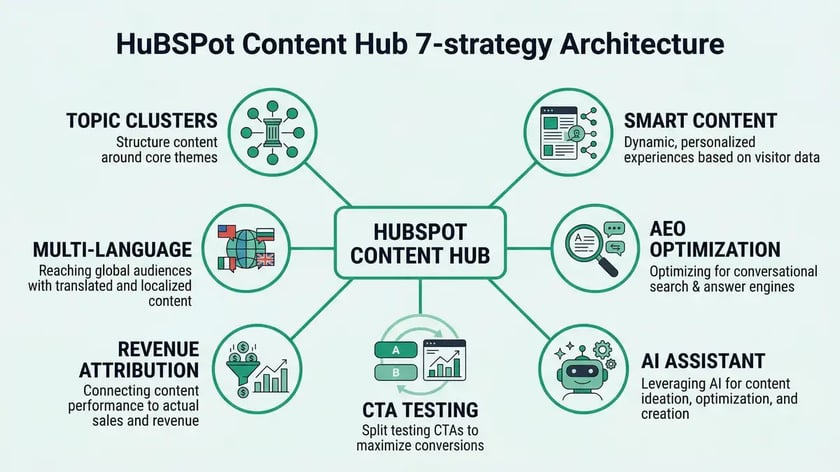
Strategy 1: Architect Content Around Topic Clusters
Topic clusters organize content into thematic silos where a pillar page links to 10–15 subtopic pages through strategic internal linking. Google's algorithm rewards this structure with topical authority, and the results are dramatic: one marketing agency documented organic blog traffic growth from 500 to 190,000 monthly visitors — a 37,900% increase — after implementing topic clusters using HubSpot's tools.
HubSpot's content strategy tool enables creation of topics with up to 100 subtopic keywords per cluster, automatic internal link tracking between pillar and cluster content, and performance analytics that attribute leads and revenue to specific topic clusters. This data-driven approach lets marketing infrastructure teams identify high-performing clusters driving qualified pipeline and retire underperforming content.
Strategy 2: Deploy Smart Content for Personalized Experiences
HubSpot's Smart Content feature adapts page copy, images, CTAs, and offers based on visitor segment, device, geography, or CRM history. The performance data is compelling: personalized CTAs convert 202% better than static CTAs, and companies using AI-driven personalization achieve up to 82% improvement in conversion rates with 10–15% revenue lift reaching 25%+ for top performers.
Beyond acquisition, personalization compounds through customer lifetime value: 96% of marketers report that personalized experiences increase repeat purchases, and 62% of business leaders confirm personalization improves customer retention. peppereffect deploys smart content rules that fire based on HubSpot CRM properties — eliminating manual content versioning and scaling personalization without proportional engineering overhead.
Strategy 3: Optimize for AI Answer Engines (AEO/GEO)
AI answer engines now summarize search results into direct answers, and your content must be structured to earn citations. HubSpot's implementation of answer engine optimization yielded remarkable results: by infusing semantic triples and schema markup throughout blog content, HubSpot increased brand mentions in AI-generated answers by 58% and AI engine citations by 642%.
This represents a new dimension of search visibility where success is measured not by page-one Google placement but by whether AI engines like ChatGPT, Perplexity, and Google AI Mode cite your content as authoritative source material. peppereffect's generative engine optimization methodology integrates schema markup, original research, and first-hand expertise to maximize AI citation probability.
peppereffect architects Marketing Infrastructure that scales content without scaling headcount.
View Marketing InfrastructureStrategy 4: Leverage Breeze AI for Content Scale
HubSpot's Breeze AI suite integrates conversational and agentic AI capabilities agentic AI marketing capabilities directly into the platform. Breeze Assistant enables content refinement with commands including Apply Brand Voice, Rewrite, Expand, Summarize, and Change Tone — all drawing from HubSpot CRM data for context-aware responses. Content Remix converts single assets into multiple formats: a blog post automatically generates social media content, email campaigns, advertisement copy, and landing page sections.
The agentic AI results are measurable: Breeze Prospecting Agent generated 11,000 customer meetings in one quarter, with customers booking 57% more meetings than the previous year. More than 10,000 customers have activated Prospecting Agent, and Data Agent adoption increased 57% quarter-over-quarter. Professional tiers support 20 daily Content Remix operations; Enterprise supports 50.
| Breeze AI Feature | Capability | Tier Availability |
| Breeze Assistant | Content refinement, brand voice, tone shifting | All tiers (limited on Free) |
| Content Remix | Multi-format repurposing (20-50 daily ops) | Professional + Enterprise |
| Prospecting Agent | Autonomous outreach, 57% more meetings YoY | Sales Hub Professional+ |
| Data Agent | Contact/company enrichment, 57% QoQ growth | Operations Hub Professional+ |
Sources: HubSpot IR 2026, HubSpot Knowledge Base

Strategy 5: Implement Conversion-Optimized CTAs and A/B Testing
Content without CTAs is a top-of-funnel ghost town. HubSpot's CTA builder lets marketing teams design buttons, forms, and offers directly within blog and landing pages, with Smart Content personalizing CTAs by segment. The 202% conversion lift from personalized CTAs is the platform's single most impactful feature for lead generation.
A/B testing is built into every content type. Email marketing with personalization delivers a median ROI of $36 for every $1 spent, with automated email flows achieving 2.5× higher conversion rates than broadcast promotional emails. Automated emails account for approximately 41% of email-generated orders despite representing only 2% of email sends — demonstrating the strategic value of trigger-based personalization over volume-based broadcasting.
Strategy 6: Unify CRM Data for Revenue Attribution
The #1 reason companies switch from WordPress to HubSpot Content Hub is revenue attribution. WordPress cannot tell you which blog articles drive closed deals. HubSpot supports multiple attribution models — first-touch, last-touch, linear, time-decay, and custom — enabling organizations to define attribution rules matching their actual business dynamics.
Contact create attribution tracks top-of-funnel acquisition effectiveness. Deal create attribution (Enterprise only) measures which touchpoints contribute to sales opportunities. Revenue attribution (Enterprise only) traces which marketing efforts contribute to closed-won deals. Creating all three report types provides full-funnel visibility from awareness through revenue.
Yet 56% of content marketers cite attributing ROI to content efforts as a top challenge. This gap represents a massive competitive advantage for companies that solve it. peppereffect's operations framework installs attribution infrastructure that connects content spend to pipeline revenue — if an article costs $500 in AI content time and generates $50,000 in pipeline, the 100× ROI becomes visible and defensible.

Strategy 7: Build a Multi-Language Content Engine for Global Reach
English-only content strategy limits addressable market. Research shows that 75% of respondents confirm localized content significantly increases customer engagement, with 96% observing positive ROI from website localization. Companies transitioning from single-language to multilingual websites report sales increases of 25% on average, with top performers achieving 70% growth.
HubSpot Content Hub's AI translation capabilities enable rapid content localization across 50+ languages while preserving brand voice. Approximately 35% of B2B and B2C marketers now use AI to scale content across languages faster than traditional workflows allowed. Each locale inherits your topic cluster architecture, smart content rules, and CRM integration — extending your Freedom Machine across geographies without proportional content team growth.
Avoid This Mistake
Do not deploy HubSpot Content Hub without a documented content strategy. Only 47% of B2B marketers have a documented content marketing strategy, and among organizations with ineffective strategies, 42% cite lack of clear goals, 39% report disconnect from the customer journey, and 35% cite lack of data-driven approach. Strategy documentation is the difference between a content engine and a content expense.
How Much Does HubSpot Content Hub Cost in 2026?
HubSpot Content Hub pricing scales across four tiers designed to align platform cost with organizational growth. Understanding the full pricing architecture — including the often-overlooked HubSpot Credits system and mandatory onboarding fees — is critical for accurate sales automation and marketing budget planning.
| Tier | Monthly Price | Included Seats | Key Features |
| Free | $0 | 2 | Basic CRM, limited hosting, HubSpot branding |
| Starter | $15/seat | 1 | No branding, basic AI, 30 landing pages, 30 blog posts |
| Professional | $450/mo | 3 | Full AI suite, Smart Content, A/B testing, unlimited pages, Content Remix (20/day) |
| Enterprise | $1,500/mo | 5 | Multi-domain (10), content partitioning, sandbox, WAF, SSO, Content Remix (50/day) |
Sources: HubSpot Content Hub Pricing 2026, Featurebase
Key Takeaway
HubSpot Content Hub Professional at $450/month with 3 seats represents the inflection point where AI content creation, Smart Content personalization, and A/B testing become fully available. Factor in mandatory onboarding fees ($2,200 for Professional, $5,100 for Enterprise) and the HubSpot Credits consumption model ($0.01/credit for AI features) when calculating true total cost of ownership.
How Should B2B Teams Implement HubSpot Content Hub for Maximum ROI?
Implementation success depends on a systematic deployment sequence — not simultaneous activation of all features. peppereffect's diagnostic methodology deploys HubSpot Content Hub through a structured 5-step framework that prioritizes revenue-generating capabilities first.
Install Content Architecture
Map your top 5 buyer journey stages. Create a pillar page for each. Assign 10–15 subtopic articles per pillar. Configure topic clusters in HubSpot's content strategy tool with keyword difficulty and search volume data.
Deploy Smart Content Personalization
Identify your top 3 visitor segments by CRM properties. Create 2–3 content variations per page. Set smart content rules for CTAs, hero copy, and offers. Measure conversion lift per segment within 30 days.
Activate AEO and Schema Markup
Implement JSON-LD schema (Article, FAQ, Organization, BreadcrumbList) across all content. Structure answers using semantic triples for AI citation. Run HubSpot's AEO Grader to score content against AI platform expectations.
Configure Revenue Attribution
Enable source tracking in HubSpot CRM. Create contact create, deal create, and revenue attribution reports. Connect content interactions to deals. Build a monthly revenue attribution dashboard linking content spend to pipeline generation.
Scale with Breeze AI and Content Remix
Configure brand voice settings for Breeze Assistant. Use Content Remix to convert high-performing blog posts into social content, email campaigns, and ad copy. Establish credit governance with monthly limits and alert thresholds to prevent cost overruns.
Key Takeaway
B2B content marketing delivers 3:1 baseline ROI reaching 748% with proper SEO strategies. Companies publishing 15+ blog posts monthly generate approximately 1,200 new leads. The key differentiator is not volume but strategic discipline: 74% of effective teams credit strategy refinement as the biggest driver of improvement — not tool adoption.
Frequently Asked Questions
What is HubSpot Content Hub?
HubSpot Content Hub is an integrated content management platform that combines CMS, blog publishing, landing pages, AI-powered content creation (Breeze AI), smart content personalization, multi-language capabilities, membership gating, HubDB structured data, and serverless functions. Unlike standalone CMS platforms, Content Hub connects directly to HubSpot CRM, enabling marketing infrastructure teams to track every content interaction against contact records and attribute revenue to specific content assets.
Is HubSpot a CMS or a CRM?
HubSpot is both. The platform includes a full CRM (contact management, deal tracking, pipeline automation) and a CMS (HubSpot Content Hub) within a unified ecosystem. This integration is HubSpot's primary competitive advantage: marketing teams can personalize content based on CRM data, attribute revenue to content interactions, and deploy CRM automation triggered by content engagement — capabilities impossible with standalone CMS platforms like WordPress.
How much does HubSpot Content Hub cost?
HubSpot Content Hub pricing starts at $0 for Free tools (2 seats, basic CRM), $15/seat/month for Starter (removes branding, basic AI), $450/month for Professional (3 seats, full AI suite, Smart Content, A/B testing), and $1,500/month for Enterprise (5 seats, multi-domain, content partitioning, sandbox). Mandatory onboarding fees apply: $2,200 for Professional and $5,100 for Enterprise. The HubSpot Credits system ($0.01/credit) adds variable cost for AI features.
HubSpot Content Hub vs WordPress — which is better for B2B?
For revenue-critical B2B websites, HubSpot Content Hub typically delivers superior three-year economics. While WordPress software is free, hidden costs in hosting ($150–$2,000/month), security remediation ($5,000–$15,000 per breach), plugin maintenance ($600–$8,000/year), and developer dependency push WordPress TCO 40–50% higher than HubSpot over three years. WordPress remains cost-effective for simple, static sites with existing developer capacity and minimal change requirements.
How does HubSpot Content Hub improve SEO?
HubSpot Content Hub accelerates SEO through native topic cluster architecture (supporting 100 subtopic keywords per cluster), built-in schema markup tools, AI content optimization, and integrated analytics attributing leads to specific content. One documented case study shows 37,900% organic traffic growth after implementing topic clusters. The platform also supports answer engine optimization for AI search visibility, with HubSpot's own implementation achieving a 642% increase in AI engine citations.
What features does HubSpot Content Hub include?
Core features include: CMS with drag-and-drop page builder, blog engine with SEO recommendations, landing page builder, Smart Content personalization (behavior, segment, CRM-based), Breeze AI content assistant, Content Remix multi-format repurposing, A/B testing, multi-language publishing (50+ languages), membership gating, HubDB structured data, serverless functions, built-in analytics with AI workflow automation, and native CRM integration with full revenue attribution reporting.
Is HubSpot Content Hub worth it for small businesses?
For small B2B businesses where the website is a key revenue channel, HubSpot Content Hub Starter ($15/seat/month) provides strong value: no branding, basic AI assistance, and CRM integration at lower cost than most WordPress managed hosting plans. If content marketing drives lead generation, the Professional tier ($450/month) typically reaches positive ROI within 6 months through improved conversion rates and eliminated WordPress maintenance costs. For simple brochure sites, WordPress remains more cost-effective.
Ready to Architect Your Content Engine for Revenue?
peppereffect installs Marketing Infrastructure that decouples revenue growth from headcount. Book a Growth Mapping Call to diagnose your biggest content bottleneck in 30 minutes.
Book Your Growth Mapping CallResources
- HubSpot Content Hub Pricing Guide 2026
- Avidly Agency — HubSpot CMS vs WordPress: Total Cost of Ownership Over 3 Years
- Resonate HQ — HubSpot Market Share 2026: CRM Industry Analysis
- Performance Marketing Advisors — How HubSpot Topic Clusters Help SEO
- Growth London — Schema Markup for HubSpot and AEO
- Think Fuel — HubSpot vs WordPress: Is WordPress Still Worth It?
- Featurebase — HubSpot Pricing 2026: Is It Worth It?
- HubSpot Knowledge Base — Understanding HubSpot Credits and Billing
HubSpot CMS vs WordPress comparison answer the buyer's questions methodology