

Is SEO dead? What actually died, and what replaced it
SEO is not dead, but the version of it built purely on ranking a page to win a click is dying as AI answers absorb the click. The foundations of quality, authority, and structure survived and matter more than ever. What changed is the goal: you now win by being cited inside AI answers, measured as Share of Model rather than clicks.
"SEO is dead" is a headline that gets written every few years, and it has always been wrong. It is wrong this time too, but for a more interesting reason than usual. A specific, dominant version of SEO really is dying, while the discipline underneath it is evolving into something with a new name and a new scoreboard. This is the honest version of the story, told as part of our wider analysis of the traffic collapse. Knowing exactly what died and what survived is the difference between panic and a plan.
What this guide covers:
- The honest answer to whether SEO is dead
- The four things that actually died
- What survived and matters more than ever
- The three things that replaced the dead parts
- The balanced counter-view, and what to do now
Key Takeaway
SEO did not die; it shed a skin. The tactics built for a world of ten blue links and guaranteed clicks are dying. The fundamentals of quality and authority are not only alive but are now the price of entry to being cited by an AI.

Is SEO actually dead?
No. SEO is not dead, but a specific version of it is dying, and the confusion comes from treating the two as the same thing. The version that is dying is the one built on a single assumption: that you rank a page, the searcher clicks it, and you get the visit. That model worked because the search results page was a list of links and the only way to get an answer was to click one. That is no longer true. AI engines now answer the question on the page itself, so a high ranking increasingly produces an impression without a visit. The tactic died; the discipline did not.
Even Google does not frame this as the end of search. It treats optimising for its AI features as a continuation of the same work, and the credible voices in the field, from Ahrefs to Search Engine Land, land on the same conclusion: SEO evolved, it did not end. The death narrative is clickbait. The evolution is real.
Key Takeaway
The honest framing is evolution, not death. If you read "SEO is dead" and abandon your search foundations, you will hand your category to the competitors who understood it was a transition, not a funeral.
What actually died?
Four things from the old playbook are genuinely finished.

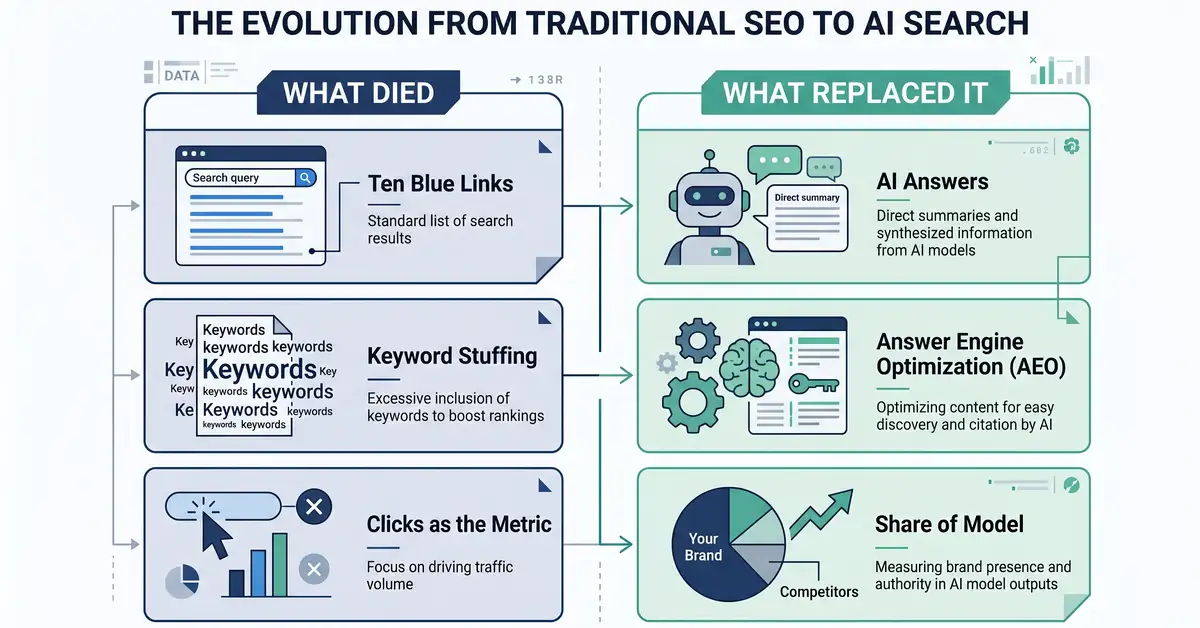
The first is the ten blue links as the default results page. A synthesised AI answer now sits above and often instead of the list. The second is keyword-stuffing and thin content built only to rank, which an AI engine has no reason to quote and every reason to ignore. The third is the assumption that a high ranking equals traffic, broken decisively by the data: SparkToro found that only 374 of every 1,000 US Google searches now reach the open web, and fewer than one in three send a click at all. The fourth, and the most important to retire, is pure click-volume as the success metric. In a world where the answer is delivered without a click, counting clicks measures the wrong thing. As SparkToro put it, in a zero-click world, traffic is a terrible goal.
| What died | What replaced it |
| Ten blue links | One synthesised AI answer |
| Keyword stuffing, thin content | Answer-first, citable content |
| Ranking equals traffic | Citation equals visibility |
| Clicks as the metric | Share of Model as the metric |
Sources: SparkToro zero-click study; Google Search Central (2026).
What survived, and matters more than ever?
The fundamentals did not just survive; they became the entry ticket to AI visibility. Quality content that genuinely answers a question, real topical authority built across a subject, a crawlable and technically sound site, structured data, and demonstrable experience and expertise are all exactly what an AI engine looks for when it decides whom to trust and cite. None of that changed. An engine cannot quote a page it cannot crawl, and it will not cite a source it does not trust, so the unglamorous foundations of good SEO are now the foundations of good AEO too.

This is why abandoning SEO to chase AI is the costliest possible misreading. The work that earned you rankings is the same work that earns you citations. You are not throwing it away; you are building a new layer on top of a foundation that still holds.
What replaced the parts that died?
Three things took the place of the dead tactics. The first is answer engine optimization and its sibling generative engine optimization, the practice of structuring content to be quoted inside AI answers rather than only to rank, which we cover in depth in AEO vs SEO and the full answer engine optimization guide. The second is the citation as the unit of success: being named and quoted inside the answer, which builds authority and recall even when no click follows. The third is Share of Model as the metric, the share of AI answers in your category that feature you, which replaces clicks as the number that actually reflects visibility.

Research on generative engines confirms this is not vague. Content that leads with direct answers and backs claims with statistics and citations is measurably more likely to be quoted, which means the new playbook is as concrete as the old one. The names changed and the scoreboard changed, but it is still optimisation, and it still rewards the same diligence.
Want to know whether AI is citing you or your competitors?
Run the free AI Visibility CheckThe balanced view: is it really that dramatic?
It is worth being honest about the other side of the argument. Search is not collapsing to zero. Billions of searches still happen every day, SEO spending is not evaporating, and a large share of queries still produce a click, especially commercial and navigational ones where people want to reach a specific site. Many experienced practitioners argue, reasonably, that AI search is simply the next phase of SEO and that calling it a new discipline overstates the break. There is truth in that, and the term you use matters less than the work.

The point is not to pick the most dramatic framing but the most useful one. Whether you call it the next phase of SEO or a new discipline called AEO, the practical instruction is identical: keep the foundations, add the answer-first layer, and stop judging success by clicks alone. The teams that argue about the label while their competitors win the citations are losing either way.
Watch Out
The dangerous overreaction to "SEO is dead" is to stop doing SEO. The foundations that earned rankings are exactly what earn AI citations, so cutting them does not future-proof you, it makes you uncitable. The right move is to keep the base and build the new layer on top, not to demolish and start over.
What B2B teams should do now
Treat this as a transition to manage, not a death to mourn. Keep investing in the SEO fundamentals, because quality, authority, and a crawlable site are now table stakes for being cited. Layer answer engine optimization on top: lead with direct answers, structure content for extraction, back claims with data, and earn presence on the sources AI engines trust. Most importantly, change what you measure. Move your primary metric from rankings and clicks to Share of Model and citations, because that is the number that now reflects whether your audience can find you. SEO did not die. It grew up, and the teams that grow up with it will own their categories in the AI era.
SEO did not die. Find out if you are winning the new game.
The AI Visibility Check measures your Share of Model across the questions your buyers actually ask, and shows whether AI answers are citing you or your competitors. It is the fastest way to see where you stand now that the click is no longer the prize, and what to build to win the citation.
Run the free AI Visibility CheckFrequently asked questions about whether SEO is dead
Is SEO dead in 2026? No. SEO is not dead in 2026, but the version built purely on ranking a page to earn a click is dying as AI answers absorb the click. The fundamentals of quality content, topical authority, technical health, and structured data survived and now underpin being cited by AI. The honest framing is evolution, not death: the discipline changed its goal and its metric rather than disappearing.
Why do people say SEO is dead? Because the most visible part of SEO, ranking a page to win a click, is genuinely breaking down as AI Overviews and chat answers deliver the answer without a visit. Data shows fewer than one in three Google searches now send a click. People mistake the death of that specific tactic for the death of the whole discipline, when in reality the foundations carried over into AI search optimisation.
What replaced SEO? Nothing fully replaced it; SEO evolved and gained new layers. The dead tactics were replaced by answer engine optimization and generative engine optimization (structuring content to be cited inside AI answers), by the citation as the unit of success instead of the click, and by Share of Model as the metric instead of rankings and clicks. The foundations of quality and authority remain underneath all of it.
Did AI kill SEO? AI killed parts of the old SEO playbook, not SEO itself. It ended the reliability of "rank equals traffic", broke the ten-blue-links results page, and made click-volume a misleading metric. But AI engines still depend on crawlable, authoritative, well-structured content to build their answers, so the core work of SEO became the core work of getting cited. AI transformed SEO rather than killing it.
Should I stop doing SEO? No. Stopping SEO is the most damaging overreaction to the "SEO is dead" narrative, because the foundations that earn rankings are exactly what make your content citable by AI. The right move is to keep investing in quality, authority, and technical health, then add an answer-first AEO layer on top and shift your success metric from clicks to Share of Model.
What is the difference between SEO and AEO? SEO optimises to rank in the list of links and earn a click; AEO, answer engine optimization, optimises to be quoted and cited inside an AI-generated answer. AEO builds on SEO rather than replacing it, since the engines still rely on the crawlability, structure, and authority that good SEO provides. The shift is in the goal and the metric, from ranking and clicks to citation and Share of Model.
Resources
- Ahrefs: Is SEO Dead?: the evolution-not-death case.
- SparkToro: fewer than one-third of searches send a click: the zero-click data.
- Google Search Central: AI features and your site: Google framing AI optimisation as part of search.
- peppereffect: The Traffic Collapse: the full picture behind the shift.
- peppereffect: AEO vs SEO: what changes when you optimise for AI answers.