

AEO vs SEO: what actually changes
Answer engine optimization (AEO) is optimising your content to be quoted and cited inside AI-generated answers from tools like Google AI Overviews, ChatGPT, and Gemini. SEO optimises to rank in the list of links and earn a click. The shift: you now win by being the cited answer, measured by Share of Model, not by ranking for a click that may never come.
SEO and AEO are not rivals, and one does not cancel the other. SEO gets your page into the running; AEO gets your content lifted into the answer the user actually reads. The reason this distinction now matters is brutal arithmetic. AI is answering more questions in-line, so a high ranking increasingly produces an impression without a visit. This page breaks down exactly what changes between SEO and AEO, what stays the same, and what a B2B team should do about it. It is part of our deeper analysis of the structural collapse of organic traffic in the AI era.
What this guide covers:
- What AEO and SEO each actually optimise for
- The six things that change, point by point
- Why the shift is happening now: zero-click search
- The two ways a brand appears in an AI answer
- Whether AEO replaces SEO, and what to do about it
Key Takeaway
SEO earns the ranking. AEO earns the citation. In a world where most searches no longer end in a click, the citation is becoming the more valuable of the two, but you need the SEO foundation to get cited in the first place.

What is AEO vs SEO?
Search engine optimization is the practice of structuring your site and content to rank as high as possible in the list of organic links, so people click through to your page. For 25 years that was the whole game: rank, earn the click, convert the visit. Every metric, from keyword rankings to organic traffic to click-through rate, measured how well you turned a query into a visitor.

Answer engine optimization is the practice of structuring your content so an AI engine selects, quotes, and cites it inside the answer it generates. When someone asks Google AI Overviews, ChatGPT, Gemini, Perplexity, or Claude a question, the engine synthesises one answer from many sources and names a few of them. AEO is how you become one of those named sources. It is sometimes called generative engine optimization, and it overlaps with what people call LLM SEO. The names vary; the goal is the same: be inside the answer. Our complete guide to answer engine optimization covers the mechanics in depth.
What actually changes, point by point
The difference is not cosmetic. Six things change when you move from optimising for rankings to optimising for citations.
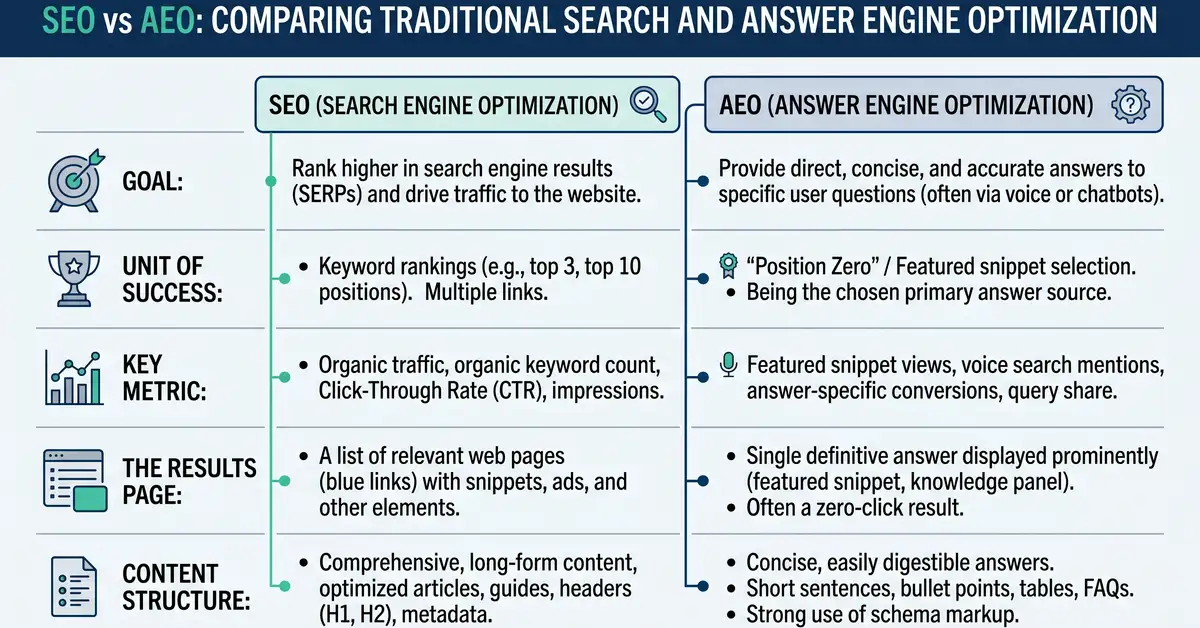
| Dimension | SEO | AEO |
| Goal | Rank a page | Be the cited answer |
| Unit of success | A ranked URL plus a click | A citation inside the answer, often with no click |
| Key metric | Rankings, clicks, CTR | Share of Model, AI citation share |
| The results page | Ten blue links | One synthesised answer |
| Content structure | Keyword-optimised pages | Direct answers, schema, quotable stats |
| Measurement | Rank trackers | AI visibility trackers |
Source: synthesis of Google Search Central and the GEO research paper (Aggarwal et al.).
The most consequential change is the unit of success. Under SEO, nothing counted until someone clicked. Under AEO, the win is the citation itself, even when the user never visits your site, because being named as the trusted source inside the answer builds authority and brand recall at the exact moment of decision. That is a different kind of victory, and it needs a different scoreboard.
Why is this shift happening now?
Because the click is disappearing. SparkToro's analysis found that in 2026, fewer than one in three Google searches still send a click to the open web. Pew Research found that users are far less likely to click any link when an AI summary appears in the results, and Search Engine Land documented AI Overviews driving a measurable drop in both organic and paid click-through rates. The pattern is consistent across every dataset: impressions hold or rise while clicks fall, because the answer is delivered on the results page itself.

We are living proof. One of our own benchmark pages earned 42,697 impressions and just 48 clicks over 90 days, a 0.11% click-through rate at an average position of 6.8, roughly 30 to 50 times below what that ranking should return. The ranking was fine. The clicks were harvested by the AI answer. If you optimise only for rankings, you can do everything right and still watch your traffic evaporate, which is the whole argument for adding AEO. We tell the full story in the traffic collapse analysis.
Watch Out
Rising impressions with flat or falling clicks is the signature of zero-click harvesting, not a tracking error. If your Search Console shows strong positions and growing impressions but a collapsing click-through rate, the AI answer is taking the visit. Measuring only rankings will hide the problem until the pipeline is already dry.
What are the two ways a brand can appear in an AI answer?
There are exactly two, and you should optimise for both. The first is being cited as a linked source, where the engine names your page and links to it, which can still send a click and clearly signals authority. The second is being mentioned in the answer text without a link, where the engine states your brand or your data as part of the answer itself. The second feels invisible in your analytics, but it may matter more, because it places your name directly in the user's decision with the engine's implicit endorsement. Both forms build your Share of Model, the share of AI answers in your category that feature you.
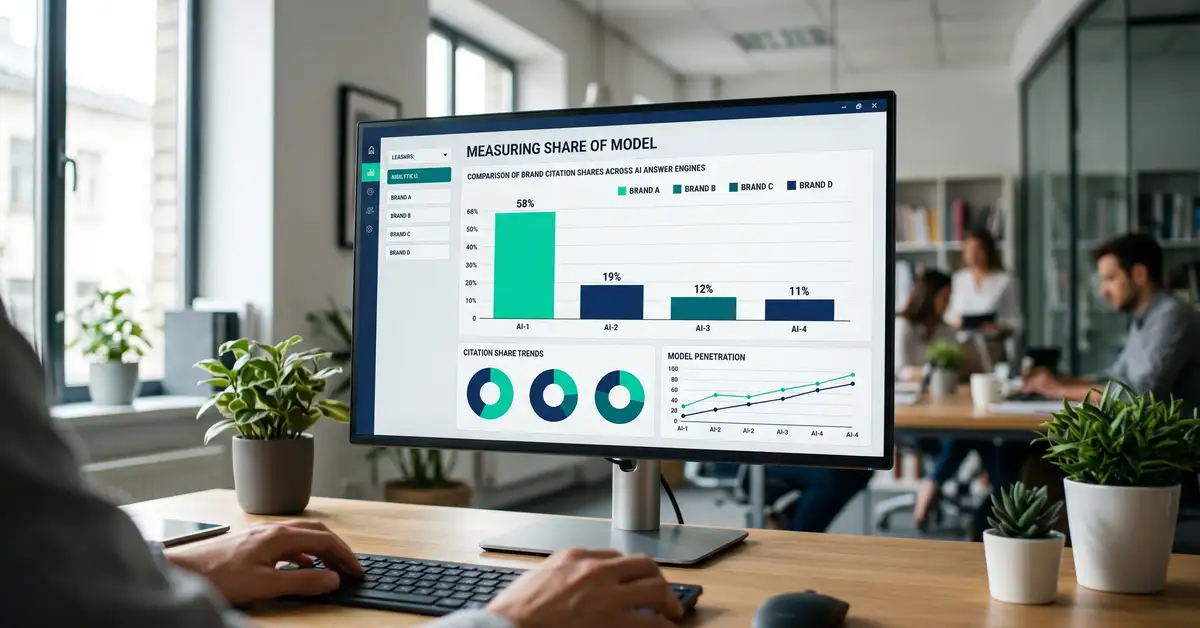
This is why the old metrics mislead. A rank tracker cannot see whether ChatGPT mentioned you, and your analytics cannot record a citation that produced no click. Measuring AI visibility requires tools built for it, and a new primary metric: Share of Model rather than position.
Want to see how often AI answers cite you versus your competitors?
Run the free AI Visibility CheckDoes AEO replace SEO?
No. AEO builds on SEO; it does not replace it. This is the single most important thing to get right, because the costliest mistake is to abandon your SEO foundation in a panic to chase AI. Google itself treats optimising for its AI features as a continuation of search, not a separate discipline, and the foundations carry straight over: quality content, genuine topical authority, a crawlable and fast site, clear structure, and schema markup are exactly what help an engine find, trust, and cite you. An AI engine cannot quote a page it cannot crawl or does not trust.

What is genuinely new sits on top of that base. You now write to be quoted, leading with a direct 40 to 60 word answer an engine can lift verbatim. You back claims with statistics and citations, which research on generative engines shows materially increases how often content is cited. You earn third-party mentions on the sources AI engines draw from. And you measure Share of Model instead of stopping at rankings. Keep the SEO foundation, add the AEO layer. For the wider distinction between AEO, GEO, and LLM SEO, see our terms explainer.
What B2B teams should do about it
Do not stop doing SEO. Add AEO on top of it and change what you measure. Keep earning rankings, because rankings are still how you get into the consideration set an AI engine draws from. Then layer in the AEO practices that get you cited: answer questions directly and early, structure content for extraction, back every claim with a quotable statistic, mark it up with schema, and build the authority and third-party presence that make engines trust you. Most importantly, stop judging success by clicks alone. In a zero-click world, the citation is the conversion event that precedes the eventual visit, and Share of Model is the metric that captures it.
Find out if AI is citing you, or your competitors.
The AI Visibility Check measures your Share of Model across the engines your buyers actually ask, and shows exactly where your competitors are being cited and you are not. It is the fastest way to see whether the traffic collapse has already reached your category, and what to build instead.
Run the free AI Visibility CheckFrequently asked questions about AEO vs SEO
What is the difference between AEO and SEO? SEO, search engine optimization, optimises your content to rank in the list of organic links so people click through to your site. AEO, answer engine optimization, optimises your content to be quoted and cited inside an AI-generated answer from tools like Google AI Overviews, ChatGPT, and Gemini. SEO wins a ranking and a click; AEO wins a citation inside the answer, which is increasingly the more valuable outcome as fewer searches end in a click.
What is GEO in digital marketing? GEO, generative engine optimization, is another name for the same practice as AEO: optimising content to be referenced inside the output of generative AI engines. The term comes from the original research paper that coined it, and in practice GEO, AEO, and LLM SEO overlap heavily and share the same goal of being cited by AI. The label matters less than the work, which is making your content easy for an AI to find, quote, and trust.
What is AI search optimization called? It goes by several names that mean roughly the same thing: answer engine optimization (AEO), generative engine optimization (GEO), and LLM SEO. Some people use AI search optimization as an umbrella term for all of them. They all describe optimising your content and brand to appear inside AI-generated answers rather than only in the traditional list of links.
How do I rank in AI search? You do not rank in the traditional sense; you earn citations. Produce clear, statistics-rich, well-structured content that directly answers real questions, lead with a short quotable answer, add schema markup, and build genuine topical authority plus third-party mentions on the sources AI engines reference. Engines favour content they can easily extract and brands they can trust, so the work is to be both the clearest answer and a credible source.
What are the two ways a brand can appear in an AI-generated answer? The first is being cited as a linked source, where the engine names and links to your page, which can still send a click. The second is being mentioned in the answer text without a link, where the engine states your brand or data as part of its answer. Both build your Share of Model, and the second matters even though it produces no click, because it places your name inside the user's decision.
How do I check if AI is taking my organic traffic? Look for rising or steady impressions alongside a falling click-through rate in Google Search Console, which is the signature of zero-click harvesting by AI answers. To go further, use an AI visibility tool that measures your Share of Model: how often AI answers in your category cite or mention you versus competitors. Our free AI Visibility Check gives you that baseline in a few minutes. build an AEO content system AI visibility playbook for SaaS
Resources
- Google Search Central: AI features and your site: how Google frames optimising for AI as part of search.
- SparkToro: fewer than one-third of Google searches send a click: the zero-click data.
- Pew Research: AI summaries and click behaviour: the CTR impact of AI summaries.
- peppereffect: The Traffic Collapse: the full picture and our own data.
- peppereffect: Answer Engine Optimization: the complete AEO guide.