

Google AI Overviews are AI-generated summaries that sit at the top of the search results page and answer a query in-line, with small citations to supporting pages. They quietly steal clicks because the searcher gets the answer without visiting any site: when an AI Overview appears, only 8% of users click a normal result, versus 15% when it does not.
Your rankings have not moved. Your impressions are flat or even rising. Yet the clicks have thinned out. If that is your organic traffic picture right now, the most likely cause is sitting at the very top of the results page: Google AI Overviews. They answer the question before the searcher ever reaches your link, and they now appear on a large and growing share of searches. This is the mechanism behind the traffic collapse, and it rewards a different game than ranking alone.
What are Google AI Overviews?

Google AI Overviews are synthesized, AI-generated answers placed above the traditional blue links on the search results page. Google composes them from content across the web and attaches inline citations to the pages that support each part of the summary. The feature began in 2023 as an experiment called Search Generative Experience, or SGE, available only to opt-in users through Search Labs. In May 2024 Google rolled AI Overviews out to all US users, moving them from a lab experiment to a default part of Search, with plans to reach over a billion users globally by the end of that year.
In 2025 Google added AI Mode, a chat-style interface built on a custom version of its Gemini model for more complex, multi-step questions. AI Mode is still a niche behaviour, reaching only 0.34% of searches in early 2026. AI Overviews, by contrast, are the mainstream surface now reshaping discovery, which is why they deserve the focus. This shift is part of the same story as the question of whether SEO is dead: the discipline did not die, but the click it was built to win is being absorbed.
How often do AI Overviews actually appear?
Often enough to matter to every B2B marketing team. A 2025 Pew Research analysis of US browsing logs found an AI summary on 18% of all searches in March 2025. By March 2026, aggregated third-party measurement put AI Overviews on more than 48% of total Google searches, up from roughly 6.5% a year earlier. SparkToro's 2026 dataset is more conservative at over 20% of all searches, and the gap between figures reflects different samples and methods, so treat the exact percentage as directional. The direction is not in doubt: AI Overviews moved from a rare overlay to a feature present on a large share of search journeys in under two years.
Coverage is also uneven by industry. Search Engine Land's analysis of 2025 query logs found AI Overviews saturating the Science category at 25.96% of keywords and Computers and Electronics at 17.92%, while Real Estate and Shopping stayed below 3%. For B2B firms in technical, scientific and software categories, that means above-average exposure precisely where your buyers research.
How do AI Overviews steal your clicks?
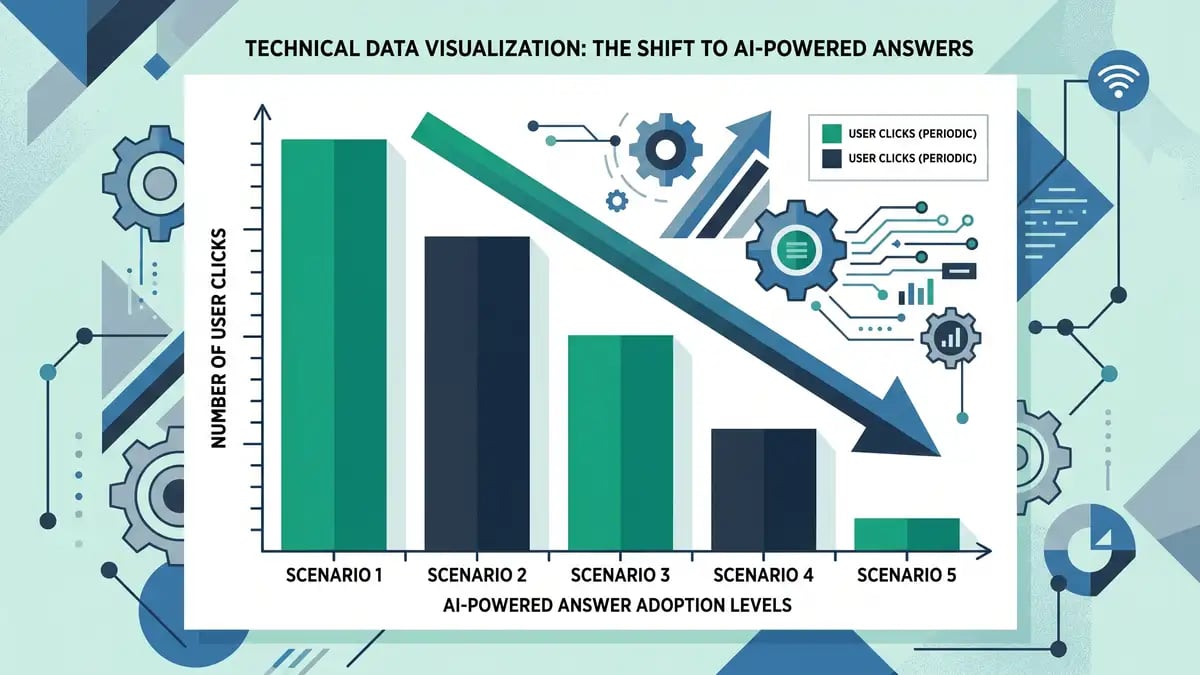
By answering the query on the page, so the searcher never needs yours. The effect is now measured across several independent datasets, and it is consistent. Ahrefs, studying 300,000 keywords, found that when an AI Overview appears on an informational query, the top-ranking page sees a 34.5% lower click-through rate than comparable queries without one. Pew's behavioural data shows the human side of the same number: with an AI summary present, users clicked a normal result in just 8% of visits, against 15% when no summary appeared, and they ended their session 26% of the time versus 16% without.
| Outcome on the results page | AI Overview present | No AI Overview |
| User clicks a normal organic result | 8% of visits | 15% of visits |
| User ends the session on that page | 26% of pages | 16% of pages |
| Top-result CTR, informational queries | 34.5% lower | Baseline |
Sources: Pew Research Center, 2025; Ahrefs, 2025.
A study by Seer Interactive, reported in Search Engine Land, found organic CTR on informational AI Overview queries fell from 1.76% to 0.61%, a 61% drop, while paid CTR fell from 19.7% to 6.34%. Agency Amsive, across 700,000 keywords, measured a more moderate 15.49% average CTR decline overall, but a 19.98% drop on non-branded terms and a punishing 27.04% drop for pages ranking outside the top three. The pattern is clear: the further down the page you sit, the harder the AI Overview hits you.
Key Takeaway
AI Overviews do not lower your ranking. They lower the value of the ranking by harvesting the click before it reaches you. Impressions stay high, clicks fall, and the gap is the traffic the AI answer kept.

Which searches trigger an AI Overview?
Mostly the informational, question-shaped searches that B2B content is built to win. Pew found that 60% of queries beginning with who, what, when or why produced an AI Overview, as did 53% of queries with ten or more words, while only 8% of one or two word searches did. Ahrefs reports that 99.2% of the keywords triggering AI Overviews in its dataset were informational in intent. That is the exact shape of early-stage B2B research: "what is zero trust architecture," "how to build a data governance framework," "best practices for vendor onboarding." The top of your funnel is the bullseye.
Branded and high-intent queries are more resilient. Amsive found only 4.79% of branded keywords triggered an AI Overview, and when one did appear, branded CTR actually rose 18.68%. The lesson is not to abandon top-of-funnel content but to understand that broad informational pages will convert impressions to clicks less efficiently, while your brand terms and high-intent comparison queries remain a safer harbour. Knowing the difference is the heart of AEO versus SEO.
Want to know whether AI is citing you or answering over you?
Run the free AI Visibility CheckHow do AI Overviews choose what to cite?

Google states there is no special markup required: to be eligible as a cited source, a page only needs to be indexed and eligible to appear with a snippet in Search, according to its Search Central documentation. AI Overviews are drawn from the same ranking systems as ordinary results, so classic fundamentals still apply: quality content, technical health, topical authority and links. Research from Botify and Demandsphere suggests pages in the top twelve organic results are far more likely to be cited.
The selection skews toward perceived authority. Pew found that 88% of AI summaries cite three or more sources, and that Wikipedia, YouTube and Reddit were the most-linked, with government domains over-represented at 6% of cited sources versus 2% in standard results. Crucially, being cited is a meaningful advantage: Seer found brands named in an AI Overview earned 35% more organic clicks and 91% more paid clicks than brands left out. AI Overviews shrink the total pool of clicks, then concentrate what remains among the cited few. This is a winner-takes-more dynamic, and it is why answer engine optimization now matters as much as ranking.

What does this mean for B2B growth?
It means search volume and rankings no longer reliably predict traffic. SparkToro's 2024 study found that for every 1,000 US Google searches, only 360 clicks reached the open web. By 2026, 68% of Google searches ended without a click at all. For a B2B company whose pipeline depends on top-of-funnel discovery, that decoupling quietly thins the funnel months before it shows up as a lead-generation problem, and nothing in your rankings report flags it.
peppereffect is patient zero here. One of our own benchmark pages earned 42,697 impressions and just 48 clicks over 90 days, a 0.11% click-through rate at an average position of 6.8, roughly 30 to 50 times below what that position should return. The clicks did not move to a competitor. They were harvested by the AI answer. Across four benchmark pages the blended figure was 66,520 impressions to 60 clicks, a 0.09% CTR. That is the traffic collapse in a single real number, and it is the same number hiding in most B2B analytics accounts right now. You can diagnose whether AI is eating your traffic in a few minutes.
Watch Out
Do not try to hide from AI Overviews with the nosnippet directive. It does stop Google from using your text in AI answers, but it also strips your normal search snippet, cutting traditional visibility too. The goal is to be the cited source, not to disappear.
How do you appear in Google AI Overviews?
You earn citation the way you earn rankings, then add an answer-first layer on top. There is no shortcut markup, only the disciplined construction of content AI engines trust and can lift.
Answer first, elaborate second
Open each page with a direct, 40 to 60 word answer to the exact question, then expand. AI Overviews lift clean, self-contained passages, so make the quotable answer easy to find.
Build topical authority, not scattered posts
Publish a connected cluster of deep content on one domain rather than thin pieces across many. Google and its AI layer reward demonstrated expertise, especially in complex B2B fields.
Add structured data and clear formatting
Use FAQ, how-to and organisation schema, question H2s, short paragraphs and tables. None is strictly required for citation, but all help Google parse and reuse your content.
Earn rank, because citations come from the top
Pages in the top results are far more likely to be cited. Keep investing in quality, links and technical health so you are in the pool the AI draws from.
Measure Share of Model, not just clicks
Track how often AI engines name you for your priority prompts. As traffic decouples from rankings, citation presence becomes the visibility metric that matters.
Run as a connected system rather than one-off posts, this compounds. That is the logic behind an AEO content system and behind measuring zero-click visibility directly.
See whether AI Overviews are citing you or answering over you
The first move is diagnosis. The free AI Visibility Check shows whether Google AI Overviews and the major answer engines name your brand for the prompts your buyers actually ask, and where competitors are taking the citation instead.
Run the free AI Visibility CheckFrequently asked questions about Google AI Overviews
What are Google AI Overviews?
Google AI Overviews are AI-generated summaries shown at the top of the search results page that answer a query in-line, composed from web content with small inline citations to supporting pages. They launched broadly in the US in May 2024 and now appear on a large share of searches, especially informational and question-style queries.
Do AI Overviews reduce website traffic?
Yes, for affected queries. Ahrefs found a 34.5% lower top-result CTR on informational queries when an AI Overview appears, and Pew found users click a normal result in only 8% of visits with an AI summary present, versus 15% without. The answer is delivered on the page, so fewer searchers click through.
When did Google AI Overviews start?
They began in 2023 as an experiment called Search Generative Experience (SGE) inside Search Labs, then rolled out to all US users as AI Overviews in May 2024. Through 2025 and 2026 Google expanded them to over 200 countries and added AI Mode for more complex queries.
How do I appear in Google AI Overviews?
There is no special markup. Be indexed and snippet-eligible, rank well (citations skew to the top results), build genuine topical authority, and structure content answer-first so a clean passage can be lifted. Then measure Share of Model to track how often you are cited.
Are Google AI Overviews accurate?
Not always. AI Overviews have been criticised for inaccuracies and hallucinations, and in January 2026 Google restricted them for some health-related searches after reporting on harmful suggestions. For regulated B2B sectors, this is a reason to be the clearly attributed, authoritative source the AI draws from.
How do I check if AI Overviews are taking my traffic?
Look for rising or flat impressions with falling clicks in Search Console, concentrated on informational queries. To see whether AI engines name your brand for your priority prompts, run the free AI Visibility Check for a baseline.
Resources
- Google: Generative AI in Search, AI Overviews launch (May 2024)
- Google Search Central: AI Features and Your Website
- Pew Research Center: Do people click links in Google AI summaries? (2025)
- Ahrefs: AI Overviews Reduce Clicks by 34.5%
- Search Engine Land: AI Overviews drive 61% drop in organic CTR
- Amsive: Google AI Overviews CTR study
- SparkToro: Less than one third of Google searches still send a click (2026)