

The AEO content system: how to build a content engine that compounds
An AEO content system is a repeatable operating system for producing, structuring, interlinking, and refreshing content so AI engines cite your brand as the trusted source in your category. Unlike one-off articles, it compounds: each piece reinforces the others, topical authority accrues, and citations beget citations, which is why a system beats random acts of content.
You cannot win answer engine optimization with a content calendar and a wish. AI engines cite sources that demonstrate depth, authority, and internal corroboration, and no single article can manufacture that. What earns durable citations is a system: a content engine that builds topical authority deliberately and keeps it fresh. This is the BOFU build inside our wider analysis of the traffic collapse, and it is the difference between publishing content and engineering an asset that gets cited for years.
What this guide covers:
- Why one-off content fails to earn AI citations
- What an AEO content system actually is
- The seven components of a content engine
- Why the system compounds over time
- How AI automation runs the engine without scaling headcount
Key Takeaway
AI engines do not cite articles; they cite authorities. The only reliable way to become an authority an LLM trusts is to build a system of interconnected, answer-first, well-sourced content that compounds, rather than scattering disconnected posts and hoping one gets picked up.

Why does one-off content fail at AEO?
Because a single page cannot prove authority, and authority is what gets cited. When an AI engine assembles an answer, it favours sources that show topical depth, freshness, and corroboration across many connected pages. One isolated article, however good, is a data point with nothing around it to vouch for it. The engine has no reason to treat it as the definitive source on a topic, so it rarely earns a repeat citation.

This is why random acts of content fail. Publishing a clever post one week and an unrelated one the next produces a pile of orphans, not an authority. The stakes are real: SparkToro's zero-click study found that for every 1,000 US Google searches, only 374 clicks reach the open web, so the page that is merely present but not cited gets neither the click nor the mention. The fix is not better individual posts. It is a different unit of production entirely: the system. Our breakdown of AEO vs SEO covers why the goal shifted from ranking to being cited.
What is an AEO content system?
An AEO content system, what we call the Content Engine, is a repeatable operating system that produces, structures, interlinks, and refreshes content so your brand becomes the most-cited source in its category. It treats content not as a stream of one-off deliverables but as an interconnected asset that grows in authority with every piece added. Where random content scatters, a system concentrates: every page is designed to reinforce a clear topical territory, formatted to be extracted by an engine, and linked to corroborate the rest.
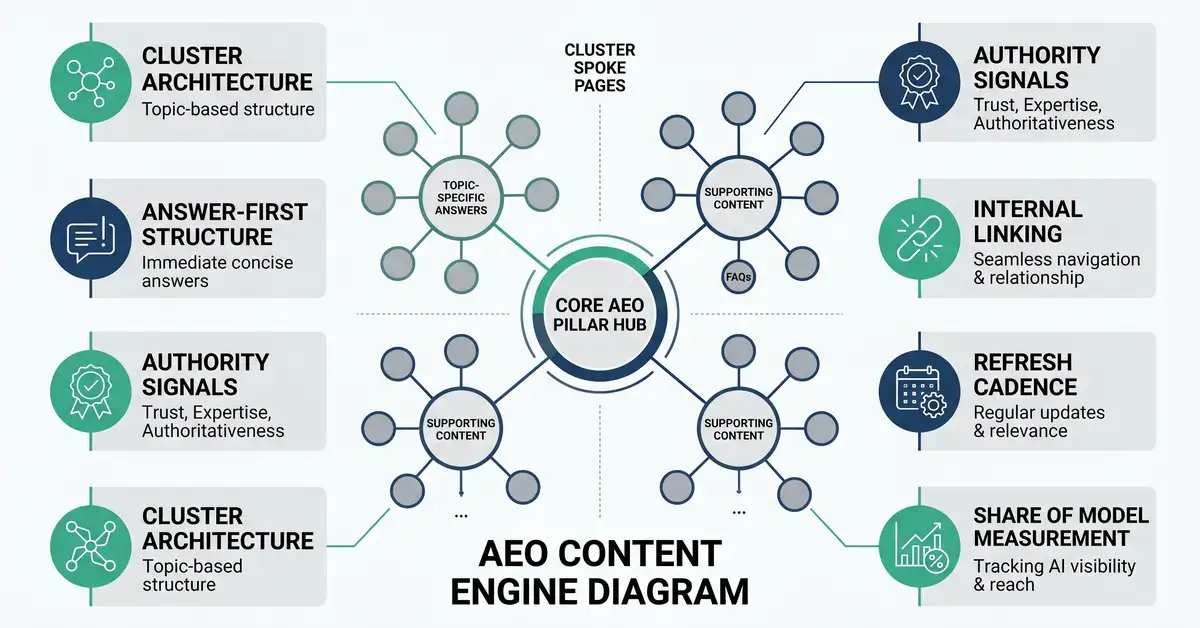
The shift in mindset is from output to architecture. A content calendar asks what to publish next. A content engine asks what authority to build and how each piece advances it. That is the move from doing content to engineering a machine that produces citations, and it is the only approach that scales in a world where being cited, not clicked, is the win.
Key Takeaway
Stop thinking in articles and start thinking in systems. The question is not "what should we write this month" but "what category must we own, and what interconnected body of content makes an AI engine treat us as the authority on it".
The seven components of a content engine
A compounding content system is built from seven parts, each of which reinforces the others.
Cluster architecture
A pillar page plus interlinked spokes that blanket a topic, building the topical authority engines reward.
Answer-first structure
Every page leads with a 40 to 60 word direct answer, uses question headings, and offers quotable stats an engine can lift.
Authority and entity signals
Consistent entities, original data, and third-party mentions that make engines trust you as a source worth citing.
Internal linking that signals depth
A deliberate hub-and-spoke link graph that tells engines your coverage is comprehensive, not incidental.
A refresh cadence
Scheduled updates that keep pages current, because freshness is a factor in what gets cited.
Share of Model measurement
Track how often AI answers cite you versus competitors, not pageviews. The citation is the result you optimise.
Distribution to AI sources
Be present on the third-party sites and platforms the engines actually draw from when they build answers.
Component two matters more than it looks. Research on generative engine optimization found that adding statistics, quotations, and cited sources materially increases how often content is cited, so an answer-first, evidence-dense template is not a stylistic choice; it is a citation lever.
Source: component framework synthesised from Semrush topic clusters, Ahrefs topical authority, and the GEO research paper (Aggarwal et al.).
Want to know how citable your content is right now?
Take the AEO Readiness AssessmentWhy does a content system compound?
Because authority is cumulative and citations are self-reinforcing. Every page you add to a cluster strengthens the topical authority of the whole, which makes every page more likely to be cited, which builds more authority. Each citation is also a signal to the next engine that you are a trusted source, so citations beget citations. The result is a flywheel: the more of your category you cover with interconnected, well-sourced content, the cheaper each additional citation becomes and the harder you are to displace.

This is the opposite of one-off content, which decays. An orphan post peaks and fades. A system appreciates, because its value is in the connections between pieces, and those connections only multiply as you add more. The compounding is why a content engine is an asset on the balance sheet of your marketing, not an expense on the income statement.
How AI automation runs the engine
In 2026, you do not staff a content engine with a room full of writers; you run it with AI agents and workflow automation. The repetitive work of the engine, researching a topic, drafting an answer-first page, optimising it for citation, publishing it, interlinking it into the cluster, and monitoring Share of Model, is exactly the kind of structured, rules-based process that automation handles. That is how output decouples from headcount, which is the whole point of building a system rather than hiring more people.

The humans move up the stack to strategy, judgment, and quality, while the machine produces the volume and consistency that topical authority demands. If you want the underlying mechanics, our guide on how to build an AI agent shows how the production layer is assembled. The engine is not a metaphor; it is an autonomous operating system that earns citations while you sleep.
Watch Out
Automation amplifies whatever system you point it at. Automating the production of disconnected, thin content just manufactures orphans faster. Build the cluster architecture, the answer-first template, and the authority signals first, then automate. Volume without a system produces noise, not citations.
How to build your content engine

The build sequence is the same for any category. Define the category you must own, then map the cluster of a pillar and its spokes that covers it. Set an answer-first template so every page is structured for citation from the start. Build the authority signals, original data, consistent entities, and third-party presence, that make engines trust you. Automate the production so you can sustain the volume topical authority requires. Measure Share of Model rather than pageviews. And refresh on a cadence so the engine stays current. Each step compounds the last, which is exactly why the system, not the individual article, is the unit that wins.
See how citable your content is, then build the engine.
The AEO Readiness Assessment scores how ready your content is to be cited by AI engines today, and shows the gaps between you and the most-cited source in your category. It is the first step toward installing a content engine that compounds Share of Model instead of chasing clicks that no longer come.
Take the AEO Readiness AssessmentFrequently asked questions about AEO content systems
What is an AEO content system? An AEO content system, or content engine, is a repeatable operating system for producing, structuring, interlinking, and refreshing content so that AI engines cite your brand as the trusted source in your category. It differs from publishing one-off articles by treating content as an interconnected, compounding asset built around topical authority, an answer-first structure, and measurement of Share of Model rather than clicks.
Why does one-off content not work for AI search? Because AI engines cite sources that demonstrate topical authority, depth, and corroboration across many connected pages, and a single isolated article cannot establish that. One good post is a data point with nothing around it to vouch for it, so engines rarely treat it as the definitive answer. Durable citations come from a system of interlinked content, not from scattered individual pieces.
What are the components of a content engine? Seven: cluster architecture (a pillar plus interlinked spokes), answer-first content structure, authority and entity signals, internal linking that signals depth, a refresh cadence, Share of Model measurement, and distribution to the third-party sources AI engines draw from. Each component reinforces the others, which is what makes the system compound rather than decay.
Why does a content system compound? Because authority is cumulative and citations are self-reinforcing. Every page added to a cluster strengthens the topical authority of the whole, which makes each page more likely to be cited, which builds more authority. Citations also signal trust to the next engine, so citations beget citations. The flywheel means each additional citation gets cheaper and your position gets harder to displace.
Can AI automate content production for AEO? Yes. The repetitive work of the engine, researching, drafting answer-first pages, optimising for citation, publishing, interlinking, and monitoring Share of Model, is structured enough for AI agents and workflow automation to run at scale. This decouples content output from headcount. The key is to build the system architecture first, because automating disconnected, thin content just produces orphans faster.
How do I measure whether my content is working for AI search? Measure Share of Model: how often AI answers in your category cite or mention your brand versus competitors, tracked with AI visibility tools built for it. Traditional metrics like rankings and pageviews miss the citation entirely, so they understate or hide your real AI visibility. The AEO Readiness Assessment gives you a starting baseline of how citable your content is today. AI visibility for B2B SaaS
Resources
- Aggarwal et al.: Generative Engine Optimization: what increases AI citation, including statistics and quotations.
- Semrush: Topic Clusters: the cluster architecture behind topical authority.
- Ahrefs: Topical Authority: how depth across a topic builds authority.
- peppereffect: The Traffic Collapse: why the click is disappearing and what to build instead.
- peppereffect: AEO vs SEO: how the goal shifted from ranking to being cited.