

The traffic collapse is the structural decline of organic search clicks as Google AI Overviews, ChatGPT, Gemini, and Claude answer questions in-line, so impressions no longer convert to visits. B2B companies counter it with answer engine optimization: structuring content to be cited inside AI answers, measured by Share of Model rather than blue-link rankings. AI visibility case study
What is the traffic collapse, and why is it accelerating now?
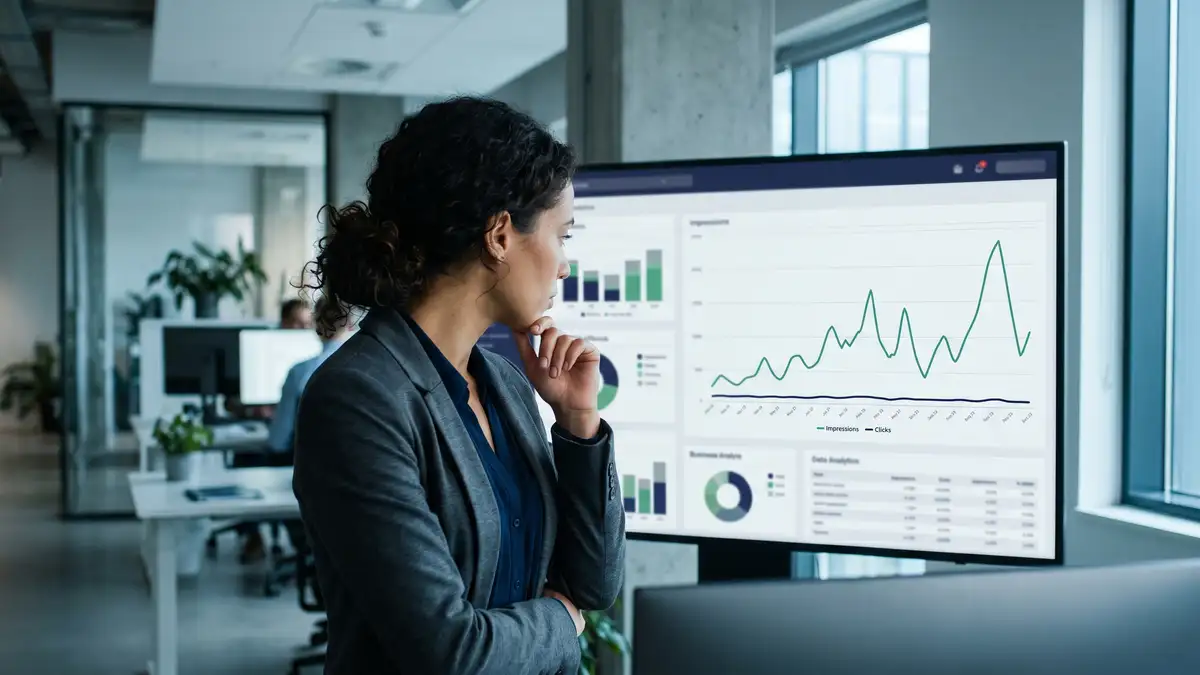
One of our own benchmark pages earned 42,697 impressions and 48 clicks in a 90-day window. That is a 0.11% click-through rate at an average position of 6.8, roughly 30 to 50 times below what that position should return. The clicks did not move to a competitor. They were absorbed by the AI answer sitting above the results. This is the traffic collapse, and it is already inside most B2B funnels, hidden behind impression counts that still look healthy.
The macro data confirms it is structural, not seasonal. In the first four months of 2026, 68.01% of Google searches ended without a click, up from 60.45% in 2024, according to SparkToro. Google AI Overviews now reduce the organic click-through rate for position-one content by 58%, per Ahrefs. And Gartner forecasts traditional search volume will drop 25% by late 2026. Ranking is no longer the same as being seen.
What you'll learn in this guide:
- How big zero-click search has become, and how fast it is still growing.
- Exactly how much traffic Google's AI Overviews are taking, across multiple independent studies.
- Where the lost attention is going as ChatGPT, Gemini, and AI Mode scale.
- Why the collapse hits B2B pipelines harder than it hits publishers.
- What answer engine optimization is, and how to win Share of Model with an evidence-backed operating system.
Key Takeaway
Impressions are no longer a proxy for traffic. When an AI answer resolves the query on the results page, your ranking earns a view and zero clicks. The strategic response is not more keyword content. It is engineering content to be cited inside the AI answer, and measuring visibility by Share of Model instead of pageviews.
What is zero-click search, and how big is it really?
A zero-click search is a query that ends without the user visiting any external website, because the answer is delivered directly on the results page through an AI Overview, snippet, or knowledge panel. It is now the default outcome, not the exception. For every 1,000 US Google searches, only about 360 clicks reach the open web, according to zero-click research compiled by ClickVision.
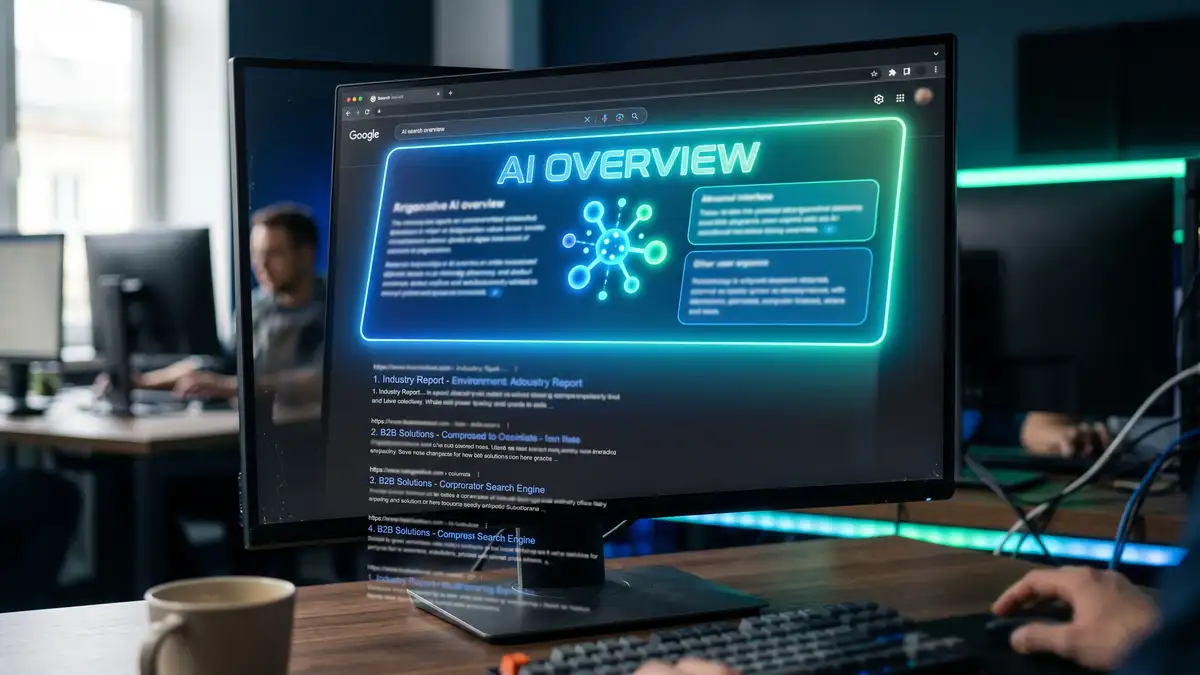
The trajectory is steep. Similarweb data shows zero-click behavior jumped from 56% to 69% in the year after AI Overviews launched in May 2024, a 13 percentage-point move in twelve months. The split widens by context: queries that trigger an AI Overview see an 83% zero-click rate, while mobile pushes it to 77% of all queries ending without an onward visit. The behavior is hardening as users learn to expect a synthesized answer rather than a list of links. Our own work on measuring zero-click visibility shows the same pattern inside B2B niches, not just consumer ones.
| Period | Zero-click share of Google searches | Primary driver |
| ~2015 | ~45% | Featured snippets, knowledge panels |
| 2024 | 60.45% | AI Overviews launch (May 2024) |
| May 2025 | 69% | AI Overviews on 20%+ of searches |
| Early 2026 | 68.01% | AI Overviews + AI Mode (1B users) |
Sources: SparkToro, 2026, Similarweb via Search Engine Roundtable, 2025.
How much traffic are Google's AI Overviews actually taking?
Every credible study lands in the same range: AI Overviews cut organic clicks roughly in half or more. Ahrefs measures a 58% CTR reduction for position-one content as of December 2025, up from 34.5% in April 2025, which means the damage is intensifying, not stabilizing. Seer Interactive, analyzing more than 3,100 queries, found a 61% drop in organic CTR when an AI Overview is present. Authoritas puts the figure at 47.5%. The range is the story: there is no version of this where the click survives intact.
There is one lifeline, and it defines the entire strategy. Seer found that sites cited inside an AI Overview saw a 35% higher organic CTR than when they were absent from it. Presence in the answer, not position beneath it, now determines whether any traffic flows at all. That is the precise mechanic that getting cited by ChatGPT and AI search is built to exploit.
| Study | Organic CTR impact when AI Overview present | Sample / date |
| Ahrefs | -58% (position 1) | December 2025 |
| Seer Interactive | -61% organic, -68% paid | 3,100+ queries, 2024-2025 |
| Authoritas | -47.5% | 2025 |
| Cited inside the AI Overview | +35% organic CTR | Seer Interactive, 2025 |
Sources: Ahrefs, 2025, Seer Interactive, 2025.
Key Takeaway
The objective has inverted. You are no longer competing for a higher rank on a list. You are competing for inclusion and prominence inside one synthesized answer, which has far fewer slots. Being cited is the new page-one, and it carries a measurable 35% CTR premium over being merely present.

Where did the attention go? The rise of AI answer engines
The clicks did not vanish. They migrated to answer engines. ChatGPT now reports over 700 million weekly active users, per OpenAI, with 88.6 million US users in 2025. Google's Gemini tripled its share of generative AI users from 16.9% to 46% between 2023 and 2025, and Google AI Mode surpassed one billion monthly users by mid-2026.
Referral traffic from these platforms is growing fast but cannot backfill the loss. ChatGPT referrals to news sites grew 25x from 2024 to 2025, yet AI assistants still account for only about 0.02% of total referral traffic, according to TechCrunch reporting on Similarweb data. The takeaway is uncomfortable but clarifying: you do not win this era by chasing AI referral clicks. You win it by being the source the AI quotes when it answers, so your brand shapes the buyer's understanding before any click is even on the table. That is the difference between traditional SEO and GEO, SEO, and AEO as distinct disciplines.
| Answer engine | Scale (2025-2026) | Trajectory |
| ChatGPT | 700M weekly active users | App users doubled in 6 months |
| Google AI Mode | 1B monthly users | Queries doubling each quarter |
| Google Gemini | 46% of gen-AI user share | Up from 16.9% (2023) |
| AI referral traffic | ~0.02% of total referrals | Up 25x, still tiny vs search loss |
Sources: OpenAI, 2025, Digiday, 2025.
Why the collapse hits B2B harder than publishers
For B2B, this is not a traffic problem. It is a pipeline problem. Forrester reports that 95% of B2B buyers plan to use generative AI in a future purchase, and over half say AI led them to consider more or different vendors. The vendor shortlist is now being assembled inside an answer engine, before your sales team is aware the buyer exists. If a competitor is cited and you are not, you are eliminated from consideration at a stage you cannot see and cannot influence by traditional means.
The math compounds for high-consideration purchases. A mid-market SaaS CEO evaluating a growth system, an executive search principal vetting a partner, or a coaching founder researching automation does not run one query and click one link. They interrogate an AI assistant across a dozen prompts and form a vendor mental model from what it cites. Invisible in those answers means invisible in the deal. This is exactly why we treat AI visibility as growth infrastructure, not a content add-on, and why benchmark-style pages like our revenue-per-employee benchmarks have to be re-engineered for citation rather than left to bleed impressions.
Want to know whether ChatGPT, Gemini, and Claude cite you or your competitors? The AI Visibility Check maps your Share of Model and the exact gaps that cost you pipeline.
Run Your Free AI Visibility CheckWhat is answer engine optimization, and how do you win Share of Model?
Answer engine optimization (AEO) is the practice of structuring content so AI answer engines select, trust, and cite it inside their generated responses. Generative engine optimization (GEO) is the closely related discipline focused specifically on large language model outputs. Both replace the old goal of ranking with a new one: becoming the attributed source. And unlike early SEO folklore, there is now hard evidence on what works.
The landmark Princeton and IIT Delhi GEO study (KDD 2024) ran 10,000 queries through AI search systems and tested nine content strategies. Adding relevant quotations lifted visibility by 41%, adding statistics lifted it by 31%, and citing sources compounded both. Keyword stuffing performed 10% below the unoptimized baseline. The signal is unambiguous: AI search rewards citation-worthiness, specific, sourced, quotable evidence, and punishes keyword density.
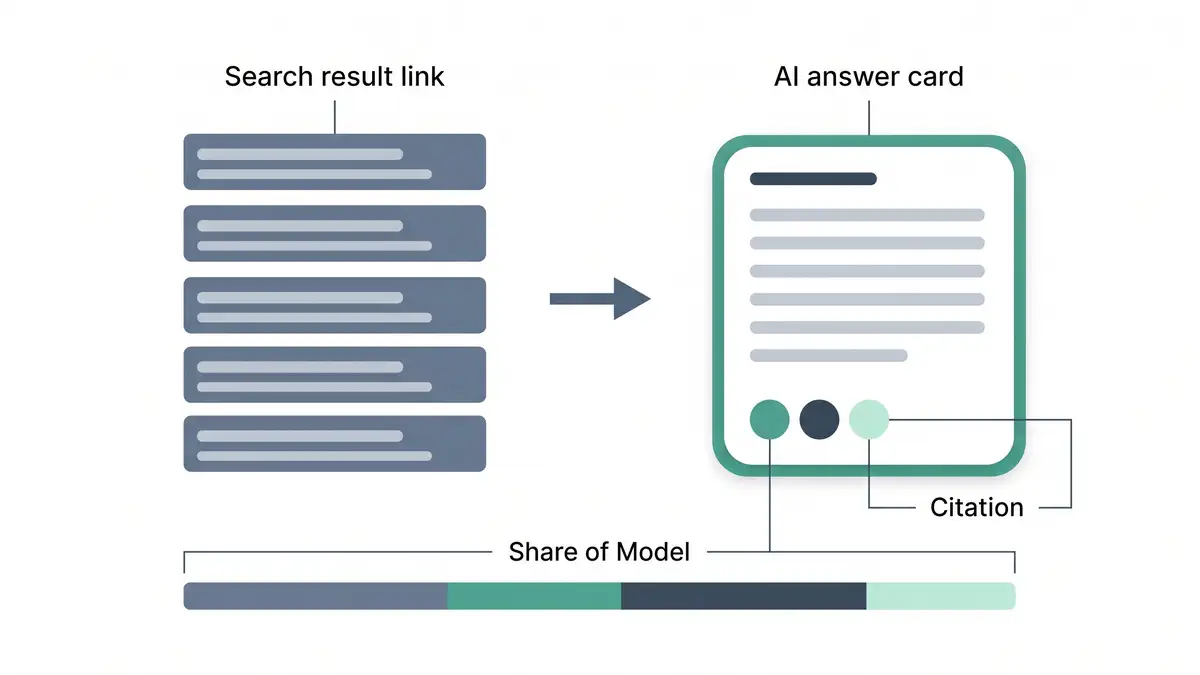
Winning Share of Model, the proportion of AI answers in your category that cite you, is an engineering exercise, not a copywriting one. Benchmark where you stand today with an AEO readiness assessment, then deploy these five moves:
Lead with a quotable answer
Open every page with a 40 to 60 word direct answer the model can lift verbatim. The quotation effect alone moved visibility 41% in the GEO study.
Replace claims with statistics and sources
Every assertion gets a specific number and an attributed, dated source. Statistics lifted citation visibility 31% and compound when combined with fluent structure.
Engineer structure and schema
Question-based headings, FAQ and Article schema, and clean tables let the model parse, attribute, and quote you without ambiguity. See our HubSpot SEO and AEO visibility guide.
Build third-party authority
AI systems weight E-E-A-T and off-site citations. Earn mentions where the model already looks, then reinforce with a full answer engine optimization strategy.
Measure Share of Model, not pageviews
Track how often each assistant cites you versus competitors, and convert that into pipeline. Codify the wins with AEO best practices.
Avoid This Mistake
Do not keep optimizing for pageviews while the click disappears. Reporting traffic and rankings in a zero-click world measures a number that no longer maps to revenue. Switch your scorecard to citations earned, Share of Model, and pipeline influenced, or you will declare victory while the pipeline quietly empties.
What do the numbers say? CTR benchmarks versus the new reality
The gap between expected and actual click-through rate is the cleanest way to see the collapse in your own data. Traditional benchmarks from Semrush put position-one organic CTR near 39.8%. Against that yardstick, our flagship page converting 42,697 impressions into 48 clicks (0.11%) at position 6.8 is not underperforming by a little. It is being intercepted before the click. Pull your own Search Console data, sort by impressions, and look for high-impression pages with near-zero CTR. That signature is AI harvesting, and it is the first thing to fix.
| Organic position | Expected CTR (Semrush) | Reality with AI Overview present |
| Position 1 | 39.8% | Up to 58% lower (Ahrefs) |
| Position 2 | 18.7% | Further suppressed below the answer |
| Position 3 | 10.2% | Often pushed below the fold |
| peppereffect flagship (pos 6.8) | ~5% expected | 0.11% actual (42,697 impr, 48 clicks) |
Sources: Semrush, 2025, Ahrefs, 2025, peppereffect Search Console (90 days to June 2026).
Key Takeaway
The traffic collapse is measurable inside your own account today. High impressions plus collapsing CTR equals AI interception. The fix is not to publish more keyword content into the same machine that is harvesting it. It is to re-engineer for citation and track Share of Model as the leading indicator of pipeline.
Frequently Asked Questions
What is the difference between AEO and SEO?
SEO optimizes to rank a page in a list of blue links. Answer engine optimization (AEO) optimizes to be selected and cited inside an AI-generated answer, where there is no list and far fewer slots. SEO measures success by position and clicks; AEO measures it by citations earned and Share of Model. They are complementary, not mutually exclusive, but in a world where 68% of searches are zero-click, AEO determines whether your ranking translates into any visibility at all. For a deeper breakdown, see our guide on GEO vs SEO vs AEO.
What is GEO in digital marketing?
GEO, or generative engine optimization, is the discipline of optimizing content to appear in and be cited by generative AI systems such as ChatGPT, Gemini, Perplexity, and Claude. The Princeton and IIT Delhi GEO study showed that adding quotations, statistics, and clear source attribution can lift visibility inside AI answers by 30 to 41%. GEO sits alongside AEO under the broader umbrella of answer engine and AI search optimization, and it prioritizes evidence-rich, well-structured content over keyword density.
What is AI search optimization called?
It goes by several overlapping names: answer engine optimization (AEO), generative engine optimization (GEO), and AI search optimization. AEO is the broadest term, covering optimization for any engine that returns a direct answer, including Google AI Overviews. GEO focuses specifically on large language model outputs. In practice they describe the same shift: optimizing to be the cited source inside a synthesized answer rather than a ranked link beneath it.
How do I rank in AI search?
You do not rank in AI search so much as get cited by it. Lead each page with a concise, quotable answer; back every claim with a specific statistic and an attributed source; structure content with question-based headings and schema markup; and build third-party authority signals that AI systems trust. The evidence shows quotations and statistics are the highest-leverage moves. Then measure Share of Model to see which assistants cite you. Our answer engine optimization strategy lays out the full framework.
How do I check if AI is taking my organic traffic?
Open Google Search Console and sort your pages by impressions. Any page with very high impressions and a near-zero click-through rate, well below the roughly 5 to 40% expected for its position, is almost certainly being intercepted by an AI Overview or snippet. Cross-reference with whether AI Overviews appear for those queries. This high-impression, low-CTR signature is the clearest fingerprint of the traffic collapse, and the starting point for an AEO program. We cover the method in measuring zero-click visibility.
Is SEO dead because of AI search?
No, but the definition of success has changed. The technical foundations of SEO, crawlability, structure, authority, still matter because AI systems retrieve and synthesize from indexed content. What is dying is the assumption that a ranking equals traffic. With AI Overviews cutting clicks by up to 58% and 68% of searches ending without a click, the discipline is evolving from earning the rank to earning the citation. Treat AEO as the next layer on a healthy SEO base, not a replacement for it.
Stop Optimizing for Clicks That No Longer Arrive
peppereffect installs the answer engine optimization operating system that gets your brand cited by ChatGPT, Gemini, and Claude, and measures it in Share of Model and pipeline, not vanity pageviews. We diagnose exactly where the collapse is costing you deals.
Run Your Free AI Visibility CheckGet your AI Visibility Value Report → why your organic traffic is dropping diagnose whether AI is eating your traffic AEO vs SEO: what actually changes the AEO content engine AI visibility for B2B SaaS
Resources
- SparkToro — In 2026, Less Than One Third of Google Searches Still Send a Click
- Ahrefs — AI Overviews Reduce Clicks by 58%
- Seer Interactive — AI Overview Impact on Google CTR
- Forrester — AI-Powered Search in B2B Marketing
- Press Gazette — Global Publisher Google Traffic Dropped by a Third in 2025
- Princeton and IIT Delhi GEO Study (KDD 2024) — Summary
- Semrush — Organic Click-Through Rate by Position
- TechCrunch — ChatGPT Referrals Are Growing but Not Offsetting Search Declines
the recruiter's pipeline leak how the collapse distributes across 17 B2B categories