

AEO vs GEO vs LLM SEO: the terms explained
AEO, GEO, and LLM SEO are three names for closely related versions of the same goal: getting your brand found, cited, and recommended inside AI answers rather than just ranked in a list of links. The acronyms differ in emphasis, not in mission. Answer engine optimization (AEO) is about being the cited answer. Generative engine optimization (GEO) is about being referenced and recommended in generative output. LLM SEO is the framing for optimising specifically for large language model assistants. If the alphabet soup is confusing, that is because the industry coined the terms faster than it agreed on them.
This guide cuts through it. You will get a precise definition of each term, an honest account of where they genuinely differ and where they are effectively synonyms, and the practical bottom line: the label matters far less than the work. For the strategy behind all of them, our pillar guide to generative engine optimization goes deep.
What you'll learn in this guide:
- A precise definition of SEO, AEO, GEO, and LLM SEO
- Where the terms genuinely differ and where they overlap
- What carries over from traditional SEO and what is new
- What actually works across all of them
- Which term to care about, and the honest answer
Key Takeaway
Do not get lost in the acronyms. AEO, GEO, and LLM SEO are three lenses on one shift: search is moving from ranking links to being named inside AI answers. The work to win is largely the same regardless of the label you use.

Defining each term
Start with clean definitions, because most of the confusion comes from fuzzy ones.
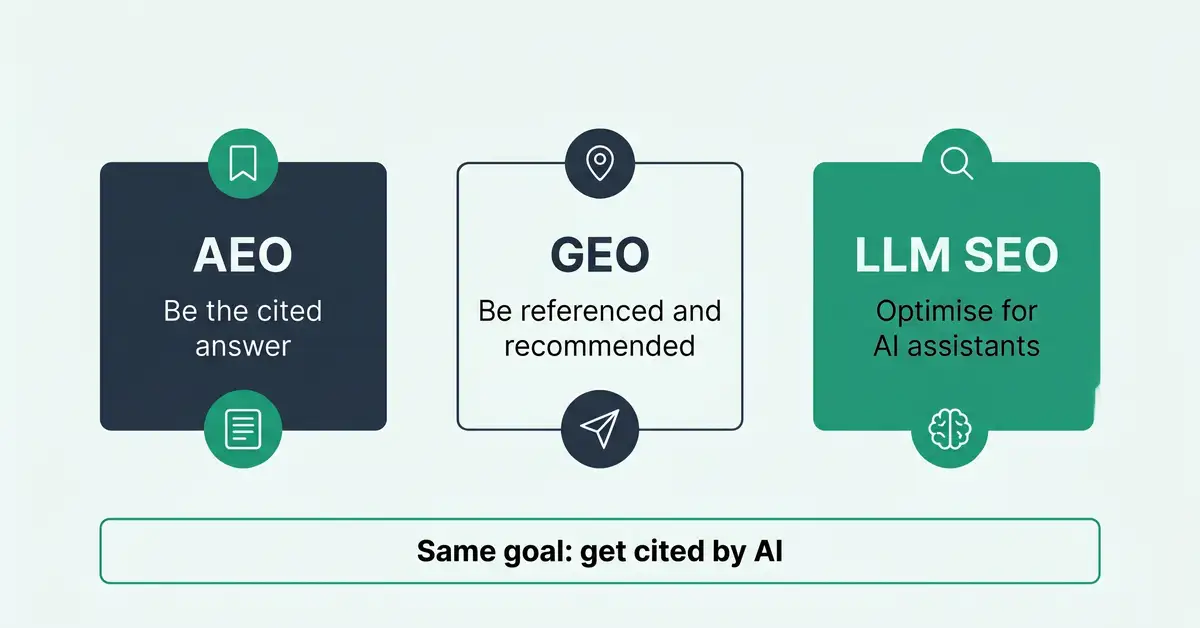
SEO, search engine optimization, is the original discipline: optimising your content and site to rank in traditional search results, the familiar list of blue links. AEO, answer engine optimization, is optimising to be the answer an engine gives directly, in a featured snippet or an AI-generated response, rather than a link the user has to click (HubSpot, 2026). GEO, generative engine optimization, is optimising to be referenced and recommended inside the output of generative AI engines. The term comes from a 2023 academic paper by Aggarwal and colleagues, which also found that adding statistics, quotations, and citations measurably increases how often content is surfaced in generative answers (Aggarwal et al., 2023). LLM SEO, sometimes called LLMO or AI SEO, is the framing for optimising specifically for large language model assistants, and is often associated with techniques like the llms.txt file (Yoast, 2026).
Where they differ, and where they overlap
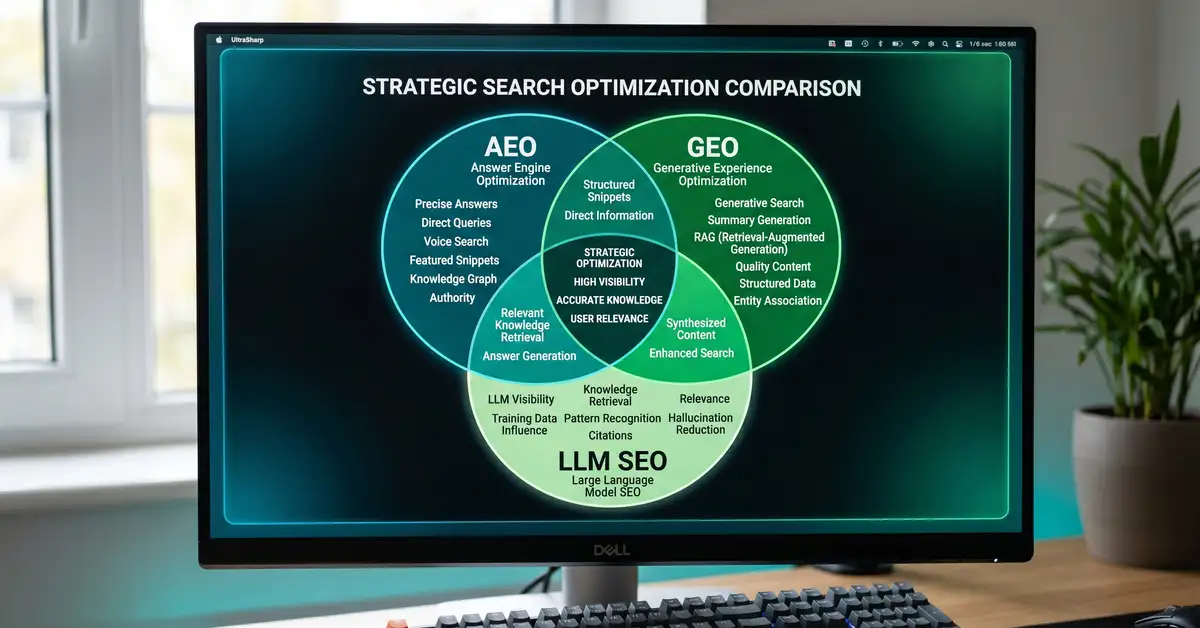
Here is the honest truth that vendors rarely state plainly: these terms heavily overlap, and the industry has not settled on one. The real differences are differences of emphasis. AEO emphasises being the single cited answer to a question. GEO emphasises being referenced and recommended across generative output, including brand mentions that may not carry a link. LLM SEO emphasises the large language model as the target and the technical signals those models read. But all three are chasing the same outcome: your brand named when an AI responds.
| Term | Emphasis | Origin |
| SEO | Rank in the blue links | The original search discipline |
| AEO | Be the cited answer | Answer engines, featured snippets |
| GEO | Be referenced and recommended | 2023 academic paper |
| LLM SEO | Optimise for AI assistants | The practitioner community |
Sources: Aggarwal et al., Digital Marketing Institute, Ahrefs.
Notably, Google itself largely treats this as a continuation of SEO rather than a separate discipline, publishing guidance on optimising for its AI features rather than crowning a new acronym (Google Search Central, 2026). That is a useful anchor: whatever you call it, it is built on the same foundations as search. Our analysis of GEO vs SEO covers that continuity in depth.
Key Takeaway
AEO, GEO, and LLM SEO are not competing methods, they are overlapping vocabularies. Treat them as one practice with three accents. Arguing about which acronym is correct is a distraction from doing the work that wins under all of them.
What carries over from traditional SEO, and what is new
The good news is that most of your SEO foundation still applies. Quality content, genuine authority and experience, clean site structure, technical health, and schema markup all carry directly into the AI era, because AI engines draw on the same web and reward the same signals of credibility (Google, 2026). If your SEO house is in order, you are most of the way there.
What is new is the shape of success. In classic SEO you wanted a click. In the AI era you increasingly want a citation or a mention inside an answer, which the user may read without ever visiting your site, a zero-click outcome that rewards being the source rather than the destination (Search Engine Land, 2026). You are also optimising for retrieval, making it easy for a model to find, quote, and trust your content, not just for ranking. Brand mentions, even without a link, now carry weight.
Want to measure whether AI engines actually cite you?
See the AI search optimization toolsWhat actually works across all of them
Strip away the labels and the winning tactics converge to one short list. These work whether you call it AEO, GEO, or LLM SEO, because they all make your content easier for an AI to find, quote, and trust.

Lead with clear, direct answers to the real questions your buyers ask, placed high on the page. Include statistics and quotations, the two levers the original GEO research found most effective at earning citations. Use strong structure and headings so a model can parse your content cleanly, and add schema markup to make its meaning explicit. Build topical authority by covering a subject thoroughly rather than thinly, and earn third-party citations and brand mentions, because AI engines weigh what others say about you, not just what you say about yourself (Orbit Media, 2026). Do these six things and you are optimised for every acronym at once.
Key Takeaway
Clear answers, statistics, structure, schema, topical authority, and third-party mentions. That single list is the practical core of AEO, GEO, and LLM SEO combined. Master it and the acronym you choose stops mattering.
Your AI search checklist, in order
If you do nothing else, work through these four moves in sequence on your most important pages. They apply under every acronym and need no special tooling to start.
Answer the question first
Open each page with a clear, direct answer to the exact question a buyer would ask. Make it quotable in one or two sentences, before any preamble.
Add proof a model can cite
Back claims with specific statistics and named sources. These are the elements AI engines pull into answers, and the GEO research confirms they lift citations.
Structure for machines and add schema
Use clear headings, short sections, and FAQ blocks, then mark the page up with schema so a model understands what each part means.
Build authority and earn mentions
Cover the topic thoroughly to build topical authority, and earn third-party citations and brand mentions, which AI engines weigh heavily.
That checklist is the entire game in miniature. For the deeper definition of the underlying discipline, see what generative engine optimization is and why traditional SEO alone no longer covers AI search.
Which term should you actually use?
Pick one, internally, and get back to work. The label you use in your strategy deck has almost no effect on whether AI engines cite you. What matters is whether your content is genuinely citable. If your audience and peers say GEO, use GEO. If your stack and your team think in AEO, use AEO. If you are deep in the technical LLM optimisation world, LLM SEO is fine. The mistake is spending energy debating terminology that you could spend producing the statistics-rich, well-structured, authoritative content that wins under any name.

This is why we treat the whole space as one discipline at peppereffect. The terms will keep shifting as the engines evolve, but the underlying job, being the brand an AI recommends, will not. If you want that work done for you, our overview of generative engine optimization services explains the managed route, and our answer engine optimization strategy guide lays out the playbook.
Watch Out
Beware anyone selling AEO, GEO, or LLM SEO as a brand-new discipline that throws out everything you know about SEO. It is not. The foundations of quality, authority, and structure still carry the load, and a vendor who pretends otherwise is selling novelty, not results. The terms are new. The fundamentals are not.
Skip the acronym debate. Get cited by AI.
peppereffect architects the content, structure, schema, and authority that get B2B brands referenced and recommended by ChatGPT, Google AI Overviews, Perplexity, and the rest, whatever you call it. We build the system that makes you the answer, then keep you there.
Book a Growth Mapping Call
Frequently asked questions about AEO, GEO, and LLM SEO
What is the difference between AEO, GEO, and LLM SEO? They are three closely related names for optimising to be found and cited by AI rather than just ranked in links. AEO, answer engine optimization, emphasises being the cited answer. GEO, generative engine optimization, emphasises being referenced and recommended in generative output. LLM SEO emphasises optimising for large language model assistants specifically. The differences are of emphasis, and all three chase the same goal.
What is LLM SEO? LLM SEO, also called LLMO or AI SEO, is the practice of optimising your content so that large language model based assistants and search tools, such as ChatGPT, Gemini, and Perplexity, surface and cite your brand. It overlaps heavily with AEO and GEO and is associated with techniques like the llms.txt file. The term simply frames the work around the language model as the target.
Is GEO the same as AEO? They overlap so much that many practitioners use them interchangeably, but the emphasis differs slightly. AEO focuses on being the single cited answer to a query, often in a featured snippet or direct AI answer. GEO focuses on being referenced and recommended across generative output, including brand mentions. In practice, optimising well for one optimises you largely for the other.
Where did the term GEO come from? Generative engine optimization was introduced in a 2023 academic research paper by Aggarwal and colleagues. The paper studied how to increase a brand's visibility in generative AI answers and found that adding statistics, quotations, and citations to content measurably improved how often it was surfaced, which remains one of the most reliable GEO tactics.
Is AI search optimization just SEO? Largely, yes, and Google treats it that way, publishing guidance on optimising for AI features rather than declaring a separate discipline. The foundations of quality content, authority, structure, and schema carry directly into AI search. What is new is optimising for citation without a click and for brand mentions inside answers, but it builds on SEO rather than replacing it.
Which term should I use, AEO, GEO, or LLM SEO? Whichever your team and audience already use. The label has almost no effect on results, because AI engines respond to the quality and structure of your content, not to the acronym in your strategy. Pick one term, stay consistent, and put your energy into producing clear, statistics-rich, authoritative content that wins under all of them. AI search engine optimization AEO vs SEO
Resources
- Aggarwal et al.: GEO Research Paper: the origin of the term and the citation findings.
- Google Search Central: AI Optimization Guide: Google's official guidance.
- HubSpot: AEO Guide: answer engine optimization explained.
- Ahrefs: Generative Engine Optimization: a practitioner view of GEO.
- Yoast: LLM SEO and llms.txt: the LLM-specific framing.