

What Is GEO vs SEO and Why Does It Matter for B2B Growth?
Traditional search engine optimization is no longer the only path to organic visibility. Generative Engine Optimization (GEO) represents the architectural shift from ranking on page one of Google to being cited inside AI-generated answers from ChatGPT, Google AI Overviews, Perplexity, and Claude. For B2B companies scaling revenue without proportional headcount, understanding GEO vs SEO is the difference between building a compounding visibility asset and watching your traffic erode quarter over quarter.
The numbers make the urgency clear. Gartner predicts traditional search engine volume will drop 25% by 2026 as AI chatbots and virtual agents replace conventional queries. Meanwhile, AI-referred sessions have surged 527% year-over-year according to Semrush's analysis of GA4 properties. BrightEdge data shows AI Overviews now trigger on 48% of all Google searches, up from 31% just twelve months earlier. The transition from search to answer engine optimization is accelerating faster than most marketing teams can adapt.
For B2B executives like SaaS CEOs targeting $50M ARR without scaling headcount, the competitive moat isn't who ranks first anymore. It is who gets cited first by the AI systems that increasingly mediate buyer research. This guide breaks down exactly how GEO differs from SEO, why it creates compounding competitive advantage, and how to architect your content infrastructure for the generative engine optimization era.
What you will learn in this article:
- The fundamental architectural differences between GEO and traditional SEO
- Why AI search engines are restructuring B2B buyer behavior and deal velocity
- The specific content attributes that make your pages citable by AI systems
- A step-by-step GEO strategy framework that compounds competitive advantage
- Which metrics to track when measuring generative engine optimization performance
- How early GEO adoption creates a defensive moat that competitors cannot replicate quickly
Key Takeaway
GEO vs SEO is not an either/or decision. GEO builds on top of strong SEO fundamentals but adds a new optimization layer focused on AI citability, structured data authority, and entity recognition. Companies that architect for both simultaneously will capture traffic from traditional search and citations from AI engines, while competitors optimizing for only one channel lose ground on the other.

How Is Generative Engine Optimization Different from Traditional SEO?
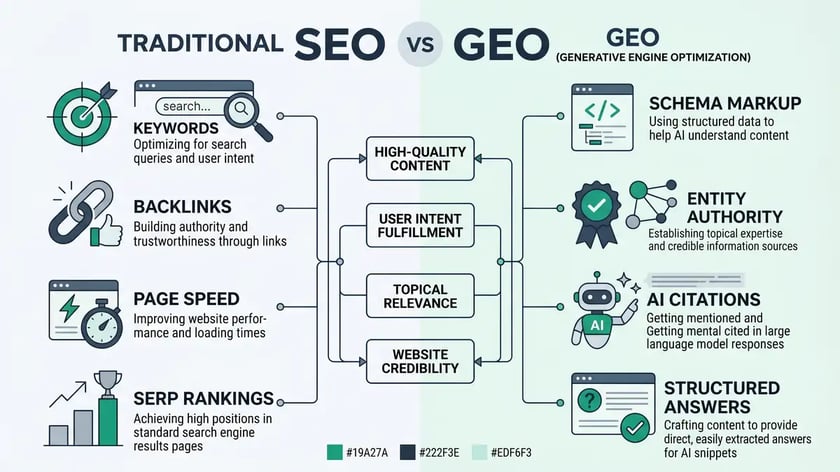
SEO optimizes for ranking algorithms. GEO optimizes for citation algorithms. That single distinction reshapes everything from content structure to success measurement. In traditional SEO, you compete for position on a search engine results page (SERP). In GEO, you compete for inclusion in a synthesized answer that may never show a traditional results page at all.
Traditional SEO operates on a click-through model: your page ranks, a user clicks, and you capture that visit. GEO operates on a citation model: an AI system retrieves your content, synthesizes it into an answer, and may or may not link back to your source. The optimization for AI search requires fundamentally different content architecture than what worked for Google's PageRank-era algorithms.

The retrieval mechanism matters. AI systems use Retrieval-Augmented Generation (RAG) to pull relevant content chunks from their index, evaluate authority and relevance, then synthesize answers. Your content must be structured so that AI crawlers can parse it efficiently, extract discrete claims, and attribute those claims back to your domain. This means clear hierarchical headings, explicit data points with sources, structured markup, and unambiguous entity relationships.
Consider the practical difference: a traditional SEO strategy might target the keyword "B2B lead generation" with a 2,000-word guide optimized for search intent. A GEO strategy targets the same topic but structures the content so that when ChatGPT or Perplexity answers "What are the most effective B2B lead generation strategies?", your framework and data points appear as cited sources in the response. The content serves both purposes when architected correctly, but the AEO best practices layer adds citation-ready structure that pure SEO misses.
| Dimension | Traditional SEO | Generative Engine Optimization |
| Primary goal | Rank on SERP page 1 | Get cited in AI-generated answers |
| Success metric | Rankings, organic clicks, CTR | Citations, brand mentions, AI referral traffic |
| Content model | Keyword-optimized pages | Citation-ready structured content |
| Discovery mechanism | Googlebot crawl + PageRank | RAG retrieval + authority scoring |
| User experience | Click to visit your page | See your data in synthesized answer |
| Competitive moat | Backlinks, domain authority | Entity authority, structured data, citation frequency |
| Time to compound | 6-12 months for authority | 3-6 months for citation momentum |
Source: Semrush AI SEO Statistics 2026, BrightEdge AI Overviews One-Year Analysis
Why Are AI Search Engines Reshaping B2B Buyer Behavior?
B2B buyers no longer start their research on Google. Forrester's 2026 B2B predictions report found that 61% of purchase influencers now use private generative AI engines to support purchasing decisions. Half of B2B software buyers begin their research in AI chatbots before ever touching a traditional search engine. This behavioral shift means that if your content is not citable by AI systems, you are invisible during the most critical phase of the buyer journey.
The conversion data reinforces the urgency. Opollo's 2026 AI Search Benchmark Report shows AI-referred visitors in B2B technology convert at 14.2% compared to 2.8% for traditional organic traffic, a 5x conversion premium. This makes sense: buyers arriving via AI citations have already received a pre-qualified recommendation. The AI system has effectively done the first round of vendor evaluation for them, positioning cited brands as trusted authorities.
The zero-click trend amplifies this shift. Bain & Company reports that 60% of Google searches now end without a click, and that number reaches 93% in Google's AI Mode. Organic CTR has dropped 61% for queries where AI Overviews appear. For B2B companies relying on organic search as their primary lead generation channel, this represents a structural threat to pipeline volume.
Avoid This Mistake
Do not treat GEO as a replacement for SEO. Companies that abandon traditional SEO fundamentals to chase AI citations lose their authority signals, which are precisely what AI systems use to determine citation worthiness. GEO without SEO is building on sand. The correct architecture layers GEO optimization on top of a strong SEO foundation.

What Makes Content Citable by AI Systems?
AI citation is not random. It follows predictable patterns that can be engineered. Research across multiple studies reveals specific content attributes that dramatically increase citation probability. Understanding these attributes transforms GEO from guesswork into systematic architecture.

Structured data is the foundation. Pages with FAQPage schema markup are 3.2x more likely to appear in Google AI Overviews. Attribute-rich schema earns a 61.7% citation rate, while generic or minimally populated schema actually underperforms having no schema at all. This means implementation quality matters as much as implementation itself. Your structured content architecture for AI discovery must be comprehensive, specific, and semantically accurate.
Content freshness drives citation preference. Analysis shows that 50% of content cited by AI systems was published within the last 13 weeks. AI engines favor recency because they aim to provide the most current information to users. This creates a structural advantage for companies with active content production pipelines and a systematic disadvantage for those relying on evergreen content that was last updated months ago.
Explicit data points with clear attribution increase citation probability. AI systems prefer content that contains specific, quantified claims tied to identifiable sources. Vague statements like "many companies report improved results" are less citable than "B2B SaaS companies using agentic workflows report 3.2x faster deal velocity (Gartner, 2025)." Every data point in your content should be structured as a discrete, extractable claim.
Implement Comprehensive Schema Markup
Deploy FAQPage, HowTo, Article, and Organization schema with attribute-rich properties. Every entity on your page should be machine-readable. Use JSON-LD format and validate with Google's Rich Results Test. Remember: minimally populated schema performs worse than no schema, so go deep or skip it.
Structure Content for RAG Retrieval
Use clear H2/H3 hierarchies that match natural language questions. Each section should contain one discrete, complete answer that can be extracted independently. AI systems retrieve content chunks, not full pages, so every section must stand alone as a citable unit.
Embed Quantified Claims with Source Attribution
Replace qualitative statements with specific data points. Cite your sources explicitly within the text. AI systems extract these claims and attribute them back to your domain, building your entity authority across repeated citations.
Maintain a 13-Week Content Freshness Cycle
Publish new content and refresh existing pages on a cycle that keeps your most important content within the 13-week freshness window. Deploy a content marketing infrastructure that produces at a cadence AI systems reward.
Allow AI Crawler Access
Ensure your robots.txt permits GPTBot, ClaudeBot, PerplexityBot, and other AI crawlers. Blocked crawlers cannot index your content for citation. Review your access rules quarterly as new AI systems launch their own crawlers.
Ready to architect your content infrastructure for AI citation? Explore peppereffect's Lead Generation systems engineered for the generative search era.
See Our ApproachHow Do You Build a GEO Strategy That Compounds Over Time?
The compounding effect of GEO is what makes it a genuine competitive moat. Unlike paid advertising where visibility stops the moment you stop spending, GEO creates a citation reinforcement loop. When an AI system cites your content, it signals authority to other AI systems. As your citation frequency increases, your content becomes the default reference for your topic cluster, making it progressively harder for competitors to displace you.
This mirrors the link-building compounding effect in traditional SEO but operates at a faster cycle. While SEO authority takes 6-12 months to build meaningfully, GEO citation momentum can establish within 3-6 months for companies that deploy structured content at sufficient volume and quality. The key is that AI systems re-index and re-evaluate far more frequently than Google's traditional crawl cycle.
Building a compounding GEO strategy requires three interconnected systems. First, a content production engine that publishes structured, citation-ready content at a cadence of 8-12 articles per month targeting your core topic clusters. Second, a schema infrastructure that makes every piece of content machine-readable with comprehensive structured data. Third, an entity authority framework that consistently reinforces your brand as the authoritative source for specific topics through cross-platform presence, consistent nomenclature, and expert attribution.
The practical execution looks like this: identify the 20-30 questions your ideal buyers ask AI chatbots during their research phase. Create definitive, data-rich answers for each question, structured with clear headings, explicit data points, and comprehensive schema. Publish these systematically, interlink them to build topical authority, and refresh them on a 13-week cycle. Within two quarters, your content begins appearing as the cited source across multiple AI platforms, creating a systematic answer engine optimization strategy that compounds with every new publication.
Key Takeaway
GEO creates a citation reinforcement loop that makes early movers progressively harder to displace. The cost of waiting is not just missed traffic. It is ceding the citation default position to competitors who will be significantly more expensive to unseat once established. For B2B companies, this directly impacts pipeline generation and deal velocity.
What Metrics Should You Track for GEO Performance?
Traditional SEO metrics are necessary but insufficient for measuring GEO success. Rankings and organic clicks still matter, but they capture only half the picture. GEO introduces a new measurement layer focused on AI visibility, citation frequency, and referral quality that most analytics stacks are not yet configured to capture.
The primary GEO metrics fall into three categories: visibility metrics (how often your brand appears in AI-generated answers), traffic metrics (how many visitors arrive via AI referral channels), and conversion metrics (how AI-referred visitors perform compared to other channels). The conversion premium is substantial: AI-referred B2B visitors convert at 14.2% vs 2.8% for organic, making AI referral traffic the highest-converting organic channel available.
| Metric Category | What to Track | Benchmark | Tool |
| AI Visibility | Brand citations in AI answers | 10+ citations/month for primary topics | BrightEdge, Semrush Copilot |
| AI Referral Traffic | Sessions from ChatGPT, Perplexity, Claude | 5-15% of organic traffic within 6 months | GA4 (referrer filtering) |
| Citation Rate | % of target queries where you are cited | 20-30% for core topic cluster | Manual audits + AEO tools |
| Conversion Premium | AI referral conversion vs organic conversion | 3-5x higher conversion rate | GA4 attribution |
| Schema Coverage | % of pages with valid structured data | 100% of blog + service pages | Google Search Console |
| Content Freshness | % of content updated within 13 weeks | 80%+ of core topic pages | CMS audit |
| Entity Authority | Knowledge panel presence, consistent NAP | Active knowledge panel for brand | Google Knowledge Graph API |
Source: Opollo 2026 AI Search Benchmark Report, Contentsquare AI Referred Traffic Benchmarks 2026
To configure AI referral tracking in GA4, create a custom channel group that captures referrals from chatgpt.com, perplexity.ai, claude.ai, and other AI platforms. Most B2B companies currently have no visibility into this traffic because it is bucketed as "referral" traffic alongside every other external link. Isolating AI referrals into their own channel reveals the true growth trajectory and conversion performance of your GEO investment.
How Does GEO Create a Competitive Moat for B2B Companies?
The moat mechanics of GEO differ fundamentally from SEO. In traditional SEO, a competitor can eventually outrank you by building more backlinks, producing more content, or improving technical performance. The moat is real but permeable. In GEO, the moat is built on citation default status, which is significantly harder to dislodge because AI systems develop preference patterns based on historical citation reliability.
When an AI system consistently cites your content for a given topic and the users who receive those citations provide positive feedback signals, you create a self-reinforcing cycle. The AI system learns that your content produces good outcomes and increases its citation probability for related queries. This is analogous to how Google's algorithm rewarded early domain authority, but it operates on a faster feedback loop because AI systems update their retrieval preferences more frequently than Google's core algorithm updates.
For B2B companies specifically, the GEO moat creates three compounding advantages. First, pipeline acceleration: buyers who encounter your brand through AI citations arrive pre-qualified, reducing the sales cycle. Second, brand authority amplification: every citation reinforces your positioning as the definitive source, building the kind of recognition that traditional SEO for B2B companies takes years to establish. Third, competitive displacement cost: once you hold citation default position, a competitor must invest significantly more to unseat you than it would have cost them to establish position simultaneously.
The window for establishing this moat is narrowing. As more companies recognize the GEO opportunity, the cost of catching up increases exponentially. First movers in GEO enjoy advantages that mirror what early adopters of content marketing experienced in 2010-2015: those who invested early built authority positions that latecomers spent years and millions trying to replicate. The same dynamic is unfolding now with agentic marketing and AI-optimized content infrastructure.
Key Takeaway
GEO creates a competitive moat through citation default status, which is harder to dislodge than traditional SEO rankings. The cost of establishing this moat increases with every month of delay, as early movers build citation momentum that compounds. B2B companies that treat GEO as a 2027 initiative will find themselves facing a multi-year catch-up against competitors who started in 2026.
Architect Your AI Visibility Infrastructure
peppereffect installs the content operating system that makes your B2B company citable by ChatGPT, Google AI Overviews, and Perplexity. We engineer the structured content architecture, schema infrastructure, and publication cadence that builds citation default status for your core topics.
Book Your Growth Mapping CallRead Our Complete GEO Guide →
Frequently Asked Questions
Is GEO replacing SEO?
No. GEO builds on top of SEO fundamentals rather than replacing them. Traditional SEO signals like domain authority, backlinks, and technical performance are precisely what AI systems use to evaluate citation worthiness. The correct approach is to layer generative engine optimization on top of a strong SEO foundation. Companies that abandon SEO for GEO lose the authority signals that make their content citable in the first place.
How long does it take to see results from GEO?
Most B2B companies begin seeing AI citations within 8-12 weeks of implementing structured content with comprehensive schema markup. Citation momentum compounds over time, with significant traffic volume typically appearing by month 4-6. The key accelerator is publication cadence. Companies publishing 8-12 structured articles per month see faster citation establishment than those publishing 2-4 per month, because AI systems reward topical coverage depth.
What is the difference between GEO and AEO?
GEO (Generative Engine Optimization) and AEO (Answer Engine Optimization) are closely related but have different scopes. AEO focuses specifically on optimizing content to appear in answer boxes, featured snippets, and AI-generated answer panels. GEO is broader, encompassing the full strategy of making your content citable across all generative AI platforms including ChatGPT, Perplexity, Claude, and Google AI Overviews. Think of AEO as a subset of GEO focused on the answer delivery mechanism.
Does GEO work for all B2B industries?
GEO is particularly effective for B2B industries where buyers conduct extensive research before purchasing, including SaaS, professional services, consulting, and technology. BrightEdge data shows B2B Technology queries trigger AI Overviews on 82% of searches, making it one of the highest-impact verticals for GEO. Industries with complex, information-rich buying cycles benefit most because buyers are already using AI tools to synthesize vendor comparisons and solution evaluations.
How do I check if my content is being cited by AI?
Start by manually querying your core topics in ChatGPT, Perplexity, and Google AI Overviews, then checking whether your brand or content appears in the responses. For systematic tracking, configure GA4 to isolate AI referral traffic from chatgpt.com, perplexity.ai, and claude.ai as a custom channel group. Tools like BrightEdge and Semrush are developing AI citation tracking features. Additionally, monitor your AI search visibility through regular citation audits of your top 20-30 target queries.
What role does schema markup play in GEO?
Schema markup is foundational to GEO success. Pages with FAQPage schema are 3.2x more likely to appear in AI Overviews, and attribute-rich schema earns a 61.7% citation rate. However, implementation quality matters significantly. Generic or minimally populated schema actually performs worse than no schema at all. Deploy comprehensive JSON-LD markup with complete property values for Article, FAQPage, Organization, and HowTo schemas across all content pages.
Can small B2B companies compete with larger competitors on GEO?
Yes, and this is one of GEO's most significant advantages. AI systems evaluate content quality and topical authority at the page and entity level, not just the domain level. A 50-person SaaS company with deeply authoritative content on a specific topic cluster can achieve citation default status ahead of a Fortune 500 competitor with shallow coverage. The key is niche depth: own a specific topic cluster with comprehensive, structured, data-rich content rather than trying to cover everything broadly. tools to measure AI search visibility AEO, GEO, and LLM SEO explained AI search engine optimization
Resources
- Gartner Predicts Search Engine Volume Will Drop 25% by 2026
- Semrush AI SEO Statistics 2026
- BrightEdge AI Overviews One-Year Analysis
- Opollo 2026 AI Search Benchmark Report
- Forrester 2026 B2B Marketing and Sales Predictions
- Bain & Company: Zero-Click Search Redefines Marketing
- SERPs.io: How AI Overviews Are Impacting Click-Through Rates
- Frase: FAQ Schema for AI Search and GEO