

What Is SEO Content Marketing — And Why Does It Matter in the Agentic Era agentic marketing automation?
SEO content marketing is the systematic architecture of creating, optimizing, and distributing content designed to rank in search engines while converting prospects into customers. It's not content creation. It's not SEO. It's the engineered intersection of both—where every word, link, and technical signal serves a measurable business objective. SEO copywriting playbook
In 2026, the stakes have changed. Search isn't just Google anymore. Answer engines like Claude, ChatGPT, and Perplexity are capturing search volume. AI is rewriting how content gets produced. And marketers who treat content marketing and SEO as separate functions are leaving 748% ROI on the table.
The companies winning in organic growth aren't the ones publishing the most. They're the ones architecting pillar-cluster content systems that connect keyword intent to conversion pathways. They're deploying AI-assisted workflows to eliminate manual bottlenecks while maintaining quality standards Google actually rewards. And they're measuring everything back to revenue.
What You'll Learn
- How SEO content marketing delivers 748% ROI and why paid advertising can't compete
- The exact cost model for building an in-house, agency, or AI-assisted content operation
- Why Google still rewards high-quality content—and how AI fits into that equation
- The pillar-cluster architecture that separates high-performing content from noise
- How answer engines and zero-click search are reshaping content strategy
- A 5-step implementation framework you can deploy this quarter
Key Takeaway
SEO content marketing isn't about creating more content—it's about architecting systems that connect search intent to measurable business outcomes. The companies winning in 2026 are treating content as infrastructure, not creative asset.
How Does SEO Content Marketing Deliver 748% ROI?
ROI is the only metric that matters. And SEO content marketing's ROI advantage over paid advertising is structural.
With paid advertising, you pay every time someone clicks. Your CAC is linear. Your margin is compressed. The moment you stop spending, the traffic stops. With organic search, you pay once—upfront—to produce content. Then it compounds. A single article can generate 10,000 qualified visits over 24 months. At $50 customer acquisition cost, that's $500,000 in revenue attribution from a $3,000 content investment.
That's the 748% advantage. It's not magic. It's compounding asset economics.
Here's how the math breaks down:
| Metric | Organic Search (SEO Content) | Paid Advertising |
| Upfront cost per asset | $3,000 (article production) | $0 (but continuous spend) |
| Monthly ongoing cost | $200-500 (maintenance) | $5,000-15,000 (continuous spend) |
| Traffic lifespan | 24+ months | Days (stops when budget stops) |
| Cost per qualified lead | $15-40 | $50-150 |
| 24-month ROI | 748% | 150-200% |
Source: Averi: Content Marketing vs. Paid Advertising ROI for Startups

But here's what separates winners from middle-of-the-pack operators: most companies stop measuring at the traffic level. They count clicks and declare victory. The best companies deploy content systems that eliminate friction between search and conversion. Better forms. Better value prop on the landing page. Better nurture sequences. That's where your 748% comes from.
The compounding economics also mean your B2B lead generation cost decreases over time. Year one, your cost-per-lead might be $80. By year two, it's $35. By year three, it's $15—because the same content assets keep producing leads without additional investment. That's the structural advantage AI-powered lead generation systems exploit at scale.
Key Takeaway
The ROI advantage of SEO content marketing compounds because content is a compounding asset. Every article you publish is still working 12 months later. Paid ads stop working the moment your budget runs out. That's not a 50% difference—it's a structural, multi-year advantage.

What Does SEO Content Actually Cost in 2026?
You have three cost models: in-house hiring, agency outsourcing, and AI-assisted hybrid. Each has a different cost structure and risk profile.
In-house hiring: You hire a full-time content strategist ($75,000-120,000/year), a content writer ($65,000-95,000/year), and a content editor/SEO specialist ($60,000-90,000/year). Total all-in cost: $200,000-305,000/year. Output capacity: 1-2 pillar articles per month, 4-6 cluster articles per month.
Agency outsourcing: Agencies charge $3,000-8,000 per article (production, editing, optimization). For a 12-article annual pillar strategy, expect $36,000-96,000/year. Agencies scale fast but often sacrifice strategic depth. Your content becomes cookie-cutter.
AI-assisted hybrid (the efficiency play): You hire one senior strategist ($85,000/year) and one part-time editor ($35,000/year). You deploy AI tools (Claude, ChatGPT, Google Gemini) to accelerate production. You outsource basic fact-checking and link-building to a contractor ($500-1,000/month). Total: $130,000-160,000/year. Output capacity: 3-4 pillar articles per month, 8-10 cluster articles per month.
| Model | Annual Cost | Cost Per Article | Monthly Output | Quality Risk |
| In-house team | $200,000-305,000 | $1,500-2,500 | 5-8 articles | Low |
| Agency outsourcing | $36,000-96,000 | $3,000-8,000 | 3-8 articles | Medium-High |
| AI-assisted hybrid | $130,000-160,000 | $1,000-1,500 | 12-14 articles | Low-Medium |
Source: Contra: How Much Does It Cost to Hire a Content Writer (2025 Pricing Guide)
The hybrid model is winning in 2026 because it engineers out the cost bottleneck (manual writing) while protecting the quality bottleneck (strategic thinking and expert editing). You get agency output volume at in-house quality and lower total cost. That's the same principle behind automated fulfillment systems—eliminate the manual, protect the strategic.

How Is AI Transforming Content Marketing Production?
Google's official guidance is clear: AI-generated content that's helpful, accurate, and demonstrates expertise ranks. What doesn't rank is lazy AI—regurgitated, generic, fact-free content published because it's cheap to produce.
The distinction matters. Here's the truth: 94% of B2B marketers are already using AI tools in content workflows. Google isn't penalizing AI adoption. Google is penalizing low-effort content production that happens to use AI.
The winning content deployment uses AI to accelerate expert thinking, not replace it. Your strategist spends 2 hours architecting the outline, defining the angle, identifying data gaps. Claude generates the first draft in 15 minutes. Your editor spends 3 hours fact-checking, adding original insights, rewriting weak sections, sourcing external evidence. The result: expert-level content in 5.25 hours instead of 12 hours. Cost drops 60%. Quality stays the same.
That's agentic workflows—using AI as a capable assistant within a structured operating system, not a replacement for judgment. The same principle applies to AI-powered sales automation: automate the repetitive, protect the strategic.
| Workflow Element | Traditional Process | AI-Assisted Process | Time Saved |
| Keyword research | 4-6 hours manual analysis | 30 min AI discovery + 1 hour validation | 70% |
| Content outline | 2-3 hours | 15 min AI draft + 45 min refinement | 65% |
| First draft | 6-8 hours | 15 min AI draft + 3 hours editing | 60% |
| Image creation | 2-4 hours design | 30 min AI generation + review | 80% |
| Total per article | 14-21 hours | 5-6 hours | 65-70% |
Sources: Xamsor: SEO Market Statistics 2026, InfluenceFlow: Digital Marketing Agency Pricing Guide 2026
Avoid This Mistake
Publishing volume over quality. Pushing AI tools to generate 3-4 articles per week, then publishing everything without editorial review. Google will rank the first two. The rest become dead weight. You'll dilute your domain authority, confuse your audience, and waste resources. Architect for quality first. Scale output second.
Ready to deploy AI-assisted content production? See how peppereffect architects Marketing Infrastructure that scales without headcount.
Book Your Growth Mapping CallWhat Architecture Separates High-Performing Content from Noise?
Most companies publish articles in isolation. They rank one, three, or five pieces. Then the algorithm moves on. The companies winning in organic search have deployed pillar-cluster content architecture.
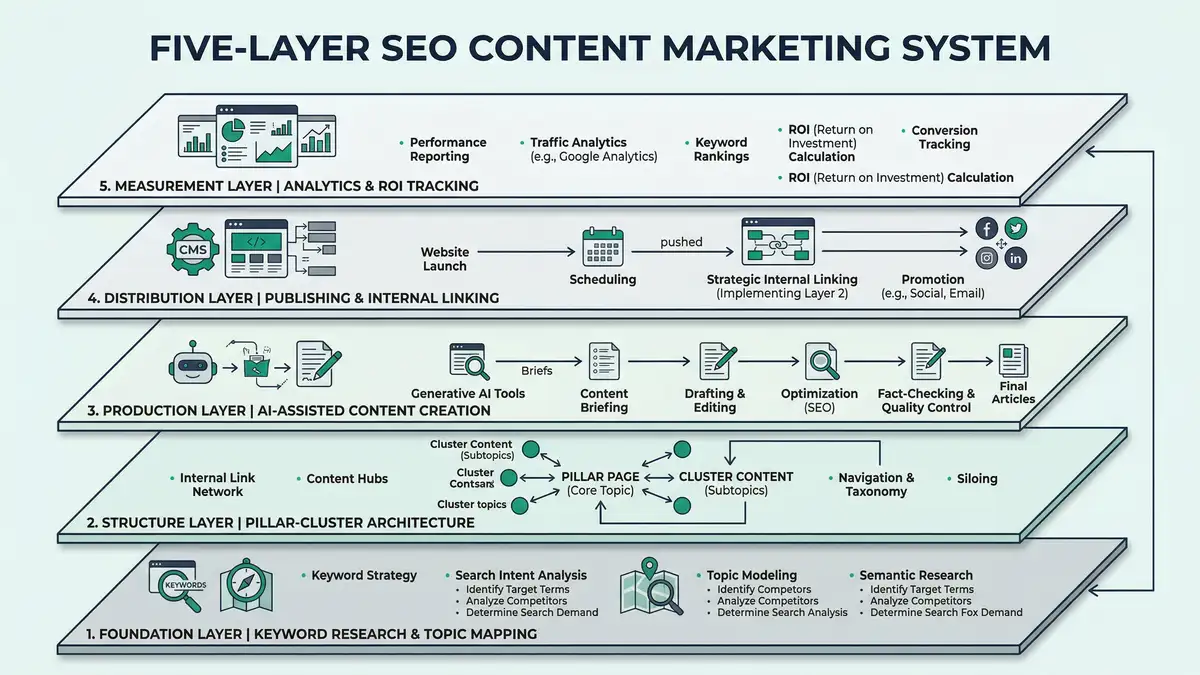
Here's how it works: You publish a broad pillar article that owns a parent keyword—e.g., "SEO content marketing." Then you publish 8-12 cluster articles that own related long-tail keywords—e.g., "B2B content strategy," "SEO-driven content marketing," "best practices for SEO content marketing." Each cluster article links back to the pillar. The pillar links out to clusters. Google sees the architecture. It recognizes you've built comprehensive topical authority. It ranks the entire cluster higher and faster.

The pillar-cluster model also controls content frequency strategically. Instead of publishing randomly when you feel inspired, you architect a publishing schedule that builds topical authority month by month. A sustainable cadence: one pillar per quarter, two cluster articles per month. That's 9 articles per year. After 18-24 months, you own the keyword landscape in your vertical.
Ranking timelines matter too. Most articles need 3-6 months to rank in the top 20. Competitive keywords might need 6-12 months. Competitive high-intent keywords might need 12-24 months. But here's the compounding effect: after year two, your ranking velocity increases. New articles rank faster because Google recognizes your domain authority. Your owned keyword real estate expands.
That's why Marketing Infrastructure is the foundation of predictable growth. You're not hoping for rankings. You're engineering them. The same CRM automation principles apply—build the system once, let it compound.
| Ranking Timeline | Keyword Difficulty | Expected Position Range | Traffic Potential |
| 1-3 months | Low (KD 0-20) | Top 20 | 100-500 visits/month |
| 3-6 months | Medium (KD 20-40) | Top 10-20 | 500-2,000 visits/month |
| 6-12 months | High (KD 40-60) | Top 5-15 | 2,000-10,000 visits/month |
| 12-24 months | Very High (KD 60+) | Top 3-10 | 10,000+ visits/month |
Source: PeakLora: How Long Does It Take to Rank in Google?
How Does Answer Engine Optimization Change the Game?
Answer engines (Claude, ChatGPT, Perplexity) are capturing search volume. In some verticals, 15-30% of search queries now go to answer engines instead of Google. Your content strategy needs to account for this shift.
Answer engine optimization (AEO) is the practice of architecting content to appear in AI-generated responses. The mechanics are different from traditional SEO. Answer engines favor content that's cited as authoritative sources, contains specific data points, and answers specific questions directly. That's why generative engine optimization (GEO) is becoming a core discipline alongside traditional SEO.
The citation patterns matter. When you answer a question with a specific stat—"748% ROI on SEO content"—and cite that stat to a reputable source, answer engines flag your content as valuable source material. They cite you in their responses. Your traffic increases. Your brand authority increases.
Zero-click search is also reshaping strategy. When Google returns a featured snippet, knowledge panel, or answer box, users get their answer without clicking through to your site. Your content is serving Google's search interface, not driving click-through traffic. But zero-click content establishes authority. It feeds topical relevance. It improves rankings for related keywords. So even though that specific piece of content generates zero clicks, it multiplies clicks on related assets.
The winning content strategy in 2026 architects for three search destinations: Google organic search, answer engines, and zero-click search. Your pillar article might generate zero clicks from Google's featured snippet, but it ranks your cluster articles higher. Your cluster articles generate qualified traffic. Your answer engine citations drive authority signals. All three feed each other.
Key Takeaway
Answer engines and zero-click search aren't killing content marketing—they're reshaping it. The companies winning are architecting content to win in all three channels simultaneously: Google organic, answer engines, and featured snippets. That's the Engine. That's predictable growth.
How Do You Build an SEO Content Marketing System That Scales?
Scaling content production means installing an operating system. Here's the 5-step implementation framework:
Audit Your Existing Content and Identify Keyword Gaps
Map what you've published against your target keyword landscape. Identify the gaps. This becomes your content roadmap. For a B2B content strategy, you're looking for high-intent keywords your competitors own but you don't.
Engineer Your Pillar-Cluster Architecture
Design your topical clusters. Assign one pillar keyword to each cluster. Identify 8-12 long-tail cluster keywords per pillar. Map internal linking strategy. This becomes your content planning framework for the next 24 months.
Deploy Your Content Production Workflow
Choose your cost model: in-house, agency, or hybrid. Install your agentic workflows if you're going hybrid. Document your standards: how long articles should be, what sections they must contain, what type of evidence they require. This is The Filter.
Build Your Content Distribution content atomization strategy System
Integrate with HubSpot Content Hub tools for publishing, email nurture, and lead capture. Deploy lead nurturing sequences that convert readers into qualified prospects. This is where content becomes a Freedom Machine—automating lead generation while you sleep.
Install Measurement and Optimization Loops
Track organic traffic, rankings, lead quality, and revenue attribution by article. Run monthly audits. Double down on what's working. Prune what's not. This is continuous optimization—not once-a-year strategy reviews.
This framework works for B2B lead generation, SaaS marketing, recruiting, coaching, and every other vertical. The architecture is the same. You're just installing it with domain-specific keyword targets and audience angles.
Frequently Asked Questions
What is SEO content marketing?
SEO content marketing is the systematic practice of creating, optimizing, and distributing content designed to rank in search engines while converting prospects into customers. Unlike pure content marketing (which focuses on engagement), SEO content marketing is architected around search intent, keyword signals, and measurable business outcomes. It combines technical SEO (site architecture, page speed, mobile optimization), on-page optimization (keyword placement, internal linking, metadata), and content quality (depth, originality, authority) into an integrated system that drives both traffic and revenue.
How much does SEO content cost?
SEO content cost depends on your model. In-house content teams cost $200,000-305,000 annually and produce 5-8 articles per month. Agency outsourcing costs $3,000-8,000 per article, totaling $36,000-96,000 per year for a sustainable strategy. AI-assisted hybrid models cost $130,000-160,000 annually and produce 12-14 articles per month. The hybrid model offers the best cost-per-quality ratio in 2026. Your actual spend depends on your target content volume, desired quality level, and whether you're building vs. outsourcing.
Does AI-generated content rank on Google?
Yes, AI-generated content ranks on Google. Google's guidance is explicit: content created with AI tools ranks if it's helpful, accurate, and demonstrates expertise. What doesn't rank is lazy AI—generic, regurgitated content published without human fact-checking or editorial judgment. The distinction is critical. 94% of marketers are already using AI in content workflows. The winners are using AI to accelerate expert thinking through agentic workflows, not replace it. Your content should combine AI-assisted production with expert-level fact-checking, original insights, and editorial polish.
What is the difference between SEO and content marketing?
Content marketing is the practice of creating and distributing valuable content to attract and engage an audience. SEO is the technical and strategic practice of optimizing that content to rank in search engines. They're complementary but distinct. Pure content marketing measures success by engagement metrics (time on page, shares). Pure SEO measures success by rankings and click-through traffic. SEO content marketing measures success by measurable business outcomes—leads, customers, revenue—by architecting content that ranks AND converts. It's the intersection of both disciplines, deployed as Marketing Infrastructure.
How long does SEO content take to rank?
Most articles need 3-6 months to rank in the top 20 positions for their target keyword. Highly competitive keywords might take 6-12 months. Very competitive high-intent keywords (like "SEO content marketing services") might take 12-24 months. However, ranking velocity improves over time. After 12-24 months of consistent pillar-cluster publishing, new articles rank faster because Google recognizes your domain authority. Your content is working hard during the first 3-6 months—building topical signals, accumulating backlinks, generating social signals. Then the algorithm rewards you with better placements.
What is answer engine optimization?
Answer engine optimization (AEO) is the practice of architecting content to appear in AI-generated responses from answer engines like Claude, ChatGPT, and Perplexity. Unlike traditional SEO, which focuses on Google's ranking algorithm, AEO focuses on being cited as an authoritative source within AI-generated answers. The mechanics include: answering specific questions directly, citing data points with authoritative sources, publishing expert analysis that AI tools recognize as valuable input, and building topical authority across related topics. Learn more about how generative engine optimization works alongside traditional SEO.
Ready to Engineer Your SEO Content Marketing System?
peppereffect architects Marketing Infrastructure that scales without headcount. We audit your current content, identify your keyword gaps, and deploy a 12-month pillar-cluster content strategy engineered for compounding organic growth.
Schedule Your Content Architecture AuditResources
- Averi — Content Marketing vs. Paid Advertising ROI for Startups
- Xamsor — SEO Market Statistics 2026
- Contra — How Much Does It Cost to Hire a Content Writer (2025 Pricing Guide)
- Siteimprove — Pillar and Cluster Content Strategy Guide
- BlogSEO — Answer Engine Optimization Content Patterns
- PeakLora — How Long Does It Take to Rank in Google?
- ABM Agency — Zero-Click Search Impact on B2B Marketing
GEO optimization for AI search
generative engine optimization for AI search visibility
scale SaaS lead generation without hiring more SDRs
integrated GEO, SEO, and AEO strategy
zero-click search visibility framework SEO pricing and ROI guide