

What Does Scalable SaaS Lead Generatio lifetime value to CAC ration Actually Look Like in 2026?
The traditional playbook for B2B SaaS lead generation follows a predictable formula: hire more Sales Development Representatives, increase outbound activity, and hope that pipeline volume scales with headcount. But the economics of that model have fundamentally shifted. A fully-loaded SDR now costs £60,000–£70,000 annually when you account for salary, benefits, tools, training, and management overhead — yet median performers generate just 8–10 qualified meetings per month. Meanwhile, annual SDR turnover exceeds 39%, with each departure costing approximately £65,000 in replacement costs. pricing framework
For mid-market SaaS companies targeting £10M–£40M ARR, this creates a structural problem: your lead generation engine scales linearly with headcount, but your growth ambitions require exponential leverage. The companies winning in 2026 are those building automated lead generation systems that decouple pipeline growth from proportional hiring — deploying content engines, AI-augmented prospecting, and product-led motions that compound over time rather than reset with every departing SDR.
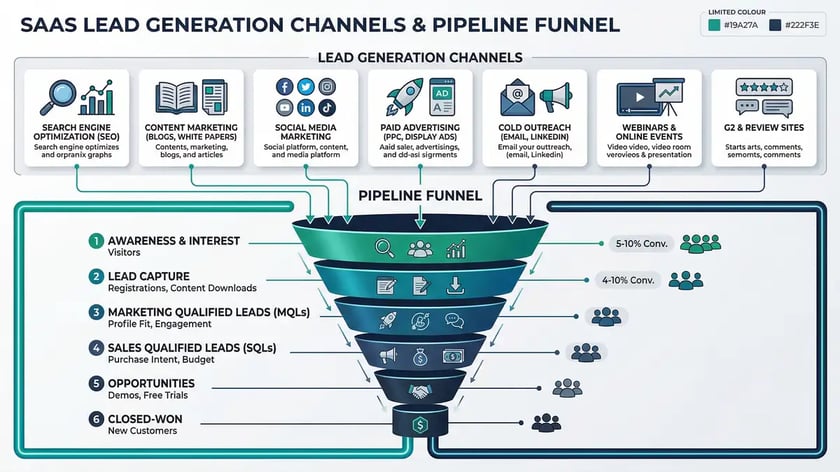
The data supports a decisive pivot. Inbound leads convert at 70–80% versus outbound's 5–10%. Content marketing delivers 702–844% three-year ROI. And the AI SDR market is expanding from $4.12 billion to $15.01 billion by 2030, signalling that the industry has decisively moved beyond the hire-more-reps paradigm.
What you'll learn in this guide:
- The true cost of SDR-dependent growth and why the economics no longer work at scale
- Five alternative SaaS lead generation channels with benchmarked ROI data
- How AI agents are replacing core SDR functions at 40–50% lower cost
- A step-by-step framework for transitioning from headcount-driven to leverage-driven pipeline
- Channel-specific benchmarks for content, cold email, LinkedIn, and product-led growth
Key Takeaway
SaaS companies that shift from SDR-dependent to leverage-driven lead generation can reduce pipeline costs by 40–50% while increasing meeting volume. The critical move is reallocating budget from headcount into content infrastructure, AI-augmented prospecting, and product-led growth — channels that compound rather than reset with turnover.
Why Does the Traditional SDR Model Fail at Scale?

The SDR model was built on a straightforward premise: dedicated prospectors generating high-volume outreach would build predictable pipelines. For a decade, this worked. But in 2026, the economics have inverted. A team of 10 SDRs at £60,000–£70,000 fully-loaded cost represents a £600,000–£700,000 annual investment before generating a single meeting. Factor in 39% annual turnover — meaning roughly 4 departures per year — and you're absorbing an additional £260,000 in replacement costs, lost pipeline productivity, and ramp time.
The productivity ceiling makes this worse. Median SDRs generate 8–10 qualified meetings monthly. For a £10M ARR company with £40,000 average contract values and 40% SQL-to-opportunity conversion, that team of 10 merely sustains baseline pipeline — it doesn't fuel growth. Every revenue expansion requires proportional headcount expansion, creating a structural dependency that contradicts scalable growth principles.
| SDR Cost Component | Annual Cost (UK) | % of Total |
| Base salary + OTE | £53,000–£60,000 | 76–86% |
| Benefits (20–30% of base) | £7,700–£12,600 | 11–18% |
| Software tools & licences | £3,500–£4,000 | 5–6% |
| Training & onboarding | £3,500–£4,500 | 5–6% |
| Management overhead (per SDR) | £10,500–£12,700 | 15–18% |
| Fully-loaded total | £60,000–£70,000 | 100% |
Sources: Martal Group 2025 SDR Salary Guide, FirstDial SDR Turnover Analysis
The hidden multiplier is ramp time. New SDRs require 3.1 months on average to reach full productivity, operating at 40–60% capacity during that period. With a 41-day average vacancy and £100,000 in lost pipeline opportunity per vacancy, the true cost of each departing SDR cascades far beyond their replacement salary. For a company pushing toward £50M ARR, this creates an untenable drag on sales velocity.
Want to see your own CAC against peer benchmarks? Run the CAC Diagnostic for your true CAC, the 30 to 50% reduction agentic deployment delivers, and a board-ready PDF in 60 seconds.
Run the CAC DiagnosticWhich Alternative Channels Deliver the Highest ROI for SaaS Lead Generation?

The most effective SaaS lead generation strategies in 2026 deploy a portfolio of channels, each optimised for a specific segment of the buyer journey. The data reveals a stark ROI disparity between channels: inbound leads from content and SEO convert at 70–80%, while outbound cold prospecting converts at just 5–10%. This isn't marginal — it's a 7–16x conversion advantage for inbound.
Content marketing generates three times more leads at 62% lower cost than traditional outbound methods. SaaS companies investing in systematic SEO and blog programmes realise 702–844% ROI over three years, with break-even achieved within 7–9 months. The compounding dynamic is what separates content from paid: while paid campaigns generate linear returns only during active spending, organic content attracts increasing traffic and lead volume over time. One B2B platform achieved a 135% increase in organic traffic and 5x boost in leads through integrated content strategy.
| Channel | Avg. Cost Per Lead | Conversion Rate | 3-Year ROI |
| SEO / Content Marketing | £400–£1,200 | 70–80% (inbound) | 702–844% |
| Google Ads (Search) | £52–£84 | 3–5% | ~199% |
| LinkedIn Ads | £77–£110 | 2–4% | Varies |
| Cold Email (optimised) | £15–£40 | 0.5–1.5% (positive reply) | Variable |
| Product-Led Growth | £10–£50 (trial signup) | 15–25% (trial-to-paid) | 10:1 LTV:CAC achievable |
Sources: Flyweel CPL Benchmarks 2025, Directive Consulting B2B SaaS Content Guide, First Page Sage Content Marketing ROI
The channel economics dictate strategy: high-ticket enterprise deals (£100K+ ACV) may still justify targeted outbound, but mid-market deals (£30K–£100K) are increasingly won through inbound + light outbound hybrid, and SMB segments (£5K–£30K) are best served through AI-powered lead generation and product-led growth.
Key Takeaway
Channel selection should follow deal economics, not historical sales team structure. Content and SEO deliver 702%+ three-year ROI and convert at 7–16x the rate of outbound — making them the foundational lever for mid-market SaaS companies seeking sustainable, non-labour-dependent growth.
How Are AI Agents Replacing Core SDR Functions?

The AI SDR market has exploded from $4.12 billion in 2025 to a projected $15.01 billion by 2030 (29.5% CAGR), driven by mid-market SaaS companies recognising that core SDR functions — prospect research, email personalisation, LinkedIn engagement, and follow-up sequencing — can be automated at dramatically lower cost. North America leads adoption with 43.1% market share, with AI Outreach Assistants commanding 27.6% of the software segment.
The productivity gains are measurable. Companies using AI-powered prospecting agents report 46% more meetings booked compared to baseline human outreach. Apollo.io's research shows that teams consolidating prospecting, outreach, and pipeline management inside unified AI-driven platforms see 30–50% productivity gains — not from individual task automation, but from workflow integration where lead research, email personalisation, and CRM updates operate within a single system, each function improving the others.
The economic case is compelling. Consider a mid-market SaaS company replacing 10 in-house SDRs (£600K–£700K annual cost, ~100 meetings/month) with 4 SDRs augmented by AI tools (£240K–£280K headcount + £180K–£300K AI platforms = £420K–£580K total). The result: equivalent or superior meeting volume at 40–50% lower total cost, with the additional benefit of redeploying 6 SDRs into higher-value qualification and CRM-driven account management.
| SDR Function | Traditional Approach | AI-Augmented Approach | Efficiency Gain |
| Prospect research | 5–10 prospects/day manually | 100+ prospects enriched/day | 10–20x throughput |
| Email personalisation | 30–40 min/day crafting | AI generates in minutes | 46% more meetings |
| LinkedIn engagement | Ad-hoc relationship building | Scheduled multi-week sequences | 30–50% higher acceptance |
| Follow-up sequencing | Manual tracking, often abandoned | Autonomous multi-touch orchestration | 4–7x conversion rates |
Sources: Apollo.io AI Agent Research, Landbase GTM Agent Analysis
Avoid This Mistake
Don't deploy AI agents as a direct SDR replacement without restructuring workflows. Gartner warns that over 40% of agentic AI projects face cancellation by 2027 due to governance and ROI clarity issues. The companies succeeding treat AI as a force multiplier for a smaller, higher-skilled team — not a headcount elimination tool deployed without strategic redesign.
What Does a Cold Email and LinkedIn Outreach System Look Like Without SDRs?

Automated cold email systems and LinkedIn outreach operate as the tactical execution layer of a non-SDR lead generation engine. The benchmarks are clear: top-quartile cold email campaigns achieve 35–50% open rates, 4–8% reply rates, and 2–4% positive reply rates — roughly double the median performance. The differentiator isn't volume; it's infrastructure discipline and personalisation depth.
Deliverability is the foundation. Approximately 17% of cold emails never reach the inbox due to poor domain authentication. The highest-performing campaigns employ SPF, DKIM, and DMARC authentication, use dedicated sending domains, warm them for 4–6 weeks before scaling, and maintain bounce rates below 2%. Critically, 44% of SDRs abandon campaigns after a single email, leaving 42% of potential replies untouched — a profound inefficiency that automated sequences eliminate entirely.
On LinkedIn, personalised connection requests achieve 9.36% reply rates versus 5.44% without personalisation — a 71% uplift. Multi-action campaigns combining connection, profile visit, and follow-up message achieve up to 11.87% reply rates. AI-assisted first messages outperform human-written by 61%, though human follow-ups maintain a slight edge for authenticity. The systematic approach to LinkedIn lead generation compounds these advantages across hundreds of prospects simultaneously.
Ready to replace manual prospecting with autonomous lead generation systems? Talk to peppereffect about installing your AI-powered pipeline engine.
Book a Growth Mapping CallHow Do You Build a Scalable SaaS Lead Generation Framework?
Transitioning from SDR-dependent to leverage-driven lead generation requires a systematic approach. The framework below maps the five critical steps, each building on the previous to create a compounding lead generation system that scales without proportional headcount growth.
Audit Your Current Pipeline Economics
Calculate your true cost-per-meeting across all channels. Include fully-loaded SDR costs (salary, benefits, tools, management, turnover replacement), not just base salary. Most SaaS companies discover their outbound cost-per-meeting exceeds £500–£625 when properly accounting for all inputs. Compare this against inbound benchmarks of £400–£1,200 per qualified lead at 70–80% conversion.
Reallocate Budget from Headcount to Leverage
Redirect 40–60% of SDR budget into content infrastructure (£150K–£200K), AI-augmented prospecting platforms (£150K–£250K), paid media amplification (£150K–£200K), and sales enablement (£100K–£150K). A £600K SDR team budget, reallocated, creates a more efficient system generating equivalent or superior pipeline.
Deploy Content-First Demand Generation
Prioritise bottom-of-funnel content: competitor comparisons, ROI calculators, and implementation guides that convert high-intent prospects at 2–3x the rate of awareness content. Build an SEO infrastructure targeting revenue-first keywords where search intent signals purchase readiness. Expect break-even within 7–9 months and 702%+ ROI by year three.
Install AI-Augmented Prospecting for High-Value Accounts
Deploy AI agents for prospect research, email personalisation, and sequence orchestration. Maintain a smaller, higher-skilled SDR team (4 instead of 10) focused on qualification and relationship building. Unified platforms combining CRM, marketing automation, and AI prospecting deliver 20–30% productivity advantage over fragmented point-tool stacks.
Shift Measurement from Activity to Outcomes
Replace calls-per-day and emails-sent with pipeline contribution by channel, cost per pipeline dollar, sales cycle length by source, and CAC payback period. Weekly velocity metrics replace weekly activity metrics. Quarterly cohort analysis replaces monthly SDR scorecards. This ensures investment decisions flow from revenue contribution, not activity volume.
Key Takeaway
The transition from SDR-dependent to leverage-driven lead generation isn't about eliminating salespeople — it's about redeploying human talent into higher-value activities while AI and content systems handle volume prospecting. Companies that make this shift reduce pipeline costs by 40–50% and eliminate the turnover drag that caps growth.
What Measurement Framework Replaces SDR Activity Metrics?
The shift from headcount-driven to leverage-driven SaaS lead generation demands a fundamentally different measurement infrastructure. Traditional SDR metrics — calls per day, emails sent, meetings booked — measure activity, not outcomes. They incentivise volume over quality and create the illusion of productivity without guaranteeing pipeline impact. The companies scaling most efficiently in 2026 have replaced these with outcome-based metrics tied directly to revenue contribution.
| Metric | Definition | SaaS Benchmark |
| Pipeline Contribution by Channel | % of pipeline value per channel | Inbound: 40–70% | Outbound: 20–40% |
| Cost Per Pipeline Dollar | Channel spend ÷ pipeline generated | £0.30–£0.50 per £1 pipeline |
| Sales Cycle Length by Source | Days from first contact to close | Inbound: 30–45 days | Outbound: 60–90 days |
| Channel Conversion Rate | % converting to opportunity within 90 days | Inbound: 5–15% | Partnerships: 10–20% |
| CAC Payback Period | Months to recover acquisition cost | 10–14 months (SaaS benchmark) |
| Content ROI | Revenue from content ÷ programme cost | 3:1 annual; 10:1+ by year 3 |
Sources: Lever Digital SaaS Benchmarks 2026, Directive Consulting
Implementation requires rigorous CRM discipline: every contact tagged with acquisition channel, every opportunity traced to its original source, every closed deal attributed to contributing touchpoints. Without this discipline, you're optimising blind. The CRM automation layer makes this tracking automatic rather than relying on manual SDR data entry — which historically suffers from 30–40% incompleteness.
Frequently Asked Questions
How much does it cost to generate a qualified lead for a SaaS company?
SaaS lead generation costs vary significantly by channel. Google Ads averages £52–£84 per lead, LinkedIn Ads £77–£110, and Facebook £19–£28. However, cost per lead alone is misleading — you must evaluate conversion rates alongside acquisition cost. Content marketing and SEO deliver the most capital-efficient leads at £400–£1,200 per qualified lead, but with 70–80% conversion rates that make the effective cost-per-customer far lower than paid channels. The industry benchmark LTV:CAC ratio of 3:1 remains the minimum threshold for sustainable growth.
Can SaaS companies scale without any SDRs at all?
Yes, though the approach depends on your product and market. TrueCoach scaled to 20,000 customers across 100 countries without hiring a single salesperson, achieving a 10:1 LTV:CAC ratio through pure product-led growth. However, complex enterprise products with long implementation timelines struggle with self-serve models. Most mid-market SaaS companies benefit from a hybrid approach: a smaller, AI-augmented SDR team handling high-value account prospecting while content, SEO, and AI-powered systems generate volume pipeline autonomously.
What is the average SDR turnover rate in B2B SaaS?
Annual SDR turnover in B2B SaaS exceeds 39%, with average tenure hovering around 16 months. High-performing teams with structured career paths experience 28% lower turnover, but poorly managed groups regularly exceed 50% annually. Each departure costs approximately £65,000 in recruitment, onboarding, lost pipeline during the 41-day vacancy, and reduced productivity during the 3.1-month ramp period. For a team of 10 SDRs, this means £255,000–£290,000 lost annually to turnover friction alone.
How effective are AI SDR tools compared to human SDRs?
AI SDR tools demonstrate measurable advantages in specific functions. Companies using AI-powered prospecting report 46% more meetings booked, while platforms like Landbase's GTM-1 achieve 4–7x higher conversion rates on outbound campaigns. Salesforce research shows that sellers partnering with AI agents are 3.7x more likely to hit quota. The optimal configuration isn't full replacement but augmentation: 4 AI-augmented SDRs outperform 10 traditional SDRs at 40–50% lower total cost.
What is the best lead generation channel for B2B SaaS in 2026?
No single channel dominates — the most successful SaaS companies deploy portfolio-based lead generation. Content and SEO provide baseline pipeline volume with 702%+ three-year ROI. Paid advertising accelerates qualified prospect identification at £52–£110 per lead. Product-led growth captures segments with strong product-market fit, achieving 10:1 LTV:CAC ratios. And AI-augmented outbound develops relationships with high-value enterprise accounts. Channel selection should follow deal economics: PLG for SMB, inbound hybrid for mid-market, targeted outbound for enterprise.
How long does it take for content marketing to generate leads for SaaS?
SaaS companies investing in systematic SEO and content programmes typically reach break-even within 7–9 months, with substantial returns compounding from year two onward. The key is prioritising bottom-of-funnel content — competitor comparisons, ROI calculators, implementation guides — that addresses purchase-ready search intent. Top performers like SaaStr report traffic increasing 60% within 8 months of focused content strategy execution. Unlike paid advertising's linear returns, content delivers compounding value as rankings strengthen and backlink profiles mature.
Should SaaS companies outsource lead generation or keep it in-house?
Outsourced SDR services deliver meetings at 60–70% lower cost than fully in-house teams, with retainers of £3,500–£8,500 monthly versus £5,000–£5,800 monthly for a single in-house SDR. The structural advantage extends beyond cost: outsourced providers absorb turnover risk, maintain standardised training, and deliver economies of scale. Industry data shows 78% of companies report improved lead generation within six months of outsourcing. The trade-off is reduced direct control — which matters less when you have clear ICP definition and documented qualification criteria.
Stop Scaling Headcount. Start Scaling Leverage.
peppereffect installs AI-powered lead generation operating systems for B2B SaaS companies. We architect the content engines, automated outreach sequences, and CRM workflows that decouple your pipeline from SDR headcount — delivering measurable pipeline growth at 40–50% lower cost.
Book Your Growth Mapping CallSee how our Lead Generation Engine works → SaaS inbound architecture B2B lead generation architecture B2B lead generation systems that scale
Resources
- Martal Group — 2025 SDR Salary Guide: Real Costs vs. Outsourced Savings
- MarketsandMarkets — AI SDR Market Report 2025–2030
- First Page Sage — Content Marketing ROI Statistics by Industry
- Apollo.io — Why Revenue Teams Are Adopting AI Agents for GTM Execution
- Belkins — B2B LinkedIn Outreach Benchmarks 2025 Study
- Directive Consulting — Guide to Content Marketing for B2B SaaS
- FirstDial — The True Cost of SDR Turnover: Data and Solutions
- GrowthMarketer — Scale a SaaS Without a Sales Team