

What Is Sales Automation for B2B — And Why Does It Matter Now?
Sales automation for B2B is the systematic deployment of technology to eliminate manual, repetitive tasks across your entire revenue pipeline — from lead capture SaaS lead generation without hiring SDRs through proposal delivery dynamic proposal pricing AI proposal generator outbound and inbound lead generation architecture to closed-won reporting. It replaces human data entry, follow-up scheduling, and pipeline tracking with intelligent systems that execute faster, more consistently, and at scale. For B2B founders running complex sales cycles with 8 to 13 stakeholders per buying committee, according to Attainment Labs research, automation is no longer optional — it is the infrastructure that decouples revenue growth from headcount. revenue operations pricing page architecture automate inbox work
The global sales and marketing automation market reached $1.73 billion in 2023 and is projected to hit $9.49 billion by 2030, growing at a 27.1% CAGR according to Grand View Research. That trajectory reflects a fundamental shift: 75% of organizations globally now use sales automation in some form, yet most still operate fragmented tool stacks that leak revenue at every handoff point.
$9.49B
Market Size by 2030
27.1% CAGR, Grand View Research
$5.44
Return Per $1 Invested
Sales automation ROI benchmark
76%
Win Rate Increase
Automated vs. manual pipelines automated fulfillment automated fulfillment systems
This article maps the complete systems architecture for B2B sales automation — the five interconnected pillars that transform isolated tools into a revenue operating system. You will learn:
- How to architect an integrated sales automation stack around your CRM
- Which automation layers deliver the highest ROI and where most implementations fail
- The five-pillar framework peppereffect deploys to decouple revenue from headcount
- How AI-powered lead scoring, outreach sequencing, and pipeline forecasting work together
- Implementation timelines, costs, and the data quality prerequisites most teams skip
Key Takeaway
Sales automation delivers $5.44 for every $1 invested, with 76% of organizations seeing ROI within the first year. The difference between marginal returns and transformative outcomes is architecture — connecting lead scoring, outreach, pipeline management B2B sales pipeline automation, proposals, and forecasting into a single operating system rather than running five disconnected tools.
How Does B2B Sales Automation Software Work?

B2B sales automation software works by connecting your CRM to intelligent workflow engines intelligent workflow automation that execute predefined sequences across lead scoring, outreach, pipeline management, and reporting — without manual intervention at each step. The CRM serves as the central nervous system, ingesting data from every touchpoint and triggering automated actions based account-based marketing architecture on lead behavior, deal stage, and engagement signals.
According to Bain & Company's 2025 analysis, 61% of sales organizations now use AI to automate repetitive tasks, yet only 11% have deployed agentic AI in production autonomous marketing systems. This gap represents a massive competitive opportunity: organizations with mature automation architectures report 55% higher operational efficiency and 35% cost reductions compared to manual-process competitors.
The architecture has three layers. The data layer captures and normalizes information from website visits, email engagement B2B web design, LinkedIn interactions, and CRM entries. The logic layer applies scoring models, routing rules, and sequence triggers based on configurable criteria. The execution layer sends emails, updates deal stages, generates proposals, and surfaces forecasts — all without a rep touching the keyboard.
| Automation Layer | Function | Key Tools | Impact |
| Data Layer | Capture, normalize, enrich contact and activity data | CRM, enrichment APIs, web tracking | Eliminates 22.5–70.3% annual data decay |
| Logic Layer | Score leads, route deals, trigger sequences | AI scoring, workflow engines, rules | 10–15% productivity increase |
| Execution Layer | Send emails, update pipelines, generate docs | Outreach tools, proposal automation, forecasting | 23% more calls/day, 20% faster close |
Sources: Landbase Data Decay Statistics, Everstage Sales Productivity Statistics 2026
The Five Pillars of Sales Process Automation

Effective sales automation for B2B is not a single tool — it is a systems architecture built on five interconnected pillars. peppereffect's methodology, rooted in the Sales Administration pillar of the Freedom Machine framework, connects these five layers into a unified revenue engine. Each pillar handles a distinct function while sharing data bidirectionally with the CRM.
The five pillars are: AI-powered lead scoring, automated outreach sequencing, pipeline management and forecasting, proposal automation, and revenue analytics. When these operate independently, you get marginal efficiency gains. When they operate as an integrated system — where a lead score triggers a sequence, the sequence updates the pipeline, the pipeline generates a proposal, and analytics surfaces forecasting data — you get compound leverage that fundamentally changes your unit economics.
According to Sopro's AI in B2B sales research, companies with integrated automation stacks report win rates increasing by up to 76% compared to those using disconnected tools. The integration layer is where most implementations fail — and where the highest ROI lives.
Key Takeaway
The five pillars of B2B sales automation — lead scoring, outreach sequencing, pipeline management, proposal automation, and revenue analytics — deliver compound returns only when they operate as an interconnected system. Isolated tools produce marginal gains; integrated architecture produces systemic leverage.
How to Implement Sales Automation: The 5-Pillar Framework

Implementing sales automation requires a structured, phased approach that starts with data quality and ends with predictive analytics. peppereffect recommends deploying these five pillars sequentially, validating each before activating the next, to avoid the most common implementation failure: automating broken processes. According to Markets and Markets research, organizations that redesign processes before deploying automation achieve significantly higher ROI than those that automate existing workflows.
AI-Powered Lead Scoring (+47% Larger Purchases)
Deploy predictive lead scoring that ingests behavioral data behavioral triggering architecture (page visits, email opens, content downloads) and firmographic data (company size, industry, tech stack) to assign probability-weighted scores. According to Landbase research, nurtured leads make purchases that are 47% larger than non-nurtured leads. Start with your CRM's native scoring, then layer AI models that learn from closed-won patterns.
Automated Outreach Sequencing (+23% Daily Call Volume)
Build multi-channel sequences that combine email, LinkedIn, and phone touchpoints triggered by lead score thresholds. Sales reps using automated sequencing make 23% more calls per day and reduce lead response time from hours to minutes. The key architectural decision: whether sequences are time-based (send email 3 days after email 1) or behavior-based (send email 2 when prospect opens email 1). Behavior-based sequences consistently outperform.
Pipeline Management and Forecasting (20% Faster Close)
Connect your outreach engine to automated pipeline management that updates deal stages based on prospect actions — not rep memory. AI-powered forecasting analyzes historical patterns to predict close dates and identify at-risk deals. According to Everstage's 2026 data, AI-driven teams reduce sales cycles by up to 20%.
Proposal and Document Automation (Hours → Minutes)
Integrate proposal automation that pulls deal data directly from your CRM to generate customized proposals, contracts, and SOWs. What previously took 2–4 hours of manual assembly can be reduced to minutes. According to Sparrow Genie, automated proposals reduce turnaround time by 65% while improving accuracy through template standardization.
Revenue Analytics and Reporting (Data-Driven Decisions)
The final pillar surfaces unified revenue data across all four preceding pillars: lead-to-close conversion rates, sequence performance, pipeline velocity, and forecast accuracy. The RevOps market supporting this capability is projected to grow from $392 million in 2025 to $1.8 billion by 2033 at a 20.99% CAGR, according to Landbase.
Avoid This Mistake
Automating broken processes instead of redesigning them first. B2B contact databases experience 22.5–70.3% annual data decay. If you deploy lead scoring on a database where one-third of email addresses are invalid, automation amplifies garbage inputs at machine speed — producing faster bad outcomes, not revenue growth.
What Is the ROI of Sales Automation for B2B Companies?
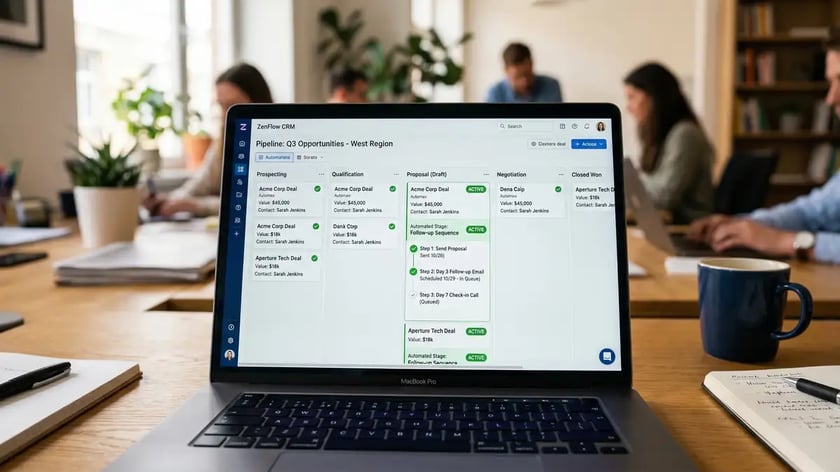
The ROI of sales automation for B2B companies averages $5.44 for every $1 invested, with 76% of organizations seeing returns within the first year and 12% within the first month. These figures come from aggregate benchmarking across enterprise and mid-market deployments, according to Utmost Agency's compilation of sales automation statistics.
However, ROI varies dramatically based on implementation quality. Organizations that invest in data cleansing, process redesign, and phased rollout before activating automation consistently outperform those that deploy tools on top of broken processes. peppereffect's experience architecting sales automation systems for B2B founders confirms this pattern: the companies that see 10x returns are those that treat automation as infrastructure, not a feature.
The financial impact compounds across multiple vectors simultaneously. Sales productivity increases by 10–15%, customer acquisition costs decrease as lead routing improves, and customer CAC payback period benchmarks lifetime value grows through better follow-up and onboarding automation. Companies automating lead generation see a 10% revenue increase within 6–9 months, according to industry benchmarking data.
| ROI Metric | Benchmark | Timeline |
| Return per $1 invested | $5.44 | Within 12 months |
| Revenue increase from lead gen automation | 10% uplift | 6–9 months |
| Sales productivity gain | 10–15% | 3–6 months |
| Win rate improvement | Up to 76% | 6–12 months |
| Sales cycle reduction | Up to 20% | 3–6 months |
| Operational efficiency gain (with AI) | 55% | 12–18 months |
Sources: Utmost Agency Sales Automation Statistics, Sopro AI in B2B Sales Statistics, Everstage 2026
Common Mistake
Only 11% of B2B organizations have agentic AI deployed in production for sales, according to Bain & Company. Most are still running first-generation rule-based automation. Early movers deploying AI-native sales systems are capturing disproportionate efficiency gains — 55% higher operational efficiency and 35% cost reductions — while competitors remain stuck in manual workflows.
Ready to architect your sales automation infrastructure? Explore peppereffect's Sales Administration Architecture.
Ready to architect a sales automation system that delivers $5.44 for every $1 invested? See how peppereffect builds revenue infrastructure.
View Sales ArchitectureHow to Choose the Best B2B Sales Automation Tools
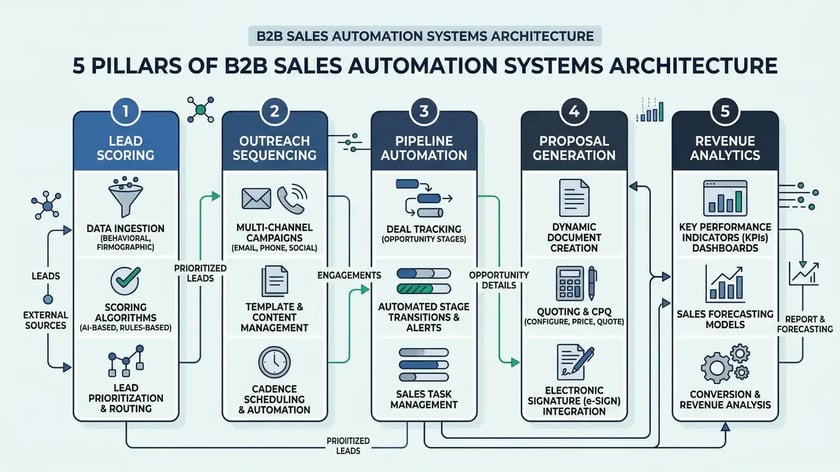
Choosing B2B sales automation tools requires evaluating integration depth, AI capabilities, and total cost of ownership — not feature checklists. The most critical selection criterion is native CRM integration: tools that connect bidirectionally with your CRM via API create compounding value, while tools that operate in silos create data fragmentation that worsens over time.
The B2B sales automation landscape spans five categories, each serving a distinct pillar in the architecture. Your CRM automation platform is the foundation — every other tool connects to it. From there, you layer sales engagement platforms (for outreach sequencing), AI scoring tools (for lead prioritization), pipeline automation (for deal management), and revenue intelligence (for analytics and forecasting).
| Category | What It Automates | Selection Criteria | Price Range |
| CRM Platform | Contact management, deal tracking, workflow triggers | API depth, customization, ecosystem | $0–$150/user/month |
| Sales Engagement | Email sequences, call logging, multi-channel cadences | CRM sync, AI personalization, analytics | $75–$150/user/month |
| AI Lead Scoring | Predictive scoring, intent signals, ideal customer profiling | Data source breadth, model transparency | $100–$500/user/month |
| Pipeline Automation | Deal stage updates, forecast generation, risk alerts | Forecasting accuracy, manager dashboards | $50–$200/user/month |
| Revenue Intelligence | Conversation analytics, activity capture, performance metrics | AI insights, rep coaching automation for coaching businesses, attribution | $80–$250/user/month |
Sources: ZoomInfo Sales Automation Guide, Forecastio Platform Comparison 2025
Why Do Sales Automation Implementations Fail?
Sales automation implementations fail primarily because organizations automate broken processes rather than redesigning them first. According to Markets and Markets, the most common failure modes are poor data quality, lack of process redesign, insufficient change management, and tool fragmentation — not technology limitations.
Data quality is the silent killer. B2B contact databases experience 22.5% to 70.3% annual decay rates, according to Landbase's data decay research. If you deploy lead scoring on a database where one-third of email addresses are invalid and company data is 18 months stale, the automation executes perfectly — on garbage inputs. peppereffect's implementation methodology mandates a data quality audit and cleansing phase before any automation deployment.
22.5–70.3% annual decay — that's the rate at which B2B contact data degrades. Automating on dirty data accelerates bad outcomes, not revenue growth. — Landbase Research
The second failure pattern is change management. Sales teams are already stretched thin and skeptical of yet another tool. Organizations that mandate top-down adoption without demonstrating individual time savings see resistance, workarounds, and shadow processes. The solution: start with a pilot team, demonstrate concrete wins (fewer manual follow-ups, faster lead routing), then expand based on peer advocacy rather than executive mandate automation in executive recruitment.
- Audit data quality first. Cleanse your CRM before activating any automation workflows. Invalid emails, stale company records, and duplicate contacts sabotage lead scoring accuracy.
- Redesign processes before automating. Map your current sales process, identify bottlenecks, and eliminate unnecessary steps. Then automate the optimized process.
- Deploy in phases. Start with one pillar (typically lead scoring or outreach sequencing), validate results, then layer the next pillar. Full-stack deployment on day one overwhelms teams.
- Measure individual rep impact. Show each rep how much time they save per week. Aggregate ROI means nothing to someone who sees automation as extra work.
Key Takeaway
The number one reason B2B sales automation implementations fail is deploying technology on top of broken processes and dirty data. peppereffect's methodology mandates a data quality audit → process redesign → phased deployment sequence that eliminates the three most common failure modes before any automation goes live.
How Does AI Sales Automation Differ from Traditional Automation?
AI sales automation uses machine learning models that learn, adapt, and improve from your sales data over time — unlike traditional rule-based automation that executes static if/then workflows. Traditional automation follows predefined rules: if lead score exceeds 80, route to SDR. AI automation identifies patterns humans miss: this prospect profile, at this company stage, engaging with this content type, historically converts at 3x the baseline rate — and adjusts scoring, sequencing, and routing dynamically.
According to McKinsey's 2025 research on agentic AI deployment, organizations deploying AI-native sales systems see qualitatively different outcomes: not just efficiency gains, but entirely new capabilities like autonomous deal negotiation preparation, real-time competitive intelligence surfacing, and predictive churn prevention that were impossible with rule-based systems.
| Capability | Traditional Automation | AI Sales Automation |
| Lead Scoring | Static point-based rules | Predictive models learning from closed-won data |
| Email Sequences | Time-based drips (send Day 3, Day 7) | Behavior-triggered with AI-personalized content |
| Pipeline Forecasting | Weighted stage probability (e.g., 40% at Stage 3) | ML models analyzing deal velocity and engagement signals |
| Data Enrichment | Manual imports, periodic batch updates | Continuous enrichment from multiple signal sources |
| Adaptation | Manual rule updates by admin | Self-optimizing based on outcome data |
Sources: McKinsey: Six Lessons from Agentic AI, Bain & Company AI in Sales 2025
Frequently Asked Questions
What is the difference between sales automation and marketing automation?
Sales automation handles the conversion side of revenue — lead qualification, outreach sequencing, pipeline management, proposal generation, and deal closing. Marketing automation handles demand demand-gen operating system demand-vs-lead architecture generation — email nurturing campaigns, content distribution, landing pages, and brand awareness. The distinction matters because sales automation acts on qualified leads (MQLs handed from marketing), while marketing automation creates the pipeline that feeds them. In a well-architected system, the two integrate bidirectionally through the CRM.
How long does it take to implement B2B sales automation?
A phased implementation typically takes 3–6 months for the full five-pillar architecture. The data quality audit and CRM cleanup phase takes 2–4 weeks. Lead scoring deployment takes another 2–3 weeks. Outreach sequencing adds 2–4 weeks. Pipeline automation, proposal automation, and analytics layer in over the following 4–8 weeks. Organizations that rush the data quality phase or attempt full-stack deployment on day one consistently experience longer total implementation times due to rework.
How much does sales automation cost for a B2B company?
Total cost depends on company size and tool selection. For a 10-person sales team, expect $500–$2,000 per month for CRM plus one or two additional tools (engagement platform + scoring). For a 50-person team with full-stack automation, costs range from $5,000–$15,000 per month including CRM, engagement, scoring, pipeline automation, and revenue intelligence. The ROI benchmark of $5.44 per $1 invested means well-implemented systems typically pay for themselves within 6–12 months.
Can small businesses benefit from sales automation?
Yes — small businesses often see the highest relative ROI from sales automation because the founder or small sales team is typically the bottleneck. A lead generation automation setup — CRM with basic scoring plus an outreach sequencing tool — can reclaim 5–10 hours per week for a two-person sales team. The key is starting with the highest-impact pillar (usually outreach sequencing for small teams) rather than deploying all five pillars simultaneously.
What sales tasks should you automate first?
Start with the task that consumes the most rep time for the least strategic value. For most B2B organizations, this is follow-up email sequences and lead routing. Automating follow-ups alone increases contact rates by 30–50% because leads receive timely responses regardless of rep availability. Lead routing eliminates the manual assignment process that introduces delays. Once these foundations are solid, layer lead scoring to prioritize which leads enter which sequences.
How do you measure sales automation success?
Measure across four dimensions: efficiency (time saved per rep per week), velocity (average sales cycle length), conversion (lead-to-close rate by source and score tier), and revenue impact (pipeline generated, average deal size, win rate). According to Revenue.io's 2026 sales metrics guide, the most predictive leading indicator is pipeline velocity — the speed at which qualified opportunities move through your funnel — because it captures the compounding effect of improvements across all five automation pillars.
What is CRM sales automation and how does it relate to the full stack?
CRM sales automation is the foundational layer — the workflow engine built into your CRM platform that automates deal stage updates, task creation, notification routing, and basic email sequences. It serves as the central nervous system that connects all five pillars. Without CRM automation working correctly, the engagement platform can't trigger sequences based on deal data, the scoring engine can't update records, and the operations layer can't generate accurate reports.
Ready to Architect Your Sales Automation Engine?
peppereffect installs AI-powered sales automation systems that decouple revenue growth from headcount. From CRM architecture to AI lead scoring, outreach sequencing, and pipeline forecasting — we build the complete operating system.
Resources
- Grand View Research: AI in Sales & Marketing Automation Market Statistics
- Bain & Company: AI Is Transforming Productivity, Sales Remains a New Frontier
- Utmost Agency: 50+ Sales Automation Statistics
- Everstage: Sales Productivity Statistics 2026
- Sopro: 75 Statistics About AI in B2B Sales
- Landbase: Data Decay Rate Statistics
- McKinsey: Six Key Elements of Agentic AI Deployment
- Attainment Labs: B2B Buying Committees Have Doubled
- peppereffect: Sales Administration Architecture
- peppereffect: CRM Automation Guide
- peppereffect: Lead Generation Infrastructure
workflow orchestration engines
proposal tracking and analytics
marketing automation platform selection ai meeting notes CRM integration
sales enablement content strategy
automation in executive recruitment re-engagement infrastructure the seven lead generation systems
AI email personalization at scale
the agentic AI playbook for B2B value equation for B2B offer design
where pipelines leak opportunities
AI automation agency versus building in-house
AI sales agent ARPU benchmarks
revenue retention infrastructure revenue per FTE LTV:CAC ratio scaling SaaS from $10M to $50M ARR
NRR and CAC payback benchmarks expansion revenue levers
Net Dollar Retention architecture
board-grade SaaS model architecture
outbound sales strategy B2B email lifecycle playbook sales-marketing SLA framework sales pipeline management three-layer pipeline software stack seven-section playbook architecture user activation playbook first VP of Sales hiring framework