

What Does It Actually Mean to Use AI in Sales?
AI in sales is the systematic deployment of machine learning, predictive analytics, and autonomous agents across the entire revenue cycle — from lead scoring and prospecting through pipeline autonomous pipeline management management, deal coaching, and AI proposal generation proposal generation. It is not a single tool. It is an operating layer that automates the 71% of selling time currently consumed by non-selling activities, redirecting that capacity toward the conversations, negotiations, and relationship-building that actually close deals. using AI to manage email
The numbers are unambiguous. 81% of sales teams have either implemented or are actively experimenting with AI, and those teams are 1.3x more likely to achieve revenue growth than teams operating without AI capabilities. Sales representatives using AI daily are twice as likely to exceed their quotas compared to non-users, and AI-adopting teams report saving an average of 2 hours and 15 minutes per rep per day on administrative tasks — time that translates directly into pipeline acceleration and deal velocity.
For B2B SaaS companies in the $10M–$40M ARR range, this is not an efficiency play. It is a growth architecture decision. The question is not whether to deploy AI in your sales automation stack — it is how quickly you can install the systems that decouple your revenue growth from proportional headcount scaling.
What you'll learn in this playbook:
- How AI-powered lead scoring delivers 47% better conversion rates than manual qualification
- The signal-based prospecting framework generating 15–25% reply rates versus the 3–5% industry average
- Why AI-driven forecasting eliminates the 80% forecast miss rate plaguing most sales organizations
- A 5-step implementation sequence for deploying AI across your complete sales infrastructure
- ROI benchmarks: 10–20% revenue lift, 37% CAC reduction, and 25% shorter sales cycles
Key Takeaway
AI in sales is not a tool — it is an operating system. Organizations that deploy AI across lead scoring, prospecting, pipeline management, and deal coaching simultaneously create compounding returns that transform sales economics. The 86% of teams reporting positive ROI within year one are not buying point solutions — they are installing integrated AI workflow automation that eliminates the manual bottlenecks capping their growth.

How Does AI Transform Lead Scoring and Qualification?

Traditional lead scoring relies on static rules that degrade the moment they are created. A sales manager assumes webinar attendees are high-value leads. A marketing director weights job title above behavioral signals. These assumptions accumulate bias over months and years, and recalibrating them requires resource-intensive meetings that lag market shifts by quarters. AI-powered lead scoring eliminates this structural limitation by continuously learning from actual conversion data.
The accuracy improvements are measurable and substantial. Organizations using signal-qualified leads report 47% better conversion rates, 43% larger average deal sizes, and close 38% more deals per quarter compared to teams using traditional scoring. These three metrics compound: the same number of leads generate dramatically more revenue through higher conversion, larger deals, and faster velocity. Currently, only 25% of B2B companies leverage intent or signal data tools — meaning early adopters establish significant competitive moats before the practice becomes standardized.
AI lead scoring integrates directly into CRM automation workflows, analyzing hundreds of signals simultaneously — demographic data, behavioral patterns, firmographic information, and engagement metrics — to generate probabilistic assessments that manual analysis simply cannot match. When predictive analytics integrate seamlessly into existing sales engagement tools, adoption increases substantially. When they require separate systems, adoption stalls.
| Scoring Method | Conversion Rate Impact | Deal Size Impact | Quarterly Close Rate |
| Manual Rule-Based | Baseline | Baseline | Baseline |
| AI Predictive Scoring | +30% improvement | Moderate increase | Standard improvement |
| AI Signal-Qualified | +47% improvement | +43% larger deals | +38% more closed |
Sources: Autobound State of AI Sales Prospecting 2026, Persana AI Lead Gen Metrics
How Should You Use AI for Sales Prospecting and Outreach?
Before 2024, signal-based personalization at scale was economically prohibitive. No SDR team could sustain 15–30 minutes of manual research per prospect while maintaining the volume needed to build pipeline. AI changes the economics entirely — automating research to seconds while maintaining personalization quality that generates 15–25% reply rates compared to the 3–5% industry average for generic cold email outreach.
The mechanics matter. AI systems analyze each prospect's company information, recent funding announcements, hiring patterns, technology stack changes, and individual role history to generate contextually relevant outreach. Rather than templates with first-name personalization, AI-generated messages reference specific trigger events — a company's recent expansion, a leadership hire in a relevant department, or website behavior indicating active solution research. This level of contextual relevance separates signal-driven outreach from the hundreds of generic emails prospects filter out daily.
Subject line personalization alone delivers 50% higher open rates, and adding the prospect's company name generates an additional 22% improvement. Messages between 50 and 125 words achieve reply rates around 50% — concise, diagnostic communication outperforms lengthy pitch emails every time. These incremental gains accumulate: a campaign achieving 40% open rates rather than 20% delivers comparable pipeline impact with half the outreach volume.

Multi-channel orchestration amplifies these gains further. Research shows that sequences utilizing three or more channels deliver 287% more responses than single-channel outreach. AI systems coordinate emails, LinkedIn outreach automation, phone calls, and other touchpoints across optimal timing windows — escalating to more direct channels when initial outreach generates no response. This orchestration complexity exceeds what manual coordination can sustain.
| Outreach Strategy | Avg Reply Rate | Pipeline Impact |
| Generic cold email (no personalization) | 3–5% | Low — high volume, low conversion |
| AI signal-personalized outreach | 15–25% | High — 5x improvement per touchpoint |
| Multi-channel AI orchestration (3+ channels) | 287% more responses | Maximum — compounds across all channels |
Sources: Autobound 2026, Outreaches Cold Outreach Benchmarks 2025, Mailforge Response Rates 2026
Key Takeaway
AI-powered prospecting is a multiplier, not an incremental improvement. A team achieving 20% reply rates versus 4% effectively quintuples their prospecting output without proportional headcount increases. Combined with multi-channel orchestration that delivers 287% more responses, AI transforms the B2B lead generation engine from a volume game into a precision architecture.
How Does AI Improve Pipeline Management and Sales Forecasting?
80% of companies have missed their revenue forecasts within the past two years. Traditional forecasting depends heavily on sales representative subjective probability estimates — the "gut feel" that systematically overweights deals where relationships feel warm and underweights deals where data signals indicate genuine buying intent. AI-powered forecasting eliminates this structural limitation by analyzing hundreds of variables: historical performance, market trends, real-time pipeline data, engagement signals, and conversation content.
The accuracy improvements translate directly to business outcomes. Early AI deployments have boosted win rates by more than 30% according to Bain & Company's 2025 analysis. Among sales professionals who frequently use AI, 81% report shorter deal cycles, and 69% shortened their sales cycles by an average of one week. When you operate across multiple product lines, compressing cycle length by one week translates to 4–5% annual velocity improvement — which accumulates to material revenue expansion quarter over quarter.
Real-time pipeline signals provide critical advantages over static forecasts. A deal that appeared solid on Tuesday can display warning signs by Thursday — champion disengagement, decision-maker departure, budget constraint — but if your CRM and marketing automation system only forecasts monthly, you remain blind to these developments for weeks. AI-enabled pipeline tracking monitors deal progression continuously, detecting engagement drops and triggering management intervention before quarter-end surprises materialize.

Pipeline velocity quantifies your daily revenue flow. The formula — (qualified opportunities × win rate × average deal size) ÷ sales cycle length — gives you a single number representing how much revenue your pipeline generates per day. For example: 15 qualified opportunities × 40% win rate × $600,000 average deal size ÷ 25-day cycle = $144,000 per day. AI improves every variable in this equation: more qualified opportunities through better scoring, higher win rates through deal coaching, and shorter cycles through automated follow-ups and proposal automation.
| Forecasting Metric | Without AI | With AI | Impact |
| Forecast accuracy | 20% miss rate is "good" | 7% higher quota attainment | Reliable planning |
| Win rate | 21% average (HubSpot) | 30%+ improvement (Bain) | More revenue, same pipeline |
| Sales cycle length | Baseline | 1 week shorter (69% report) | Faster cash collection |
| Deal risk detection | Monthly review (reactive) | Real-time signals (proactive) | Earlier intervention |
Sources: Cirrus Insight AI in Sales 2025, MarketsandMarkets Revenue Intelligence 2025
Avoid This Mistake
The most expensive AI implementation failure is deploying predictive forecasting on top of dirty CRM data. Poor data quality costs organizations an average of $12.9 million annually (Gartner), and AI systems inherit every inconsistency in your data layer. Before deploying AI forecasting, ensure your CRM has complete fields, deduplicated records, and standardized data formats. AI amplifies whatever it finds — clean data produces accurate predictions, dirty data produces confident wrong answers.
Ready to architect your AI-powered sales administration infrastructure?
Book a Growth Architecture CallHow Do You Deploy AI Across Your Entire Sales Stack?
Successful AI implementation follows a specific sequence. Organizations that deploy AI tools randomly — a lead scoring plugin here, a forecasting dashboard there — create fragmented systems that generate disconnected insights. The compounding returns of AI in sales come from integrated deployment across the full revenue cycle, where each layer feeds intelligence to the next.
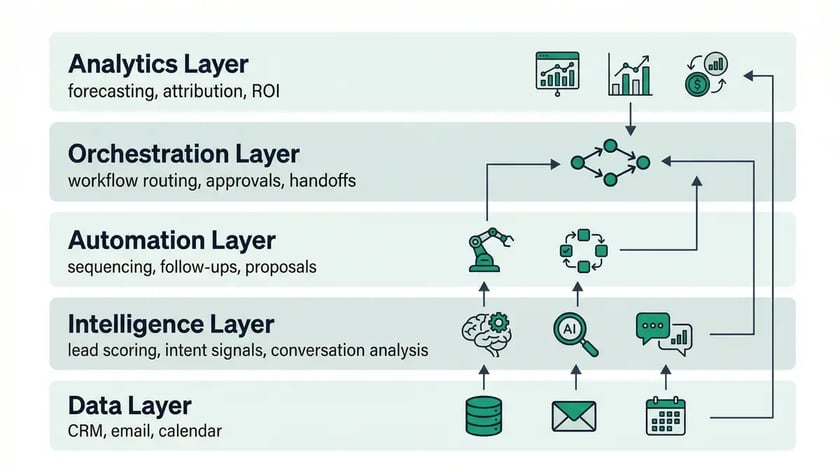
Establish the Data Foundation
Audit your CRM for completeness, deduplication, and field standardization. AI systems require clean, unified datasets — skip this step and every subsequent layer produces unreliable outputs. Integrate all customer touchpoints into a single data layer: email engagement, website behavior, call logs, and sales intelligence signals.
Deploy AI Lead Scoring and Qualification
Replace manual rule-based scoring with predictive models that learn from your actual conversion data. Connect intent signals, behavioral patterns, and firmographic data into a unified scoring engine that prioritizes leads based on genuine buying propensity — not assumptions. Target: 30–47% improvement in conversion rates within the first quarter.
Automate Prospecting and Multi-Channel Outreach
Install AI-powered research and personalization across your outbound engine. Deploy signal-triggered sequencing that initiates outreach when prospects show elevated buying intent — not on fixed schedules. Orchestrate across email, LinkedIn, and phone with AI managing timing, channel selection, and message personalization. Target: 15–25% reply rates.
Install Pipeline Intelligence and Forecasting
Deploy AI-powered pipeline tracking that monitors deal progression in real time — detecting champion disengagement, competitive signals, and stalled stages before they become quarter-end surprises. Replace subjective probability estimates with data-driven forecasting that analyzes engagement patterns, conversation content, and historical win/loss data. Target: 30%+ win rate improvement.
Activate Conversation Intelligence and Deal Coaching
Deploy conversation intelligence across all sales calls and meetings. AI analyzes every interaction, surfaces coaching opportunities, identifies winning talk patterns, and enables managers to review AI-generated summaries rather than listening to hours of recordings. This makes scalable coaching feasible for the first time — every rep receives data-driven feedback on every call. Target: 36% increase in follow-up meeting scheduling AI meeting extraction eliminates CRM data entry.
Key Takeaway
The 5-step deployment sequence is non-negotiable. Data foundation first, then scoring, then prospecting, then pipeline intelligence, then coaching. Each layer depends on the one below it. Organizations that skip to step 3 or 4 without clean data and accurate scoring deploy sophisticated tools on broken foundations — the "more pilots than Lufthansa" pattern that agentic workflows literature warns about.
What ROI Should You Expect from AI in Sales?
86% of sales teams report positive ROI within their first year of AI adoption. This rapid payback reflects the immediate time savings from automation combined with conversion rate improvements from enhanced personalization and lead targeting. Most organizations do not require multi-year payback periods to justify AI investment in sales — productivity gains and pipeline improvements deliver returns within the first operational year.
The specific dimensions of ROI compound across the entire revenue cycle. McKinsey research indicates that organizations investing in AI see a 10–20% sales ROI boost. For a $10M ARR company, this represents $1–2M in incremental revenue. For a $40M ARR company, AI-driven improvements could contribute $4–8M in incremental revenue — the economic equivalent of hiring an entire sales team without the associated overhead, management complexity, or ramp time.
Customer acquisition cost reduction proves particularly significant for growth-stage organizations. Companies using AI-driven sales and marketing tools report an average 37% reduction in CAC compared to traditional methods, with 30% improvement in targeting accuracy and 15% gains from smarter campaign optimization. Combined with up to 25% shorter sales cycles and up to 40% productivity increases, the cumulative impact on scaling capacity far exceeds the sum of individual improvements.
| ROI Dimension | Benchmark | Impact at $20M ARR |
| Revenue lift (McKinsey) | 10–20% | $2M–$4M incremental |
| CAC reduction | 37% average | $500K–$1M savings |
| Sales cycle compression | Up to 25% shorter | Faster cash collection |
| Productivity increase | Up to 40% | Equivalent to 3–4 additional reps |
| Win rate improvement | 30%+ (Bain) | More deals from same pipeline |
Sources: Sopro AI Sales Statistics, Cirrus Insight 2025, Lucid AI-Powered CAC Management
What Are the Biggest Mistakes When Implementing AI in Sales?
The primary failure pattern is not technological — it is organizational. McKinsey captures it precisely: organizations end up with "more pilots than Lufthansa." Dozens of successful AI experiments validate compelling use cases in controlled environments, and then momentum stalls. What works with 10 users breaks when scaled to 1,000 across departments. Each AI tool requires months of custom integration, security reviews, and manual deployment — creating sequential timelines measured in years.
78% of sales leaders worry about falling behind competitors on AI adoption, yet this urgency does not translate to organizational readiness. Teams resist new systems, find workarounds, or use tools just enough to satisfy management reporting requirements. The solution is systematic change management: executive alignment treating AI as strategic priority, transparent communication positioning AI as augmentation rather than replacement, and structured training enabling genuine team competence.
Data quality is the technical barrier that derails the most AI implementations. Poor data costs organizations an average of $12.9 million annually (Gartner), and AI systems are only as intelligent as the data feeding them. Clean, unified datasets enable accurate predictions; fragmented, inconsistent data produces confident but wrong recommendations that destroy user trust and kill adoption momentum. The client onboarding automation lesson applies here: fix the foundation before building the structure.
Skills gaps compound the challenge. 83% of leaders say AI skills are essential in new hires, yet most organizations lack programs to develop these capabilities internally. Salespeople need training in leveraging AI effectively, managers need coaching skills for AI-augmented environments, and administrators need technical skills to configure platforms. Without investment in people alongside technology, organizations deploy sophisticated tools into teams unprepared to leverage them — the Freedom Machine remains trapped in the Technician's hands.
Frequently Asked Questions
How do you use AI in sales effectively?
Effective AI deployment in sales follows a specific sequence: establish clean data foundations in your CRM, deploy AI-powered lead nurturing and scoring, automate prospecting with signal-based personalization, install pipeline intelligence for real-time forecasting, and activate conversation intelligence for scalable coaching. The key is integrated deployment — each layer feeds intelligence to the next — rather than deploying isolated point solutions that create fragmented insights across disconnected systems.
How does AI technology improve sales prospecting?
AI transforms prospecting economics by automating the 15–30 minutes of manual research previously required per prospect, compressing it to seconds while maintaining personalization quality. AI systems analyze company information, hiring patterns, technology changes, and buying signals to generate contextually relevant outreach. Signal-personalized messages achieve 15–25% reply rates versus the 3–5% industry average. Combined with cold email automation and multi-channel orchestration, AI enables teams to maintain both volume and quality simultaneously.
What is the ROI of AI in sales?
86% of sales teams report positive ROI within their first year of AI adoption. Specific benchmarks include 10–20% revenue lift (McKinsey), 37% CAC reduction, up to 25% shorter sales cycles, and up to 40% productivity increases. For a $20M ARR B2B company, these improvements translate to $2M–$4M in incremental revenue, $500K–$1M in acquisition cost savings, and the productivity equivalent of 3–4 additional sales representatives — without the headcount, ramp time, or management overhead.
How is AI changing B2B sales in 2026?
The shift from AI-as-tool to AI-as-autonomous-agent defines 2026. By year-end, the majority of initial outreach — first emails, first LinkedIn messages — will be AI-generated and signal-triggered, with human reps engaging after positive responses. Gartner predicts AI agents will outnumber human sellers 10x by 2028. The AI agents market, valued at $5.1 billion in 2024, is projected to reach $47.1 billion by 2030. Organizations completing AI implementation now establish competitive advantage before these capabilities become table stakes.
What are the best AI sales tools for B2B?
The most effective AI sales implementations combine capabilities across four categories: lead intelligence platforms for scoring and qualification, outreach automation for personalized multi-channel prospecting, AI agent workflow automation for pipeline management and forecasting, and conversation intelligence for deal coaching. The specific tools matter less than the integration architecture — point solutions create data silos, while integrated platforms enable the compounding returns that transform sales economics at scale.
How do you implement AI in sales without disrupting your team?
Start with the data foundation — CRM cleanup and integration — which requires no workflow changes from your sales team. Then deploy AI lead scoring alongside existing processes, letting representatives compare AI recommendations with their own judgment. Introduce outreach automation gradually, beginning with follow-up sequencing before expanding to initial prospecting. This phased approach builds trust through demonstrated results rather than demanding immediate behavioral change across the organization.
Install the AI Sales Infrastructure That Scales Without Headcount
peppereffect architects integrated AI operating systems across lead scoring, prospecting, pipeline management, and deal intelligence — eliminating the manual bottlenecks that cap your revenue growth. Deploy the sales automation architecture that decouples your pipeline from your payroll.
Book Your Growth Architecture CallResources
- Autobound — State of AI Sales Prospecting 2026: Data, Trends & Insights
- HubSpot — 37 Stats That Make the Case for Sales Automation
- Cirrus Insight — AI in Sales 2025: Statistics, Trends & Generative AI Insights
- Sopro — 75 Statistics About AI in B2B Sales and Marketing
- Datagrid — Statistics on AI Agents for Sales: Adoption and Impact
- Syncari — Why Data Quality Is the Bedrock of AI-Ready Enterprises
- Outreach — Sales Call Recording vs. Conversation Intelligence
AI-powered proposal generation