

What Does It Really Mean to Scale a Service Business Without Hiring?
Most service business founders hit the same wall between $2M and $10M in revenue: every new client requires more people, more management overhead, and more complexity. The math is brutal — the average cost of employee turnover in 2026 is $45,236 per person, up sharply from $36,723 the previous year, according to Express Employment Professionals. And that number only captures the direct cost. When you factor in lost productivity, management distraction, and the 4-6 months it takes before a new hire reaches full output, the real figure doubles. return on investment from automation
Scaling a service business without hiring scaling up your B2B business is not about doing more with less. It is about replacing manual throughput constraints with autonomous systems that expand your capacity 3x to 5x while your headcount stays flat. Professional service firms typically operate at 80-90% capacity utilization, with the industry median at 82.4% according to Monograph. Firms that push above 90% without systems face burnout, quality degradation, and client churn. The solution is not more bodies — it is better architecture.
This is the Capacity Expansion Blueprint: a systematic framework for scaling delivery without scaling headcount, built on the same principles that power peppereffect's Freedom Machine methodology.
What you will learn in this article:
- Why hiring is the most expensive and slowest way to expand service capacity
- The five-stage Capacity Expansion Blueprint from audit to 5x throughput
- Which operational bottlenecks to automate first for maximum leverage
- How productized service models unlock 50-65% gross margins versus 20-40% for custom delivery
- Real benchmarks for automation ROI across onboarding, fulfillment, and project management
- The role of AI agents in replacing manual capacity constraints
Key Takeaway
Scaling a service business without hiring requires replacing manual capacity constraints with autonomous systems. Professional services firms that fail to adopt automation lose 5-10% of potential revenue annually from administrative drag, idle capacity, and scope leakage — according to a 2026 IDC study commissioned by Kantata.
Why Hiring Is the Most Expensive Way to Scale a Service Business

The instinctive response to capacity constraints is to hire. A new project manager here, a junior consultant there, maybe a coordinator to manage the growing communication overhead. But the economics of hiring in professional services tell a different story.

Professional and business services report a monthly separation rate of 4.75%, placing them in the mid-to-high range across all industries according to Corporate Navigators. That means nearly one in twenty employees leave every single month. With turnover costs now exceeding $45,000 per departure, every hire carries embedded replacement risk that compounds your operating costs.
The hidden costs extend further. Up to 20% of skilled employees' time is lost to administrative work — not client delivery, not strategic thinking, but filing, updating statuses, formatting reports, and chasing approvals. Another 10% evaporates to idle capacity from misutilization, plus 5% to unmanaged scope creep, plus 3% to invoice delays. In one modeled scenario, IDC calculated more than $7 million in annual value erosion from these compounding inefficiencies across a mid-sized professional services firm.
Half of all US companies now expect turnover to surge in 2026, up from 39% in fall 2024. Among those anticipating higher turnover, 37% cite increased workplace demands creating vacancies, 35% point to a competitive job market, and 32% attribute it to better compensation elsewhere. This is not a temporary labor market disruption — it is a structural shift that makes the "hire more people" approach increasingly untenable for service businesses trying to scale beyond founder-dependent delivery.
| Cost Category | Per Employee | At 5 Hires/Year |
| Average turnover cost (2026) | $45,236 | $226,180 |
| Admin time lost (20% of salary) | ~$16,000 | $80,000 |
| Idle capacity from misutilization (10%) | ~$8,000 | $40,000 |
| Scope leakage (5% margin erosion) | ~$4,000 | $20,000 |
| Total annual drag per hire cycle | ~$73,236 | $366,180 |
Sources: Express Employment Professionals, IDC/Kantata PSA Study 2026
Avoid This Mistake
Do not hire to fix a systems problem. If your team spends more than 30% of their time on administrative tasks, onboarding coordination, or status reporting, adding headcount amplifies the inefficiency rather than solving it. Fix the process automating repeatable processes architecture first — then evaluate whether you actually need more people or just better workflow automation.
The Capacity Expansion Blueprint: Five Stages to 3x-5x Throughput
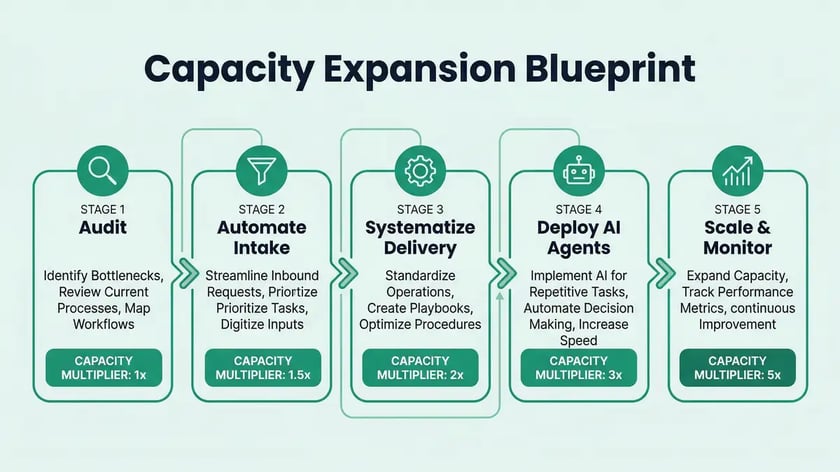
The Capacity Expansion Blueprint is a sequential framework that takes a founder-dependent service business from manual bottlenecks to autonomous scale. Each stage builds on the previous one, and skipping stages guarantees the same scaling failures that hiring creates — just with technology instead of people.
Capacity Audit — Map Your Actual Throughput Constraints
Before automating anything, measure where your time actually goes. Track every team member's hours for two weeks across four categories: client delivery, administrative overhead, communication and coordination, and business development. Most service businesses discover that 30-40% of total hours are non-delivery activities that can be eliminated or automated. This audit reveals your real capacity ceiling — and it is almost always lower than you think.
Automate Client Intake — Eliminate the Onboarding Bottleneck
Client onboarding is the single biggest capacity constraint in most service businesses. Replace manual intake forms dynamic intake workflows, welcome emails, contract routing, and project setup with an autonomous onboarding pipeline. Coaching businesses that automate onboarding report 30% higher client retention rates according to Accountability Now. Capacity multiplier: 1.5x.
Systematize Delivery — Productize Your Core Offering
Convert custom delivery into standardized, repeatable service packages. Productized services achieve 50-65% gross margins compared to 20-40% for traditional time-and-materials models. One design agency scaled to $160K monthly recurring revenue by converting project-based work to a subscription model with fixed-scope deliverables. Standardization is the prerequisite for automation — you cannot automate chaos. Capacity multiplier: 2x.
Deploy AI Agents — Automate the Repeatable 70%
With standardized processes in place, deploy agentic workflows to handle the repeatable portions of delivery: automated reporting, status updates, content generation, data analysis, and client communication. 87% of professional services organizations plan to use AI agents as part of their workforce. The remaining 30% of work — strategic thinking, relationship building, complex problem-solving — stays human. Capacity multiplier: 3x.
Scale and Monitor — Install Autonomous Feedback Loops
Deploy autonomous project management dashboards that flag exceptions, predict bottlenecks, and reallocate resources without human intervention. Enterprises automating labor-intensive workflows record average savings of 30-40% per process according to Mordor Intelligence. At this stage, your capacity is limited by market demand, not delivery bandwidth. Capacity multiplier: 5x.
Key Takeaway
The Capacity Expansion Blueprint is sequential by design. Stage 1 (audit) exposes the real bottlenecks. Stage 2 (intake automation) eliminates the onboarding drag. Stage 3 (productization) creates the standardized processes that Stage 4 (AI agents) can actually automate. Stage 5 (autonomous monitoring) closes the loop. Skipping to Stage 4 without Stages 1-3 is why most "AI transformation" projects fail.
Which Bottlenecks Should You Automate First?
Not all operational bottlenecks deliver equal returns when automated. The research is clear on where the highest-leverage automation opportunities exist in service businesses.
Customer service automation delivers the highest ROI of any AI application — 520% average return with a 4.5-month payback period, according to Hashmeta AI. For service businesses, this translates directly to automated client communication: status updates, progress reports, FAQ responses, and scheduling. Code generation and development follows at 480% ROI (5.2-month payback), and content marketing automation at 410% ROI (6.1-month payback).

The bottleneck priority matrix for service businesses is straightforward. Start with client onboarding — it touches every single engagement and compounds across your entire client base. Then move to reporting and status updates, which consume disproportionate team hours relative to their value. Third, automate proposal generation and scope documentation proposal pricing engine, where manual drafting creates sales cycle delays. Fourth, deploy CRM automation to eliminate data entry and follow-up tracking. Finally, systematize fulfillment delivery itself using workflow orchestration platforms.
| Automation Area | Average ROI | Payback Period | Capacity Impact |
| Customer service / client communication | 520% | 4.5 months | High — frees 15-20% of team time |
| Content and report generation | 410% | 6.1 months | High — eliminates manual reporting |
| Document processing and proposals | 350% | 8.6 months | Medium — accelerates sales cycle |
| Knowledge management and onboarding | 290% | 10.4 months | Medium — reduces ramp-up time |
| Workflow orchestration (end-to-end) | 30-40% savings/process | 6-12 months | Highest — systemic throughput gain |
Sources: Hashmeta AI — Generative AI Statistics 2026, Mordor Intelligence — Service Delivery Automation Market
The critical insight is that only 17% of companies use automation productivity gains for headcount reduction. The majority reinvest in expanded capabilities, R&D, and upskilling — according to Master of Code. Automation is not about firing your team. It is about deploying AI workflow automation so your existing team can serve 3x-5x more clients at the same quality standard.
Ready to identify your highest-leverage automation opportunities? Use the peppereffect Automation ROI Calculator to quantify your capacity expansion potential.
Book Your Capacity Mapping CallHow Productized Services Unlock Scalable Margins

The single most powerful capacity expansion lever available to service businesses is productization. Converting custom, scope-every-engagement delivery into standardized service packages fundamentally changes the economics of your business.
The margin difference is dramatic. Productized services achieve 50-65% gross margins, compared to 20-40% for traditional custom services according to Datacose. A productized CFO advisory firm, for example, delivers significantly higher margins than fractional CFO services because the deliverables are standardized, the scope is fixed, and the fulfillment process is repeatable — as documented by the New Jersey Society of CPAs.
Productization eliminates the three biggest scaling obstacles in service businesses. First, it removes scope creep — clients purchase a defined package, not open-ended consulting. Second, it eliminates proposal overhead — no more custom scoping, pricing, and negotiation for every engagement. Third, it creates the standardized processes that AI agents and agentic workflows can actually execute autonomously.
| Model | Gross Margin | Scalability | Revenue Predictability |
| Custom / time-and-materials | 20-40% | Linear (requires proportional headcount) | Low — project-based, variable |
| Productized services | 50-65% | Semi-linear (SOPs enable leverage) | High — subscription/package MRR |
| Pure product (SaaS) | 70-85% | Non-linear (build once, sell many) | Highest — but long payback |
Sources: Datacose — Service Business vs Product Business, Expand US Business Coaching
The productivity multiplier effect compounds rapidly. AI and automation tools enable work that previously required five people to be completed by one person with the right technology stack — potentially doubling or tripling profit per client without raising prices. Combined with productized delivery, this creates the mathematical foundation for 3x-5x capacity expansion: standardized processes multiplied by autonomous execution equals exponential throughput without proportional cost.
How AI Agents Transform Service Delivery Capacity
The professional services industry is approaching a structural inflection point. 87% of professional services organizations plan to use AI agents as part of their workforce, according to Kantata's 2026 State of the Professional Services Industry Report cited by BusinessWire. This is not speculative — it is a near-unanimous strategic direction among established firms.
The application areas that deliver the most capacity expansion align precisely with where service businesses waste the most time. Automated client communication reduces mean-time-to-resolve by up to 40% for routine queries, according to Mordor Intelligence. Sales automation eliminates manual follow-up sequences that consume 10-15 hours per week for most service founders. And automated reporting — which 88% of employees say improves their job satisfaction — reclaims the status-update treadmill that eats into actual delivery time.
The practical deployment sequence for AI agents in a service business follows the Capacity Expansion Blueprint stages. After systematizing delivery (Stage 3), deploy agents for client-facing communication first (highest ROI at 520%), then for internal reporting and documentation, then for lead generation and qualification, and finally for fulfillment execution itself. Each layer of automation compounds the previous one.
| AI Agent Application | Time Reclaimed (Weekly) | Capacity Multiplier |
| Client communication and status updates | 8-12 hours | 1.3x |
| Reporting and dashboard generation | 5-8 hours | 1.5x |
| Proposal and document generation | 4-6 hours | 1.8x |
| Lead qualification and scheduling | 6-10 hours | 2.2x |
| Fulfillment orchestration (end-to-end) | 15-25 hours | 3x-5x |
Sources: Hashmeta AI, C-Suite Strategy, Master of Code — AI ROI 2026
Key Takeaway
AI agents deliver the highest capacity expansion when deployed in sequence: communication first, then reporting, then documentation, then fulfillment. The compounding effect means a service business deploying all four layers can realistically achieve 3x-5x client volume without adding headcount — but only if the underlying processes are systematized first (Blueprint Stage 3).
What Happens When You Scale Without Systems?
The consequences of scaling client volume without capacity infrastructure are predictable and devastating. Service quality drops. Client churn increases. Your best people burn out and leave — creating a death spiral where you are simultaneously losing capacity and gaining commitments.
Research from CGP Group identifies the earliest warning sign: gross margin compression of more than 2-3 percentage points quarter-over-quarter. This signals that you are absorbing costs rather than scaling efficiently — a classic indicator that manual processes are consuming the revenue generated by new clients.
The operational cascade works like this. New clients flood onboarding, overwhelming your intake process. Communication gaps multiply as coordinators juggle more accounts than they can track. Reporting falls behind, which erodes client confidence. Delivery timelines slip. Your experienced team members spend more time managing fires than doing the work that generates value. According to Trilliad's 2025 study, internal alignment issues — not technology — drive most growth challenges in B2B service companies.
The irony is that businesses can typically increase output by 20-30% through improved systems without adding significant costs. The capacity is already there — it is just buried under process inefficiency. Before expanding capacity with people or technology, fix the structural problems that are capping your current throughput. This is the logic behind Blueprint Stage 1: audit before automate, systematize before orchestrate.
Frequently Asked Questions
How do I scale a service business without hiring more people?
Start by auditing where your team's time actually goes — most service businesses discover 30-40% of hours are consumed by non-delivery activities. Then follow the Capacity Expansion Blueprint: automate client onboarding, productize your core delivery into standardized packages, deploy AI agents for communication and reporting, and install autonomous monitoring. Professional services firms that adopt automation systems recover 5-10% of revenue previously lost to administrative drag and idle capacity.
What is the ROI of automating a service business?
ROI varies significantly by automation area. Customer service automation delivers the highest return at 520% average ROI with a 4.5-month payback period. Content and report generation follows at 410% ROI (6.1-month payback). Document processing and proposal automation achieve 350% ROI with an 8.6-month payback. At enterprise scale, organizations report an average AI ROI of 1.7x with 26-31% cost savings across operations.
What does it cost to scale through hiring vs. automation?
The average cost of employee turnover in 2026 is $45,236, and professional services experience a 4.75% monthly separation rate. When you add administrative time lost (20% of salary), idle capacity (10%), and scope leakage (5%), the total annual drag per hire cycle exceeds $73,000. Automation typically requires a one-time investment with ongoing returns — the peppereffect Automation ROI Calculator can help you model the comparison for your specific business.
What are productized services and how do they help scale?
Productized services convert custom, scope-every-engagement delivery into standardized packages with fixed scope and pricing. They achieve 50-65% gross margins versus 20-40% for custom services. More importantly for capacity expansion, they create the repeatable processes that agentic workflows and AI agents can execute autonomously — eliminating the proposal overhead, scope creep, and inconsistent delivery that cap throughput in traditional service models.
How long does it take to see results from capacity automation?
Initial returns from automation typically appear within 6-18 months, with more meaningful financial impact emerging over 18-36 months according to industry benchmarks. However, high-impact areas like client communication automation show a 4.5-month payback period. The Blueprint's sequential approach delivers incremental capacity gains at each stage: 1.5x at Stage 2 (intake automation), 2x at Stage 3 (productization), 3x at Stage 4 (AI agents), and 5x at Stage 5 (autonomous monitoring).
Which service businesses benefit most from the Capacity Expansion Blueprint?
The Blueprint is designed for B2B service businesses between $2M and $10M in revenue where the founder or a small leadership team is the delivery bottleneck. This includes consulting firms, coaching businesses building a Freedom Machine, executive search firms, marketing agencies, and professional services firms. The common denominator: high-value expertise delivered through manual processes that create a hard capacity ceiling tied to headcount.
Ready to Scale Your Service Business 3x-5x Without Hiring?
peppereffect installs the Capacity Expansion Blueprint as part of our Freedom Machine methodology — autonomous AI operating systems that decouple your revenue from headcount. Book a Capacity Mapping Call to identify your highest-leverage automation opportunities.
Book Your Capacity Mapping CallLearn About the Freedom Machine →
Resources
- Express Employment Professionals — Turnover Cost and Workforce Trends 2026
- IDC/Kantata — Professional Services Firms Lose 5-10% of Revenue Without PSA
- Hashmeta AI — 75+ Generative AI Statistics 2026: Market Size, Adoption and ROI Data
- Master of Code — AI ROI: Why Only 5% of Enterprises See Real Returns in 2026
- Mordor Intelligence — Service Delivery Automation Market Size and Growth 2026
- C-Suite Strategy — How AI Automation Is Transforming Coaching and Consulting
- CGP Group — When Growth Stalls: How to Spot the Ceiling Before You Hit It
- Accountability Now — 9 Essential AI Tools for Coaching CEOs in 2026
LinkedIn networking for executive search
build a consulting business that scales without you
AI-augmented retained search cycles
automation ROI benchmarks 5-hour-week operating model MRR optimization
board search and advisory revenue
cross-border executive search revenue expansion
building a 7-figure coaching business automate vs hire whether to build or buy outsource vs automate delegating recurring work to a virtual assistant