

AI visibility for B2B SaaS: when your competitors are cited and you are not
AI visibility for B2B SaaS is how often AI engines like ChatGPT, Perplexity and Google AI Overviews name and recommend your product when a buyer asks for software. Since roughly half of B2B software buyers now start their research in an AI chat, being absent from the engine's shortlist of three to five vendors means you are invisible at the exact moment of decision.
Your buyers are no longer starting on Google and clicking ten links. They are asking an AI for the best tools in your category and acting on the handful of names it returns. If your competitor is in that answer and you are not, you have lost the shortlist before the buying committee has even met. That shortlist forms whether or not anyone clicks, which is what the AI traffic share objection misses. This is the SaaS-specific face of the traffic collapse, and it is an existential problem for any software company that depends on category and comparison discovery. the six changes we made in ninety days
What this playbook covers:
- Why the SaaS buying journey now starts in an AI chat
- The asymmetric risk of being left out of the shortlist
- Where AI engines actually source their software recommendations
- The five-step playbook to win your Share of Model
- How to measure AI visibility, and what it costs you to ignore it
Key Takeaway
For B2B SaaS, AI visibility is a category-ownership problem, not a content task. The engine collapses your market to a few names. Your job is to be one of them, in every prompt your buyers actually ask, measured as Share of Model rather than clicks.

Why does the SaaS buying journey now start in an AI chat?
Because asking an AI is faster than reading ten links, and buyers have noticed. G2 found that around half of B2B software buyers now begin their research with AI chatbots rather than a search engine. With ChatGPT alone at roughly 900 million weekly active users, the behaviour is mainstream, not fringe. A buyer types "best CRM for mid-market", "Salesforce alternatives", or "HubSpot vs Pipedrive", and the engine returns a synthesised recommendation instead of a page of links to evaluate.

This compresses the top of your funnel into a single moment. The old journey gave you many chances to be discovered: a ranking, an ad, a review site, a comparison post. The new journey gives the engine the job of pre-filtering the market down to a shortlist, and most buyers trust that shortlist. The discovery surface that used to be wide is now narrow, and you are either on it or you are not. Our breakdown of AEO vs SEO explains why winning that placement is a different discipline from ranking.
What is the asymmetric risk for SaaS?
An AI answer to a software question names three to five vendors. If your competitor is one of them and you are not, you are functionally invisible, no matter how good your product is. This hits SaaS harder than most categories because software discovery is so comparison-driven. Buyers ask for "alternatives", "best of", and "X vs Y" by default, and those are exactly the prompts where the engine produces a tight, named shortlist. There is no second page of an AI answer to be on. You are in the list or you are not in the consideration set.

The asymmetry is what makes this urgent. A small visibility gap on Google cost you some clicks. A visibility gap in the AI shortlist costs you the entire opportunity, silently, because nothing shows up in your analytics to tell you it happened. Your pipeline simply thins, your cost of acquisition creeps up, and the cause is invisible unless you go looking for it. For a SaaS CEO targeting efficient growth toward higher ARR, that is the difference between compounding pipeline and a slow leak.
Watch Out
Being left out of an AI shortlist generates no signal in your dashboards. There is no lost-click metric for an answer that never mentioned you. The first symptom is usually a quietly rising CAC and a thinning top of funnel with no obvious cause. By the time it shows in revenue, your competitors have a head start in the model.
Where do AI engines source their software recommendations?
Engines do not invent their shortlists; they assemble them from a small set of sources they trust. For software, that means a few specific places. Review platforms like G2, Capterra, and TrustRadius carry structured, comparative signal that engines lean on heavily. Community discussion on Reddit, Hacker News, and niche forums supplies the candid peer opinion models weight as authentic. Comparison and listicle content provides ready-made shortlists the engine can echo. And your own structured, citable content tells the engine what you are, who you are for, and why you belong in the answer.
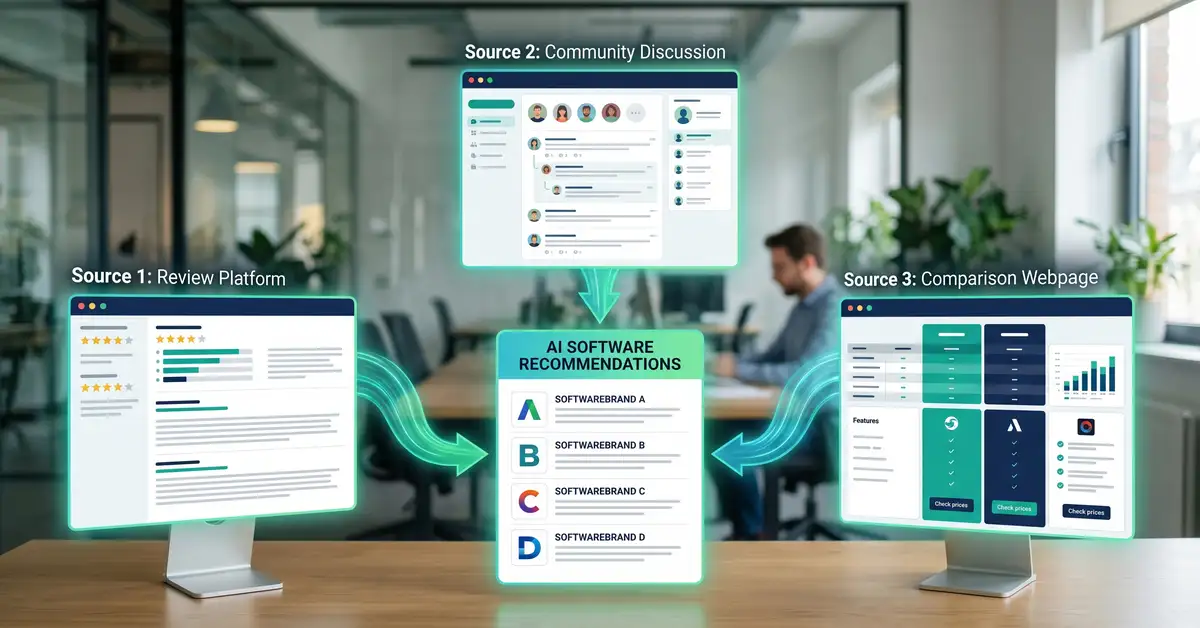
This is the most actionable insight in the whole problem. AI visibility for SaaS is not won inside your own marketing site alone; it is won across the third-party sources the engines cite, plus your own answer-first content. That is why it is a function of generative engine optimization and Share of Model, not just traditional SEO. You have to be present, positively, in the places the model looks.
Want to see which AI answers name your competitors but not you?
Run the free AI Visibility CheckThe playbook to win your Share of Model
Winning AI visibility for SaaS is a deliberate five-step play, not a single campaign.
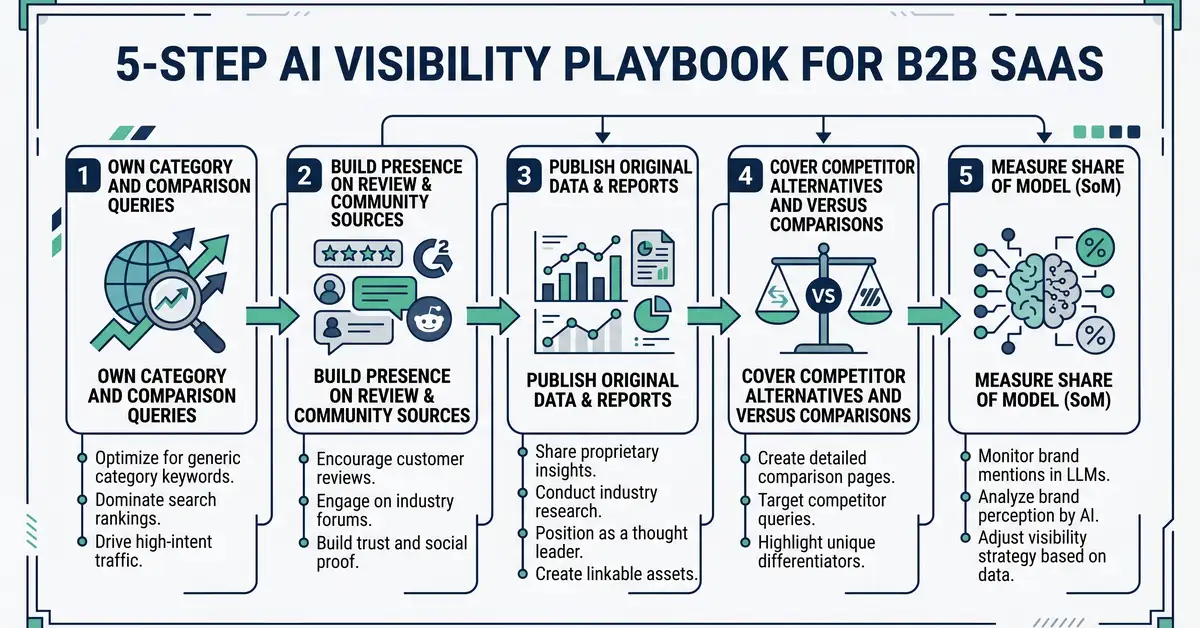
Own your category and comparison queries
Build answer-first, well-structured content for "best [category]", "[you] vs [competitor]", and use-case queries so engines can extract and cite you.
Build presence on the sources LLMs cite
Earn strong, current reviews on G2, Capterra, and TrustRadius, and positive mentions in community discussion and listicles.
Publish original data and clear positioning
Give engines something specific to cite and a crisp answer to who you are best for, so you are easy to name.
Cover alternatives and versus comparisons
Create honest "alternatives to [competitor]" and head-to-head pages, the exact prompts that drive SaaS shortlisting.
Measure Share of Model
Track how often engines name you versus competitors across the prompts your buyers use, and act on the prompts you lose.
These steps are most powerful run as a system rather than one-offs, which is the case for building an AEO content system that compounds. A single comparison page helps; a connected engine of category, comparison, and authority content is what makes you the default name.
How do you measure AI visibility for SaaS?
You measure Share of Model: the percentage of relevant buyer prompts in which an AI engine names or recommends your brand. The right scoreboard tracks your share of voice against your named competitors, which specific prompts you win, and which you lose, across the engines your buyers actually use. Traditional rankings and pageviews cannot see any of this, because the citation happens inside an answer that may never produce a click. AI visibility tools built for the job make this measurable, and a free diagnostic is the fastest way to get your baseline. The tools landscape is covered in our roundup of AI search optimization tools.

The stakes connect straight to the numbers a SaaS leader cares about. Absence from AI shortlists raises customer acquisition cost and shrinks pipeline, because the cheapest top-of-funnel discovery, being recommended for free inside the answer, is going to your competitors instead. Winning Share of Model is how you keep growing efficiently as zero-click erodes the old organic channel.
Sources: G2 on AI search for B2B buyers; TechCrunch on ChatGPT usage; SparkToro zero-click study (2026).
Find out if AI is recommending your competitors instead of you.
The AI Visibility Check measures your Share of Model across the prompts your SaaS buyers actually ask, and shows exactly which answers name your competitors and leave you out. It is the fastest way to see whether you are winning or losing the AI shortlist, and what to build to win it.
Run the free AI Visibility CheckFrequently asked questions about AI visibility for B2B SaaS
What is AI visibility for B2B SaaS? AI visibility for B2B SaaS is how often AI answer engines like ChatGPT, Perplexity, Gemini, and Google AI Overviews name and recommend your software when a buyer asks a question in your category. It is measured as Share of Model, the share of relevant prompts in which you are cited, rather than as rankings or clicks. Because buyers increasingly act on the AI's shortlist, this visibility directly shapes which vendors get considered.
Why are AI answer engines a risk for SaaS specifically? Because SaaS discovery is heavily comparison-driven, and AI engines answer those queries with a tight shortlist of three to five named vendors. If a competitor is named and you are not, you are invisible at the moment of shortlisting, with no second page to appear on. The risk is asymmetric: a small visibility gap can cost you the entire opportunity, silently, since nothing in your analytics flags an answer that never mentioned you.
How do AI engines decide which software to recommend? They synthesise their recommendations from sources they trust: review platforms like G2, Capterra, and TrustRadius, community discussion on Reddit and forums, comparison and listicle content, and the vendor's own structured, citable content. That means AI visibility for SaaS is won across third-party sources plus your own answer-first content, not on your marketing site alone.
How can a B2B SaaS company improve its AI visibility? Follow a five-step playbook: own your category and comparison queries with answer-first content, build a strong presence on the review sites and communities AI engines cite, publish original data and clear positioning so you are easy to name, create honest alternatives and head-to-head comparison pages, and measure Share of Model to find and fix the prompts you lose. Run as a connected content system, this compounds.
How do you measure AI visibility? You measure Share of Model: the percentage of relevant buyer prompts in which an AI engine names or recommends your brand, plus your share of voice versus named competitors and which prompts you win and lose. Use AI visibility tools built for this, because traditional rankings and pageviews cannot see citations that happen inside an answer. A free AI Visibility Check gives you a baseline quickly.
What does poor AI visibility cost a SaaS company? It raises customer acquisition cost and shrinks pipeline, because the cheapest source of top-of-funnel discovery, being recommended for free inside the AI answer, goes to competitors instead. As zero-click search erodes traditional organic traffic, the companies that are named in AI shortlists grow more efficiently while those that are absent pay more for every customer and see their funnel quietly thin.
Resources
- G2: AI search is surging for B2B buyers: the buyer-behaviour shift.
- Forrester: The State of Business Buying: how B2B buyers research today.
- SparkToro: fewer than one-third of searches send a click: the zero-click context.
- peppereffect: The Traffic Collapse: the full picture behind the shift.
- peppereffect: The AEO Content System: the content engine that compounds Share of Model.
AI visibility for coaches and consultants category benchmark data from 3,011 B2B domains