

What Is Customer Success Automation and Why Does It Matter for B2B SaaS?
Customer success automation is the systematic deployment of AI-driven workflows, predictive analytics, and autonomous agents to manage the entire post-sale customer lifecycle — from onboarding through renewal and expansion — without proportional headcount growth. For B2B SaaS companies operating between $10M and $40M ARR, it represents the single highest-leverage investment available: the ability to protect and grow existing revenue at a fraction of the cost of acquiring new customers.
The economics are unambiguous. Retaining an existing customer costs 5 to 25 times less than acquiring a new one, and for established SaaS companies, expansion revenue from existing customers now contributes 58% of total new ARR — fundamentally rebalancing growth sources from acquisition to retention net dollar retention and expansion. The customer success platforms market reflects this shift, expanding from $1.4 billion in 2024 to a projected $7.96 billion by 2033 at a 21.3% CAGR. The broader customer success management market is growing even faster at 24.73% CAGR, reaching $16.56 billion by 2033.
More than 50% of companies are now integrating AI into core customer success workflows — using it for churn prediction, personalised engagement, and expansion identification. Leading teams using advanced platforms are 13% more likely to adopt AI and support 25–70% more accounts per CSM without proportional headcount increases. This is not incremental improvement. It is a structural transformation of how AI-driven business operations generate and protect revenue.
What you will learn in this article:
- The retention-expansion economics that make customer success automation the highest-ROI investment for mid-market SaaS
- How AI churn prediction achieves up to 95.13% accuracy and delivers 15–40% churn reduction
- The specific workflows — health scoring, onboarding, expansion identification — where automation delivers measurable returns
- A 5-phase implementation roadmap for deploying agentic customer success systems
- Platform selection criteria and build-vs-buy decisions for the $10M–$40M ARR segment
- The failure modes that cause 95% of automation implementations to stall — and how to avoid them
Key Takeaway
Customer success automation is not about replacing CSMs — it is about decoupling revenue protection from headcount. Companies implementing agentic customer success systems report 3–6x ROI within the first year, driven by churn reduction, expansion revenue uplift, and CSM productivity gains that allow smaller teams to serve dramatically larger customer bases.

Why Do Retention and Expansion Economics Drive the Case for Automation?
Net Revenue Retention (NRR) has become the single most important metric for evaluating sustainable SaaS growth. When NRR exceeds 100%, a company retains all original revenue while generating additional revenue through expansion — effectively achieving growth without new customer acquisition. For bootstrapped SaaS companies in the $3M–$20M ARR segment, the median NRR stands at 104%, with the 90th percentile achieving 118%. For companies with ACVs exceeding $6,000, top-quartile NRR reaches 109.3%.
The strategic implication is clear: companies unable to achieve strong NRR will find themselves increasingly disadvantaged in fundraising, competitive positioning, and M&A attractiveness. The CAC payback period for new customer acquisition has stretched as acquisition costs rose approximately 14% through 2024, while the LTV-to-CAC ratio averaged only 2.5:1 across many companies — well below the 3:1 benchmark. This creates a structural economic argument: if new customer acquisition has become more expensive relative to expansion from existing customers, then systems that improve expansion rate and reduce churn deliver outsized returns.
| Metric | Benchmark | Top Quartile | Strategic Implication |
| Net Revenue Retention | 104% (median) | 118% (90th percentile) | NRR above 110% transforms growth model |
| CAC Payback Period | 12 months | 5–7 months | Longer payback shifts focus to expansion |
| LTV-to-CAC Ratio unit economics ratio | 3:1 | 4:1+ | Expansion investment delivers higher returns |
| Expansion % of New ARR | 58% ($50–100M ARR) | 65%+ | Existing customers drive majority of growth |
| Gross Dollar Churn | 5% annual | <3% annual | Every 1% reduction = millions in retained ARR |
Sources: SaaS Capital Benchmarks 2025, CRV Net Revenue Retention, Churnfree B2B SaaS Benchmarks

For a mid-market SaaS company at $30M ARR with 5% annual churn, reducing churn to 3% through AI-driven automation prevents approximately $600,000 of customer revenue from churning each year. Layer in expansion revenue improvements — where AI-powered recommendation systems increase conversion rates by 20–30% — and the compounding effect is transformative. Companies that reduce churn by just 5 percentage points can increase profits by 25–95%, depending on operating leverage. This is the economic engine behind customer success automation — not efficiency alone, but revenue architecture that compounds over time.
How Does AI Churn Prediction Transform Customer Retention?
Modern AI models predict customer churn with accuracy rates up to 95.13%, a capability that was essentially impossible a decade ago. According to Lucid.now's analysis, these systems identify at-risk customers 30–90 days before cancellation, providing an intervention window that transforms reactive firefighting into proactive retention.
The prediction engine integrates four categories of customer data: behavioural data (app usage, login frequency, feature interaction), transactional data (purchase history, subscription renewals, refunds), engagement metrics (NPS scores, support tickets, complaint frequency), and demographic data (industry, company size, contract value). Natural language processing layers scan support tickets, emails, and meeting notes for frustration indicators before customers formally communicate intent to leave.
The financial impact is documented across multiple studies. Companies leveraging predictive analytics report churn reductions of 15–30% alongside 3–5% revenue growth, with one case study documenting a 260% higher conversion rate and 310% increase in revenue per customer by focusing interventions on high-risk segments. Companies implementing these strategies often achieve up to 10x return on investment from their churn prevention efforts. For companies deploying agentic workflows, the response speed advantage is equally significant — AI-monitored accounts receive interventions 80% faster than manually monitored portfolios.
| Churn Prediction Capability | Performance Benchmark | Business Impact |
| Prediction Accuracy | Up to 95.13% | Reliable early warning for intervention |
| Early Detection Window | 30–90 days before cancellation | Sufficient time for CSM intervention |
| Churn Reduction | 15–40% reduction | Millions in retained ARR annually |
| Response Speed | 80% faster than manual monitoring | Earlier intervention = higher save rate |
| ROI on Churn Prevention | Up to 10x investment | Payback within 6–12 months |
Sources: Lucid.now AI Churn Prediction, Phoenix Strategy Group Predictive Analytics
Key Takeaway
AI churn prediction does not merely identify at-risk customers — it fundamentally changes the economics of retention by shifting from reactive firefighting to proactive protection. A company with $30M ARR that reduces churn by 5 percentage points through predictive systems adds $1.5M+ in retained revenue annually, with implementation costs typically recovered within 6–12 months.
Which Customer Success Workflows Deliver the Highest Automation ROI?
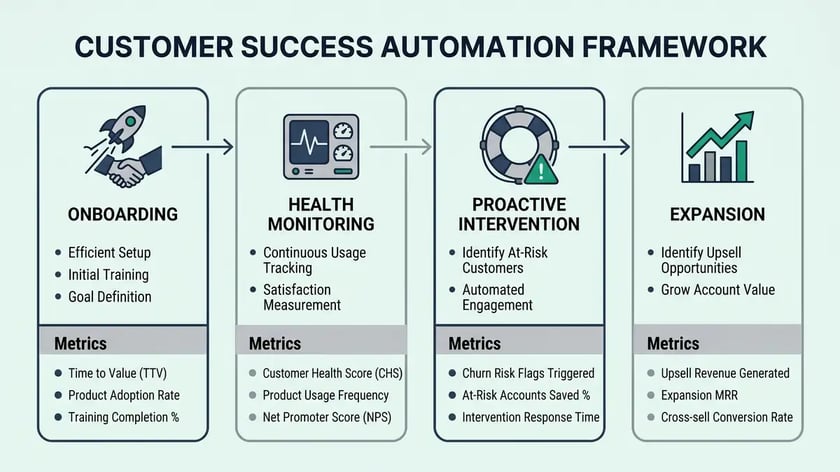
Not all customer success workflows benefit equally from automation. The highest-ROI targets share three characteristics: they are high-frequency, they involve predictable patterns that AI can learn, and their outcomes are directly measurable. Based on documented implementations across mid-market SaaS companies, five workflows consistently deliver the strongest returns.

Health Scoring is the foundational workflow. AI-driven health scores consolidate product usage patterns, support volume, NPS scores, and lifecycle events into a unified metric that updates continuously — daily or weekly rather than the quarterly cadence of manual assessment. Planhat's analysis shows these AI scores identify which factors historically lead to churn or expansion and weight them accordingly, creating predictive rather than retrospective assessments. The result: CSMs focus effort where it drives maximum impact rather than managing by calendar.
Onboarding Automation addresses one of the most critical inflection points in the customer lifecycle. According to GuideCX, 48% of customers abandon onboarding if they do not see value quickly. Automated onboarding systems — trigger-based in-app guidance, personalised milestone tracking, exception routing to humans — increase successful onboarding rates by approximately 45% while reducing onboarding cycle times by 40–45%. This directly improves the client onboarding experience while accelerating time-to-value.
Expansion Identification uses AI to continuously monitor usage patterns and compare them against historical expansion triggers — approaching plan limits, deep feature adoption, growing user counts, and product whitespace analysis. Monday.com reports that these systems identify expansion opportunities before CSMs or customers even recognise the need, enabling proactive upsell conversations rather than reactive price negotiations.
Renewal Management increasingly leverages AI for preparation and execution. Vitally's analysis shows AI systems now pull together usage data, financial metrics, and engagement history into executive summaries for QBR preparation, reducing preparation time from hours to minutes while improving CSM conversation quality.
Administrative Automation recovers 30–50% of CSM time currently consumed by data entry, manual meeting preparation, follow-up generation, and presentation building. MindStudio estimates this translates to 7–10 hours per week freed for strategic customer work per CSM — capacity that enables either reduced headcount requirements or expanded coverage ratios.
Ready to deploy autonomous customer success systems that protect and expand your revenue? Talk to peppereffect about building your Customer Success Engine.
Book Your Growth Mapping CallHow Should Mid-Market SaaS Companies Implement Customer Success Automation?

Implementation success depends 95% on organisational factors, not technology. The nCino research on automation execution gaps documents a 55-point gap between companies that recognise automation's potential (87%) and those that have moved beyond pilots to meaningful implementation (32%). The technology is only 5% of the problem — the rest is organisational readiness, process clarity, and change management.
Breakthrough performers adopt focused 90-day proof-of-concept projects targeting one specific pain point with success metrics defined upfront, rather than attempting enterprise-wide transformation. For companies implementing AI automation metrics from day one, this phased approach dramatically improves success rates.
Establish Data Foundation (Weeks 1–6)
Consolidate customer data from product analytics, CRM, support, and billing systems into unified customer profiles. Establish data governance rules ensuring consistency and accuracy. Clean historical data before using it to train predictive models. Companies that skip this foundational work encounter implementations that take 9–12 months to generate value rather than the 3–6 months achievable with proper preparation.
Deploy Health Scoring and Churn Prediction (Weeks 4–10)
Implement AI-driven health scoring that consolidates multiple signals into real-time assessments. Configure churn prediction models using historical customer data. Define alert thresholds and CSM intervention playbooks. Target: identify at-risk customers 30+ days before cancellation with 80%+ accuracy within the first quarter.
Automate Onboarding and Digital Touchpoints (Weeks 8–14)
Replace manual one-to-one onboarding with trigger-based automated systems. Deploy in-app guidance, personalised milestone tracking, and exception routing for complex cases. Implement digital engagement sequences for low-touch and mid-touch segments. Target: 45% improvement in successful onboarding completion rates.
Activate Expansion Intelligence (Weeks 12–18)
Configure AI systems to monitor usage patterns against historical expansion triggers. Build automated expansion recommendation workflows that surface upsell and cross-sell opportunities to CSMs with context and timing guidance. Integrate CRM automation to track and measure expansion pipeline. Target: 20–30% increase in expansion revenue conversion rates.
Scale with Autonomous Agents (Weeks 16–24)
Deploy autonomous AI agents for routine customer interactions — automated check-ins, usage reports, renewal preparation, and proactive outreach. Implement agent handoff protocols to route complex situations to human CSMs seamlessly. Establish governance frameworks for AI decision-making boundaries. Target: 25–70% increase in accounts managed per CSM.
Avoid This Implementation Trap
Do not automate broken processes. The most common execution gap occurs when organisations attempt to deploy AI on top of undocumented or inconsistent customer success workflows. Documented workflows often differ significantly from actual practices. Map and standardise your actual processes first, then automate — otherwise you are scaling dysfunction at machine speed.
How Do You Choose the Right Customer Success Platform?
Platform selection should match company stage, team size, and technical sophistication — not feature lists. The customer success platform market includes several dominant options serving different use cases. For mid-market SaaS companies in the $10M–$40M ARR range, the critical evaluation criteria are integration depth, time-to-value, and the ability to scale from current team size to 2–3x without re-platforming.
| Platform | Best For | Starting Price | Implementation | Key Differentiator |
| Gainsight | Full-scale CS at $20M+ ARR | Enterprise pricing | 8–16 weeks | Deepest AI, multi-product support |
| Totango | Fast deployment, modular | $249/mo (2 users) | ~12 weeks | Pre-built SuccessBLOCs, Unison AI |
| ChurnZero | Salesforce-heavy orgs | $20K–$40K/year | 4–8 weeks | In-app messaging, fast setup |
| Vitally | Fast-growing mid-market | Mid-market pricing | 4–8 weeks | Account health + impact analytics |
| Planhat | Onboarding-to-retention | Mid-market pricing | 6–10 weeks | Lifecycle workflows, AI scoring |
| HubSpot Service Hub | HubSpot ecosystem users | CRM-integrated | 2–4 weeks | Unified CRM + CS, lowest friction |
Sources: Accoil Gainsight Alternatives Analysis, Gainsight vs Totango Comparison
The build-vs-buy decision has fragmented beyond a simple binary. As CIO.com reports, companies increasingly adopt a hybrid approach: buying foundation models and vendor-provided agents, building specialised risk-management agents, purchasing orchestration platforms, and maintaining governance and integration layers internally. For most mid-market SaaS companies, the optimal path is purchasing a capable CS platform for core functionality while building custom integrations for company-specific business logic.
Integration architecture deserves particular attention. When integrations between customer success platforms, CRM systems, product analytics tools, and billing systems are unreliable, the quality of AI-driven insights degrades substantially. Gainsight's data-driven CS research confirms that data silos kill AI effectiveness — successful implementations prioritise robust data integration as a foundational prerequisite before deploying AI capabilities.
What Are the CSM Productivity and Coverage Gains from Automation?
The most immediate measurable benefit is the ability to serve dramatically more customers without proportional headcount growth. Gainsight's 2026 Customer Success Index documents that companies using advanced CS platforms support approximately 25% more accounts per CSM in commercial and enterprise segments, and nearly 70% more accounts per CSM in SMB segments. These coverage improvements do not come from cutting corners — they come from automating routine touchpoints, scaling self-service capabilities, and enabling AI agents to handle interactions that do not require human judgement.
The operational efficiency metrics are equally compelling. Leading customer success organisations operate at approximately 3% of revenue spent on CS operations, compared to approximately 8% for companies not using advanced platforms — despite the leading companies actually delivering better retention and NRR metrics. This 5-percentage-point gap in CS cost efficiency translates directly to margin expansion and profitability improvement.
| Productivity Metric | Before Automation | After Automation | Improvement |
| Admin Time per CSM | 40–50% of work time | 20–25% of work time | 30–50% reduction |
| Enterprise Accounts per CSM | 10–30 accounts | 15–40 accounts | 25% increase |
| SMB Accounts per CSM | 100–300 accounts | 170–500 accounts | 70% increase |
| CS Spend (% of Revenue) | ~8% | ~3% | 5pp margin improvement |
| Onboarding Cycle Time | Baseline | 40–45% faster | Accelerated time-to-value |
| ARR Managed per CSM | Baseline | 40–60% higher | 12–18 months post-implementation |
Sources: Gainsight CS Index 2026, MindStudio AI Agents for CS, SaaS Pulse Media CS Automation 2026
The tiered engagement model is how the best AI-driven professional services organisations structure their customer success operations. High-touch enterprise accounts receive dedicated CSMs with regular strategic check-ins and custom success plans. Mid-touch accounts operate with pooled CSMs using standardised playbooks and automated data preparation. Digital-led SMB accounts receive automated engagement with occasional CSM intervention for complex issues. The Freedom Machine architecture enables this tiered model to scale — delivering consistent, personalised engagement across the entire customer base rather than concentrating attention on a few high-value accounts.
Key Takeaway
Customer success automation does not eliminate CSMs — it amplifies their impact. By automating administrative work (30–50% time savings), scaling digital engagement for lower-touch segments, and providing AI-driven prioritisation, companies can serve 25–70% more accounts per CSM while operating at 3% of revenue instead of 8%. The result is simultaneously better customer outcomes and dramatically improved unit economics.
Frequently Asked Questions
What is a good customer retention rate for B2B SaaS companies?
For established B2B SaaS companies, the industry benchmark targets annual customer churn of 5% or lower, which translates to a 95%+ gross retention rate. Companies with higher Average Contract Values exceeding $6,000 typically achieve better retention, with top-quartile performers maintaining annual gross dollar churn below 3%. Mid-market companies ($10M–$40M ARR) implementing AI-driven customer success automation report retention improvements of 15–40% within the first year, driven by predictive churn identification and proactive intervention playbooks that address risk 30–90 days before cancellation.
How do you measure customer success automation ROI?
Measure customer success automation ROI across four dimensions: retention impact (reduction in gross churn rate and dollars retained), expansion revenue (increase in NRR and upsell/cross-sell conversion rates), operational efficiency (reduction in CS spend as a percentage of revenue, increase in ARR managed per CSM), and time-to-value (reduction in onboarding cycle time). Companies deploying comprehensive AI automation metrics typically achieve 3–6x ROI within the first year, with payback periods of 6–12 months for mid-market implementations.
What is a customer success platform and how does it differ from CRM?
A customer success platform is specialised software designed to manage the post-sale customer lifecycle — health scoring, churn prediction, onboarding orchestration, renewal management, and expansion identification. While CRM systems focus on managing customer relationships and sales pipeline data, CS platforms focus on customer outcomes and proactive engagement. The distinction matters because CRM data alone cannot predict churn or identify expansion opportunities — CS platforms integrate product usage, support, and engagement data to create predictive health assessments that CRMs lack.
Can customer success automation work for companies with small CS teams?
Customer success automation delivers disproportionately high value for small CS teams precisely because it addresses their primary constraint — limited human capacity. A 3–5 person CS team managing 200+ accounts cannot deliver consistent, proactive engagement manually. Automation handles digital touchpoints, data aggregation, and routine interactions, enabling small teams to focus human effort on high-impact strategic conversations. Platforms like Totango, ChurnZero, and Vitally specifically target mid-market teams with fast deployment timelines of 4–12 weeks and pricing starting below $25,000 annually.
How long does it take to implement customer success automation?
Implementation timelines vary by scope. Individual workflow automations using platform tools can reach production within 4–8 weeks. Full-scale implementations including data integration, health scoring, churn prediction, and expansion intelligence typically span 16–24 weeks. The critical prerequisite — data foundation and governance — accounts for 6–8 weeks of that timeline. Companies that skip data preparation encounter implementations taking 9–12 months to generate value. The phased deployment approach with 90-day proof-of-concept sprints consistently outperforms big-bang transformation attempts.
What happens when automation fails to predict churn accurately?
Churn prediction accuracy depends directly on data quality and model training. The most common failure modes are insufficient historical data (models need 12+ months of customer behaviour data), poor data integration (disconnected systems create incomplete customer profiles), and stale models (prediction accuracy degrades if models are not retrained as customer behaviour evolves). Companies addressing these issues systematically achieve prediction accuracy above 85%, while those deploying AI on messy data foundations often see accuracy below 60%. AI governance frameworks that mandate regular model retraining and data quality audits prevent this degradation.
How do autonomous AI agents differ from traditional automation in customer success?
Traditional automation follows predetermined rules and requires human intervention at exception points — an automated email sequence, a scheduled check-in reminder, a rule-based alert. Autonomous AI agents can reason about problems, generate solution paths, and execute complex multi-step workflows with minimal human oversight. An autonomous CS agent does not just flag a declining health score — it analyses the specific signals causing the decline, selects the appropriate intervention playbook, executes initial outreach, and escalates to a human CSM only when the situation requires judgement that exceeds its boundaries.
Stop Losing Revenue to Preventable Churn
peppereffect architects autonomous customer success systems that protect your existing revenue while systematically identifying and converting expansion opportunities. Our 4 Pillars methodology deploys AI-driven health scoring, churn prediction, and expansion intelligence — so your CS team serves 2–3x more accounts without adding headcount.
Book Your Growth Mapping CallLearn How peppereffect Deploys AI Operating Systems → customer success metrics causal churn driver framework customer health score early warning system SaaS support automation
Resources
- SkyQuest — Customer Success Platforms Market Report 2024–2033
- Lucid.now — AI Churn Prediction Benefits and Accuracy Benchmarks
- Gainsight — Customer Success Index 2026: Priorities and Results
- nCino — 4 Execution Gaps That Explain Why Automation Strategies Fail
- CRV — Net Revenue Retention Formulas and Benchmarks
- SaaS Capital — 2025 Benchmarking Metrics for Bootstrapped SaaS Companies
- Envive — 26 AI-Powered Upsell and Cross-Sell Statistics
- Monday.com — AI in Customer Success: Use Cases and Real ROI