

What Is a Freedom Machine — and Why Does Every B2B Founder Need One?
The term freedom machine describes a business business process automation buyer's guide operating system that generates revenue, delivers coaching business automation client results, and acquires new customers without the founder's daily involvement. It is not a metaphor. It is an architectural blueprint — a set of interconnected, autonomous systems that replace founder dependency with AI-powered workflow automation across every critical business function. orchestration infrastructure
Most B2B founders build businesses that depend entirely on them. They close every deal, manage every client, and approve every deliverable. The result is what Michael Gerber called The Technician's Trap in The E-Myth Revisited — a business that cannot function without its creator. Research shows that founder-dependent businesses grow 42% slower than those with independent management structures (McKinsey), and nearly 40% of startup founders work more than 60 hours per week (Gitnux).
The freedom machine concept solves this by installing four integrated pillars 4 pillars of B2B growth — Lead Generation, Sales Administration, Operations, and Marketing Infrastructure — each powered by autonomous agents and logic-gated workflows that execute without founder input.
What you will learn in this article:
- Why the Technician's Trap destroys business value — and what the data proves
- How traditional business operating systems like EOS and Scaling Up fall short in the AI era Scaling Up OPSP and Rocks framework
- The 4 Pillars architecture that decouples revenue from founder hours
- Step-by-step blueprint for installing your own freedom machine
- Real performance benchmarks 2026 SaaS growth rate benchmarks: hours reclaimed, CAC reduction, and valuation multiples
Key Takeaway
A freedom machine is not a philosophy — it is a business operating system built on autonomous AI agents that handle lead generation, sales, operations, and marketing without founder intervention. The result: predictable revenue growth, 8-15 hours reclaimed per week, and a business that commands 2x higher valuation multiples at exit.
Why the Technician's Trap Destroys Your Business Value

The Technician's Trap operates on a deceptively simple mechanism: the founder is the business. Every critical decision, every client relationship, every quality check flows through one person. This feels productive. It is, in fact, the single greatest constraint on growth, profitability, and exit value.

The hours problem is severe. Research from Founder Reports shows that 32% of entrepreneurs work more than 70 hours weekly, and the average entrepreneur spends 10 hours more per week working than a typical employee. A 2024 study found that 53% of founders experienced burnout (Entrepreneur), with 61% suffering sleep disruptions and 58% reporting anxiety.
But the real damage is financial. Founder-dependent B2B companies trade at 3-4x EBITDA multiples, while businesses with independent operations command 7-8x multiples (SE Advisors). That is a 30-50% valuation discount applied by buyers who see concentrated operational risk. Beyond the purchase price, founder-dependent exits include extended earnout periods of 2-3 years, larger escrow amounts, and employment agreements that keep the founder tied to the business long after the sale (Bennett Financials).
| Metric | Founder-Dependent | Systems-Independent |
| EBITDA Multiple at Exit | 3-4x | 7-8x |
| Founder Hours / Week | 60-70+ | 10-20 |
| Growth Rate | 42% slower | Market-rate or above |
| Burnout Rate | 53%+ | Significantly lower |
| Earnout Period at Exit | 2-3 years | 0-6 months |
Sources: SE Advisors, Gitnux, Bennett Financials
Why EOS and Scaling Up Are Not Enough Anymore
Traditional business operating systems solved the awareness problem. Gino Wickman's Entrepreneurial Operating System (EOS) — now adopted by over 100,000 companies — gave founders a structured framework with six components: Vision, People, Data, Issues, Process, and Traction. Verne Harnish's Scaling Up addressed similar challenges through the Four Decisions framework (EOS One).
These frameworks delivered real results. Companies implementing EOS report 18-30% average revenue growth and 83% report increased clarity and focus (Strety). But they share a critical limitation: they assume human execution. Every meeting rhythm, every scorecard update, every accountability chart requires a person to run it. The framework creates structure — but the structure still runs on founder hours.
In the agentic AI era, that assumption is outdated. Gartner projects that at least 15% of day-to-day work decisions will be made autonomously through agentic AI by 2028, up from 0% in 2024 (Gartner). McKinsey's State of AI 2025 report found that 78% of enterprises now use AI in at least one function (McKinsey), and Deloitte's 2026 enterprise survey confirmed worker access to AI rose 50% in 2025 alone (Deloitte).
The Framework Fallacy
Implementing EOS or Scaling Up without AI automation business process automation consulting is like installing a road map in a car that still requires the founder to pedal. The structure is correct, but the execution engine is missing. A freedom machine takes the same structural principles — Vision, Process, Data, Accountability — and replaces the human execution layer with autonomous AI agents.
| Dimension | EOS / Scaling Up | Freedom Machine (AI-Native) |
| Execution Model | Human-driven meetings and scorecards | Autonomous agents with logic gates |
| Lead Generation | Manual outreach + marketing hire | AI-powered prospecting at scale |
| Sales Administration | CRM discipline + sales manager | Automated proposals, nurture, CRM |
| Operations | SOPs + project manager | AI onboarding + fulfillment systems |
| Marketing | Content calendar AI content refinery + agency | Agentic content + SEO automation |
| Founder Hours Required | 30-40/week for oversight | 5-15/week for strategy only |
Sources: ScaleUpExec, Align Today
The 4 Pillars: Architecture of a Freedom Machine
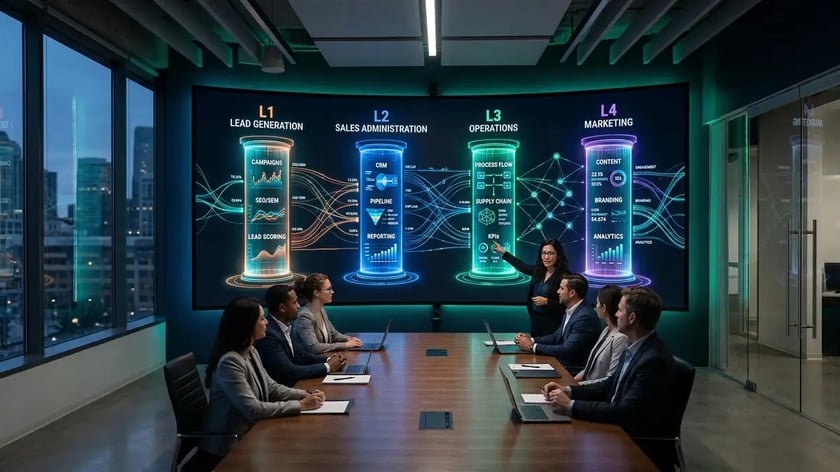
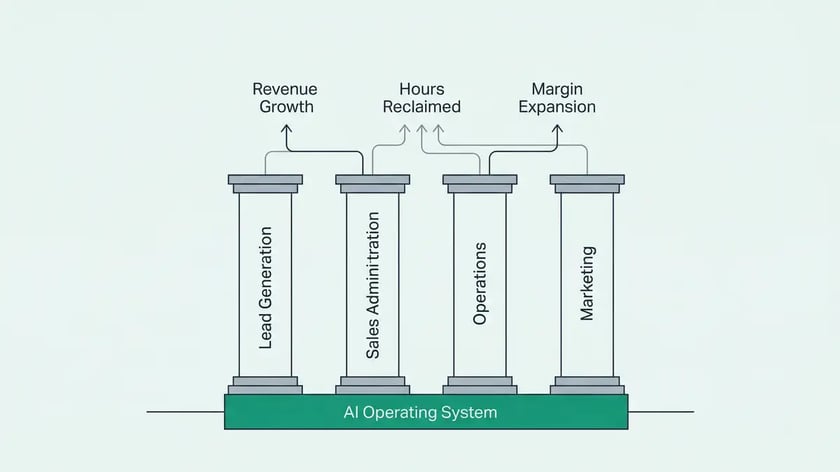
A freedom machine is not one tool or one automation. It is an integrated business operating system built on four pillars, each containing autonomous agents that handle execution while the founder focuses on strategic direction. This is the architecture that decouples revenue from headcount — and from founder hours.
Lead Generation — The Engine
Autonomous cold email outreach, LinkedIn prospecting, and content systems that generate qualified pipeline 24/7. AI agents research prospects, personalise messages, and book meetings without manual intervention. Companies using AI-powered lead generation report 50% more sales-ready leads and 60% lower acquisition costs (Cirrus Insight).
Sales Administration — The Conversion
Automated proposal generation, lead nurture sequences, and CRM intelligence that move deals through the pipeline. Sales representatives currently spend only 28% of their time actively selling — the rest is consumed by administration (Everstage). A freedom machine eliminates this waste by automating follow-ups, proposals, and data entry.
Operations — The Delivery
Systematic client onboarding, automated fulfillment, and AI project management that deliver results without founder involvement. Onboarding automation alone can reduce onboarding time by 78% and improve early-stage client retention by 36%.
Marketing Infrastructure — The Foundation
Web architecture, generative engine optimization (GEO), answer engine optimization, and search visibility systems that build brand authority autonomously. These are the long-term assets that compound over time — unlike paid acquisition that stops generating leads when you stop spending.
Key Takeaway
The four pillars are not independent tools — they form a single integrated system where lead generation feeds sales administration, sales feeds operations, and operations data informs marketing strategy. Each pillar strengthens the others, creating systemic leverage that grows autonomously while the founder focuses on vision and strategic partnerships.
How to Install a Freedom Machine: The 5-Phase Blueprint

Building a freedom machine is not a weekend project. It is a systematic installation that follows a proven sequence, starting with the highest-leverage pillar and expanding outward. The timeline varies by business complexity, but most B2B companies can achieve meaningful founder independence within 90-180 days.
Phase 1: Audit and Architecture (Weeks 1-2). Map every process the founder currently executes. Identify which tasks are strategic (keep) versus operational (automate). Most founders discover that 60-70% of their weekly hours are spent on tasks that an AI agent or workflow orchestration system could handle.
Phase 2: Lead Generation Engine (Weeks 3-6). Install the first pillar — the one with the fastest ROI. Deploy cold email and LinkedIn outreach systems that generate qualified meetings without founder involvement. This immediately frees the hours previously spent on manual prospecting and follow-up.
Phase 3: Sales Administration Automation (Weeks 5-10). Overlap with Phase 2. Install AI-powered sales systems including automated proposals, CRM workflows, and nurture sequences. Sellers using AI automation save 1-5 hours weekly on administrative tasks (Cirrus Insight).
Phase 4: Operations and Fulfillment Systems (Weeks 8-14). Automate client onboarding, project management, and delivery tracking. This is where the freedom machine truly decouples revenue from the founder — clients receive consistent results regardless of founder availability.
Phase 5: Marketing Infrastructure (Weeks 12-24). Install the compounding layer — content systems, search visibility, and GEO optimization that build long-term authority. This pillar takes longest to mature but delivers the highest lifetime value.
| Phase | Pillar | Timeline | Hours Reclaimed / Week |
| 1 | Audit and Architecture | Weeks 1-2 | Baseline established |
| 2 | Lead Generation Engine | Weeks 3-6 | 3-5 hours |
| 3 | Sales Administration | Weeks 5-10 | 4-6 hours |
| 4 | Operations and Fulfillment | Weeks 8-14 | 3-5 hours |
| 5 | Marketing Infrastructure | Weeks 12-24 | 2-4 hours |
Sources: Rep Order Management, Cirrus Insight
Ready to escape the Technician's Trap and architect your freedom machine? peppereffect installs the complete 4-pillar operating system for B2B founders who refuse to trade hours for revenue.
Book Your Growth Mapping CallPerformance Benchmarks: What a Freedom Machine Actually Delivers
The business case for building a freedom machine is not theoretical. The data across AI adoption, automation ROI, and founder independence research converges on clear outcomes that B2B founders can benchmark against.
Time recovery is the most immediately felt benefit. Research shows that founders implementing comprehensive AI automation recover 8-15 hours per week, with the largest gains in lead generation (3-5 hours), sales administration (4-6 hours), and operational tasks like invoice processing and client communication (2-3 hours). One engineering services firm implementing workflow automation saved their team 360 hours per month on administrative tasks alone.
Revenue acceleration follows from the time recovery. When AI handles prospecting, proposals, and follow-ups, the founder can focus on high-value activities: strategic partnerships, product development, and relationship building. Businesses using AI for sales report 50% increases in lead volume while reducing customer acquisition costs by up to 60% (Rep Order Management). Personalised follow-up emails demonstrate 32% higher response rates compared with generic sequences.
Valuation impact compounds over time. As the business demonstrates the ability to operate independently, the key-person discount evaporates. Moving from a 3-4x to a 7-8x EBITDA multiple on a business earning $1M EBITDA represents a $3-4M increase in enterprise value — purely from building systems that reduce founder dependency (Website Closers).
| Outcome | Without Freedom Machine | With Freedom Machine |
| Founder Hours / Week | 50-70+ | 10-20 |
| Lead Volume | Capped by manual effort | +50% via AI prospecting |
| Customer Acquisition Cost | High (manual process) | -60% via targeted automation |
| Sales Cycle Length | Extended by admin overhead | -30% via automated nurture |
| EBITDA Multiple at Exit | 3-4x | 7-8x |
| Enterprise Value ($1M EBITDA) | $3-4M | $7-8M |
Sources: SE Advisors, Cirrus Insight, Website Closers
Key Takeaway
The freedom machine is not about working less — it is about working on the right things. The founder shifts from operator to architect: setting vision, building strategic relationships, and making the high-leverage decisions that only a founder can make. The AI operating system handles everything else.
Frequently Asked Questions
What is a freedom machine in business?
A freedom machine is a business operating system that generates revenue and delivers client results without the founder's daily involvement. It comprises four integrated pillars — Lead Generation, Sales Administration, Operations, and Marketing Infrastructure — each powered by autonomous AI agents and logic-gated workflows. The outcome is a business that runs predictably regardless of whether the founder is present, dramatically increasing both quality of life and enterprise valuation at exit.
What is a business operating system?
A business operating system is a structured framework for running a company. Traditional examples include EOS (Entrepreneurial Operating System) by Gino Wickman and Scaling Up by Verne Harnish, which organize businesses around vision, process, data, and accountability. The next generation of business operating systems — what we call the freedom machine — adds an AI execution layer that automates the manual work these frameworks still require humans to perform.
How do you build a business that runs without you?
Building a business that runs without you requires systematically replacing founder dependency with autonomous systems. Start by auditing every task you perform weekly and categorizing each as strategic (keep) or operational (automate). Then install AI-powered systems across lead generation, sales, operations, and marketing in a phased sequence over 90-180 days. The goal is to reduce founder involvement from 60+ hours to under 15 hours per week focused exclusively on strategic decisions.
What is the difference between EOS and a freedom machine?
EOS provides the structure for running a business — meeting rhythms, scorecards, accountability charts, and issue resolution processes. A freedom machine provides both structure and autonomous execution. Where EOS requires a human to update every scorecard and run every meeting, the freedom machine uses AI agents to execute these processes automatically. EOS tells you what to track; a freedom machine tracks it for you.
How do you systemize a B2B company with AI?
Start with the highest-leverage pillar — typically lead generation or sales automation — where ROI is fastest and most measurable. Deploy AI agents for prospecting, proposal generation, and CRM automation. Then expand to operations (automated client onboarding, fulfillment tracking) and marketing (GEO, content systems). Each pillar should connect to the others through shared data and workflow orchestration.
What are the 4 pillars of a business operating system?
The four pillars are: Lead Generation (cold email, LinkedIn, content systems), Sales Administration (proposals, nurture, CRM automation), Operations (client onboarding, fulfillment, project management), and Marketing Infrastructure (web architecture, SEO, GEO, paid acquisition). Together, they cover the complete customer lifecycle from first touch to ongoing delivery. Each pillar operates autonomously while sharing data with the others for systemic leverage.
How long does it take to build a business that runs itself?
Most B2B companies can achieve meaningful founder independence within 90-180 days using a phased installation approach. The lead generation pillar typically delivers results within 3-6 weeks. Sales automation follows in weeks 5-10. Full operational independence — including automated fulfillment AI candidate screening AI candidate screening and marketing infrastructure — requires 4-6 months of systematic implementation. The key is starting with the pillar that frees the most founder hours immediately.
Install Your Freedom Machine
peppereffect architects the complete AI operating system for B2B founders ready to decouple revenue from headcount — and from their own calendar. Four pillars. One integrated system. Measurable freedom.
Book Your Growth Mapping CallEscape the Technician's Trap: related systems
The playbooks: scale a service business without hiring, decouple revenue from headcount, and when to bring in an AI marketing agency.
The systems: automated fulfillment, client onboarding automation, and AI workflow automation.
Install it: our AI operations systems put your Freedom Machine into production. Book a Growth Mapping Call.
Resources
- McKinsey — The State of AI 2025: Agents, Innovation, and Transformation
- Gartner — Top 10 Strategic Technology Trends for 2025
- Deloitte — The State of AI in the Enterprise 2026
- SE Advisors — Founder Dependency: The Hidden Valuation Killer
- ScaleUpExec — How Many Companies Run on EOS?
- Founder Reports — 17 Mental Health Statistics for Entrepreneurs
- Cirrus Insight — AI in Sales 2025: Statistics, Trends and Insights
- Bennett Financials — The Key Man Discount: Reducing Owner Dependency
AI agent workflow infrastructure calculate your Freedom Score
7-figure consulting operations
autonomous AI agents replacing chatbots grand slam offer architecture
professional services delivery automation
B2B operational automation playbook Freedom Machine blueprint for 7-figure founders ARPU expansion infrastructure recurring revenue growth
SaaS financial model that gets funded
coaching practice architecture operational efficiency without adding headcount AI revenue operations when to automate vs when to hire virtual assistant strategy for consultants project management templates and workflows