What Does It Really Cost to Build AI how much an AI agent costs Automation — Agency vs In-House?
The decision between hiring an AI automation agency and building an in-house team isn't just a procurement question — it's a strategic infrastructure choice that determines how fast your B2B company can deploy autonomous workflows, reclaim executive hours, and decouple revenue from headcount. Yet most founders approach this decision with incomplete data, comparing monthly retainers against salaries without accounting for the full cost architecture underneath.
The numbers tell a stark story. According to Gartner's 2026 infrastructure analysis, only 28% of AI infrastructure and operations projects deliver meaningful ROI returns. Meanwhile, building an in-house AI team costs between $702,000 and $914,000 per year for a minimum viable three-person unit — before a single workflow goes live. The alternative? Agency retainers ranging from $2,000 to $20,000+ per month, with deployment timelines measured in weeks rather than quarters.
This isn't a simple cheaper-vs-more-expensive comparison. It's about total cost of ownership, deployment velocity, and which model actually produces the systemic leverage your business needs to scale. Here's the full cost architecture for both paths — with real data, not vendor marketing.
What you'll learn in this comparison:
- The true total cost of ownership for both agency and in-house AI automation — beyond surface-level pricing
- Why deployment speed differences (8-12 weeks vs 16-30 weeks) compound into massive revenue gaps
- Which model fits each B2B scenario: SaaS scaling, executive search firms, and high-ticket consulting
- A quantitative decision framework to evaluate your specific situation against real benchmarks
- When a hybrid model outperforms both pure options — and how 35-42% of enterprises are already using one
Key Takeaway
The agency-vs-in-house decision isn't about which option is cheaper — it's about which delivers faster time-to-value for your specific operational complexity. For most B2B companies under $50M revenue, an AI automation agency delivers 40-50% lower total cost of ownership on initial implementations while deploying 2-3x faster than an equivalent in-house build.
How Much Does an AI Automation Agency Actually Cost?

Agency pricing for AI automation services follows two primary models: monthly retainers and project-based engagements. The range is wide because scope varies dramatically — from a single cold email automation workflow to a full four-pillar operating system covering lead generation, sales administration, operations, and marketing infrastructure.
According to Digital Agency Network's 2026 pricing guide, retainer-based AI automation engagements typically fall between $2,000 and $20,000+ per month, depending on the complexity and number of workflows deployed. Project-based fees range from $1,000 to $35,000+ for standalone implementations. Premium agencies specialising in agentic workflow architecture — where autonomous agents execute multi-step processes without human intervention — command the higher end of this range.
| Agency Model | Monthly Cost | Typical Scope | Best For |
| Starter Retainer | $2,000-$5,000 | 1-2 workflow automations, basic CRM setup | Solo consultants, early-stage testing |
| Growth Retainer | $5,000-$10,000 | 3-5 workflows, lead gen + sales admin | B2B companies $2M-$10M revenue |
| Scale Retainer | $10,000-$20,000+ | Full 4-pillar system, agentic orchestration | Mid-market B2B $10M-$50M revenue |
| Project-Based | $1,000-$35,000+ (one-time) | Single system build, migration, or integration | Specific pain-point deployment |
Sources: Digital Agency Network, MonetizeBot 2026 Pricing Analysis

What these numbers don't capture is the hidden cost architecture of agency engagements. Most agencies charge separately for tool licensing, API costs (OpenAI, Anthropic, Make.com, n8n), and third-party integrations. A $5,000/month retainer can easily become $7,000-$8,000 when you add platform subscriptions, usage-based API billing, and data enrichment tools. The transparent agencies — the ones worth hiring — itemise these costs upfront rather than burying them in inflated retainers.
The critical variable is what you're actually buying. A traditional digital agency selling "AI services" typically delivers glorified templates — pre-built workflow automations that require manual adjustment and ongoing maintenance. A genuine AI automation agency architects autonomous systems: logic-gated workflows that self-execute, self-monitor, and adapt to changing inputs without requiring a human in every loop. The price difference between these two approaches is often 2-3x, but the value difference is 10x.
What Does Building an In-House AI Team Actually Cost?
The in-house path requires assembling a minimum viable AI team: an AI/ML engineer, a data engineer, and a project manager or automation specialist. Coursera's 2026 salary analysis places the median AI engineer salary at $145,080, while Glassdoor data shows an average of $141,619 for AI engineering roles in the US. But base salary is only the starting line.
Total compensation — including benefits, equity, workspace, tooling, and management overhead — typically runs 1.3-1.5x base salary. For a three-person team, the fully loaded annual cost breaks down like this:
| Role | Base Salary | Fully Loaded Cost | Time to Fill |
| AI/ML Engineer (Senior) | $145,000-$185,000 | $189,000-$278,000 | 90-142 days |
| Data Engineer | $120,000-$155,000 | $156,000-$233,000 | 60-90 days |
| Automation/Project Manager | $95,000-$130,000 | $124,000-$195,000 | 30-60 days |
| Total Team (Year 1) | $360,000-$470,000 | $702,000-$914,000 | 120-180 days (sequential) |
Sources: Coursera, Glassdoor, Second Talent
Year 1 costs extend beyond salaries. You're also covering tool and infrastructure licensing ($30,000-$80,000/year for AI platforms, cloud compute, development environments, and monitoring tools), recruitment costs ($45,000-$90,000 in agency fees or internal recruiting time at 15-20% of first-year salary per hire), and the opportunity cost of the 4-6 month hiring window before the team is assembled. According to Second Talent's global AI talent data, the demand-to-supply ratio for AI professionals sits at 3.2:1, meaning every role averages 142 days to fill.
The Hidden Productivity Gap
Even after hiring, a new in-house AI team typically requires 3-6 months of ramp-up before delivering production-grade workflows. During this period, you're paying full salaries for partial output. The combined hiring + ramp-up timeline means 9-12 months from decision to first live deployment — compared to 8-12 weeks with an experienced agency. For companies facing competitive pressure or lead leakage, this delay has a direct revenue cost.
How Do the Total Costs Compare Over 12-36 Months?

The real comparison isn't monthly retainer vs monthly salary — it's total cost of ownership (TCO) over a meaningful time horizon. For single-project implementations, agencies deliver 40-50% lower TCO. But the economics shift as the scope and duration of AI automation work expands.
Here's the TCO comparison across three common B2B scenarios, modelled over 12, 24, and 36 months:
| Scenario | Agency TCO (12 mo) | In-House TCO (12 mo) | Breakeven Point |
| Single pillar (e.g., lead gen only) | $60,000-$120,000 | $750,000-$1,000,000 | Never (agency wins) |
| Two pillars (lead gen + sales admin) | $120,000-$240,000 | $750,000-$1,000,000 | 36+ months |
| Full 4-pillar system | $240,000-$360,000 | $750,000-$1,000,000 | 18-24 months |
Sources: MonetizeBot, MKT Clarity
The breakeven analysis reveals a clear pattern: the narrower your automation scope, the more the agency model dominates. If you need one or two pillars automated — lead generation and sales automation, for instance — the in-house build never breaks even economically. Only when you're deploying comprehensive, continuous automation across all four pillars does the in-house investment start to amortise within a reasonable timeframe.
Key Takeaway
For B2B companies under $50M revenue targeting 1-2 automation pillars, the agency model delivers 3-8x better cost efficiency over 12 months. The in-house model only becomes economically competitive when you're running full-stack AI operations across lead generation, sales, operations, and marketing — and even then, only after 18-24 months of sustained investment.
Why Does Deployment Speed Matter More Than Most Founders Think?
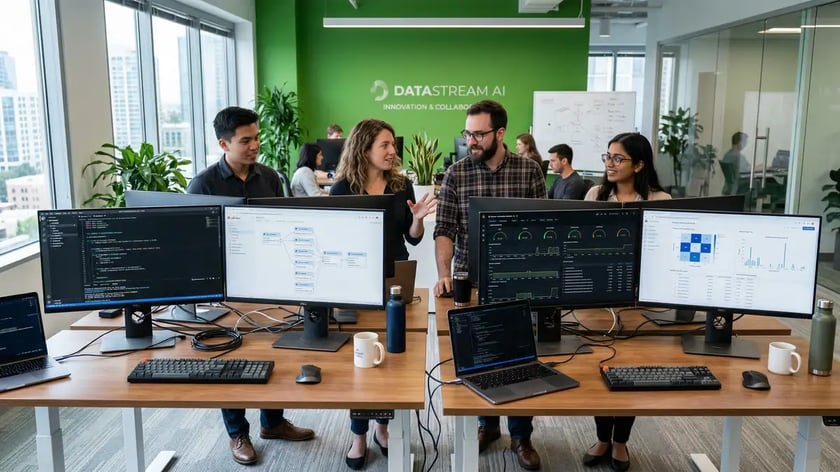
Deployment velocity is where the agency advantage compounds most aggressively. An experienced AI automation agency deploys production workflows in 8-12 weeks because they've built the same patterns dozens of times. An in-house team, even a talented one, takes 16-30 weeks for equivalent deployments — and that's after the hiring period.
The revenue impact of this speed gap is quantifiable. According to McKinsey's State of AI report, 88% of organisations now use AI in at least one business function, with 23% actively scaling agentic AI workflows. Companies deploying 6 months earlier capture market position that compounds: earlier pipeline generation, earlier conversion optimisation, earlier operational efficiency. For a B2B SaaS company growing at 50% YoY, a 6-month deployment delay represents $2.5M-$12.5M in deferred revenue on a $10M-$50M ARR base.
This is why the pure cost comparison misses the strategic picture. Choosing the cheaper option that takes twice as long doesn't save money — it costs revenue. For companies trapped in the Technician's Trap, where the founder is the bottleneck in every sales and delivery process, each additional month of manual operations has a compound cost that far exceeds any agency retainer. The real question isn't "can I afford an agency?" — it's "can I afford to wait 9-12 months for an in-house team to reach the same point?"
What Are the Risks of Each Model?
Both paths carry distinct risk profiles that most comparison articles ignore. Understanding these risks is critical because Gartner reports that 50% of GenAI projects are abandoned after the proof-of-concept stage — regardless of whether the team is internal or external. The failure mode differs, but the failure rate is alarmingly consistent.
| Risk Category | Agency Model | In-House Model |
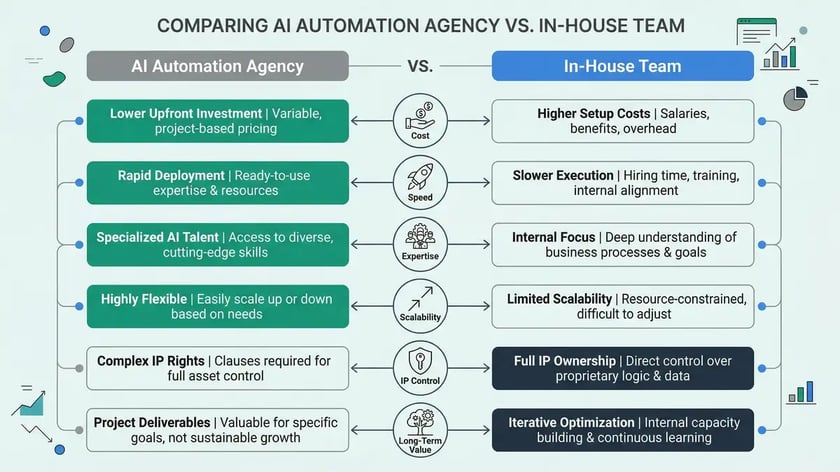
| Vendor dependency | High — switching costs if agency relationship ends | Low — knowledge stays internal |
| Knowledge retention | Medium — documented if agency is disciplined | High — but key-person risk if team is small |
| Customisation depth | Medium — constrained by agency's methodology | High — full control over architecture |
| Scaling flexibility | High — add/remove capacity without HR burden | Low — each new capability requires a hire |
| Time-to-value risk | Low — proven deployment playbooks | High — learning curve, hiring delays |
| Quality consistency | High — if agency has productised methodology | Variable — depends on individual talent |
Sources: Gartner, Forrester 2026 Predictions
The agency risk that keeps executives awake is vendor dependency — the fear that critical business infrastructure lives in someone else's hands. This risk is real but manageable. The best AI automation agencies build on platforms their clients own (HubSpot, Make.com, n8n) and document every workflow comprehensively. The worst agencies use proprietary tools and opaque configurations that create intentional lock-in. The mitigation is straightforward: require full documentation, own all platform accounts, and ensure every workflow can be operated or modified without the agency's involvement.
The in-house risk that most founders underestimate is key-person dependency. A three-person AI team means losing one person eliminates 33% of your capacity — and with 72% of employers reporting difficulty finding AI-skilled talent, replacing that person takes months. According to IDC's workforce readiness report via Workera, the global AI skills gap represents a $5.5 trillion economic impact — indicating the talent shortage is structural, not cyclical.
Ready to architect your AI automation strategy? Explore how agentic workflow automation eliminates manual bottlenecks across your entire B2B operation.
Book a Growth Architecture CallWhich Model Fits Your B2B Company — A Decision Framework
Rather than relying on generic advice, use this quantitative decision framework to evaluate your specific situation. Each factor is scored 1-5, and the total determines the recommended path. This framework is adapted from the approach peppereffect uses with clients across SaaS, executive search, and consulting verticals.
Assess Your Automation Scope (1-5)
Score 1 if you need a single workflow automated (e.g., proposal generation). Score 5 if you need comprehensive automation across lead generation, sales, operations, and marketing. Scores 1-3 favour the agency model; 4-5 favour in-house or hybrid.
Calculate Your Time-to-Value Urgency (1-5)
Score 1 if you have 12+ months before competitive pressure forces deployment. Score 5 if every month of delay costs measurable revenue from lead leakage or operational bottlenecks. Scores 3-5 strongly favour the agency model for initial deployment.
Evaluate Your AI Talent Access (1-5)
Score 1 if you're in a major tech hub with strong recruiting networks. Score 5 if you're in a secondary market or competing against FAANG-level compensation. Scores 3-5 make in-house hiring significantly more expensive and slower.
Determine Your Budget Architecture (1-5)
Score 1 if you have $750K+ allocated for Year 1 AI infrastructure. Score 5 if your budget is under $150K for the first 12 months. Scores 3-5 make the agency model the only viable path to production deployment.
Score and Decide
Total 4-10: In-house build is viable and likely optimal long-term. Total 11-16: Hybrid model — agency for initial deployment, build in-house over 12-18 months. Total 17-20: Agency-first is the clear path. Most B2B companies under $50M revenue score 14-18.
When Does the Hybrid Model Win?
The data increasingly points to a third option: the hybrid model, where an agency handles initial deployment and specialised architecture while the company builds internal capacity to operate and extend the systems. According to Deloitte's 2026 State of AI report, AI access in enterprises has increased by 50%, with 35-42% of enterprises adopting hybrid approaches that combine external expertise with internal operations.
The hybrid model works because it addresses the core weakness of each pure approach. The agency solves the deployment speed problem — getting production workflows live in 8-12 weeks rather than 9-12 months. The internal team solves the long-term ownership problem — retaining institutional knowledge, customising workflows to evolving needs, and eliminating ongoing agency dependency.
The optimal hybrid architecture follows a three-phase pattern that maps directly to how peppereffect deploys the Freedom Machine methodology:
| Phase | Timeline | Agency Role | In-House Role |
| Deploy | Months 1-3 | Architecture, build, launch core workflows | Observe, document, learn the systems |
| Transfer | Months 4-6 | Train, hand over, quality assurance | Operate daily, flag edge cases |
| Scale | Months 7-12+ | Advisory, advanced builds, quarterly reviews | Full ownership, extend and customise |
Sources: Deloitte State of AI 2026, McKinsey State of AI
This model is particularly effective for mid-market B2B SaaS companies (the Sarah Chen profile) scaling from $10M to $50M ARR, where the urgency to deploy is high but the long-term need for internal AI capability is clear. The agency handles the first two pillars — typically lead generation and CRM automation — while the company hires its first AI operations specialist to take ownership within 6 months.
Key Takeaway
The hybrid model delivers the best risk-adjusted outcome for most B2B companies: agency speed for initial deployment (8-12 weeks to first live workflow), combined with internal ownership that eliminates long-term vendor dependency. 35-42% of enterprises have already adopted this approach — and that number is accelerating as the agentic AI landscape matures.
Frequently Asked Questions
How much does an AI automation agency cost per month?
AI automation agency retainers typically range from $2,000 to $20,000+ per month, depending on the number of workflows, complexity of integrations, and whether the agency deploys agentic workflows or simpler rule-based automations. Project-based engagements run $1,000 to $35,000+ as one-time fees. Factor in an additional 20-40% for platform licensing, API costs, and third-party tool subscriptions that most agencies bill separately from their retainer.
Is it cheaper to build an in-house AI team or hire an agency?
For most B2B companies, an agency is significantly cheaper over the first 12-18 months. Building a minimum viable in-house AI team costs $702,000 to $914,000 per year in fully loaded compensation, plus $75,000-$170,000 in tooling and recruitment costs. An agency handling equivalent scope runs $60,000-$240,000 annually. The in-house model only becomes cost-competitive after 18-24 months of full-stack automation across multiple business functions.
How long does it take an AI automation agency to deploy workflows?
Experienced AI automation agencies typically deploy production-ready workflows in 8-12 weeks, compared to 16-30 weeks for an in-house team building from scratch. This speed advantage comes from reusable architecture patterns, pre-built integrations, and cross-client learning. For companies experiencing lead leakage or manual sales bottlenecks, this deployment speed difference translates directly into months of recovered revenue.
What are the biggest risks of hiring an AI automation agency?
The primary risk is vendor dependency — your critical business infrastructure lives in someone else's hands. Mitigate this by ensuring you own all platform accounts (HubSpot, Make.com, n8n), requiring complete workflow documentation, and confirming every system can operate without the agency's involvement. Avoid agencies using proprietary tools or opaque configurations that create intentional lock-in. A legitimate AI automation agency builds on platforms you control.
Can I start with an agency and build in-house later?
Yes — this is the hybrid model that 35-42% of enterprises now use. Start with an agency for initial deployment (months 1-3), transition to a knowledge-transfer phase (months 4-6), then shift to internal ownership with agency advisory support (months 7-12+). This approach captures agency deployment speed while building internal capability. It's the optimal path for mid-market B2B companies scaling from $10M-$50M revenue who need results immediately but want long-term autonomy.
What should I look for when evaluating an AI automation agency?
Evaluate five critical dimensions: methodology (do they have a documented, repeatable deployment framework or are they building custom every time?), platform ownership (do you own all accounts and data?), deployment history (can they show documented case studies with measurable ROI?), integration depth (do they work across your full stack — CRM, email, project management, marketing?), and exit strategy (can you operate independently if the relationship ends?).
How does the AI talent shortage affect the in-house vs agency decision?
The global AI talent shortage is a structural constraint, not a temporary blip. With a 3.2:1 demand-to-supply ratio and average time-to-fill of 142 days for AI roles, building an in-house team is slower and more expensive than most founders anticipate. According to IDC research, the AI skills gap represents a $5.5 trillion economic impact globally. This shortage makes the agency model — where you're renting access to an existing talent pool rather than competing for scarce individual hires — significantly more practical for companies outside major tech hubs.
Stop Debating. Start Deploying.
peppereffect architects AI operating systems for B2B companies that need to scale without scaling headcount. Whether you're evaluating the agency path, building in-house, or designing a hybrid model — our Growth Architecture Call maps the fastest route to production-grade automation across your entire customer lifecycle.
Book Your Growth Architecture CallExplore Our AI Automation Services →
Resources
- Gartner — AI Infrastructure and Operations Projects Stall Ahead of ROI Returns (2026)
- Gartner — 50% of GenAI Projects Abandoned After Proof of Concept
- McKinsey — The State of AI: 88% Adoption, 23% Scaling Agentic Workflows
- Deloitte — State of AI 2026: Enterprise AI Access Up 50%
- Coursera — AI Engineer Salary Analysis ($145,080 Median)
- Digital Agency Network — AI Agency Pricing Guide 2026
- Workera/IDC — The $5.5 Trillion AI Skills Gap Report
- ManpowerGroup — Global AI Talent Shortage Reaches Turning Point
what AI automation services actually deliver transparent build cost ranges buy versus build success rates build-and-handover versus retainer models