Skip Navigation or Skip to Content
Conductor raising baton before a half-assembled modular control room — visual metaphor for B2B AI orchestration coordinating autonomous agents across a workflow stack.

Table of Contents

20 Apr 2026

From Task Automation to Orchestration: The Evolution Every B2B Company Must Make

What is AI Orchestration, and Why Does It Matter in 2026?

AI orchestration is the architectural layer that coordinates autonomous agents, deterministic workflows, systems of record, and human approvals into a single, governed operating model. It is not a smarter version of task automation. It is the infrastructure that decides what should happen next across your entire customer lifecycle, and it has just become the fastest-growing category in enterprise software.

The global AI orchestration platform market was valued at USD 11.1 billion in 2025 and is projected to reach USD 82.15 billion by 2035, expanding at a 22.16 percent compound annual growth rate — a pace that substantially exceeds the broader IT infrastructure market (Precedence Research, 2025). Agentic adoption has hit a tipping point alongside it: 100 percent of surveyed enterprises have committed to expanding agentic AI in 2026, 65 percent are already running autonomous agents in production, yet fewer than 10 percent have implemented robust orchestration governance (CrewAI, 2026). That gap — between deployment velocity and operational maturity — is where automation debt is quietly compounding across mid-market B2B.

The companies that will compound value across 2026-2028 are not the ones with the most Zapier scenarios or the most Make.com blueprints. They are the ones that treat orchestration as infrastructure — on par with databases and networks — rather than as a tool upgrade. This article unpacks the shift, the failure modes of task-only thinking, the five-layer orchestration stack, and the operating model redesign your growth function needs before the end of the year.

$82.15B

AI Orchestration Market

2035 projection (22.16% CAGR)

100%

Enterprises Expanding Agentic AI

2026 survey

<10%

With Robust Governance

The orchestration gap

40%

Enterprise Apps with Agents

2026 (up from <5% in 2025)

What you'll learn in this article:

  • The precise difference between task automation and orchestration — and why conflating them is costing B2B companies millions
  • The six systematic failure modes of task-only automation that create "automation debt"
  • The five-layer orchestration stack every B2B operator needs to architect
  • Where orchestration delivers quantifiable business impact across lead gen, sales, and customer success
  • The governance, observability, and cost-management rails that prevent agentic chaos
  • How to diagnose your organisation's orchestration readiness and sequence the migration

Key Takeaway

Task automation substitutes labour on a single step. Orchestration coordinates decisions, agents, systems, and humans across an entire process — and it is the only path to scaling revenue without scaling headcount in the agentic era.

How Does Orchestration Differ From Task Automation?

The definitional confusion between automation and orchestration is not academic — it is the root cause of most failed AI programmes. IBM's reference framing is precise: automation is the use of technology to complete a specific task with minimal human involvement; orchestration takes a broader view, managing and coordinating multiple automated processes across systems, applications, and teams to achieve cohesive business outcomes (IBM, 2024). Automation is the "what." Orchestration is the "when, how, and whether."

Forrester has formalised this evolution under the term adaptive process orchestration — an automation category that uses AI agents and nondeterministic control flows alongside traditional deterministic workflows to meet business goals, execute complex tasks, and make autonomous decisions (Forrester, 2025). The distinction matters because task automation is stateless and linear; orchestration is stateful and adaptive, with persistent memory, branching logic, exception pathways, and multi-agent handoffs.

Precision control dial turning from TASK to ORCHESTRATION on a schematic backdrop — the architectural shift from task automation to AI orchestration in B2B operating models

Here is the lived reality for most mid-market B2B operators: you invested in Zapier or Make.com between 2021 and 2024, wired up dozens of single-trigger workflows, and hit a ceiling. Lead scoring fires, but the follow-up cadence does not adapt to live buying signals. A deal closes in HubSpot, but onboarding only starts when a CSM manually runs a playbook. Support tickets are routed, but they are not reasoned about. You have scaled task automation to its natural limit — which is efficiency within a single step — without ever building the control plane that coordinates steps into outcomes. That ceiling is the definition of the orchestration gap, and it is the same wall that separates companies still thinking in tools from those architecting agentic workflows as their operating model.

DimensionTask AutomationOrchestration
ScopeSingle task, single systemEnd-to-end process, multiple systems, multiple agents
StateStateless, linearStateful with persistent memory and branching logic
Decision logicDeterministic rulesDeterministic rules + nondeterministic agent reasoning
Human involvementMostly replaced for that taskSelectively reintroduced via approval gates and exception pathways
Failure modeIndividual bot breaks when UI changesCascading effects — requires observability and governance
Business caseCost reduction ($5.44 per $1 invested)Revenue acceleration (3-15% lift) + cycle-time compression (50-70%)
Governance loadMinimalFoundational — embedded at agent-design time

Sources: IBM, 2024; ShipStation, 2026; McKinsey, 2025; TechBlocks, 2026.

The practitioner implication is uncomfortable. Task automation is no longer a strategic investment category. It has become a commodity capability embedded within broader orchestration platforms. Continuing to procure and configure isolated automations as if they were stand-alone assets is the enterprise software equivalent of buying more chairs while the building's foundation cracks.

Why Does Task-Only Automation Fail at Scale?

Industry studies have documented a stubbornly consistent pattern: 30 to 50 percent of initial RPA implementations fail to deliver expected value, a failure rate that has not improved in five years despite dramatic improvements in tool quality (VSoft Consulting, 2026). The problem is not the technology. The problem is that task-level thinking produces six systematic failure modes that orchestration is specifically designed to resolve.

Scattered disconnected mechanical widgets with tangled wires representing automation debt — the fragmentation that task-only automation creates when scaled without orchestration governance
1

Silo-driven programmes that never cross functional boundaries

Automation initiatives that begin with a single department deliver local efficiencies but leave enterprise constraints untouched. McKinsey's research shows that aligning automation with business strategy improves ROI by up to 200 percent in the first year, which implies the majority of programmes are strategically misaligned at initiation (VSoft Consulting, 2026).

2

Unrealistic KPIs that trigger premature abandonment

Organisations that overestimate short-term ROI are three times more likely to abandon automation prematurely. RPA success compounds through process maturity — it is not a silver bullet that transforms a broken operating model in 90 days.

3

Governance gaps that turn bots into maintenance burdens

Without IT involvement, bots break when systems update, permissions change, or UI elements shift. Task automations without governance become fragile liabilities — transforming automation from an efficiency engine into a constant remediation project.

4

Scaling failure from non-reusable, non-modular architecture

Deloitte's research identifies the three biggest barriers to scaling automation: integration issues (62 percent), limited skills (55 percent), and resistance to process change (52 percent) (Martal, 2025). Every bot built without shared infrastructure becomes a stand-alone maintenance burden.

5

Codifying broken processes at machine speed

"If you automate a broken process, you just get to the wrong outcome faster." RPA does not fix underlying process design or dirty data — it propagates inefficiencies across systems at machine speed. The fix is upstream: standardise, optimise, then automate.

6

Integration sprawl that compounds as "automation debt"

Disconnected apps are the fastest-growing blind spot in enterprise identity security, with many failing at the authentication layer and creating compounding risks for security, compliance, and operations (IDS Alliance, 2025). Left unmanaged, disconnected automation produces the infrastructure equivalent of technical debt — compounding liabilities that eventually force rearchitecture.

The Automation Debt Trap

When task-specific AI agents explode from less than 5 percent of enterprise applications in 2025 to a projected 40 percent in 2026 — an eight-fold expansion in a single year (TechBlocks, 2026) — organisations without orchestration governance are not deploying agents. They are deploying chaos. Each new agent adds governance surface area, security risk, and integration complexity. Without an orchestration layer, this scales into operational liability faster than it scales into value.

What Are the Five Layers of the Orchestration Stack?

Modern orchestration systems are not single products. They are integrated stacks of layers, each solving a specific problem while contributing to coherent workflow execution. Evaluating vendors, building competence, or diagnosing your own readiness requires understanding what each layer does. This is the architecture peppereffect uses when installing workflow orchestration as a system — not a tool.

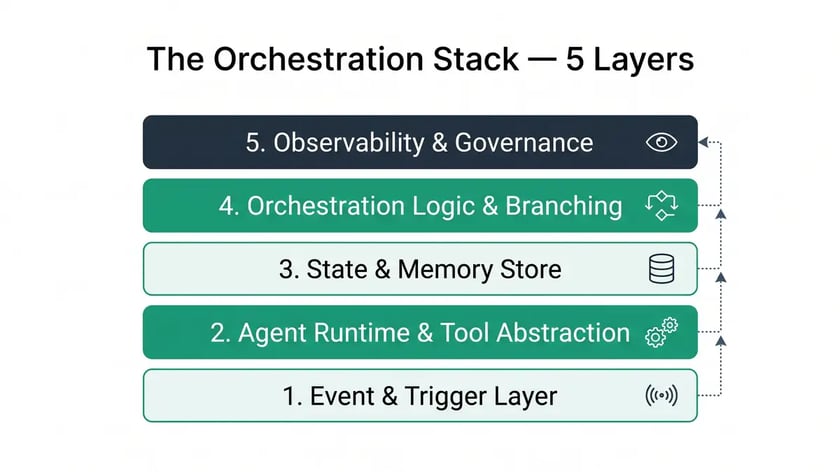
The five-layer orchestration stack: Event & Trigger, Agent Runtime & Tool Abstraction, State & Memory Store, Orchestration Logic & Branching, Observability & Governance

Layer 1 — Event & Trigger Layer. Captures the signals that initiate workflows: a CRM record update, an inbound email, an LLM decision, a scheduled cron, a webhook from a third-party system. In mature stacks, this layer includes deduplication, rate-limiting, and signal enrichment so that downstream agents reason from context rather than noise.

Layer 2 — Agent Runtime & Tool Abstraction. Executes agent logic and provides standardised tool access. The Model Context Protocol — originally introduced by Anthropic and now adopted across the ecosystem — provides a client-host-server architecture enabling agents to integrate capabilities across applications while maintaining clear security boundaries (MCP, 2025). OpenAI's Agents SDK now ships configurable memory, sandbox-aware orchestration, and Codex-like filesystem tools as primitives (OpenAI, 2026). Anthropic's orchestrator-worker pattern coordinates a lead agent that analyses queries, develops strategy, and spawns specialised subagents operating in parallel (Anthropic, 2026). A deeper comparison of platform choices lives in our multi-agent AI frameworks compared analysis.

Revenue operations command cockpit with teal-green connected nodes showing lead qualification, nurture, handoff, onboarding, and expansion stages orchestrated as a single B2B growth system

Layer 3 — State & Memory Store. Maintains persistent context across workflow execution: the conversation history, the intermediate decisions, the outputs of prior agents. Without this layer, orchestration collapses back into stateless task automation. With it, agents can reason about the current state of a deal, a customer, or a support case over time — which is what enables adaptive behaviour.

Layer 4 — Orchestration Logic & Branching. This is the control plane. It is where deterministic blueprints (the workflow shape) coordinate nondeterministic elements (the agent decisions). Temporal represents an emerging architecture pattern where workflow code remains deterministic — enabling durability, crash recovery, and exact replay — while agent decision-making remains nondeterministic and responsive to runtime signals (Temporal, 2026). For data pipelines, Apache Airflow, Prefect, and Dagster cover mature deterministic orchestration; for agentic workflows, Temporal, CrewAI, LangGraph, and n8n's agent framework dominate the 2026 vendor landscape.

Layer 5 — Observability & Governance. The top of the stack — and the layer most commonly neglected. Distributed tracing across every agent decision, audit trails, replay capability for debugging, cost accounting per agent, and policy enforcement at execution time. Leading LLM evaluation platforms include Arize AX, Arize Phoenix, LangSmith, Braintrust, and Langfuse (Arize AI, 2025). Without this layer, agentic deployments become black boxes. For the full governance architecture, see our AI governance framework for B2B.

Key Takeaway

Orchestration is not a product. It is a five-layer stack spanning event capture, agent runtime, state management, control plane, and governance. Point solutions that address a single layer — even very capable ones — will not produce orchestration outcomes. The architecture has to be coherent across all five.

Where Does Orchestration Deliver Quantifiable Business Impact?

The business case for orchestration differs fundamentally from the business case for task automation. Task automation sells cost reduction: 22 percent lower operational costs, $5.44 return per $1 invested, 20 or more hours reclaimed per employee per week (ShipStation, 2026). Orchestration sells something larger and harder to replicate: cycle-time compression, revenue acceleration, and the decoupling of revenue growth from headcount growth.

McKinsey's 2025 State of AI survey documents that companies implementing orchestrated AI systems report revenue increases of 3 to 15 percent alongside 10 to 20 percent improvements in sales return on investment (McKinsey, 2025). AI high performers — companies with enterprise-wide adoption and redesigned workflows — commit more than 20 percent of their digital budgets to AI and scale roughly three times faster than their peers. That scaling advantage is the compound effect of orchestration working at stack scale, not at task scale.

Symphony orchestra rendered as high-tech holographic panels with a central conductor's dashboard — the metaphor for orchestrated multi-agent systems harmonising toward unified business outcomes

The clearest B2B growth-function payoffs sit inside revenue orchestration. Marketing automation with lead scoring and behavioural triggers delivers MQL-to-SQL conversion rates 30 to 50 percent higher than batch-and-blast email, with a median improvement of 38 percent. When combined with AI intent signals, the uplift reaches 62 percent; layering account-based orchestration on top pushes cumulative improvement to 76 percent relative to non-orchestrated baselines (Digital Applied, 2026). Orchestration does not replace agentic marketing — it is the infrastructure that makes agentic marketing deliver.

Business OutcomeTask Automation BenchmarkOrchestration BenchmarkSource
ROI per $1 invested$5.44Revenue lift 3-15% + sales ROI lift 10-20%ShipStation; McKinsey
Operational cost reduction22%20-31% TCO reduction with unified platformsShipStation; Corcava
Time to measurable ROI6-12 months typical30-60 days for unified orchestration platformsCorcava, 2026
Process cycle-time compression10-20% local gains50-70% end-to-end reductionTechBlocks, 2026
MQL-to-SQL conversion lift15-25% with basic scoringUp to 76% with orchestrated ABM + AI intentDigital Applied, 2026
Implementation failure rate30-50% of RPA programmesSubstantially lower with governance-first designVSoft Consulting; CIO.com

Sources: ShipStation, 2026; McKinsey, 2025; Corcava, 2026; TechBlocks, 2026; Digital Applied, 2026; VSoft Consulting, 2026.

Deloitte's 2026 Human Capital Trends research lands the strategic point: organisations leading in orchestration capability are about twice as likely as their peers to report better financial results (Deloitte, 2026). The distinction Deloitte draws between allocation and orchestration is worth internalising: allocation means assigning a musician to play a specific part; orchestration is the conductor's role, adjusting elements in real time to deliver the outcome. Allocation is a spreadsheet exercise. Orchestration is an operating model. For the full measurement architecture we use with clients, see our guide to measuring AI automation ROI and the metrics that actually matter.

Wondering where task automation ends and orchestration begins inside your own operating model? We map it in a single 45-minute diagnostic.

Book a Growth Mapping Call

How Do You Govern Orchestrated Workflows Without Creating Brittleness?

Orchestration introduces governance complexity that task automation largely avoids. When one bot performs one task, governance is confined to that bot and that task. When dozens of agents coordinate across systems of record, systems of engagement, and external partners, governance requirements expand non-linearly. The operators struggling most with agentic deployments are the ones treating governance as an overlay on completed systems, rather than as an integral part of agent construction.

Three governance pillars are non-negotiable for 2026-onwards deployments:

Cost governance. Within LLM workflows, the biggest line item is typically "tokens processed." For orchestrated systems with multiple LLM calls per workflow, costs multiply. Organisations have documented cost variance between unoptimised and well-optimised AI deployments of 30 to 200 times (Finout / FinOps Foundation, 2026). Separate API keys or organisation identifiers per agent team, cost allocation at the use-case level, and an ongoing "AI Ops Efficiency" metric (tokens per user session, cost per query) are table stakes.

Observability. Distributed tracing across every orchestration step, audit trails capturing every consequential decision, replay capability to reproduce problematic workflows for debugging, and dashboards surfacing both operational metrics (throughput, latency, error rates) and business metrics (conversion, revenue impact, customer satisfaction). If an agent cannot be replayed, it cannot be trusted with a high-stakes decision.

Policy enforcement at execution time. Governance frameworks must balance autonomy with accountability. Over-constrained governance creates brittleness and prevents agents from adapting to novel situations; under-constrained governance creates chaos and compliance exposure (CIO.com, 2026). The architectural answer is to embed policy at the agent-definition layer: categories of decisions an agent can make autonomously, categories that require human approval, data-handling rules, and audit trails emitted as a default side-effect — not as an optional add-on.

This governance maturity is exactly where most mid-market B2B companies are under-resourced. The fractional Chief AI Officer role exists precisely to install this architecture without the fully-loaded cost of a permanent executive hire, and the autonomy maturity model gives you a diagnostic for where you are on the curve today.

Key Takeaway

When enterprise buyers were surveyed on their selection priorities for agentic platforms, security and governance topped the list at 34 percent, followed by integration at 30 percent and reliability at 24 percent. Time-to-value and ROI ranked last at 2 percent — not because returns do not matter, but because leaders recognise that without the right foundation, sustainable ROI is impossible (CrewAI, 2026). Buy and build decisions should follow the same logic.

How Should a B2B Company Sequence the Migration From Automation to Orchestration?

The transition is an architectural decision before it is a tooling decision. Most mid-market B2B operators cannot rip-and-replace existing automation investments — nor should they. More than half of organisations (57 percent) prefer to build on top of existing tools rather than start from scratch when orchestrating AI agents and workflows (CrewAI, 2026). The build-versus-buy binary has collapsed into an assemble-from-components model in which you purchase foundation models from one provider, adopt vendor-provided domain agents for commodity use cases, build your own workflows for differentiated use cases, and connect everything under shared governance (CIO.com, 2026). The best CIOs in the agentic era are not the ones choosing most decisively; they are the ones assembling most coherently.

Here is the sequence we architect with clients across the three peppereffect ICPs — SaaS, executive search, and high-ticket coaching — starting from existing task automation stacks:

1

Audit the task automation estate against outcome metrics

Inventory every workflow, bot, and integration. Measure which produces outcome-level value (revenue, retention, cycle-time compression) versus activity-level value (hours saved, steps eliminated). Kill the ones that produce only activity value — they are automation debt. This is the prerequisite to every subsequent step and the starting point of the Intelligence-First Methodology.

2

Select one outcome-critical workflow as the orchestration pilot

Pilot orchestration on a workflow that matters — lead-to-opportunity, onboarding-to-first-value, renewal risk management — not on something tangential. The pilot is where you prove the five-layer architecture and build institutional confidence. CrewAI's research shows that organisations have automated 31 percent of their workflows today and expect to expand by an additional 33 percent in 2026 (CrewAI, 2026) — most of that growth will be orchestration-shaped, not task-shaped.

3

Install governance before scaling

Before the second orchestrated workflow goes live, install the observability layer, the cost-accounting rails, and the policy enforcement framework. Scaling orchestrated workflows without these rails is where governance crises originate. Pair this with explicit agent handoff protocols so that inter-agent and human-in-the-loop transitions are contractually defined.

4

Extend across the customer lifecycle, not across departments

The highest-leverage orchestration pattern for B2B is revenue orchestration — connecting marketing, sales, and customer success around revenue and retention outcomes rather than departmental silos. Journey orchestration makes real-time decisions about what should happen next across channels and teams, rather than executing pre-programmed sequences (CX Today, 2026). This is what decouples revenue from headcount.

5

Productise the orchestration layer as internal infrastructure

Once you have three to five orchestrated workflows in production, treat the orchestration layer as internal infrastructure. Document the patterns. Create reusable agent templates. Build an internal platform that lets new workflows be composed from vetted components rather than built from scratch. This is the inflection point where AI for business operations stops being a vendor conversation and starts being a capital allocation one.

The mid-market B2B reality check: most companies in the $5M-$40M ARR band will not implement the full stack in-house in 2026. They do not need to. What they need is to own the architectural decisions — the governance model, the assemble-from-components logic, the sequence — and then deploy implementation capacity (internal, partner, or fractional) against a coherent plan. That is the difference between orchestration as a strategic engagement and orchestration as a tool purchase. The first compounds. The second does not.

Frequently Asked Questions

What is the difference between AI orchestration and AI automation?

AI automation uses technology to complete a specific task with minimal human involvement — a single data transfer, a single email, a single record update. AI orchestration coordinates multiple automated tasks, agents, systems, and human approvals into cohesive end-to-end processes, maintaining state, branching on context, and handling exceptions across workflows. In architectural terms: automation is the "what" (a single action), orchestration is the "when and how" (which actions fire, in what order, under what conditions, with what handoffs). Companies that conflate the two typically end up with AI workflow automation deployed as orchestration expectations — and then wonder why the business case never materialises.

Is AI orchestration the same as workflow orchestration?

They overlap but are not identical. Workflow orchestration originated in data engineering and IT operations — tools like Apache Airflow, Prefect, and Dagster coordinate deterministic data pipelines and system tasks. AI orchestration extends workflow orchestration to include nondeterministic elements: LLM-based agent reasoning, multi-agent handoffs, stateful memory, and adaptive decision-making. Forrester formalises this extension as adaptive process orchestration — platforms that use AI agents and nondeterministic control flows alongside traditional deterministic workflows. In practice, the 2026 orchestration stack needs both: deterministic blueprints for durability and replay, nondeterministic agents for contextual reasoning.

What is an orchestration platform, and do I need one?

An orchestration platform is the software layer that coordinates agents, workflows, systems, and humans across end-to-end processes. Leading examples include Temporal, LangGraph, CrewAI, Microsoft Copilot Studio, UiPath Maestro, Salesforce Agentforce, and n8n's agent framework. Whether you need a dedicated orchestration platform depends on your scale and complexity: companies with fewer than five orchestrated workflows can often operate on top of existing tools (HubSpot workflows, Make.com, Zapier). Companies moving beyond that threshold — or running any revenue-critical workflow across three or more systems — need an explicit orchestration layer to avoid automation debt. Our multi-agent AI frameworks compared analysis unpacks the vendor landscape in detail.

How long does it take to migrate from task automation to orchestration?

For mid-market B2B companies in the $5M-$40M ARR range, the first orchestrated workflow typically goes live within 60-90 days using existing tool investments plus an added orchestration layer (Temporal, n8n, or similar). The governance rails — observability, cost accounting, policy enforcement — add another 30-60 days. Full operating-model migration, in which orchestration becomes the default architecture for net-new workflows, typically takes 9-12 months. Corcava's research on unified platforms shows ROI emerging within 30 to 60 days of implementation, but that is tool-level ROI, not operating-model ROI — the latter compounds over quarters, not days (Corcava, 2026).

What are the biggest risks when adopting orchestration?

Three risks dominate. First, governance drift: deploying autonomous agents without clear policy boundaries, resulting in unauthorised decisions, compliance exposure, or security vulnerabilities. Second, cost overruns: unoptimised LLM workflows can cost 30-200x more than well-optimised equivalents (FinOps Foundation, 2026); without token-level accounting, monthly bills explode unpredictably. Third, vendor lock-in: selecting monolithic orchestration platforms before establishing architectural principles leaves organisations unable to adopt newer foundation models or agent frameworks as they emerge. The mitigation in every case is architectural: assemble-from-components, embed governance at agent-definition time, and keep the orchestration layer deliberately vendor-agnostic.

Which B2B function sees the highest orchestration ROI?

Revenue orchestration — the coordination of marketing, sales, and customer success around revenue outcomes — consistently delivers the highest measurable ROI for mid-market B2B. MQL-to-SQL conversion lifts of 38-76 percent, cycle-time compression of 50-70 percent, and 3-15 percent top-line revenue acceleration are typical. The second highest is customer success orchestration across the onboard-adopt-value-expand lifecycle, which drives net revenue retention — the single metric that most predicts enterprise valuation multiples for B2B SaaS. Operations and back-office orchestration matter, but they produce cost-reduction ROI rather than revenue ROI, which is why they should follow the revenue layer in migration sequencing.

How does orchestration fit into the Freedom Machine architecture?

The Freedom Machine is peppereffect's term for the operating system that decouples revenue growth from founder hours and headcount — the ultimate outcome of systemic leverage. Orchestration is its infrastructure layer. Without orchestration, "agentic automation" collapses back into task automation decorated with LLM calls, and the founder remains the bottleneck that task automation cannot remove. With orchestration — governance-first, stack-coherent, assembled from components — autonomous agents, deterministic workflows, and selective human judgment compose into an operating model that scales output without scaling input. Every pillar of the 4 Pillars (Lead Generation, Sales Administration, Operations, Marketing Classics) requires an orchestration layer to deliver Freedom Machine outcomes.

Install Orchestration as Infrastructure — Not as a Tool Upgrade

peppereffect architects AI orchestration systems for B2B companies in the $5M-$40M ARR range. We start with a Growth Mapping Call that diagnoses your current automation estate, identifies the orchestration gap, and returns a sequenced 90-day installation plan — governance layer first, revenue workflows second, platform decisions last. This is how you move from tool sprawl to a Freedom Machine.

Book a Growth Mapping Call

Read the companion piece on agentic workflows →

Resources

Related blog

Glass pane showing a schematic cascade of five intelligence layers — representing the Intelligence-First Methodology for AI project success
20
Apr

The Intelligence-First Methodology: Why Most AI Projects Fail and How to Fix Them

Schema markup JSON-LD structured data code for AI citation optimization displayed on developer screen with ChatGPT and Google AI Overviews browser tabs
17
Apr

Schema Markup for AI Citation: Technical Implementation Guide for B2B Sites

AI-powered client onboarding dashboard showing automated workflow timeline with accelerated onboarding stages in a modern consulting office
16
Apr

AI-Powered Client Onboarding: From 14 Days to 48 Hours with Autonomous Workflows

THE NEXT STEP

Stop Renting Leverage. Install It.

Together we can achieve great things. Send us your request. We will get back to you within 24 hours.

Group 1000005311-1