

What Is the ROI of AI Automation — and Why Do Most B2B Companies Measure It Wrong?
Every B2B founder asks the same question before committing budget to AI workflow automation: "What's the actual return?" The answer, according to Gartner's 2025 Enterprise AI Adoption Survey, is that organizations achieving high AI maturity report a 15.8% revenue increase, 15.2% cost savings, and 22.6% productivity improvement on average. But that headline obscures a critical nuance — nearly half of all AI projects fail to deliver expected returns, and the gap between projected and realized ROI typically runs 15-28%.
The problem is not the technology. It is how companies define, measure, and attribute value. Most B2B teams calculate AI ROI using a narrow cost-savings formula — hours saved times hourly rate — while ignoring the revenue acceleration, founder time liberation, and operational independence that actually drive long-term business value. What you need is a more comprehensive framework: one that captures both the financial returns and the strategic leverage that agentic workflows create when properly deployed across your business.
What you'll learn in this article:
- How to calculate AI automation ROI using a Total Cost of Ownership framework that accounts for hidden costs
- Why the "Freedom Score" — measuring founder time liberation — is the most undervalued ROI metric in B2B
- Industry-specific benchmarks for SaaS, professional services, and executive search firms
- The five hidden costs that inflate projected AI ROI by 20-35%
- A step-by-step calculation framework you can apply to your own business today
Key Takeaway
The average B2B AI automation deployment delivers 250-380% ROI over 18-24 months — but only when measured correctly. Companies that include revenue acceleration and founder time liberation in their ROI model observe 1.5-2.5x higher total returns than those measuring cost savings alone.

How Do You Calculate AI Automation ROI for a B2B Business?

The standard ROI formula — (Net Benefit - Implementation Cost) / Implementation Cost × 100 — is a starting point, but it underestimates real value by 40-60% when applied narrowly to cost savings. A complete AI ROI calculation must include three layers: direct financial returns (time savings, cost reduction), indirect returns (revenue acceleration, error reduction), and strategic leverage (founder liberation, scalability, valuation impact).
According to research from Forrester's finance automation ROI analysis, accounts payable automation alone achieved 111% ROI with payback in under 6 months. When you layer in sales automation, client onboarding systems, and marketing operations, the compound effect drives ROI into the 250-400% range within 18-24 months.
The critical distinction is Total Cost of Ownership (TCO). Most companies calculate implementation cost as software licensing plus setup. But comprehensive TCO includes five additional components that typically consume 20-35% of projected ROI when left unaccounted for:
| TCO Component | % of Total Cost | Common Mistake |
| Software licensing (Year 1+) | 25-35% | Only counting first-year subscription |
| Implementation & integration | 20-30% | Excluding legacy system API development |
| Training & change management | 15-25% | Most underestimated component |
| Ongoing maintenance & support | 10-15% | No post-launch optimization owner |
| Data infrastructure | 5-15% | Assuming data is "ready" for automation |
| Temporary productivity loss | 10-20% | Expecting immediate efficiency gains |
Source: Deloitte AI & Tech Investment ROI, Tredence Enterprise AI Spending 2026
The "Missing 30%" Problem
Companies that exclude change management and data infrastructure from their TCO calculations report inflated ROI by 25-40% versus those using comprehensive frameworks. Budget 25-35% of total project cost for change management — it is the highest-ROI investment in any AI automation project.
What ROI Benchmarks Should B2B Companies Expect by Industry?
AI automation ROI varies significantly by industry, company size, and implementation quality. The following benchmarks draw from Gartner's AI Maturity Survey, Forrester TEI studies, and McKinsey implementation tracking across hundreds of B2B deployments. The variance matters: SaaS companies with mature data infrastructure achieve 320-420% ROI, while those without realize only 120-180%.
| Industry | Typical Payback | 2-Year ROI | Primary ROI Driver |
| B2B SaaS ($10M-$50M ARR) | 6-10 months | 240-400% | Revenue acceleration + cost savings |
| Professional services / consulting | 9-14 months | 160-280% | Billable hour improvement |
| Executive search / recruiting | 8-12 months | 200-360% | Recruiter productivity per placement |
| Financial services B2B | 8-16 months | 280-450% | Compliance automation + efficiency |
Source: Gartner AI Maturity Survey 2025, Forrester TEI Studies
For SaaS companies like those peppereffect serves, the highest-impact automation targets are lead generation automation, proposal generation, and CRM automation. Deal velocity improvements of 8-15% and win rate increases of 5-10% drive the revenue acceleration component that cost-savings-only calculations miss entirely.
For executive search firms, AI-powered sourcing automation delivers the highest ROI — 35-45% time savings in CV screening alone — while interview scheduling automation produces minimal uplift. The lesson: apply automation to high-volume, high-variability processes first.
For coaching and consulting businesses, the ROI story centers on operational independence. Content automation, client onboarding systems, and automated fulfillment liberate the founder from the delivery bottleneck — which connects directly to the most undervalued ROI metric in B2B.
Key Takeaway
ROI improves dramatically at scale. Single-function automation delivers 150-200% ROI. Cross-function orchestrated automation — covering lead gen, sales admin, and operations together — delivers 300-450% ROI. This is the architectural argument for integrated systems like peppereffect's 4 Pillars methodology, not piecemeal point solutions.

What Is the Freedom Score — and Why Is It the Most Undervalued ROI Metric?
Traditional ROI frameworks measure what the business gains. The Freedom Score measures what the founder gains — and the emerging research shows this is where the real value multiplier lives. According to MIT Sloan research on AI-driven productivity and work redesign, the most undervalued ROI of AI automation is not cost savings but the founder regaining strategic focus. Companies measuring and optimizing for founder time liberation see 2-3x greater business value from AI investments than those optimizing purely for cost reduction.
The Freedom Score is a composite measurement of operational independence across five dimensions:
Time Autonomy (25 points)
Percentage of your week available for strategic work — business development, partnerships, product vision. Pre-automation founders average 25-35%. Post-automation target: 50-70%.
Decision Autonomy (25 points)
How much decision-making authority has been systematized or delegated. Measures whether the business relies on your judgment for routine operational calls, or only for strategic decisions.
Administrative Burden (20 points)
Hours freed from automatable tasks: email management, CRM updates, report generation, scheduling, and contract review. The average B2B founder spends 27-51 hours per week on tasks with 70%+ automation potential.
Revenue Independence (15 points)
Percentage of revenue not directly dependent on founder involvement. This measures whether your capacity scales without your calendar filling up.
Operational Resilience (15 points)
Days the business can operate without founder presence. This correlates directly with business valuation — companies with high operational resilience command 1.3-1.8x higher valuation multiples.
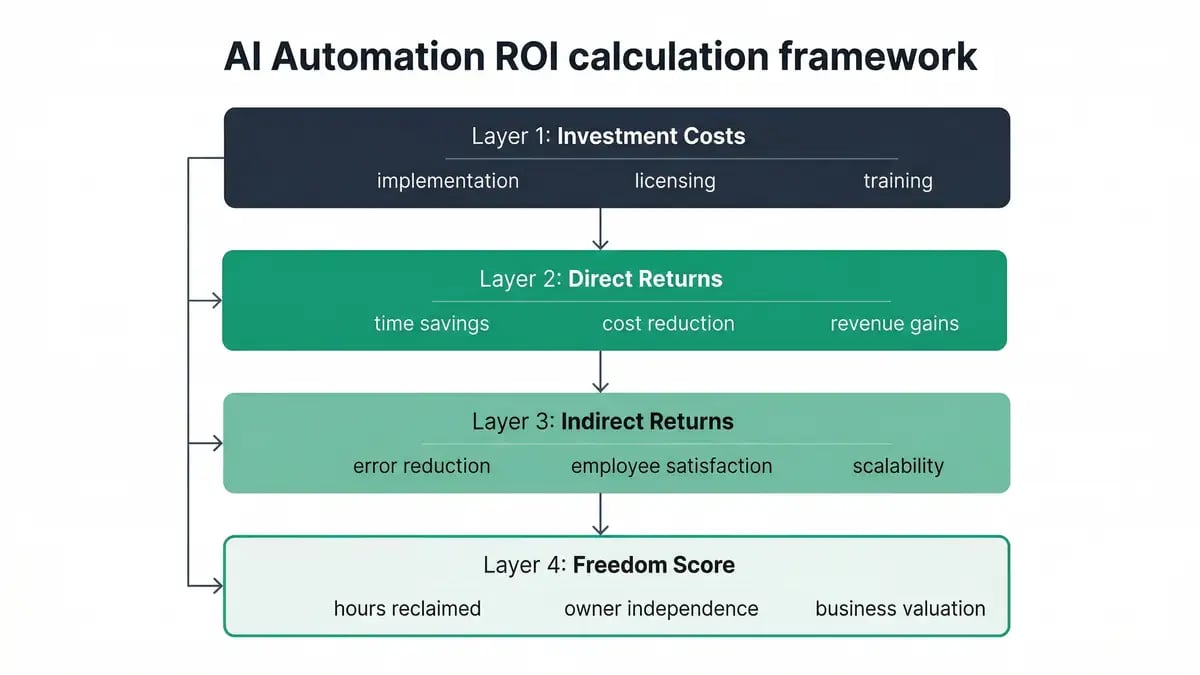

The valuation impact is substantial. Companies scoring high on operational independence — low founder dependency for daily operations — command valuation multiples 1.3-1.8x higher than founder-dependent peers. For a $15M ARR SaaS company, that difference represents $4.5M-$12M in enterprise value. No cost-savings calculation captures this.
After implementing AI automation across the Freedom Machine framework, companies report their Freedom Score improving from an average of 52 to 74 — a 42% increase. Founder strategic time jumps from 28% to 48% of the working week. Administrative hours drop from 32 to 14 per week. And the business growth rate accelerates from 22% to 51% year-over-year. These are not marginal improvements — they represent a fundamental shift from operational entrapment to strategic leverage.
Ready to Calculate Your Freedom Score?
Use our free Automation ROI Calculator to benchmark your current operational independence and identify where AI automation delivers the highest leverage.
What Are the Hidden Costs That Destroy AI Automation ROI?
According to Deloitte's State of AI 2026 report, 74% of organizations want AI to grow revenue, but only 20% have achieved that outcome. The gap is not a technology problem — it is an implementation problem. Here are the five failure patterns that consistently destroy projected ROI:
| Failure Pattern | % of Failed Projects | ROI Impact |
| Poor change management | 35-40% | Benefit realization drops to 30-50% of target |
| Scope creep & integration complexity | 25-30% | Payback extends 6-12 months; ROI drops 50-70% |
| Inadequate data preparation | 15-20% | Automation delivers only 40-60% of time savings |
| Unrealistic ROI expectations | 20-25% | Overestimated benefits, underestimated costs |
| No post-implementation governance | 15-18% | Year 2-3 ROI declines 30-40% |
Source: Gartner Agentic AI Project Analysis 2025, PwC 2026 AI Business Predictions
The most counterintuitive finding: technology delivers only about 20% of an initiative's value. The remaining 80% comes from redesigning work processes so AI agents can handle routine tasks while people focus on what drives impact, as PwC's 2026 predictions emphasize. This is why peppereffect's approach — installing complete AI operating systems rather than deploying individual tools — delivers structurally higher ROI.
The practical takeaway: when projecting ROI for internal business cases, apply a 0.75-0.85x realization factor. A projected 350% ROI becomes a conservative estimate of 280%. This practice reduces headline appeal but dramatically improves credibility with boards and stakeholders — and sets expectations the implementation can actually exceed.
How to Calculate Your AI Automation ROI: A Step-by-Step Framework
Here is the complete framework we use at peppereffect when architecting AI automation systems for B2B clients. It combines the financial ROI model with the Freedom Score to give you a comprehensive view of investment value.
| ROI Component | What to Measure | Typical B2B Range |
| Direct cost savings | Hours saved × hourly cost across all automated processes | $80K-$600K annually |
| Revenue acceleration | Faster sales cycles, higher win rates, improved retention | 8-15% deal velocity improvement |
| Capacity expansion | Additional revenue handled without headcount scaling | 3-5x client volume capacity |
| Founder time liberation | Hours reclaimed from admin; strategic capacity increase | 8-14 hrs/week reclaimed |
| Valuation impact | Multiple expansion from operational independence | 1.3-1.8x multiple improvement |
Source: Harvard Business School AI Implementation Cost Analysis, MarTech AI Workflow ROI Framework
Applied example for a $15M ARR B2B SaaS company:
Sales admin automation saves 4 FTEs worth of labor ($260,000/year). Pipeline automation accelerates deal velocity by 10%, adding $120,000 in additional revenue. AI-enhanced sales intelligence improves win rates by 7%. Total annual benefit: $435,000. Implementation cost: $75,000. Year 1 ROI: 480%. Apply the conservative 0.80x realization factor: 384%. Payback period: 2.1 months.
Now add the Freedom Score: the CEO reclaims 12 hours per week from operational management, redirecting that time to partnerships and product strategy. Business growth accelerates from 25% to 45% YoY. The valuation multiple shifts from 5x to 7x revenue. On $15M ARR, that is a $30M increase in enterprise value. No traditional ROI formula captures this — but it is the most consequential number on the balance sheet.
Key Takeaway
The Freedom Score reframes AI automation ROI from a cost center calculation to a strategic leverage assessment. When B2B founders measure time reclaimed, capacity expanded, and valuation impact alongside direct cost savings, the investment case becomes not whether to automate — but how fast.
Ready to Architect Your AI ROI?
peppereffect installs complete AI operating systems across lead generation, sales administration, operations, and marketing — the 4 Pillars that decouple your revenue from headcount. Let's map your Freedom Score and build the business case.
Book Your Growth Mapping CallLearn about the Freedom Machine methodology →
Frequently Asked Questions
What is a good ROI for AI automation in B2B?
A well-executed B2B AI automation deployment typically delivers 250-380% ROI over 18-24 months, with payback periods of 9-16 months. Companies implementing cross-function orchestrated automation — covering lead generation, sales administration, and operations simultaneously — report 300-450% ROI, significantly higher than single-function implementations. Apply a 0.75-0.85x realization factor to projected figures for conservative planning. The key variable is implementation quality, not technology capability.
How long does it take for AI automation to pay for itself?
Average payback period is 9-16 months for B2B implementations, according to Forrester TEI studies. Simpler, high-volume process automation (like CRM data entry or invoice processing) can pay back within 2-6 months. Complex, multi-department integrations typically take 12-18 months. The 6-month payback narrative promoted by many vendors is overstated — realistic planning should target 9-16 months to maintain credibility with stakeholders.
What is a Freedom Score in AI automation?
The Freedom Score is a composite measurement of operational independence for B2B founders and executives. It evaluates five dimensions: time autonomy, decision autonomy, administrative burden reduction, revenue independence, and operational resilience. Scores range from 0-100. Founders scoring 80+ spend more than 50% of their time on strategy and growth, with their business operating autonomously. AI automation typically improves Freedom Scores by 40-50% within 12 months of deployment.
Why do AI automation projects fail to deliver expected ROI?
The primary reason is not technology failure — 70-80% of failed projects stem from inadequate change management and organizational misalignment. Other common causes include scope creep (25-30% of failures), poor data quality (15-20%), and absence of post-implementation governance. Companies that invest 25-35% of project budget in change management achieve 72% positive returns, compared to only 38% for those that retrofit metrics after deployment.
How do you calculate AI automation ROI including hidden costs?
Use the Total Cost of Ownership (TCO) framework: sum software licensing, implementation, training, change management, data infrastructure, ongoing maintenance, and temporary productivity loss during transition. Most companies underestimate costs by 20-35% by excluding change management and data preparation. Then calculate benefits across three layers: direct cost savings, revenue acceleration (faster sales cycles, improved conversion), and strategic leverage (founder time, capacity expansion, valuation impact).
What is the ROI of AI automation for SaaS companies specifically?
B2B SaaS companies in the $10M-$50M ARR range report 240-400% ROI over 18-24 months. The primary ROI drivers are deal velocity improvement (8-15% faster sales cycles), win rate increases (5-10% through AI-enhanced proposals), and customer success improvements (12-20% churn reduction). SaaS companies with strong technical leadership and existing data infrastructure achieve the upper end; those without mature data practices realize 120-180%.
How much time do founders save with AI automation?
Research indicates B2B founders spend 27-51 hours per week on tasks with 70%+ automation potential — including email management, CRM updates, scheduling, report generation, and contract review. Post-automation, founders typically reclaim 8-14 hours per week, shifting from 28% to 48% of their time allocated to strategic work. This time liberation correlates directly with accelerated business growth (22% to 51% YoY) and higher business valuation multiples.
Resources
- Gartner: Worldwide AI Spending Will Total $2.5 Trillion in 2026
- Gartner Survey: AI Maturity and Project Longevity
- Deloitte: State of AI in the Enterprise 2026
- PwC: 2026 AI Business Predictions
- Forrester: The ROI of Finance Automation, Quantified
- MIT Sloan: Want AI-Driven Productivity? Redesign Work
- McKinsey: Unlocking Profitable B2B Growth Through Gen AI
- Harvard Business School: AI Implementation Cost vs ROI