
What Are Agent Handoff Protocols and Why Do They Matter?
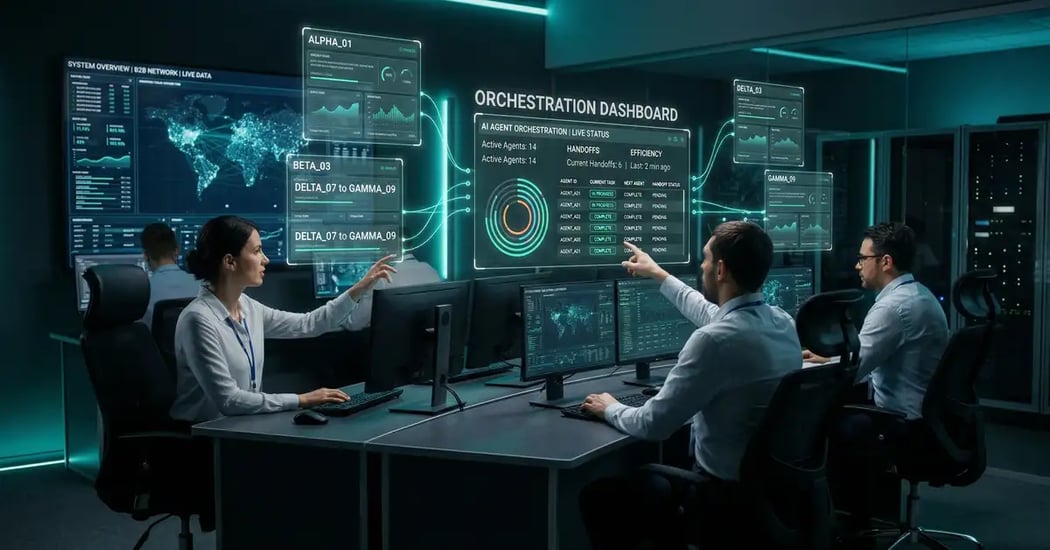
Agent handoff protocols define how autonomous AI agents transfer control, context, and decision authority to each other in multi-agent systems. As B2B organizations deploy increasingly sophisticated agentic workflows, the weakest link is rarely the individual agent — it is the transition point between agents where context gets lost, state corrupts, and cascading failures begin.
The shift from single-agent to multi-agent architectures is accelerating at an extraordinary pace. Gartner reports a 1,445% surge in multi-agent system inquiries from Q1 2024 to Q2 2025, and predicts that 40% of enterprise applications will embed task-specific AI agents by the end of 2026 — up from less than 5% in 2025. Yet Gartner also warns that more than 40% of agent projects will fail by 2027, with Anthropic's analysis of 200+ enterprise deployments finding that 57% of project failures originated in orchestration design — agents were individually capable but poorly coordinated.
The problem is not intelligence. It is infrastructure. And agent handoff protocols are the infrastructure layer that most organizations skip.
What you will learn in this article:
- The four core handoff patterns used in production multi-agent systems — and when each applies
- How OpenAI Agents SDK, Google A2A, LangGraph, and CrewAI implement agent-to-agent transfer differently
- The five failure modes that cause 80% of multi-agent coordination breakdowns
- A step-by-step protocol for designing reliable agent handoffs in your B2B operations
- The metrics that matter for measuring handoff quality at scale
Key Takeaway
Agent handoff protocols are the single most under-engineered component in multi-agent AI deployments. Organizations that invest in structured handoff design — explicit state schemas, context budgeting, and standardized error contracts — reduce task failure rates by 20-40% and cut debugging time by 30% compared to teams relying on implicit context passing.
What Are the Core Agent Handoff Patterns in Multi-Agent Systems?
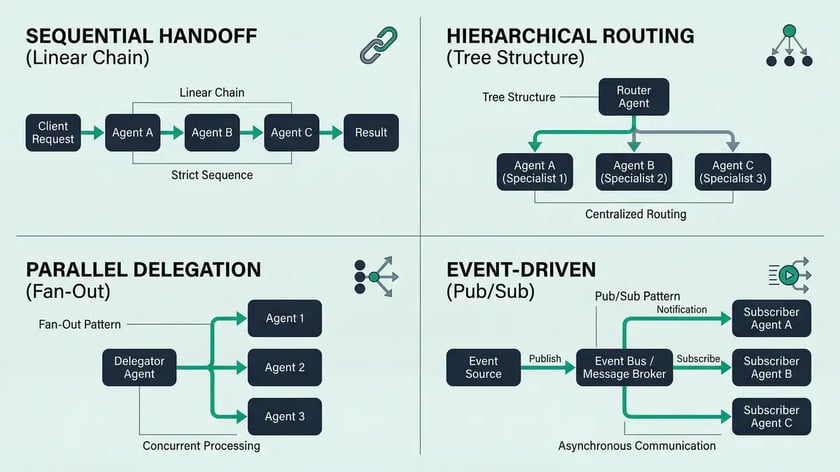
Production multi-agent systems rely on four established handoff patterns, each with distinct trade-offs between control, latency, and observability. Choosing the wrong pattern is the most common architectural mistake teams make when moving from single-agent workflow automation to multi-agent coordination. And before you coordinate several agents, check which steps need one at all: our breakdown of agentic AI vs traditional automation includes a step classifier for exactly that.

Sequential Handoff is the simplest pattern: Agent A completes a task and explicitly transfers responsibility to Agent B with a context payload. Think of a customer service workflow where a triage agent classifies an inquiry, then hands off to a billing specialist with the full conversation history. Sequential handoff dominates in structured business processes like document approval pipelines and client onboarding workflows where the order of operations is fixed.
Hierarchical Routing uses a supervisor agent to direct tasks to specialized worker agents. This is the most commonly deployed pattern in enterprise environments — approximately 60% of documented production implementations use hierarchical routing because it provides centralized observability and failure handling. The supervisor acts as a single coordination point, routing incoming requests to the right specialist and aggregating results.
Parallel Delegation enables a supervisor to spawn multiple agents concurrently for divide-and-conquer workflows. Google's research team demonstrated that parallel multi-agent research produces 40% more comprehensive outputs than sequential single-agent research given the same total compute budget. Anthropic's multi-agent research system uses this pattern — a lead researcher agent plans the process, then spawns parallel subagents that search for information simultaneously.
Event-Driven (Pub/Sub) Handoff enables loose coupling where agents emit events and other agents subscribe based on event type. This pattern offers maximum flexibility but introduces significant observability challenges. Adoption remains limited in production due to debugging complexity — when a handoff fails in an event-driven system, tracing the root cause across asynchronous boundaries requires sophisticated distributed tracing infrastructure.
| Pattern | Control Model | Latency | Observability | Best For |
| Sequential Handoff | Linear chain | Additive per agent | High | Fixed-order workflows, onboarding |
| Hierarchical Routing | Supervisor-worker | Supervisor + worker | High (centralized) | Customer service, task triage |
| Parallel Delegation | Fan-out/fan-in | Max of parallel branches | Medium | Research, competitive analysis |
| Event-Driven | Pub/sub | Variable | Low | Loosely coupled microservices |
Sources: Hatchworks — Orchestrating AI Agents in Production, TrueFoundry — Multi-Agent Architecture Patterns
The 4 Pillars Playbook breaks down the entire framework with deployment maps, KPIs, and real case studies across SaaS, recruiting, and coaching.
Open the Interactive PlaybookHow Do Leading Frameworks Implement Agent Handoff?
Every major agent framework implements handoff differently — and none of them are interoperable out of the box. This framework fragmentation is one of the critical challenges facing B2B organizations building production agentic systems. Understanding the specific handoff primitives each framework offers is essential before committing to an architecture.
OpenAI Agents SDK introduced a first-class handoff() function that represents handoffs as tools visible to the LLM. When an agent decides to hand off, it calls a function like transfer_to_refund_agent, and the new agent receives the entire conversation history by default. Developers can customize context transfer using an input_filter that transforms the handoff payload. The SDK also supports structured metadata transfer via input_type — a triage agent can hand off with {"reason": "duplicate_charge", "priority": "high"}.
LangGraph takes a state-machine approach where developers define explicit state schemas using typed dictionaries. Each node in the graph represents an agent, and transitions between nodes carry the full state object. This is more reliable than naive context passing because it forces developers to declare upfront what transfers between agents — eliminating silent data loss from undeclared state fields.
CrewAI uses a task-chain delegation model where Crew.kickoff() orchestrates agents through defined task sequences. Context passes between agents via task object serialization. However, CrewAI relies on Python pickle for complex nested objects, which creates brittleness across versions and environments — a known failure mode in production deployments.
Google A2A (Agent2Agent) Protocol is the most ambitious standardization effort. Announced in April 2025, A2A is an open protocol under the Linux Foundation designed to enable cross-framework, cross-vendor agent communication. It uses JSON-RPC 2.0 over HTTPS, with each agent publishing an "Agent Card" at a well-known URL describing its capabilities. Version 0.3 introduced gRPC support and security card signing, backed by more than 50 technology partners.
| Framework | Handoff Primitive | State Transfer | Interoperability |
| OpenAI Agents SDK | handoff() function | Conversation history + input_filter | Proprietary |
| LangGraph | send() operator + state schema | Typed state objects (Pydantic) | Framework-specific |
| CrewAI | Crew.kickoff() delegation | Task object serialization | Framework-specific |
| Google A2A | JSON-RPC 2.0 + Agent Cards | Protocol-defined task lifecycle | Open standard |
| Anthropic MCP | Tool use + context management | Conversation history (XML) | Open specification |
| Microsoft AutoGen | Message-passing protocol | ConversableAgent queue | Open (limited adoption) |
Sources: OpenAI Agents SDK Documentation, A2A Protocol Specification
Key Takeaway
No cross-framework serialization standard exists yet. Porting a multi-agent workflow from CrewAI to LangGraph requires completely rewriting handoff logic. Standardize on a single framework initially and design agent interfaces so the underlying handoff protocol can be swapped without rewriting agent logic. Google A2A is the strongest candidate for future interoperability — monitor its adoption through 2026.
What Are the Five Critical Failure Modes in Agent Handoff?
Research from UC Berkeley and Galileo analyzing multi-agent LLM system failures found that coordination breakdowns account for approximately 35% of all failures — and most originate at handoff boundaries, not within individual agents. Understanding these failure modes is the first step toward engineering them out of your agent workflow architecture.

1. Context Truncation: When Agent A transfers control to Agent B, the original task context must be preserved. But LLM context windows are finite. After 8-10 handoffs, context loss becomes measurable — task output degradation appears in 15-20% of long workflows. Summarized context reduces token count by 70-90% but introduces information loss and adds 500ms-1.5s of latency per handoff.
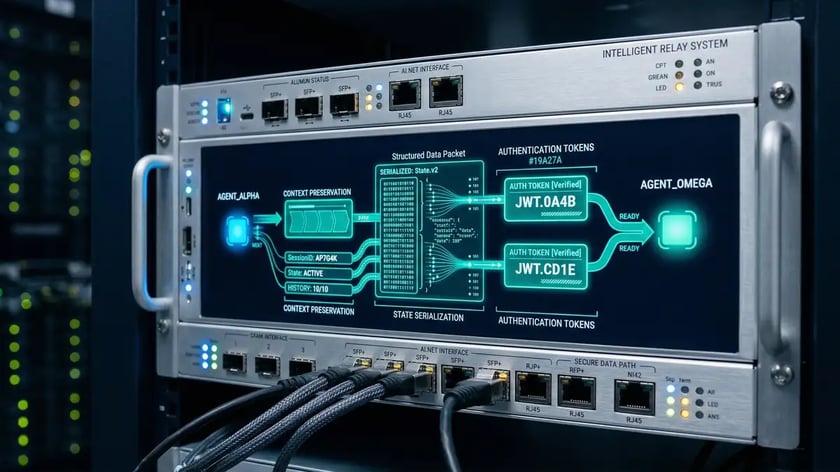
2. State Serialization Failure: Complex nested objects fail to serialize between agents — especially in frameworks using Python pickle. The failure is often silent: Agent B receives malformed state with no error message, produces incorrect output, and the error propagates downstream before anyone notices.
3. Timeout Cascade: If Agent B exceeds its timeout, the supervisor agent may not retry cleanly. The entire workflow hangs, resources leak, and all child agents stall. A workflow requiring 10 agent handoffs adds 1-5 seconds of pure coordination overhead before accounting for actual processing time.
4. Infinite Loop / Deadlock: Agent A routes to Agent B, which routes back to Agent A — creating a circular dependency that consumes resources indefinitely. This is especially common in peer-to-peer models without explicit state machine constraints. Without bounded retry logic and clear transition rules, a single misconfigured handoff can bring down an entire orchestration pipeline.
5. Lost Audit Trail: Handoffs occur without logging the context transfer. This creates a compliance gap — in regulated industries, every agent decision must be traceable. When debugging production failures, missing handoff logs make root cause analysis nearly impossible.
| Failure Mode | Root Cause | Detection Difficulty | Impact |
| Context Truncation | Token budget exceeded at handoff | Medium | Incomplete outputs, degraded accuracy |
| State Serialization | Type mismatch or dropped fields | Low (often silent) | Incorrect downstream results |
| Timeout Cascade | Missing retry logic in supervisor | Low | Full workflow hang, resource leak |
| Infinite Loop | Circular agent routing | Medium | Resource exhaustion, system crash |
| Lost Audit Trail | No structured logging at handoff | Low (only found during audit) | Compliance breach, undebuggable failures |
Sources: Cemri et al. — Why Do Multi-Agent LLM Systems Fail? (arXiv), Maxim — Multi-Agent System Reliability
Avoid This Mistake
Do not assume that testing individual agents guarantees system reliability. Multi-agent failures emerge at handoff boundaries — where Agent A's output becomes Agent B's input. Research confirms that most "agent failures" are actually orchestration and context-transfer issues. Test the transitions, not just the agents.
Architecting multi-agent handoff protocols for your B2B operations? Talk to our team about building reliable agentic systems.
Book a Growth Mapping CallHow Do You Design Reliable Agent Handoff Protocols?
Reliable agent handoff is an engineering discipline, not a configuration toggle. Organizations that reduce handoff failure rates invest in five specific architectural decisions — each addressing one of the failure modes above. Here is the protocol we deploy at peppereffect for B2B multi-agent systems:
Define Explicit State Schemas
Declare every field that transfers between agents in a typed schema (Pydantic, JSON Schema, or Protocol Buffers). LangGraph's approach of requiring developers to define state upfront reduces context loss failures by approximately 70% compared to naive context passing. Never rely on implicit conversation history alone.
Implement Token Budgeting and Context Compression
Set hard token limits for each handoff boundary. Monitor context window utilization in real time. Use hierarchical state storage (Redis, PostgreSQL) for full context preservation with handoff references — this preserves fidelity without violating token budgets. Context truncation is the number one failure mode; proactive management prevents 60-80% of multi-agent failures.
Add Schema Validation at Every Handoff Boundary
Validate the state object at both the sending and receiving ends of every handoff. Catch type mismatches, missing fields, and format corruption before they propagate downstream. This eliminates the silent failure pattern where Agent B processes malformed data without raising an error.
Enforce Bounded Retry Logic and Timeout Policies
Set hard timeout limits on every handoff (e.g., 30 seconds). Implement bounded retry with exponential backoff — never allow unbounded retries. Use explicit state machines to define allowed agent transitions, preventing circular routing. LangGraph's graph structure makes this architectural rather than optional.
Deploy Structured Logging at Every Transition Point
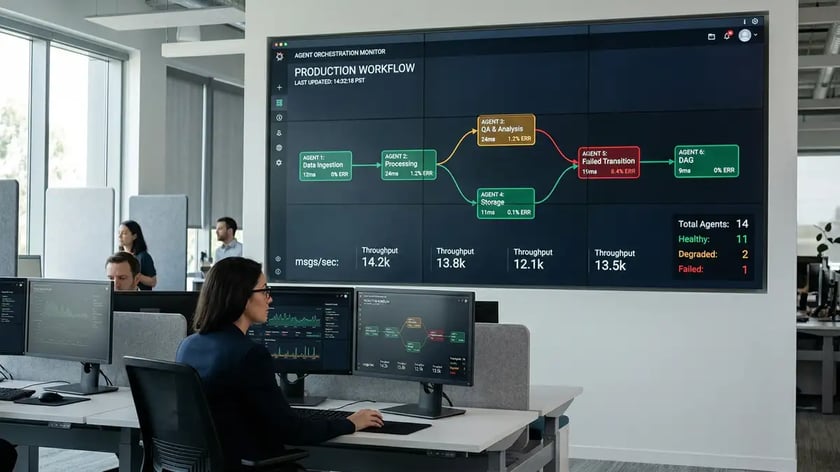
Log the complete handoff payload — context size, serialization type, source agent, destination agent, timestamp, and outcome — at every transition. This creates the audit trail required for human-in-the-loop oversight and enables root cause analysis when production issues arise. Use distributed tracing (Datadog, New Relic) to correlate handoff events across agent boundaries.
What Metrics Should You Track for Agent Handoff Quality?
You cannot improve what you do not measure. Most organizations deploying multi-agent AI frameworks track individual agent accuracy but completely ignore handoff-specific metrics. This blindspot is why coordination failures compound undetected until they cause visible production incidents.
The metrics below represent the minimum observability layer for any production multi-agent system. Each metric maps directly to one of the five failure modes — if you track these, you will catch handoff degradation before it affects end users or CRM data integrity.
| Metric | Definition | Target Benchmark | Failure Mode Detected |
| Handoff Latency (p95) | Time from Agent A completion to Agent B context receipt | <500ms | Timeout Cascade |
| Context Retention Rate | % of original context preserved post-handoff | >95% | Context Truncation |
| Handoff Error Rate | % of handoffs producing malformed state | <1% | State Serialization |
| Task Completion Post-Handoff | % of tasks successfully completed after agent transfer | >95% | All modes |
| Cascading Failure Rate | % of Agent B failures causing upstream failures | <5% | Timeout Cascade, Infinite Loop |
| Audit Trail Completeness | % of handoffs with full logged context | >99% | Lost Audit Trail |
| Communication Overhead | % of total execution time on inter-agent transfer | 5-15% | Latency bloat |
Sources: Google Developers — Context-Aware Multi-Agent Framework, Maxim — Multi-Agent System Reliability
Where Is Agent Handoff Standardization Heading?
The standardization landscape shifted dramatically in 2025 with Google A2A, and 2026 will determine whether open interoperability wins or framework lock-in persists. For B2B leaders planning multi-agent deployments, understanding the trajectory of standardization is critical for architecture decisions you make today.
Google's A2A protocol is the strongest candidate for becoming the industry standard. It is an open-source project under the Linux Foundation, uses standardized communication via JSON-RPC 2.0 over HTTPS, and features agent discovery through Agent Cards published at well-known URLs. With more than 50 technology partners and gRPC support in version 0.3, A2A addresses the interoperability gap that has plagued multi-agent deployments.
Anthropic's Model Context Protocol (MCP) complements A2A by standardizing how LLMs access external tools — but MCP is a client-server protocol, not an agent-to-agent handoff standard. The two protocols serve different layers of the stack and are likely to coexist. Google's developer guide to AI agent protocols explicitly positions A2A and MCP as complementary.
Microsoft merged AutoGen and Semantic Kernel into a unified Microsoft Agent Framework that reached Release Candidate status in February 2026 — signaling enterprise commitment to standardized agent communication. Meanwhile, Gartner predicts that by 2027, 70% of multi-agent systems will use narrowly specialized agents, increasing the number of handoff points and making standardized protocols even more critical.
The strategic implication for B2B organizations moving beyond chatbots into agentic systems: design your handoff interfaces as abstraction layers. Standardize internally now, and plan for protocol migration to A2A or equivalent open standards as they mature through 2026-2027.
Key Takeaway
Google A2A is emerging as the leading open standard for agent-to-agent interoperability, backed by 50+ technology partners and the Linux Foundation. Design your agent interfaces as abstraction layers so you can swap the underlying handoff protocol from framework-native to standardized A2A without rewriting agent logic. Cross-organization agent deployments should wait for A2A maturity rather than building proprietary bridges.
Frequently Asked Questions
What is the difference between agent handoff and agent orchestration?
Agent orchestration is the broader discipline of coordinating multiple AI agents — defining which agents exist, what they do, and how they collaborate. Agent handoff is a specific mechanism within orchestration that governs how one agent transfers control, context, and decision authority to another. Think of orchestration as the architecture and handoff as the wiring between components. Effective agentic workflow design requires both.
Can agents from different frameworks communicate with each other?
Not natively. As of 2026, no cross-framework serialization standard exists in production. An agent built in CrewAI cannot directly hand off to a LangGraph agent without custom serialization adapters. Google's A2A protocol aims to solve this, but adoption is still maturing. For now, standardize on a single framework for any given workflow and build abstraction layers that allow future migration.
How does Google A2A differ from Anthropic MCP?
They solve different problems. MCP (Model Context Protocol) standardizes how an LLM accesses external tools and data sources — it is a client-server protocol. A2A (Agent2Agent) standardizes how autonomous agents discover and communicate with each other — it is an agent-to-agent protocol. In practice, an agent might use MCP to access tools and A2A to coordinate with other agents. The two protocols are complementary, not competing.
What causes most multi-agent system failures?
Context loss and coordination breakdowns at handoff boundaries — not individual agent intelligence. Research from UC Berkeley found that coordination breakdowns account for approximately 35% of all multi-agent failures. Anthropic's enterprise analysis puts the number even higher at 57% of failures originating in orchestration design. Testing individual agents in isolation misses these systemic failure points.
How many handoffs can a multi-agent workflow handle before degradation?
Without explicit context management, performance degrades noticeably after 8-10 sequential handoffs. Each handoff adds 100-500ms of coordination latency. The key mitigation is token budgeting — monitoring context window utilization and using hierarchical state storage to preserve full context outside the LLM's window. With proper engineering, production systems can handle 20+ handoffs reliably.
Should B2B companies build multi-agent systems or wait for standards to mature?
Build now, but architect for migration. The competitive advantage of deploying multi-agent sales automation or operational workflows today outweighs the risk of future protocol changes — provided you design handoff interfaces as abstraction layers. Start with hierarchical routing patterns on a single framework, implement the five-step protocol above, and plan to adopt A2A or equivalent standards as they mature.
What is the minimum observability stack for production agent handoffs?
At minimum, you need structured logging at every handoff point capturing context size, serialization type, source and destination agents, and outcome. Layer distributed tracing (Datadog, New Relic, or Jaeger) to correlate events across agent boundaries. Track the seven metrics in the handoff quality table above. Without this observability layer, diagnosing fulfillment system failures in multi-agent workflows becomes nearly impossible.
Ready to Engineer Reliable Multi-Agent Handoff Protocols?
peppereffect architects production-grade agentic systems with structured handoff protocols, explicit state management, and full observability — so your B2B operations scale without cascading failures.
Book Your Growth Mapping CallExplore our Agentic Workflows Guide →
Resources
- Google Developers Blog — Announcing the Agent2Agent Protocol (A2A)
- OpenAI Agents SDK — Handoffs Documentation
- Anthropic — How We Built Our Multi-Agent Research System
- Cemri et al. — Why Do Multi-Agent LLM Systems Fail? (arXiv Research Paper)
- Gartner — Multiagent Systems in Enterprise AI
- Hatchworks — Orchestrating AI Agents: The Patterns That Actually Work
- Maxim — Multi-Agent System Reliability: Failure Patterns and Validation Strategies
- A2A Protocol Specification (Official)