

The recruitment CRM is the operational nervous system of an executive search firm. The platform either compounds placement velocity by capturing every candidate touchpoint, mandate decision, and client relationship across time, or it becomes a glorified contact database that consultants work around with shadow spreadsheets. The difference between firms scaling placement volume and firms plateauing rarely lives in the consultant talent layer. It lives in the CRM data layer that determines whether the next mandate starts with 50 pre-qualified candidates already cultivated or with a cold-search clock running. The 2026 recruitment CRM market has matured into a sophisticated category with 12+ credible platforms, AI agents redefining what the system can do autonomously, and pricing spreads from $50 to $500+ per user per month. The selection decision matters disproportionately because migration cost compounds.
This article maps recruitment CRM selection and deployment for elite executive search firms and recruiting operations leaders. Coverage: the 2026 market context, the CRM versus ATS distinction, the 8 core capabilities of modern recruitment CRM, the 12 most popular platforms compared, placement velocity metrics that CRM transforms, the 7-step selection framework, pricing benchmarks, AI augmentation, common implementation pitfalls, and the 7-step playbook for transforming placement velocity through CRM.
The 2026 Recruitment CRM Market

The global recruitment software market continues structural growth. Per Mordor Intelligence's recruitment software market analysis, the category compounds at 9-12 percent annually as agency operating models shift from manual to systematised workflows. Per Coherent Market Insights' recruitment software research, the executive search subsegment grows faster than the broader category because consolidation and AI capability emergence reward firms with mature CRM infrastructure.
The 2026 vendor landscape concentrates around 12 platforms with distinct positioning. Per Bullhorn's GRID 2026 Industry Trends Report, firms running mature CRM deployment with embedded AI report 3.5-4.5x revenue growth probability versus AI-immature peers. Per Bullhorn's press release on AI firms outperformance, 55 percent of high-performing firms report KPIs up by more than 25 percent specifically from AI capabilities embedded in the CRM. The CRM is no longer back-office infrastructure. It is the competitive moat that compounds across mandates.
The market context for executive search firms specifically: per Hunt Scanlon Media's industry coverage and AESC professional standards, retained search firms running 60-120 day mandate cycles need CRM capabilities that contingency-focused vendors often underbuild: off-limits tracking, retainer billing logic, NDA status per candidate, mandate-stage workflows that distinguish exclusivity tiers. The vendor selection decision filters firms by depth of executive search-specific functionality, not just by raw feature count.
Recruitment CRM vs ATS: The Structural Distinction
Per Loxo's research on the CRM-ATS distinction and Avionte's guide to recruitment CRM, the architectural difference between the two systems matters more than vendor marketing typically suggests. ATS optimises around the requisition: a job opens, applications arrive, candidates progress through pipeline stages, an offer closes the loop. Recruitment CRM optimises around the relationship: a candidate enters the database during one mandate, gets cultivated across multiple mandate cycles, eventually places when the right opportunity emerges. The time horizons differ. The data models differ. The KPIs differ.
| Dimension | ATS Focus | Recruitment CRM Focus |
| Primary unit | Requisition | Relationship |
| Time horizon | Single mandate cycle (60-120 days) | Multi-year longitudinal cultivation |
| Data model | Application stages | Relationship history plus mandate associations |
| Off-limits tracking | Often missing or basic | Native, with expiry and retainer logic |
| Best fit | High-volume staffing, in-house TA | Executive search, retained search, boutique to mid-market |
Sources: Loxo CRM vs ATS Distinction, Avionte Recruitment CRM Guide, Oleeo CRM Glossary
Modern platforms increasingly bundle CRM and ATS in a single product, but the architectural emphasis varies. Bullhorn, Loxo, Recruit CRM, and Recruitly lead with CRM-first design with ATS layered on. Workday, Greenhouse, and Lever lead with ATS-first design with CRM features added later. For executive search firms, the CRM-first vendors typically outperform because the relationship layer matters more than the requisition layer.
The 8 Core Capabilities of Modern Recruitment CRM
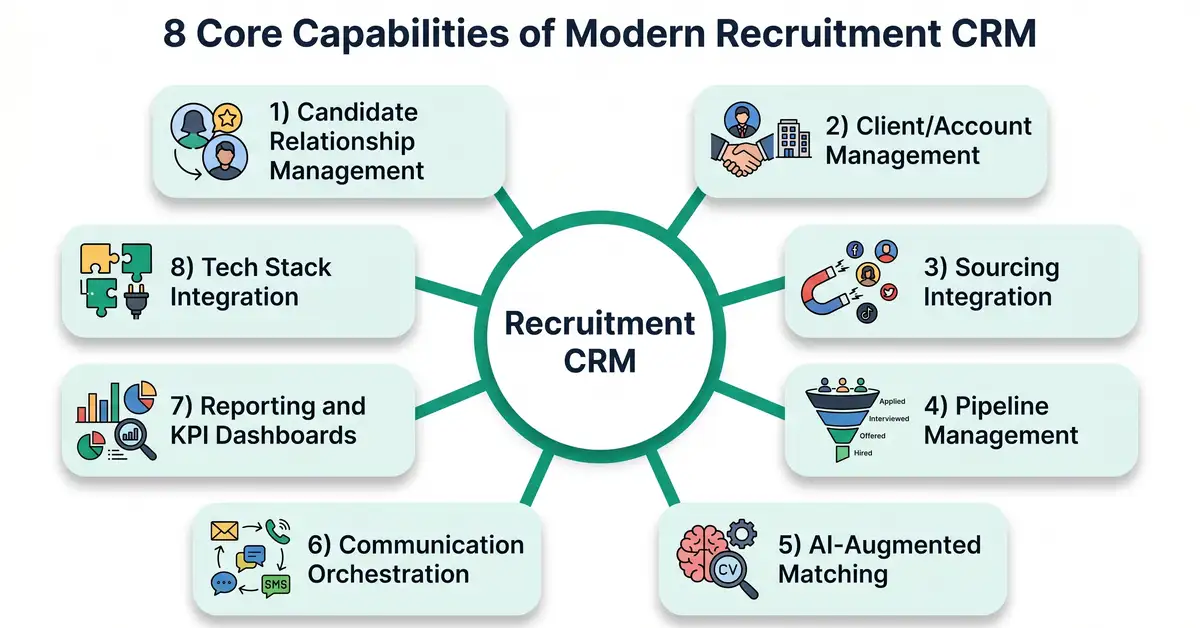
The 8 capability layers that define modern recruitment CRM in 2026. Vendor depth varies significantly across these layers, and the selection decision depends on which layers matter most for the firm's mandate mix.
Candidate Relationship Management
Longitudinal tracking with relationship history, last-touch dates, mandate associations, sentiment notes, and personal context that compounds over years. Per iCIMS' research on candidate pipeline management, the relationship depth distinguishes elite search firms from competitors.
Client/Account Management
Off-limits status with expiry dates, retainer logic, NDA tracking per candidate-client pair, mandate history per client. Per JRG Partners' off-limits policy research and NGS Global's off-limits framework, retained search firms cannot operate without rigorous off-limits tracking that many CRMs underbuild.
Sourcing Integration
Direct connections to HireEZ, SeekOut Recruit, LinkedIn Recruiter, and specialist sourcing platforms. Connects to the cluster's candidate sourcing tools comparison.
Pipeline Management
Mandate-stage workflows with velocity tracking. Per Recruiterflow's recruiting metrics research, pipeline visibility correlates directly with placement velocity. Stage configurations should mirror the firm's actual delivery model.
AI-Augmented Matching
Algorithmic candidate-to-mandate fit scoring, automated longlisting, predictive next-best-action. Per Bullhorn's analysis of best recruitment AI tools and Gem's top 12 AI recruiting software, the AI layer increasingly differentiates leaders from followers.
Communication Orchestration
Email, LinkedIn, SMS sequence automation with personalisation. Per UStech's marketing automation for recruiting research, multi-channel orchestration drives 2-3x response rates versus single-channel outreach. Connects to the cluster's CRM automation architecture for elite firms.
Reporting and KPI Dashboards
Time-to-shortlist, time-to-fill, repeat placement metrics, mandate revenue per consultant. Per RecruitBPM's research on measuring recruitment KPIs and the cluster's executive search KPI dashboard architecture.
Tech Stack Integration
Accounting (Xero, QuickBooks), e-signature (DocuSign), video interview (HireVue), reference check (Crosschq), calendar, and broader executive search tech stack. Per Bullhorn's marketplace ecosystem, the integration depth often matters more than core CRM features for established firms with existing tech investments.
The 12 Most Popular Recruitment CRM Platforms Compared

The 12 platforms dominating executive search firm consideration sets in 2026. Per Yena AI's 2026 recruitment CRM software guide, Automindz' best recruitment CRM for agencies 2026 analysis, and Leonar's best ATS for executive search firms research:
| Platform | Best Fit | Pricing Tier | Key Differentiator |
| Bullhorn | Mid-market to enterprise | $150-500+/user/mo | Deepest ecosystem, strongest staffing heritage, Bullhorn Amplify AI |
| Loxo | Boutique to mid-market | $150-300/user/mo | Talent intelligence integration, sourcing-native |
| Recruit CRM | Boutique to mid-market | $85-165/user/mo | AI-first, intuitive UX, strong G2 reviews |
| Recruitly | Boutique to mid-market UK | $85-185/user/mo | Operating system architecture, UK staffing focus |
| Crelate | Boutique to mid-market US | $85-200/user/mo | Sales-CRM heritage, Living Platform model |
| Vincere | Mid-market global | $100-200/user/mo | Global staffing focus, all-in-one suite |
| JobAdder | Australia and UK mid-market | $100-220/user/mo | Australia/UK staffing strong, modern UX |
| TargetRecruit | Enterprise Salesforce-native | Custom + Salesforce licence | Salesforce-native architecture, deep customisation |
| Manatal | Asia and budget-conscious | $15-50/user/mo | Best entry-tier value, Asia presence |
| Tracker | Mid-market US staffing | $100-200/user/mo | Tech stack flexibility, customisation depth |
| Avionte | US staffing focus | Custom enterprise | US staffing strong, payroll integration |
| Firefish | UK boutique to mid-market | $100-200/user/mo | UK boutique focus, candidate marketing |
Sources: Yena AI 2026 CRM Guide, Capterra Bullhorn Reviews, G2 Recruit CRM Reviews, Capterra Firefish Reviews
The CRM-as-stack insight
The high-performing executive search firms in 2026 do not select a single CRM and expect it to do everything. They build a stack with the CRM as the orchestration core, layered with specialist sourcing (HireEZ, SeekOut), assessment (Hogan, Pymetrics), reference (Crosschq), and video tools (HireVue). The CRM choice matters because it determines integration depth and ecosystem breadth, but the stack approach typically outperforms enterprise single-vendor lock-in. Per Tracker's research on recruitment tech stacks, firms running 4-6 integrated tools through a CRM orchestrator deliver 30-50 percent better placement velocity than firms relying on monolithic enterprise vendors.
Placement Velocity Metrics That CRM Transforms

The Bullhorn GRID 2026 dataset quantifies the placement velocity transformation that mature CRM deployment delivers. Per Bullhorn's GRID 2026 Industry Trends Report, firms with mature CRM and AI deployment achieve measurable improvements across the placement funnel that compound quarter on quarter.
Time-to-shortlist compression of 35-50 percent versus pre-CRM baseline, driven by faster candidate identification and matching. Per Recruit CRM's executive search software analysis, mature CRM users shortlist within 7-14 days versus 30-60 days for cold-search firms.
Time-to-fill reduction of 25-40 percent across mandate types. Per Workable's time-to-fill research and iCIMS' time-to-fill versus time-to-hire research, the metric improvement compounds because CRM relationship history accelerates client introductions and reduces qualification friction.
Candidate-to-placement conversion uplift of 2-3x. Per Join's candidate conversion rate research, the improvement reflects better candidate-mandate matching and reduced drop-off across the funnel.
Repeat placement rate improvement of 30-50 percent. The CRM's relationship history enables placed candidates to return for future mandates as their careers evolve. Per Bullhorn GRID 2026, repeat placements compound annually as the candidate database matures.
Consultant productivity gains of 25-40 percent. Per Bullhorn's analysis of AI firm outperformance, AI-augmented CRM workflows reduce administrative burden by 40-60 percent, freeing consultant time for high-value relationship and judgment work.
These metrics integrate with the broader executive search KPI framework and feed into firm-level operational dashboards.
The 7-Step Recruitment CRM Selection Framework
Define your mandate mix and engagement model
Map the firm's current and target mandate mix (retained vs contingency vs container), engagement durations, off-limits requirements, and client account structure. The CRM data model must accommodate the firm's actual operating reality, not the vendor's preferred abstraction. Per StrategyBrain's executive search workflow research, firms that skip this step typically end up with shadow spreadsheets within 12 months.
Establish must-have integrations
LinkedIn Recruiter, sourcing tools, email and calendar, e-signature, accounting, video interview, reference platforms. Per Veris Insights' recruiting tech stack research, the integration depth typically matters more than core CRM features for established firms. Document must-have integrations versus nice-to-have before vendor evaluation.
Map data model requirements
Off-limits status with expiry, retainer logic per client, NDA tracking, mandate-stage workflows, custom field requirements for executive search specifics. Per the cluster's talent pipeline management framework, the data model determines what the firm can do with the CRM over multi-year horizons.
Budget and seat math
Entry $50-100/user/mo (Recruitly, Manatal, Top Echelon basic, Firefish starter), mid-market $100-250/user/mo (Recruit CRM, JobAdder, Vincere, Crelate, Tracker), enterprise $250-500+/user/mo (Bullhorn enterprise, Loxo, TargetRecruit). Per GetSales' CRM cost analysis for agencies, the per-user mo is only 60-70 percent of total cost of ownership. Implementation, training, custom integrations add 30-40 percent.
AI capability requirements
Bullhorn Amplify, Recruit CRM AI agents, Loxo talent intelligence. Per Bullhorn's 1 billion automations milestone, AI capability gaps compound rapidly in 2026 market dynamics. The CRM without modern AI agents loses ground within 12-18 months as competitors close placements faster.
Migration risk assessment
Data migration from existing CRM, ATS, or spreadsheets is the highest-risk implementation phase. Per CRM Insights' analysis of data migration pitfalls, 40-60 percent of CRM implementations encounter material data migration issues. Pilot migration with subset before full cutover.
Vendor stability and roadmap
Vendor financial health, customer count trajectory, product roadmap clarity, M&A risk. Per Ivalua's vendor selection process research, the 5-year horizon matters because CRM switching cost is high. Bullhorn, Loxo, Recruit CRM, and Recruitly all show strong 2026 trajectory; mid-tier vendors carry higher consolidation risk.
Architecting the recruitment CRM stack that compounds placement velocity across mandates?
Book a Growth Mapping CallAI-Augmented Recruitment CRM in 2026
The 2026 generation of recruitment CRM ships embedded AI agents that change the consultant workflow from manual data entry to AI-orchestrated next-action surfacing. Per Bullhorn Amplify's AI agent platform, modern CRMs handle candidate matching, sentiment analysis on communications, predictive next-best-action, and autonomous outreach orchestration. Per Bullhorn GRID 2026, 30 percent of agencies now use agentic AI in CRM workflows, up from 56 percent merely experimenting with basic generative AI in 2025.
The 4 AI capability layers most relevant to executive search CRM:
Automated candidate matching against open mandates with algorithmic fit scoring across competency, experience, and cultural dimensions. The consultant reviews AI-ranked candidates rather than manually filtering full database.
Sentiment analysis on communications surfaces candidate hesitation or engagement signals from email and call data. Per Grid Dynamics' next-best-action research, sentiment-augmented CRM workflows catch candidate dropout risk 1-2 stages earlier than human-only review.
Predictive next-best-action recommendations surface what the consultant should do next on each candidate, mandate, or client relationship. The AI integrates touch history, sentiment, mandate stage, and historical conversion patterns to suggest the highest-leverage next move.
Autonomous outreach orchestration handles routine sequences (LinkedIn, email, SMS) with personalisation while preserving consultant judgment for high-stakes interactions. Per Bullhorn GRID 2026, autonomous outreach in CRM workflows produces 2-3x higher response rates than manual single-channel sending.
Where AI in CRM hurts: replacing human judgment on complex candidate fit signals, scoring cultural fit subjectively, evaluating senior leadership presence from algorithmic signals alone. The high-performing model uses AI for high-volume low-judgment work and reserves human attention for the relationship-defining moments.
The 8 Most Common Implementation Pitfalls
Pitfall 1: Vendor lock-in via custom development
Extensive customisation that makes future migration prohibitive. Per Superblocks' vendor lock-in analysis, customisation should solve specific problems not general workflow preferences. Vendors monetise lock-in; firms should optimise for portability.
Pitfall 2: ATS-first thinking when CRM-first needed
Selecting an ATS-architected vendor when executive search requires CRM-architected relationship-first design. The mistake compounds because mandate-to-mandate value compounds in CRM logic but not in ATS logic.
Pitfall 3: Under-investing in implementation
Firms spending less than 15-20 percent of annual license fee on implementation typically fail adoption. Per CRM.org's implementation research and Eagle Hill Consulting's CRM adoption case study, implementation investment correlates directly with adoption success.
Pitfall 4: Ignoring consultant adoption
Top-down deployment without consultant input produces shadow-spreadsheet workarounds. Per Heydan AI's analysis of why CRM adoption fails, consultant ownership of CRM design decisions matters more than feature richness.
Pitfall 5: Single-vendor enterprise lock-in
Bullhorn-only or Loxo-only architecture when Bullhorn plus HireEZ plus Crosschq plus video would serve better. Per Pin's talent intelligence software analysis, multi-tool stacks typically outperform monolithic enterprise vendors at the executive search level.
Pitfall 6: Data model rigidity
CRMs without flexible custom fields struggle with executive search specifics like off-limits expiry, retainer billing tiers, NDA status per candidate-client pair. The rigidity compounds as the firm's operating model evolves.
Pitfall 7: No governance discipline
Data quality decays without ownership. Per Veris Insights' tech stack research, firms with explicit CRM data governance (named owner, quarterly audits, deduplication discipline) outperform firms treating CRM as everyone's-and-no-one's responsibility.
Pitfall 8: Ignoring AI capability gaps
CRMs without modern AI agents lose ground quickly in 2026 dynamics. Per Bullhorn GRID 2026, firms without AI-augmented CRM workflows are 3-4x less likely to grow revenue than AI-augmented competitors. The gap widens annually.
The 7-Step Playbook for Transforming Placement Velocity Through CRM
Baseline current placement velocity metrics
Measure time-to-shortlist, time-to-fill, candidate-to-placement conversion, repeat placement rate, consultant productivity. Per the cluster's executive search KPI framework, baseline data enables CRM ROI measurement post-deployment.
Apply the 7-step selection framework
Mandate mix definition, integration requirements, data model mapping, budget math, AI capability requirements, migration risk, vendor stability. Output: shortlist of 3-5 candidate platforms.
Pilot the top 2-3 candidates
30-60 day pilot with subset of users on top 2-3 platforms. Migrate a representative data subset. Test integrations and AI workflows. Per Eagle Hill Consulting research, pilot data outperforms vendor demos by 2-3x on selection accuracy.
Negotiate contract with portability clauses
Data export rights, API access guarantees, no custom-development lock-in. Per Superblocks vendor lock-in research, contract terms determine future flexibility.
Execute migration and implementation
15-20 percent of annual license budget on implementation including consultant training. Per CRM.org implementation research, this is the single highest-leverage investment in CRM ROI.
Establish governance discipline
Named data owner, quarterly audit cadence, deduplication protocols, AI training data hygiene. Connects to the firm's broader executive search methodology architecture.
Measure ROI and iterate
Compare placement velocity metrics to baseline at 6, 12, 18, 24 months. Per Bullhorn GRID 2026 research, mature CRM deployment compounds annually; firms see disproportionate gains in years 2-3 versus year 1.
Install the recruitment CRM operating system that compounds placement velocity
Elite executive search firms scaling CRM into competitive infrastructure need integrated sourcing, structured assessment, communication orchestration, KPI dashboards, and AI augmentation operating at the operating-system level. peppereffect installs the agentic workflows that decouple placement velocity from individual consultant memory, automate the 70 percent of repetitive CRM administration, and protect the relationship-compounding moat that justifies elite-tier search engagement positioning.
Book a Growth Mapping CallFrequently Asked Questions
What is recruitment CRM?
Recruitment CRM (Candidate Relationship Management) is a software platform that manages long-term relationships with candidates, clients, and accounts across multiple mandates and time horizons. Unlike an applicant tracking system (ATS) which manages applicants for specific job requisitions, a recruitment CRM tracks candidate relationships longitudinally with mandate history, off-limits status, NDA tracking, last-touch dates, and AI-augmented next-action recommendations. Leading platforms include Bullhorn, Recruit CRM, Recruitly, Loxo, Crelate, Vincere, JobAdder, TargetRecruit, Manatal, Avionte, Top Echelon, and Firefish. Pricing ranges from $50 to $500+ per user per month.
What is the difference between a recruitment CRM and an ATS?
Recruitment CRM manages relationships across mandates and time (longitudinal candidate and client relationship tracking, off-limits and retainer logic, mandate-stage workflows). ATS manages applicants for specific job requisitions (req creation, application receipt, candidate stage progression, offer management). Per Loxo's research on the CRM-ATS distinction, executive search firms need CRM-first architecture because their value compounds across mandates through long-term candidate cultivation rather than transactional requisition processing. Modern platforms increasingly bundle CRM and ATS functions, but the architectural distinction matters for vendor selection at the executive search level.
What are the 8 core capabilities of modern recruitment CRM?
The 8 core capabilities of modern recruitment CRM are: 1) Candidate Relationship Management (longitudinal tracking with relationship history and last-touch dates); 2) Client/Account Management (off-limits status, retainer logic, NDA tracking); 3) Sourcing Integration (LinkedIn Recruiter, SeekOut, HireEZ direct connections); 4) Pipeline Management (mandate-stage workflows with velocity tracking); 5) AI-Augmented Matching (algorithmic candidate-to-mandate fit scoring); 6) Communication Orchestration (email, LinkedIn, SMS sequence automation); 7) Reporting and KPI Dashboards (time-to-shortlist, time-to-fill, repeat placement metrics); 8) Tech Stack Integration (accounting, e-signature, video interview, calendar). Per Bullhorn GRID 2026 research, firms deploying mature CRM capability across all 8 layers report 25-40 percent consultant productivity gains versus partial deployment.
How much does recruitment CRM cost in 2026?
Recruitment CRM pricing in 2026 spans three tiers: entry-tier $50-100 per user per month (Recruitly, Manatal, Top Echelon basic, Firefish starter); mid-market $100-250 per user per month (Recruit CRM, JobAdder, Vincere, Crelate, Tracker); enterprise $250-500+ per user per month (Bullhorn enterprise, Loxo, TargetRecruit Salesforce-native, custom implementations). Total cost of ownership including implementation ($10k-$100k+), training ($5k-$20k), and custom integrations ($10k-$50k+) per Bullhorn pricing analysis and Recruit CRM pricing transparency. Annual seat commitments common at enterprise tier.
What placement velocity gains does recruitment CRM deliver?
Per Bullhorn GRID 2026 research, executive search firms deploying mature recruitment CRM report measurable placement velocity transformation: time-to-shortlist compression of 35-50 percent, time-to-fill reduction of 25-40 percent, candidate-to-placement conversion uplift of 2-3x, repeat placement rate improvement of 30-50 percent, consultant productivity gains of 25-40 percent. Top-performing firms using AI-augmented CRM are 3.5-4.5x more likely to have grown revenue, with 55 percent reporting key performance indicators up by more than 25 percent specifically from AI screening capabilities. The velocity gains compound through repeat mandates from the same candidates and clients.
Which is the best recruitment CRM for executive search firms?
The best recruitment CRM for an executive search firm depends on firm size, mandate mix, and tech stack maturity: Bullhorn (mid-market to enterprise, deepest ecosystem, strongest staffing); Loxo (talent intelligence integration, mid-market); Recruit CRM (boutique to mid-market, AI-first, intuitive UX); Recruitly (boutique to mid-market UK strong, operating system architecture); Crelate (boutique to mid-market US, sales-CRM heritage); Vincere (mid-market global); JobAdder (Australia and UK mid-market); TargetRecruit (Salesforce-native, enterprise custom); Manatal (Asia and budget-conscious); Avionte (US staffing); Firefish (UK boutique to mid-market); Top Echelon (smaller agencies budget-conscious). Boutique executive search firms typically prefer Recruit CRM, Recruitly, Crelate, or Loxo; mid-market and global firms typically prefer Bullhorn.
What are common recruitment CRM selection mistakes?
The 8 most common recruitment CRM selection mistakes are: 1) Vendor lock-in via custom development (extensive customisation makes future migration prohibitive); 2) ATS-first thinking when CRM-first architecture is needed for executive search; 3) Under-investing in implementation (firms spending less than 15-20 percent of license fee on implementation typically fail adoption); 4) Ignoring consultant adoption (top-down deployment without consultant input produces shadow-spreadsheet workarounds); 5) Single-vendor enterprise lock-in when multi-tool stack would serve better (Bullhorn plus Hireez plus Crosschq often outperforms Bullhorn-only); 6) Data model rigidity (CRMs without flexible custom fields struggle with executive search specifics like off-limits and retainer logic); 7) No governance discipline (data quality decays without ownership); 8) Ignoring AI capability gaps (CRMs without modern AI agents lose ground quickly in 2026 market dynamics).
Resources
- Bullhorn GRID 2026 Industry Trends Report
- Mordor Intelligence: Recruitment Software Market
- Coherent Market Insights: Recruitment Software Market
- Loxo: Recruitment CRM vs ATS
- Avionte: Recruitment CRM Guide for Staffing Agencies
- Oleeo: Candidate Relationship Management Glossary
- Recruit CRM Pricing
- Recruit CRM: Executive Search Software
- Loxo Pricing
- Bullhorn Pricing
- Bullhorn Amplify AI Agent Platform
- Manatal Pricing
- Tracker RMS Plans
- Recruitly Platform
- Crelate Platform
- Vincere Platform
- JobAdder Platform
- TargetRecruit Salesforce-Native
- Avionte Platform
- Top Echelon Platform
- Firefish Software
- Capterra: Bullhorn Reviews
- G2: Recruit CRM Reviews
- Yena AI: Recruitment CRM Software Guide 2026
- Automindz: Best Recruitment CRM for Agencies 2026
- Leonar: Best ATS for Executive Search Firms
- Recruiterflow: Recruiting Metrics
- RecruitBPM: How to Measure Recruitment KPIs
- CRM.org: CRM Implementation
- CRM Insights: Three Pitfalls in CRM Data Migration
- Heydan AI: Why CRM Adoption Fails
- Eagle Hill Consulting: CRM Implementation Case Study