

The candidate sourcing tool category has exploded into a $700M+ market with a confusing array of vendors making nearly identical promises. Every platform claims AI-powered matching, multi-source aggregation, and personalised outreach automation. The structural truth, hidden underneath the vendor marketing, is that no single platform dominates the executive search use case. Elite firms layer 3 to 5 specialised tools across distinct functional categories rather than relying on a single platform monolith. The firms that get tool selection right see 35 to 50 percent reductions in time-to-shortlist and 40 to 60 percent sourcer productivity gains. The firms that get it wrong burn $50k to $200k annually on tool sprawl that produces no measurable lift.
This article maps the candidate sourcing tool landscape for executive search firms, retained search practitioners, and recruiting operations leaders running senior mandates. Coverage: the 2026 market context and adoption data, the 4 core tool categories with structural definitions, 12 vendor deep dives with pricing and differentiation, the feature comparison matrix that matters for executive search versus volume hiring, ROI benchmarks from published case studies, the layered tool stack architecture that elite firms run, build versus buy decisions, common selection pitfalls, and the 7-step procurement playbook.
The 2026 Sourcing Tool Market Reality

The global AI recruitment market was valued at $706.54M in 2025 and is projected to reach $1,119.79M by 2032 at a 6.8% compound annual growth rate, per Maximize Market Research's AI recruitment market analysis. The software segment dominates because executive search firms are racing to automate the 60 to 70 percent of consultant time historically consumed by manual candidate identification, initial screening, and outreach. North America leads adoption while APAC is the fastest-growing region.
The financial impact data is unambiguous. Per Bullhorn's GRID 2026 Industry Trends Report, firms that increased revenue in 2025 had significantly higher AI adoption rates than firms experiencing revenue decline. Top-performing firms are 4 times more likely to use AI technologies, with 55% reporting key performance indicators up by more than 25% specifically from AI screening alone. The 2025 advantage was 1.25 to 1.4x; the 2026 advantage is 3.5 to 4.5x. The gap is widening.
Despite the data, adoption is uneven. Per Hunt Scanlon Media's AI adoption analysis, only 12% of executive search firms have AI embedded throughout their workflow, while 30% have progressed to agentic AI tools capable of autonomous multi-step workflows. This represents a major shift from 2025, when 56% of agencies were merely experimenting with basic generative AI. Per Korn Ferry's Talent Trends 2026 APAC research, 84% of 1,600+ surveyed talent leaders plan to use AI in 2026. The structural insight is that the AI sourcing tool category has moved from optional experimentation to operational infrastructure.
The 4 Categories of Candidate Sourcing Tools
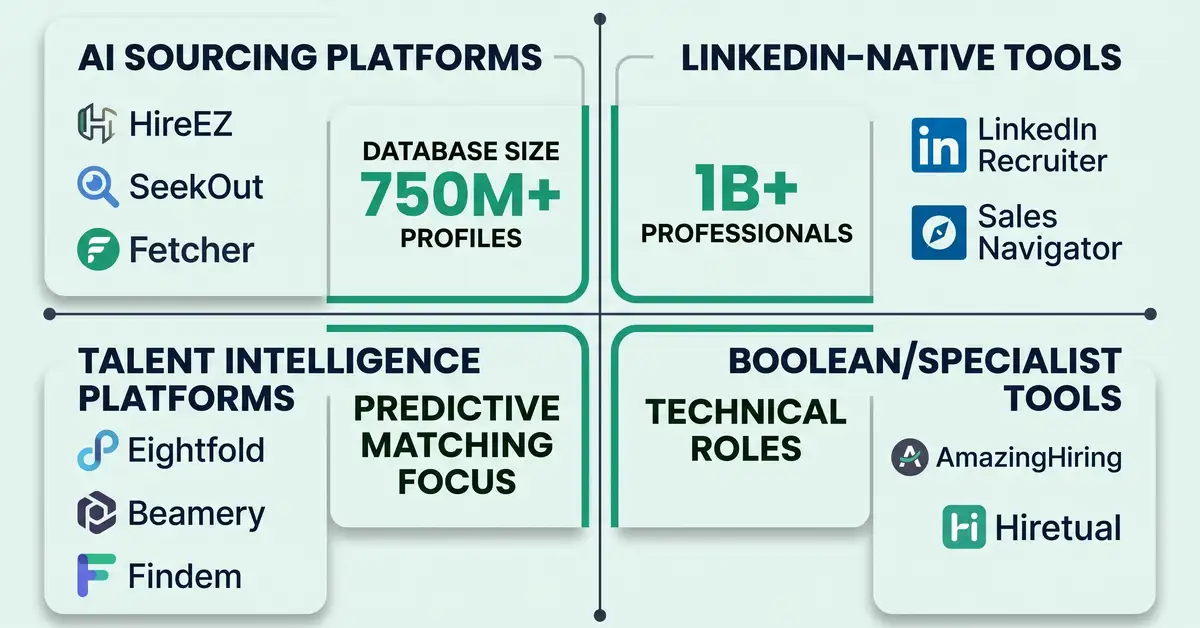
The candidate sourcing tool landscape divides into four discrete categories. Understanding the category boundaries prevents the most common mistake in tool selection: comparing platforms that solve different problems. Per Pin's talent intelligence software analysis, executive search firms that operate without a categorical framework consistently overpay for redundant capabilities while underinvesting in critical capability gaps.
| Category | Core Function | Representative Vendors | Pricing Range |
| AI Sourcing Platforms | External candidate discovery plus AI matching plus multi-channel outreach | HireEZ, SeekOut, Fetcher, Juicebox, GoPerfect | $100-500/user/mo |
| LinkedIn-Native Tools | Access to LinkedIn's 1B+ professional network plus InMail outreach | LinkedIn Recruiter, Sales Navigator, Recruiter Lite, Talent Insights | $170/mo - $11,500/seat/yr |
| Talent Intelligence Platforms | Enterprise-scale skills graphs plus internal mobility plus workforce planning | Eightfold, Beamery, Findem, Phenom, Pin | $1,500/mo - $580,000+/yr |
| CRM/ATS-Integrated Sourcing | Pipeline management plus AI search layered on existing recruitment data | Bullhorn, Loxo, Recruiterflow, Crelate, Recruit CRM | $100-300/user/mo |
Sources: Pin Talent Intelligence Software Analysis 2026, Juicebox 2026 Sourcing Tools Guide, Gem 7 Best Candidate Sourcing Software 2026
The categorical distinction matters because no single category covers the full sourcing workflow for executive search. AI sourcing platforms excel at discovery and outreach but lack the relationship infrastructure of CRMs. LinkedIn-native tools have unmatched professional network access but limited automation. Talent intelligence platforms provide enterprise-scale insights but require enterprise budgets. CRM/ATS-integrated sourcing manages pipelines well but lacks the discovery breadth of dedicated sourcing tools. Elite firms layer across categories.
Vendor Deep Dive: 12 Platforms Compared

HireEZ (formerly Hiretual)
Category: AI Sourcing Platform. Pricing: $169 to $250+ per user per month billed annually per Juicebox HireEZ pricing analysis. Core differentiation: Automated sourcing plus multi-channel outreach combined. Database: Billions of profiles aggregated from public web. Best fit: Mid-to-large executive search firms managing 5+ concurrent mandates. Recent case study: Dental Care Alliance reduced total recruitment budget by 20%, cut Indeed spending by 60% YoY, and improved offer-acceptance rates by 18% for dentists and 45% for clinical leadership per hireEZ's Dental Care Alliance case study.
SeekOut
Category: AI Sourcing Platform. Pricing: Tiered structure, enterprise plans available per Juicebox SeekOut pricing guide. Core differentiation: Graph-based search across 850M+ professional profiles aggregated from diverse sources including code repositories, conference talks, and patents. Best fit: Technology executive search, diversity sourcing, hard-to-fill specialist roles. Key strength: Surfacing candidates who exist outside traditional LinkedIn-only sourcing through technical contribution analysis.
Gem
Category: Recruiting CRM. Pricing: From $100 per user per month (Professional tier billed annually) per Gem's own candidate sourcing software guide. Free tier available for individual recruiters. Core differentiation: Centralised candidate relationships across the entire pipeline plus AI-powered relationship intelligence. Best fit: Executive search firms running long-cycle nurture relationships across multiple mandates. Case study: Pure Storage documented significant recruiter productivity gains and TA strategy influence via Gem per Gem's Pure Storage case study.
LinkedIn Recruiter
Category: LinkedIn-Native. Pricing: Recruiter Lite approximately $170/month single seat or $270/month for 2-5 seats; Recruiter Professional Services approximately $11,500 per seat annually; Talent Insights add-on ~$6,000 annually per Juicebox LinkedIn Recruiter pricing 2026. Core differentiation: 1 billion+ member professional network, the deepest in the industry. Best fit: Foundational tool for nearly every executive search firm. Caveat: Algorithm restrictions have diminished X-ray search efficacy per PCRecruiter's death of X-ray search analysis.
Eightfold
Category: Talent Intelligence Platform. Pricing: Enterprise custom quote, typically $100k to $500k+ annually. Core differentiation: Combines talent acquisition with talent management on a unified skills graph per Eightfold AI's platform overview. Best fit: Large enterprises and global executive search firms serving them. Key strength: Internal mobility recommendations bundled with external sourcing, valuable when clients are evaluating internal promotion versus external hire.
Beamery
Category: Talent Intelligence Platform. Pricing: Enterprise deployments $580k+ annually per Pin's talent intelligence software comparison. Core differentiation: Enterprise talent CRM unifying TA and TM on a single skills-intelligence layer. Best fit: Organisations with 5,000+ employees plus executive search firms serving them. Key strength: Skills graphs that map competencies across enterprise functions for matrixed leadership roles.
AmazingHiring
Category: Technical Specialist Sourcing. Pricing: Tiered $200-500/user/mo. Core differentiation: Search across 50+ technical networks including GitHub, Stack Overflow, and Kaggle per AmazingHiring's platform overview. Best fit: CTO, VP Engineering, Chief AI Officer, and other technology executive mandates where surfacing candidates by technical contribution (not just job title) is critical. Key strength: Hidden technical talent identification 50% faster than generalist tools.
Findem
Category: AI Talent Intelligence. Pricing: Enterprise model. Core differentiation: Assistive AI handling sourcing busywork to free consultants for relationships per Findem's AI talent intelligence platform. Best fit: Executive search firms running multiple concurrent searches needing predictive workforce intelligence. Key strength: Combines streamlined sourcing with talent marketing and analytics.
Phenom
Category: Talent Intelligence Platform. Pricing: Enterprise model. Core differentiation: Applied AI for hiring, employee development, and retention combined per Phenom's Applied AI talent intelligence platform. Best fit: Enterprise clients with mature talent management; executive search firms working alongside in-house TA teams. Key strength: Candidate experience layer that bridges sourcing to engagement.
Bullhorn
Category: CRM/ATS-Integrated. Pricing: Custom enterprise quotes per Bullhorn's recruitment software pricing. Core differentiation: Industry-leading ATS for staffing and recruitment firms with AI capabilities increasingly embedded. Best fit: Established executive search firms needing scale-grade pipeline management. Key strength: Native AI features layered on familiar workflows per Bullhorn's GRID 2026 trends report; widely deployed across the industry.
Loxo
Category: Talent Intelligence Platform with built-in CRM. Pricing: Subscription tiers. Core differentiation: Comprehensive talent intelligence layered onto ATS plus CRM in one unified product per Loxo's comparison versus Crelate. Best fit: Boutique executive search firms wanting one tool instead of three. Key strength: AI-powered sourcing baked into the same data model as the ATS, eliminating data sync friction.
Recruiterflow / Crelate / Recruit CRM
Category: CRM/ATS-Integrated. Pricing: Per-user monthly subscriptions, typically $99-249/user/mo per Jarvi's 2026 ATS and CRM comparison and Recruit CRM's AI-first platform. Core differentiation: Mid-market focus with AI-first capabilities increasingly standard per Recruiterflow's recruitment automation 2026 guide. Best fit: Boutique to mid-market executive search firms with 5 to 50 consultants. Key strength: Lower cost-per-seat than Bullhorn with comparable feature breadth for most mandate volumes.
The Layered Tool Stack Architecture
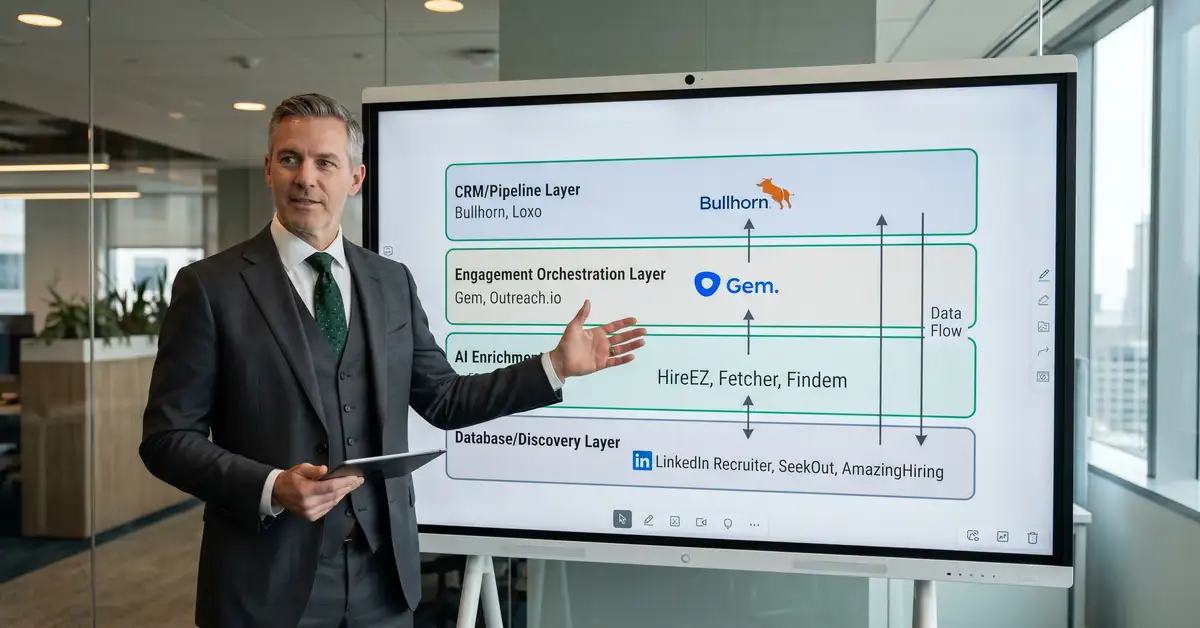
The 2026 best practice for elite executive search firms is a 4-layer tool stack rather than single-platform monoliths. Per Pin's recruiting tech stack 2026 architecture, top-performing firms structure their tool stack as Database/Discovery layer, AI Enrichment layer, Engagement Orchestration layer, and CRM/Pipeline layer. Each layer has a specialised purpose, and tools within a layer are interchangeable based on firm-specific requirements.
| Layer | Function | Typical Vendors | Annual Budget Range |
| Database/Discovery | Surface candidates from external talent pools | LinkedIn Recruiter, SeekOut, AmazingHiring | $15k-$80k |
| AI Enrichment | Score candidates, enrich contact data, infer skills | HireEZ, Fetcher, Findem, Juicebox | $10k-$60k |
| Engagement Orchestration | Multi-channel outreach automation, sequences, response tracking | Gem, Outreach (cross-purpose), HireEZ outreach | $10k-$50k |
| CRM/Pipeline | Manage candidate stages, client relationships, billing | Bullhorn, Loxo, Recruiterflow, Crelate | $15k-$120k |
Sources: Pin Recruiting Tech Stack 2026, Juicebox 12 Best Candidate Sourcing Platforms 2026
The single-platform monolith trap
Vendors marketing themselves as the "all-in-one platform that replaces your tech stack" consistently underperform layered architectures because no single vendor dominates database breadth plus AI quality plus relationship management plus pipeline workflows simultaneously. The 4-layer architecture lets executive search firms pick the best vendor in each layer while controlling integration through CRM workflows. This approach connects to the broader cluster's CRM automation architecture for elite search firms, where the CRM serves as the orchestration backbone rather than the limiting factor.
Executive Search vs Volume Recruitment Feature Requirements
The features that matter for executive search differ materially from volume recruitment. Executive search emphasises depth of candidate insight, relationship management capabilities, and integration with sophisticated assessment methodologies. Volume recruitment emphasises candidate throughput, automated screening efficiency, and integration with high-volume ATS pipelines processing hundreds of applications per role.
| Feature | Executive Search Priority | Volume Recruitment Priority |
| Database breadth (specialist platforms) | Critical (technical, board, conference data) | Lower (LinkedIn-only often sufficient) |
| AI auto-sourcing volume | Moderate (50-300 candidates per mandate) | Critical (1000s per requisition) |
| X-ray and Boolean precision | Critical (audit trail, DEI compliance) | Moderate (AI auto-expansion sufficient) |
| Contact enrichment depth | Critical (personal email, mobile, calendar) | Moderate (work email typically enough) |
| Multi-channel outreach | Critical (LinkedIn + email + phone) | Moderate (email-dominant) |
| Talent intelligence and diversity insights | Critical (client expectation) | Moderate |
| ATS/CRM integration | Critical (retainer billing, off-limits, confidentiality) | Critical (req management, EEO reporting) |
| GDPR plus data residency | Critical (cross-border senior search) | Moderate |
Sources: Pin Candidate Sourcing Software Compared 2026, Kiteworks GDPR Data Residency Requirements
ROI Benchmarks for Sourcing Tool Investment

The ROI case for candidate sourcing tools is well-documented across multiple credible sources. The headline benchmarks are 35 to 50 percent reduction in time-to-shortlist for critical leadership roles, 40 to 60 percent sourcer productivity uplift, and 20 to 30 percent customer acquisition cost reduction. The Bullhorn GRID 2026 data showing top-performing firms 4 times more likely to use AI is the strongest macro signal of correlation between adoption and revenue growth.
Specific case study evidence: HireEZ's Dental Care Alliance case documented 20% recruitment budget reduction, 60% Indeed spending cut year-over-year, and 18% offer-acceptance improvement for dentists plus 45% for clinical leadership roles. Gem's Pure Storage case study describes a free trial that produced immediate visible productivity increases sufficient to make adoption "a no-brainer" per the senior director of global talent. Per Hunt Scanlon Media's industry overview, executive search Americas revenue is tracking up 10 to 11 percent in 2026 with technology-enabled firms significantly outperforming traditional firms, aligning with the broader future of executive search trajectory.
Per Aisera's 2026 guide to agentic AI in recruiting, the agentic AI category is where the most dramatic productivity gains will accrue over the next 24 months. Agentic systems that autonomously spot candidates, analyse fit, time outreach, and initiate engagement compress the consultant-hours per candidate by an order of magnitude versus traditional manual sourcing workflows. This trajectory aligns with the cluster's AI for executive search infrastructure.
Build vs Buy: When Custom Infrastructure Makes Sense
The 2026 best practice is hybrid. Buy specialised sourcing platforms (HireEZ, SeekOut, LinkedIn Recruiter, AmazingHiring) for the database and AI search layers where the vendor's data network and algorithm investment are impossible to replicate in-house. Build custom orchestration via n8n, Make.com, or HubSpot workflows for the layers that depend on proprietary methodology, confidential search workflows, client-specific scoring rubrics, multi-tool aggregated dashboards, and off-limits and retainer-billing logic.
Per DigitalScouts' automation platform analysis, HubSpot Workflows suit CRM-anchored automations, n8n suits engineering teams needing code control and self-hosting, while Make.com sits between the two on technical depth. Boutique executive search firms with technically-comfortable operations leads can build remarkably sophisticated custom layers on these platforms at 5 to 10 percent of the cost of enterprise talent intelligence platforms, addressing the orchestration gap that vendors cannot solve generically.
Architecting the candidate sourcing tool stack that compounds across mandates?
Book a Growth Mapping CallThe 5 Most Common Selection Mistakes
Mistake 1: Single-platform monolith bias
Believing one vendor can deliver the full sourcing stack. Per Pin's tech stack analysis, top-performing firms run 3 to 5 specialised tools rather than relying on consolidated platforms. The vendors most aggressively marketing all-in-one solutions consistently underperform layered architectures because no single vendor dominates every layer.
Mistake 2: Over-buying seats
Purchasing per-user licenses for consultants who use the platform less than once per week. The economics of executive search platforms favour shared power-user accounts plus role-based access controls rather than universal seat distribution. Audit actual usage every 90 days and reclaim unused seats.
Mistake 3: Ignoring CRM integration depth
Selecting a sourcing tool whose CRM integration is shallow, requires manual export-import, or duplicates candidate records across systems. Per Loxo's competitive analysis, data sync friction destroys the productivity gains the sourcing tool was supposed to deliver. Audit the CRM integration before signing the contract, not after.
Mistake 4: Ignoring data residency for cross-border search
Selecting tools without explicit data residency controls for executive search engagements spanning multiple regulatory jurisdictions. Per Kiteworks GDPR analysis, executive candidate data plus the strategic context of confidential C-suite searches requires careful attention to where data is stored and processed. EU clients increasingly require EU data residency as a contract condition.
Mistake 5: Treating AI scoring as ground truth
Letting AI candidate scoring drive shortlist decisions without human review for executive-level mandates. Per Korn Ferry's Talent Trends 2026 research, the human plus AI power couple consistently outperforms either alone. AI scoring is decision support for executive search, not ground truth. The candidates AI ranks highest are not necessarily the candidates the search firm should engage, particularly for confidential or culturally-sensitive mandates.
The 7-Step Tool Selection Playbook
Define use cases by mandate type
Map the firm's mandate mix (retained C-suite, retained mid-management, contingency, vertical specialist) against the tool stack layers. The Database/Discovery layer requirements differ materially between technology executive search and consumer goods executive search, even if both run on retained models. Defining mandates first prevents over-buying capabilities that do not apply to the firm's actual book of business.
Budget and seat math
Calculate the per-mandate sourcing tool cost (annual tool budget divided by annual mandate count) and benchmark against the firm's mandate fee structure documented in the executive search pricing model breakdown. Mid-market firms should expect $1,500 to $10,000 per month for the full stack. If the per-mandate sourcing tool cost exceeds 3 percent of average mandate fee, the stack is over-engineered.
Database fit assessment
Run identical test searches across 3 to 5 candidate vendor platforms during free trials. Compare results for the same role brief: candidate count, candidate quality, overlap percentage, and unique-to-platform candidate count. The platforms with the highest unique-to-platform contribution add the most to your stack. Platforms whose database is 90% overlap with LinkedIn add minimal value at premium pricing.
CRM integration depth
Test the bidirectional sync between candidate platform and CRM during the trial. Look specifically for: candidate record duplication, custom field mapping, activity logging fidelity, and confidentiality controls. Platforms that require manual CSV export every week kill the productivity gains they were supposed to deliver. Reject any platform with shallow CRM integration.
Compliance and data residency
For cross-border executive search, verify EU data residency, GDPR data subject rights workflows, and right-to-be-forgotten implementation. The platforms with mature compliance frameworks reduce client legal review time significantly. The platforms without mature compliance frameworks create contract friction with EU and UK clients increasingly demanding data sovereignty commitments.
ROI measurement framework
Establish baseline metrics before tool adoption: candidates surfaced per consultant per week, time-to-first-conversation, time-to-shortlist, candidate response rate. Measure the same metrics 90 days post-adoption to validate the vendor's claimed ROI uplift. Tools that fail to demonstrate measurable lift against baseline should be replaced, not renewed.
Vendor stability and roadmap
Executive search platforms have consolidated rapidly via M&A. Evaluate vendor financial stability, product roadmap clarity, and consolidation risk before committing to multi-year contracts. The platforms most likely to be acquired and disrupted are the mid-tier vendors without category leadership, where the post-acquisition product direction is uncertain. Anchor on vendors with category leadership and clear roadmap commitment, integrated with the firm's KPI dashboard architecture.
Install the candidate sourcing tool stack that compounds productivity across mandates
Elite executive search firms scaling sourcing operations into competitive infrastructure need a layered tool architecture, AI-augmented search precision, CRM-integrated relationship management, and compliance-grade data sovereignty across cross-border mandates. peppereffect installs the agentic workflows that decouple placement capacity from sourcer headcount, automate the 70 percent of repetitive sourcing work, and protect the methodological depth that justifies elite-tier search engagement positioning.
Book a Growth Mapping CallFrequently Asked Questions
What are candidate sourcing tools?
Candidate sourcing tools are software platforms that identify, enrich, and engage potential candidates from external talent pools across LinkedIn, GitHub, Stack Overflow, technical communities, and proprietary databases. The 2026 candidate sourcing tool landscape divides into four categories: AI sourcing platforms (HireEZ, SeekOut, Fetcher, Juicebox), LinkedIn-native tools (LinkedIn Recruiter, Sales Navigator), talent intelligence platforms (Eightfold, Beamery, Findem, Phenom), and CRM/ATS-integrated sourcing (Bullhorn, Loxo, Recruiterflow, Crelate). The global AI recruitment market was valued at $706.54M in 2025 and is projected to reach $1,119.79M by 2032 at a 6.8% CAGR. Pricing ranges from free tiers to $580,000+ annually for enterprise deployments.
What are the best candidate sourcing tools for executive search?
The best candidate sourcing tools for executive search in 2026 are: HireEZ (AI sourcing plus outreach, $169-250+ per user per month); SeekOut (graph-based search across 850M+ profiles, strong for technical executives); Gem (recruiting CRM that centralizes relationships, from $100 per month per user); LinkedIn Recruiter Professional (~$11,500 per seat annually, 1B+ professional network); Eightfold (enterprise talent intelligence, $100k-$500k+); Beamery (enterprise talent CRM, $580k+ scaled deployments); AmazingHiring (technical talent across 50+ networks); Fetcher (AI candidate matching and automated outreach); Findem (AI talent intelligence with executive search focus); Bullhorn (recruitment ATS with AI capabilities); Loxo (talent intelligence platform with built-in CRM); Phenom (talent experience platform). Elite firms layer 3-5 tools rather than relying on single platforms.
How much do candidate sourcing tools cost?
Candidate sourcing tool pricing spans an extraordinary range from free tiers for individual recruiters to enterprise contracts exceeding $580,000 annually. Mid-market executive search firms with 10-50 consultants typically invest $1,500 to $10,000 per month for enterprise-grade platforms. Specific 2026 benchmarks: HireEZ $169-250+ per user per month billed annually; SeekOut tiered structure with enterprise plans available; Gem from $100 per month per user; LinkedIn Recruiter Lite approximately $170 per month single seat or approximately $270 per month for 2-5 seats; LinkedIn Recruiter Professional approximately $11,500 per seat annually; LinkedIn Talent Insights approximately $6,000 annually; Eightfold enterprise quote $100k-$500k+; Beamery enterprise deployments $580k+. Pricing typically structures around seat licenses, data volume, and feature sets rather than per-hire models common in volume recruitment.
What is the ROI of candidate sourcing tools for executive search firms?
Documented ROI benchmarks for candidate sourcing tool adoption in executive search: 35-50% reduction in time-to-shortlist for critical leadership roles; 40-60% sourcer productivity uplift; 20-30% customer acquisition cost reduction. Bullhorn GRID 2026 finds firms using AI at any stage are 3.5-4.5x more likely to have grown revenue (up from 1.25-1.4x in 2025), with 55% of high-performing firms reporting KPIs up over 25% specifically from AI screening. HireEZ Dental Care Alliance case study documented 20% recruitment budget reduction, 60% Indeed spending cut year-over-year, and 18% offer-acceptance improvement for clinicians plus 45% for clinical leadership. Hunt Scanlon Media reports executive search Americas revenue tracking up 10-11% in 2026 with technology-enabled firms significantly outperforming traditional firms.
What is the difference between candidate sourcing tools and an ATS?
Candidate sourcing tools identify and engage external candidates from open talent pools across LinkedIn, GitHub, technical communities, and proprietary databases through search, AI matching, contact enrichment, and outreach automation. Applicant tracking systems (ATS) manage the pipeline of candidates who have already entered the recruitment process (applied, been referred, or actively shortlisted) through requisition management, candidate stages, interview scheduling, and offer management. The distinction matters for executive search because external sourcing tools surface passive executive talent who never applied to a job posting, while ATS workflows manage post-engagement pipeline. Elite executive search firms layer both: sourcing tools (HireEZ, SeekOut, Gem) for external discovery; ATS/CRM platforms (Bullhorn, Loxo, Recruiterflow) for pipeline management. Some platforms like Loxo and Recruiterflow blur the boundary by combining sourcing with ATS in a unified data model.
How do AI candidate sourcing tools work?
AI candidate sourcing tools aggregate data from professional networks (LinkedIn, GitHub, Stack Overflow), technical repositories, and proprietary databases into unified candidate profiles, then apply machine learning to surface matches against role criteria. Core AI capabilities include: semantic search that interprets job descriptions rather than literal keyword matching; skills inference that detects transferable competencies from career trajectories; multi-channel outreach automation with personalised messaging adapted to candidate context; ranking and scoring of candidates against success profiles; diversity analytics that surface underrepresented talent. Agentic AI systems (the 2026 frontier) autonomously perform multi-step workflows: spot a candidate, analyse profile fit, determine optimal outreach timing, initiate personalised communication, learn from engagement patterns. Per Bullhorn GRID 2026, 30% of agencies now use some level of agentic AI, up from 56% merely experimenting with basic generative AI in 2025.
Should elite executive search firms build custom sourcing infrastructure or buy off-the-shelf tools?
The 2026 best practice for elite executive search firms is hybrid: buy specialised sourcing tools (HireEZ, SeekOut, LinkedIn Recruiter, AmazingHiring) for the database and AI search layers, then build custom orchestration via n8n, Make.com, or HubSpot workflows for the layers that depend on proprietary methodology (success profile scoring, candidate confidentiality, client-specific reporting). Single-platform monolith approaches consistently underperform layered architectures because no single vendor dominates database breadth plus AI quality plus relationship management. Pin's recruiting tech stack analysis confirms top firms run 3-5 specialised tools connected through CRM workflows rather than relying on one platform for everything. Custom builds make sense for: confidential search workflows, client-specific scoring rubrics, multi-tool aggregated dashboards, integration with off-limits and retainer-billing logic. Off-the-shelf wins for: database breadth, AI search algorithms, established outreach platforms.
Resources
- Maximize Market Research: AI Recruitment Market Analysis 2025-2032
- Bullhorn GRID 2026 Industry Trends Report
- Hunt Scanlon Media: AI Adoption Linked to Revenue Growth in Executive Search
- Korn Ferry Talent Trends 2026: Human-AI Power Couple APAC
- Gem: 7 Best Candidate Sourcing Software Tools 2026
- Pin: Candidate Sourcing Software 8 Best Platforms Compared 2026
- Pin: Talent Intelligence Software 8 Best Platforms 2026
- Pin: How to Build All 6 Layers of a 2026 Recruiting Tech Stack
- Juicebox: 2026 Top Candidate Sourcing Tools for Recruiters
- Juicebox: HireEZ Pricing and Sourcing Tools 2026 Analysis
- Juicebox: SeekOut Pricing Guide 2026
- Juicebox: LinkedIn Recruiter Pricing 2026 Full Breakdown
- Juicebox: 12 Best Candidate Sourcing Platforms for Recruiters 2026
- HireEZ: Dental Care Alliance Case Study
- Gem: Pure Storage Productivity Case Study
- Aisera: AI Recruitment 2026 Guide to Agentic AI and Hiring
- GoPerfect: Most Popular AI Recruitment Systems 2026 Comparison
- Recruiterflow: Recruitment Automation 2026 Complete Guide
- PCRecruiter: The Death of X-Ray Search for Recruiters
- Loxo: Talent Intelligence Platform vs Crelate Comparison
- Findem: AI Talent Intelligence for Hiring and Workforce Planning
- Eightfold AI: AI Recruiting Software and Talent Intelligence Platform
- AmazingHiring: Hire Hidden Tech Talent 50% Faster
- Phenom: Applied AI Talent Intelligence Platform
- Jarvi: Best ATS and CRM Software Comparisons 2026
- Recruit CRM: AI-First Recruiting Software
- Bullhorn: Recruitment Software Pricing and Plans
- DigitalScouts: HubSpot Workflows vs n8n vs Make Automation Platform Analysis
- Kiteworks: Understand and Adhere to GDPR Data Residency Requirements
- Metaview: Executive Search Strategy 2026
candidate experience operating system
recruitment CRM platform comparison recruitment CRM software comparison for boutique firms recruitment tech stack 2026 recruitment automation for search firms