

Roughly 70 to 75 percent of the global workforce is passive at any given moment. They are employed, productive, and not browsing job boards. At the executive level the proportion climbs to 80 to 90 percent, and for specialist C-suite roles it approaches 95 percent. The active applicant pool is the visible 25 percent. The strategic talent pool is the invisible 75 percent. Recruiters who only work the active pool fight 4 to 6 competing firms for the same candidates, watch CAC inflate annually, and lose the specialist roles that never appear on LinkedIn's open-to-work signal. The discipline of passive candidate sourcing is no longer optional infrastructure for elite executive search firms. It is the differentiator between firms that scale placement volume and firms that plateau at the manual-sourcing capacity ceiling.
This article maps the full passive sourcing operating system for executive search firms, retained search practitioners, and in-house TA leaders running senior mandates. Coverage: the structural reality of the passive workforce, why passive sourcing is harder in 2026 than ever, the 8 engagement channels with response-rate benchmarks, multi-touch sequence architecture, personalisation depth tiers, optimal timing strategies, 5 passive candidate personas with engagement playbooks, confidentiality mechanics for senior search, long-term talent community nurture, AI-augmented passive engagement, the 5 most common mistakes, and the 7-step playbook that turns passive sourcing from craft to repeatable system.
The Passive Candidate Reality

A passive candidate is a professional currently employed and not actively searching for a new role, but who would consider the right opportunity if approached properly. Per LinkedIn Talent Solutions' analysis of recruiting passive candidates, approximately 70 to 75 percent of the global professional workforce is passive at any given time, with the proportion rising to 70 to 90 percent at the executive level and even higher for specialist and C-suite roles. Per Scion Staffing's 2024 passive candidate research, 73 percent of candidates self-report as passive but 87 percent are open to opportunities if approached. The distinction matters: passivity is search posture, not unwillingness to move.
The structural insight is that passive sourcing inverts the active recruiting model. Active recruiting waits for candidates to declare interest, then competes against the 30+ other firms also marketing to declared candidates. Passive sourcing identifies the candidate first, calibrates the approach to the candidate's situation, and engages on a relationship timeline that often spans 6 to 24 months before a placement materialises. Per Hunt Scanlon's analysis of passive candidate engagement in executive search, the firms that institutionalise this longer engagement cycle build candidate relationships that compound across mandates, generating repeat placement opportunities that active-only firms cannot replicate.
Why Passive Sourcing Is Harder Than Ever
Three structural shifts have made passive sourcing materially harder in 2026 than in the LinkedIn-dominant era of 2015 to 2020. Recruiters who operate on 2018-era playbooks see response rates decay quarter on quarter without understanding why.
Outreach saturation: Senior executives now receive 40 to 80 InMails and cold emails per month. The volume reflects the proliferation of AI-augmented sourcing tools that auto-generate outreach at unprecedented scale. The mathematical consequence is that generic templated outreach response rates have collapsed from 5 to 8 percent in 2018 to 1 to 3 percent in 2026. Per Gem's recruiting metrics analysis, the only outreach styles maintaining response rates above 10 percent are deeply personalised, multi-channel, and timed to candidate-side triggers.
LinkedIn algorithm changes: LinkedIn's 2024-2025 product changes (InMail credit caps, profile view throttling, recruiter ranking opacity) make broadcast sourcing harder. Per SHRM's analysis of passive candidate sourcing trends, recruiters now need 2 to 3 platforms in rotation rather than LinkedIn-only workflows. The implication is that the elite sourcing firms build multi-platform engagement infrastructure, while LinkedIn-only firms watch their pipeline contract.
Trust erosion from AI-generated outreach: Executives have learned to identify and ignore AI-generated InMails (the over-flattering opening, the generic "saw your profile" hook, the obvious template structure). Per Scion Staffing 2024 research, 67 percent of senior executives report deleting outreach without reading it once they identify AI-generated patterns. The competitive advantage now belongs to outreach that demonstrably could not have been written by a template, which paradoxically requires AI augmentation to produce at scale without sacrificing quality.
The 2026 sourcing inversion
The recruiters winning passive engagement in 2026 are not the ones running the most outreach. They are the ones running the most differentiated outreach. Volume without personalisation collapses to 1 to 3 percent response. Personalisation without volume cannot fill an executive search firm's mandate pipeline. The infrastructure that produces both, personalisation at volume, is the operating system that decouples placement capacity from sourcer headcount.
The 8 Engagement Channels
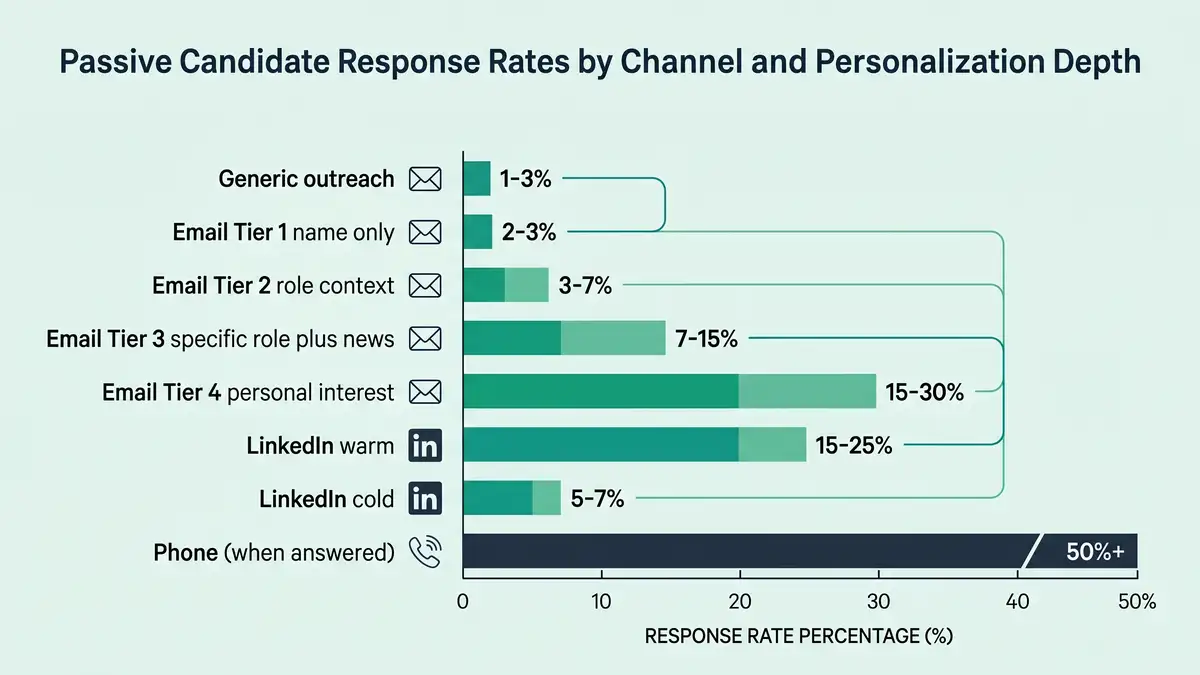
Passive sourcing operates across 8 distinct engagement channels, each with different access patterns, response rate benchmarks, and best-fit use cases. The elite firms run 3 to 5 channels in coordinated sequences rather than depending on any single channel.
| Channel | Response Rate Benchmark | Best-Fit Use Case |
| LinkedIn InMail (personalised) | 10-25% (vs 3-8% generic) | First-touch for known profiles with strong relevance signal |
| Cold email (deep personalisation) | 9-18% (vs 1-3% templated) | Executive-level, where InMail is over-saturated |
| Phone outreach | 15-30% connect rate | Senior search where direct dial reaches candidates |
| Referral / network warm intro | 40-60% engagement | Highest-trust path; protected by relationship capital |
| SMS / text | 8-15% (declining) | Follow-up only; rarely effective for cold first-touch |
| Industry events and conferences | 20-35% follow-up engagement | Pre-event mapping plus in-person rapport, then warm digital follow-up |
| Content engagement (LinkedIn comments) | 5-12% conversion to conversation | Long-cycle nurture; converts thought-leadership audience to candidates |
| Slack / Discord / community channels | 8-18% (specialist niches) | Engineering, design, and creative roles where candidates avoid LinkedIn |
Sources: Gem Recruiting Metrics Analysis, Hunt Scanlon Executive Search Engagement Research
The differentiator between proficient and elite passive sourcing is not channel choice but channel sequencing. Per Gem's multi-channel sequence analysis, combined LinkedIn plus email sequences produce 15 to 25 percent reply rates, which is 3 to 4 times the single-channel performance. Channel diversification reduces dependency on any single platform's algorithmic changes and reaches candidates whose preferred medium varies by persona and seniority level.
The channel mix calibrates to the role. Specialist engineering hires respond strongly to GitHub plus Discord plus email. Healthcare executives respond to phone plus referral plus encrypted email. Finance and legal executives respond to early-morning email plus warm LinkedIn intro. The cluster's candidate sourcing strategies overview documents the role-by-role channel mapping in greater detail.
Multi-Touch Sequence Architecture

The single-touch outreach model is structurally broken for passive sourcing. The optimal architecture runs 4 to 7 touches for typical mid-management roles and 5 to 9 touches for executive searches across 2 to 8 weeks. Per Gem's multi-touch sequence research, approximately 80 percent of positive responses arrive after touch one, which means the follow-up sequence carries the highest leverage in the entire passive sourcing operation.
Touch 1: Personalised LinkedIn connection or InMail
Open with the specific signal that triggered the outreach (recent post, project, promotion). State the relevance to the candidate in one sentence. Avoid CV-summary openings ("I noticed your impressive 15 years of experience"); executives know it is templated. Connection requests outperform InMail for first touch: personalised connection requests achieve 45 percent acceptance versus 12 to 18 percent generic.
Touch 2: Email (3-5 days later)
If LinkedIn was not opened, switch channel rather than re-touching the same channel. Personalised email referencing one specific candidate context point. Subject line carries 60 percent of open-rate variance; avoid "Opportunity" or "Quick question". Use the candidate's company name or a specific project reference.
Touch 3: LinkedIn engagement (7-10 days later)
Genuine engagement on the candidate's most recent post (substantive comment, not generic "great post"). The objective is presence in the candidate's notification feed without explicit outreach. Builds familiarity for the next direct touch.
Touch 4: Value-add follow-up email (10-14 days)
Send a relevant industry report, framework, or insight without explicit ask. Position as one-way value rather than transactional outreach. The high-performing recruiters reserve a library of curated assets for this touch.
Touch 5: Phone or warm-channel attempt (14-21 days)
For senior searches, attempt phone outreach via direct dial or mutual-connection warm intro. The 15 to 30 percent connect rate produces the highest-quality conversations in the sequence. For mid-management roles, skip to touch 6 if phone is not appropriate.
Touch 6: Re-engagement with new angle (21-28 days)
If the role has evolved or a new strategic signal has emerged (the candidate's company just announced layoffs, restructuring, or M&A), surface the new context as the reason for re-engagement. Avoid "just following up" framing.
Touch 7: Soft-close and nurture transition (28-45 days)
If no response after 6 touches, transition the candidate to long-term nurture. Send a final message stating intent ("I'll stop reaching out on this role but would value staying in touch") and add to the talent community for quarterly touch points. The candidate often returns 6 to 18 months later when their personal trigger activates.
Personalisation Depth Tiers

Personalisation is not binary. Response rates scale across four discrete depth tiers, and the highest-performing recruiters operate at tiers 3 and 4 by default. Per LinkedIn Talent Solutions' effective recruiter outreach analysis, the response-rate differential across tiers exceeds 10x.
| Tier | Definition | Response Rate | Production Effort |
| Tier 1: Generic templated | Mass merge with name only | 1-3% | 30 seconds per touch |
| Tier 2: Light personalisation | Name plus company name plus role | 3-5% | 1-2 minutes per touch |
| Tier 3: Mid-tier personalisation | Custom subject line plus one specific sentence about candidate | 6-9% | 4-6 minutes per touch |
| Tier 4: Deep personalisation | References specific project, recent post, conference talk, GitHub repo | 9-18% (top campaigns 15-30%) | 10-20 minutes per touch |
Sources: LinkedIn Effective Recruiter Outreach Research, Gem Recruiting Benchmarks 2024
The economics calibrate to seniority. For executive search at $200,000+ mandate fees, tier-4 personalisation (10 to 20 minutes per touch) is the right investment because the conversion delta justifies the time cost. For volume mid-management hiring, tier-3 personalisation aided by AI-generated drafting represents the productivity sweet spot. Tier-1 generic outreach is strategically unjustifiable at any seniority level; the response rate is too low and the brand damage too high.
Timing Strategies
The timing of passive outreach materially affects response rates. Per Gem's outreach timing benchmark research, optimal send timing produces 30 to 40 percent higher response rates than poorly timed outreach to the same candidates.
Day-of-week: Tuesday through Thursday produces the strongest response rates, with Tuesday outperforming and Thursday a close second. Monday morning is structurally weak because executives are catching up on weekend backlog. Friday afternoon is weak because executives are wrapping up rather than engaging on new opportunities. Cold sends on Monday morning and Friday afternoon produce approximately 20 percent lower response rates.
Time-of-day: Executives respond best 7am to 9am or late evening windows when their calendars are less defended. Mid-level professionals respond best in mid-morning (9am to 11am) and early afternoon (1pm to 3pm) windows. Always send in the candidate's local time zone; LinkedIn InMail timing follows the recruiter's time zone unless explicitly scheduled, which is a frequent operational miss.
Industry-specific timing: B2B SaaS responds best Tuesday through Thursday mid-week. Creative and agency professionals respond best Wednesday and Thursday. Finance and legal executives respond best early morning Tuesday through Thursday. Healthcare clinicians respond best mid-morning weekdays when patient-load demands have not yet peaked.
Trigger-based timing: The highest-conversion outreach is timed to candidate-side triggers (recent promotion, company restructuring, M&A announcement, recent leadership change). Per HireEZ's analysis of trigger-based passive engagement, outreach within 30 to 60 days of a trigger event produces 2 to 3 times the response rate of un-timed outreach.
The 5 Passive Candidate Personas
Passive candidates are not homogeneous. The high-performing sourcers segment passive candidates into 5 personas, each with distinct engagement patterns, message framing, and channel preferences.
Quiet High-Performer
Long-tenured, content in current role, no public signals of dissatisfaction. Profile updates rarely, posts rarely, has no "open to work" markers. Requires the deepest personalisation (Tier 4) plus explicit confidentiality framing. Engagement timeline often spans 12 to 36 months. Channel: warm referral via mutual connection beats cold outreach 4-to-1 for this persona.
Curious Climber
Mid-career to mid-senior, lurks on LinkedIn and engages with thought leadership without explicit job-seeking signals. Open to exploratory chat framing ("Would value 20 minutes to share market intel on senior product roles in B2B SaaS"). Responds well to content-engagement-led outreach where the recruiter has commented thoughtfully on their posts prior to the formal approach.
Trigger-Activated
Recently promoted, completed major project, experiencing restructuring or M&A at their current employer. Personal trigger window is open and the candidate is unusually responsive. Outreach within 30 to 60 days of trigger event produces 2 to 3 times normal response rates. Channel: speed matters; reach quickly via the channel with the lowest friction.
Selective Executive
C-suite or VP-level juggling 2 to 3 active opportunities at any time. Trusts known recruiters cultivated over years, ignores cold outreach almost categorically. Values discretion, strategic alignment, and recruiter credibility signals (firm reputation, prior placement track record in their sector). Channel: warm intro from a trusted board member or fellow executive is the only reliable cold-conversion path.
Specialist / Hard-to-Find
Niche skill, regulatory expertise, or unique experience profile that is invisible to job boards and LinkedIn default ranking. Often active on specialist platforms (GitHub for engineers, ResearchGate for scientists, specialist Slack and Discord communities for design and product). Requires technical credibility from the recruiter (the candidate vets the recruiter's knowledge of the specialism before engaging) plus role specificity in the first message.
Confidentiality Mechanics

Executive passive sourcing operates under confidentiality requirements that mid-management hiring does not face. Per Hunt Scanlon's confidential search best practices research, the elite firms institutionalise five confidentiality mechanics across every senior mandate engagement.
Tailored NDAs before strategic detail: Bilateral NDA in place before sharing client identity, financial trajectory, or strategic context. Standard at C-suite mandates; increasingly standard at VP-level mandates in cross-border searches. Without the NDA layer, candidates refuse to engage on competitive-sensitive opportunities.
Blind hiring / confidential search: Company name withheld from candidate until the candidate has qualified through initial screening. Per StevenDouglas analysis of confidential executive search, the blind-hiring approach is the core value proposition for cross-border senior search where the client cannot signal market intent without triggering competitor or shareholder reaction.
Explicit confidentiality framing for candidate protection: The candidate's risks include counter-offer exposure if their current employer learns of the search, non-compete enforcement if they have signed restrictive covenants, and board optics for currently public executives. Framing the confidentiality protections explicitly in the first conversation reduces candidate friction and accelerates engagement.
Communication discipline: No work email for sensitive content. Encrypted channels (Signal, Proton, password-protected document portals) for financial or strategic detail. Separate phone numbers for candidate communication where appropriate. Clear in-channel rules ("I'll only ever message you on personal email and Signal") so the candidate can rapidly verify legitimate communication and ignore impersonation attempts.
Talent-pool signal management: Avoid public talent-pool signals that executives would see and refuse to engage with. A senior executive seeing themselves listed in a recruiter's published "top 20 CTOs in Europe" article will not engage; the public visibility creates risk. The discipline is to keep relationship cultivation private and let candidates choose their level of visibility.
Long-Term Talent Community Nurture
The structural insight for executive passive sourcing is that relationships compound over years, not months. The recruiter who has cultivated a candidate for 18 months wins the next mandate when the candidate is finally ready to move, even if a competitor sees the same opportunity first. Per Hunt Scanlon's long-cycle nurture analysis, retained C-suite searches frequently close on candidates whose relationship with the lead consultant spans 2 to 5 years.
The mechanics of long-term nurture are repetitive and unglamorous. Quarterly touchpoint with high-value passive candidates. Personal email with industry insight, not mass newsletter. Annual market intelligence briefing at conferences or in-person meetings. Birthday and work-anniversary acknowledgement (timed, not generic). Promotion congratulations within 7 days of the candidate's announcement. The cumulative effect is that the candidate considers the recruiter their default trusted advisor for executive career moves, which is the deepest competitive moat in executive search.
The CRM infrastructure to maintain long-term nurture across hundreds of executives is non-trivial. Manual approaches fail at scale because the cadence demands consistency that human recall cannot sustain. The elite firms deploy CRM automation (Bullhorn, Loxo, custom HubSpot stacks) layered with logic-gated reminder workflows that surface the next-touch decision to the consultant rather than the consultant having to remember. This is precisely the kind of operational infrastructure that the CRM automation engine for elite recruiting firms productises.
AI-Augmented Passive Engagement
The 2026 passive sourcing leaders combine human relationship discipline with AI augmentation for the high-volume, low-judgment portions of the workflow. The key distinction is that AI accelerates personalisation production rather than replacing the personalisation discipline itself.
AI-augmented workflows now standard at elite firms: LLM-drafted first-touch personalisation referencing the candidate's recent post or project (consultant edits before sending); auto-summarised candidate intelligence (recent posts, news mentions, GitHub activity, conference talks) delivered to the consultant 5 minutes before the call; sequence-optimisation AI that recommends next-touch channel and timing based on prior response pattern; AI-suggested OR-block expansions for Boolean searches that surface candidates the consultant would not have considered. Per HireEZ's analysis of AI in passive candidate sourcing, the productivity uplift is 25 to 40 percent recruiter time recapture and 30 to 50 percent faster time-to-slate.
What AI cannot do in passive engagement: replace the relationship judgment that distinguishes when a candidate is genuinely ready to move versus politely declining; replicate the confidentiality discipline that protects senior candidate trust; substitute for the consultant's network capital that converts cold outreach to warm intros. The high-performing model is AI for production scale, human for relationship judgment. The Boolean discipline documented in advanced Boolean search techniques for recruiting remains the deterministic control layer that anchors the AI-augmented workflow.
Architecting the passive engagement infrastructure that compounds relationships across mandates?
Book a Growth Mapping CallThe 5 Most Common Mistakes
Mistake 1: Single-touch generic outreach
Sending one templated InMail and giving up when no response arrives. The mathematical consequence is 1 to 3 percent response rate where multi-touch deep-personalisation produces 15 to 25 percent. The mistake compounds because the brand damage from generic outreach reduces future response rates from the same candidates.
Mistake 2: Channel monoculture
Operating LinkedIn-only without diversifying to email, phone, referral, and specialist platforms. Single-channel performance is 3 to 4 times lower than multi-channel sequences. Channel monoculture also leaves the firm exposed to algorithmic changes at the dominant platform.
Mistake 3: Premature transactional framing
Leading with the opportunity ("I have a CTO role at a Series B SaaS company") rather than the candidate ("Your recent post on infrastructure-as-code architecture resonated with the technical pattern I'm seeing across our portfolio"). The transactional opening signals templated outreach and triggers immediate dismissal at the executive level.
Mistake 4: Confidentiality discipline failures
Sending sensitive client or strategic detail to candidate work email. Sharing candidate identities or current employer information without NDA. Public talent-pool signals that executives see and refuse to engage with. Each failure damages the recruiter's reputation in a small executive market where word travels fast.
Mistake 5: No long-term nurture infrastructure
Treating passive candidates as single-mandate prospects rather than multi-year relationship assets. The firms that win the most executive placements have the deepest CRM nurture infrastructure; the firms that plateau are the ones treating each candidate as a transactional touchpoint. The compounding advantage of long-term nurture is the deepest competitive moat in executive search.
The 7-Step Passive Sourcing Playbook
Define the persona segments
Map the mandate's ideal candidate profile against the 5 personas (Quiet High-Performer, Curious Climber, Trigger-Activated, Selective Executive, Specialist). Different personas require different channels, message framing, and sequence cadence. Without persona-level calibration, the sequence applies generic logic to mixed audiences and underperforms.
Build the channel mix
Select 3 to 5 channels based on persona, role seniority, and industry. Executive senior: LinkedIn plus email plus phone plus warm referral. Specialist engineer: GitHub plus Discord plus email. Healthcare clinician: phone plus referral plus encrypted email. Document the mix in advance; do not improvise mid-mandate.
Identify triggers and timing windows
Scan for candidate-side triggers (recent promotion, restructuring, M&A, project completion) within the last 30 to 60 days. Trigger-activated outreach produces 2 to 3 times normal response rates. Calibrate send timing to candidate time zone, Tuesday through Thursday, with executive-level early-morning or late-evening windows.
Compose tier-3 or tier-4 personalisation
For each candidate, draft a personalised first touch referencing a specific signal (recent post, project, conference talk, GitHub repo). AI-augmented drafting acceptable; human edit before sending mandatory. Avoid CV-summary openings and generic "saw your profile" hooks.
Run the 4-7 touch sequence
Touch 1 LinkedIn or InMail, touch 2 email (3-5 days), touch 3 LinkedIn engagement (7-10 days), touch 4 value-add email (10-14 days), touch 5 phone or warm channel (14-21 days), touch 6 re-engagement (21-28 days), touch 7 soft-close and nurture transition (28-45 days). 80 percent of positive responses arrive after touch one; the follow-up sequence carries the leverage.
Apply confidentiality mechanics
NDA in place before strategic detail. Blind hiring or confidential search positioning for sensitive mandates. Encrypted channels for sensitive content. Personal email for sensitive communication. Talent-pool signal management to protect candidate privacy. Aligned with the 7-pillar executive search methodology's confidentiality discipline.
Transition non-responders to long-term nurture
Candidates who do not respond to the 7-touch sequence are not lost; they are transitioned to quarterly nurture. CRM workflow surfaces the next touchpoint at appropriate cadence. Promotion congratulations within 7 days. Annual market briefing. The candidate often returns 6 to 18 months later when their personal trigger activates, and the relationship capital compounds. Feeds the candidate community measured against the executive search KPI dashboard.
Install the passive sourcing operating system that compounds relationships across mandates
Elite executive search firms scaling passive engagement into operational infrastructure need integrated channel sequences, AI-augmented personalisation, confidentiality discipline, and long-term nurture CRM workflows operating at the operating-system level. peppereffect installs the agentic workflows that decouple placement capacity from sourcer headcount, automate the 70 percent of repetitive sequence work, and protect the relationship capital that justifies elite-tier search engagement positioning.
Book a Growth Mapping CallFrequently Asked Questions
What is a passive candidate?
A passive candidate is a professional who is currently employed and not actively searching for a new role but would consider the right opportunity if approached properly. Approximately 70 to 75 percent of the global workforce is passive at any given time, rising to 70 to 90 percent at the executive level and even higher for specialist and C-suite roles. Research from Scion Staffing indicates 73 percent are passive but 87 percent are open to opportunities if approached, meaning passivity is search posture rather than unwillingness.
What is the response rate for passive candidate outreach?
Passive candidate outreach response rates vary by channel and personalisation depth: generic templated outreach 1 to 3 percent, light personalisation (name plus company) 3 to 5 percent, mid-tier personalisation (custom subject line and one specific sentence) 6 to 9 percent, deep personalisation (references specific project or recent post) 9 to 18 percent with top campaigns reaching 15 to 30 percent. Personalised LinkedIn connection requests achieve 45 percent acceptance versus 12 to 18 percent generic. Combined email plus LinkedIn multi-channel sequences produce 15 to 25 percent reply rates and 3 to 4 times single-channel performance.
How many touches does a passive candidate outreach sequence need?
Optimal sequences run 4 to 7 touches for typical roles and 5 to 9 touches for executive searches across 2 to 8 weeks. Approximately 80 percent of positive responses arrive after touch one, making follow-ups the highest-leverage portion of the sequence. The recruiting baseline is 3 to 5 structured touches across email plus LinkedIn over 10 to 14 days for mid-management roles, extending to 5 to 9 touches over 4 to 8 weeks for executive mandates. Multi-touch sequences improve outcomes by several hundred percent versus single-touch outreach.
What is the best time to contact passive candidates?
The best timing for passive candidate outreach is Tuesday through Thursday (strongest), with Tuesday outperforming and Thursday close second, sending between 8am to 10am or 2pm to 4pm in candidate time zone. Executives respond best 7am to 9am or late evening windows when calendars are less defended. Mid-level professionals respond best in mid-morning windows. By industry: B2B Tuesday through Thursday mid-week, creative and agency Wednesday and Thursday, finance and legal early morning Tuesday through Thursday. Avoid Monday morning and Friday afternoon for cold sends (approximately 20 percent lower response rates).
What are the 5 passive candidate personas?
The five passive candidate personas are: Quiet High-Performer (long-tenured, content, no public signals, requires deep personalisation plus confidentiality); Curious Climber (mid-career mid-senior who lurks on LinkedIn and engages with thought leadership, open to exploratory chat framing); Trigger-Activated (recently promoted, completed major project, restructuring or M&A in motion, outreach within 30 to 60 days of trigger spikes response); Selective Executive (C-suite or VP juggling 2 to 3 active opportunities, trusts known recruiters cultivated over years, values discretion and strategic alignment); Specialist or Hard-to-Find (niche skill or regulatory expertise invisible to job boards, requires technical credibility and role specificity).
How do you maintain confidentiality in executive passive outreach?
Confidentiality mechanics for executive passive outreach include: tailored NDAs in place before sharing financial or strategic detail, blind hiring or confidential search offerings (company name withheld until candidate qualified), plain explanation of why confidentiality protects the candidate (counter-offer risk, non-compete exposure, board optics), communication discipline (no work email for sensitive content, encrypted channels for documents, separate phone numbers, clear in-channel rules), and avoiding public talent-pool signals that executives would see and refuse to engage with. Hunt Scanlon and StevenDouglas describe confidential targeted outreach as the core value proposition in cross-border senior search.
How long does executive passive sourcing take?
Executive passive sourcing operates on materially longer cycles than active candidate hiring. The search itself runs 60 to 120 days for retained C-suite mandates, with full cycle to candidate start date reaching 5 to 6 months including notice period. Long-term talent community nurture relationships span 2 to 5 years before placement for the most senior mandates. The structural rule is that executive relationships compound: the recruiter who has cultivated a candidate for 18 months wins the next mandate when the candidate is finally ready to move, even if a competitor sees the same opportunity first.
Resources
- LinkedIn Talent Solutions: Recruiting the Passive Candidate
- LinkedIn Talent Solutions: Effective Recruiter Outreach
- Scion Staffing: Passive Candidates Research 2024
- Hunt Scanlon: Engaging Passive Candidates in Executive Search
- Hunt Scanlon: Confidential Search Best Practices
- Gem: Recruiting Passive Candidates Benchmarks
- Gem: Multi-Touch Recruiting Sequences Analysis
- Gem: Best Time to Send Recruiter Outreach
- SHRM: Passive Candidate Sourcing Trends 2024
- HireEZ: Trigger-Based Passive Engagement
- HireEZ: AI in Passive Candidate Sourcing
- StevenDouglas: Confidential Executive Search Insights
vendor comparison of candidate sourcing tools
candidate experience best practices
diverse candidate sourcing strategy talent mapping strategy playbook