

What Is Recruitment CRM Automation and Why Do Elite Search Firms Need It?
Recruitment CRM automation is the systematic deployment of intelligent workflows, AI-powered screening, and pipeline orchestration within a candidate relationship management platform — transforming how executive search firms track placements, nurture talent pools, and accelerate deal velocity. Unlike generic applicant tracking systems designed for high-volume contingency staffing, recruitment CRM automation for elite search firms integrates long-cycle relationship management, multi-stakeholder engagement tracking, and predictive placement analytics into a unified operating system.
The business case is structural. Recruiters currently spend approximately 80% of their working hours on non-billable administrative tasks — scheduling, data entry, candidate communication, and resume screening — leaving only 20% for the strategic relationship-building and market intelligence that differentiate elite search practice (ShortlistD). Meanwhile, the global talent acquisition software market has reached $10.8 billion in 2024 and is projected to expand to $24 billion by 2034 at an 8.5% CAGR (GM Insights).
The performance gap between automated and manual search firms is now measurable. Among firms that grew revenue by more than 25% in 2025, 78% use AI tools embedded in their ATS, compared to only 51% of firms whose revenue declined (Bullhorn GRID Report). For elite search firms managing retained placements averaging $45,000-$80,000 in fees per placement, even modest improvements in CRM automation translate to hundreds of thousands in incremental revenue.
What you'll learn in this guide:
- Why elite search firms lose 80% of recruiter capacity to administrative friction — and the automation architecture that reclaims it
- Which CRM automation workflows produce measurable improvements in placement velocity, fill rates, and revenue per recruiter
- How AI-powered pipeline tracking delivers 78% correlation with revenue growth above 25%
- The 6-step framework for implementing recruitment CRM automation at retained search firms
- Retained vs. contingency CRM requirements — and why elite firms need fundamentally different pipeline infrastructure
Key Takeaway
Recruitment CRM automation is not about replacing recruiters with software. It is about eliminating the 80% of administrative work that prevents recruiters from doing what they are paid to do — building relationships, conducting market intelligence, and making placements. Elite search firms implementing comprehensive CRM automation report 24% more placements per recruiter, 16% faster time-to-fill, and revenue growth rates three times higher than manual competitors.

Why Do Recruiters Lose 80% of Their Time to Administrative Tasks?
The time allocation crisis in recruitment is not a productivity problem — it is a structural inefficiency that compounds across every open search. Research examining actual recruiter workflows reveals that recruiters spend 44% of their time on sourcing activities, 22% on resume review, and approximately two-thirds of overall hiring time on interview coordination alone (ShortlistD). When these allocations are combined, the majority of working hours are directed toward tasks requiring persistence rather than the strategic thinking that differentiates elite search professionals.

Sourcing passive candidates consumes the most recruiter time — 13 hours per week per role searching for candidates (ShortlistD). For a recruiter simultaneously managing six to eight open positions, sourcing alone overwhelms productive capacity. This is not advanced strategic work — it is pattern-matching across databases that AI workflow automation handles in minutes.
Resume screening compounds the burden. Recruiters spend 30-90 seconds per resume during initial screening, which compounds to 5-15 hours for a single position receiving 200 applications. For search firms managing multiple positions simultaneously, screening alone consumes entire days without advancing client relationships.
Interview scheduling represents the most frustrating administrative drain. 67% of recruiters report that scheduling a single interview takes 30 minutes to two hours, with 35% identifying it as the most time-consuming aspect of recruitment (ShortlistD). For ten open positions requiring five candidate interviews each, that translates to 25-100 hours of coordination time alone.
| Activity | % of Recruiter Time | Hours/Week (per role) | Automation Potential |
| Candidate Sourcing | 44% | 13 hours | 80-90% reduction via AI matching |
| Resume Screening | 22% | 5-15 hours per 200 applications | 90%+ via AI screening |
| Interview Scheduling | ~67% of hiring time | 30 min - 2 hrs per interview | 95% via self-service scheduling |
| Candidate Communication | Significant | Variable | 70-80% via automated sequences |
| Data Entry & Admin | Balance of 80% | 2+ hours/day | 85%+ via CRM automation |
Source: ShortlistD
Which CRM Automation Workflows Drive the Biggest Gains for Search Firms?
Not all automation workflows deliver equal impact on search firm performance. The highest-leverage automations target the specific bottlenecks that consume recruiter time without adding strategic value — and the data shows which workflows produce measurable improvements in placement velocity and revenue per recruiter.
AI-powered candidate screening delivers the most immediate impact. 55% of firms report that AI screening alone improved their KPIs by more than 25%, with 46% reporting that AI cut screening time by half or better (Bullhorn GRID Report). AI-led candidate interviews achieve a succession rate of 53.12% in subsequent human interviews compared to just 28.57% from traditional resume screening — nearly doubling candidate viability at the top of the funnel (iMocha).
Automated interview scheduling reduces coordination time from 15 minutes per candidate to under 2 minutes through self-service scheduling systems that sync with interviewer calendars (Sapia.ai). For retained searches requiring coordination across hiring committees of 5-10 stakeholders, this acceleration compounds into substantial time recovery — saving recruiters up to 10 hours per week on scheduling alone.
Predictive analytics transforms recruitment from reactive to strategic. Companies leveraging advanced recruitment technologies report a 71% improvement in candidate quality, 23% reduction in turnover, and 31% boost in quality of hires (X0PA AI). Predictive analytics delivers 85% shorter hiring cycles, 40% improved hiring accuracy, and 30% lower recruitment costs compared to manual processes.
Candidate nurture workflows automate long-cycle relationship management — critical for retained search where candidate relationships span 12-18 months before placement. Best-practice platforms personalise outreach across email, SMS, and LinkedIn while providing real-time analytics to track relationship signals (CareerPuck). This is the same lead nurturing architecture applied to candidate pipelines.
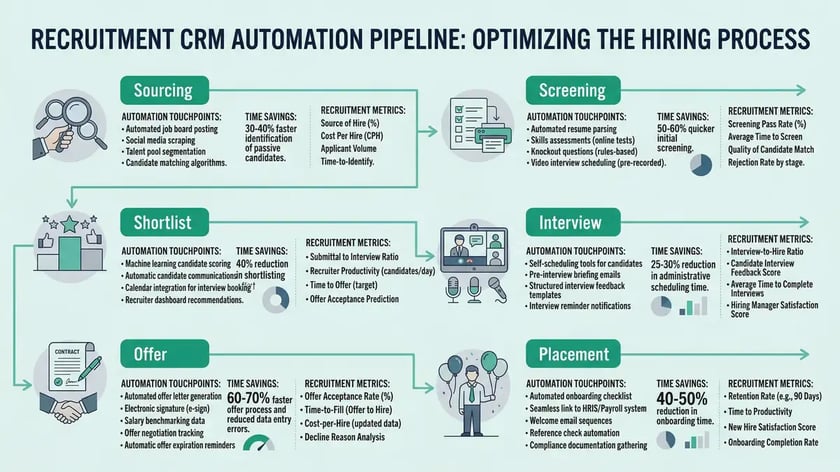
Avoid This Mistake
Automating without measuring is worse than not automating at all. Only 10% of firms have implemented agentic AI across their full workflow, with many citing data readiness and unclear implementation strategies as barriers (Bullhorn GRID Report). Before deploying any automation, establish baseline metrics: current time-to-fill, placements per recruiter, and cost-per-hire by role level. Without baselines, you cannot measure ROI or identify which workflows deliver the highest leverage.
| Automation Workflow | Impact Metric | Quantified Improvement |
| AI Candidate Screening | KPI improvement | 55% of firms report 25%+ improvement |
| AI-Led Interviews | Candidate viability | 53% succession rate vs 29% manual |
| Interview Scheduling | Time per interview | 15 min → under 2 min |
| Predictive Analytics | Hiring cycle length | 85% shorter cycles |
| Candidate Nurture | Relationship continuity | Automated 12-18 month engagement |
| Reference Checking | Completion time | Weeks → hours |
Sources: Bullhorn GRID, iMocha, Sapia.ai, X0PA AI
How Does CRM Automation Accelerate Placement Velocity and Revenue?
Placement velocity — the speed at which candidates move through your pipeline from sourcing to signed offer — is the single most commercially significant metric in executive search. Every day a search remains open costs the firm in unrealised fees, recruiter capacity, and client confidence. CRM automation compresses this timeline through systematic elimination of manual bottlenecks at every pipeline stage.

The evidence is quantified. 56% of the highest-growth staffing firms report average placement times under 10 days (Bullhorn GRID Report). Among firms submitting multiple candidates to individual positions, 72% achieve time-to-place under 20 days. Most significantly, 85% of firms with formal redeployment plans report time-to-place under 20 days — demonstrating that pipeline visibility and automated candidate matching directly accelerate placement velocity.
The revenue mathematics are compelling. CRM platforms have been demonstrated to increase sales by 29%, boost productivity by 34%, and improve forecast accuracy by 42% (Cirrus Insight). In recruitment specifically, revenue can increase by as much as 245% when firms fully leverage their CRM platforms. Bullhorn customer Growing HVAC documented 24% more placements per recruiter, 16% faster time-to-fill, and 47% increase in candidate redeployment (Bullhorn ATS & CRM).
For a mid-market retained search firm placing candidates at an average first-year compensation of $150,000 with 30% fees, each placement generates $45,000 in revenue. A recruiter placing 8-10 candidates annually generates $360,000-$450,000. If CRM automation increases placement capacity by even 24%, that is 2-3 additional placements per recruiter — $90,000-$135,000 in incremental annual revenue per recruiter with no headcount increase. This is the Freedom Machine principle applied to search firm economics: decouple revenue from headcount.
Key Takeaway
Placement velocity is not just an efficiency metric — it is a revenue multiplier. Every reduction in time-to-fill creates capacity for additional placements without proportional headcount growth. Firms implementing comprehensive CRM automation achieve placement velocities 40-50% faster than manual competitors, generating revenue growth rates three times higher than non-adopting firms. The competitive gap is widening: 78% of firms growing revenue 25%+ use AI in their ATS, while only 51% of declining firms do.
Ready to architect your recruitment pipeline automation? Our Growth Mapping Call diagnoses the specific bottlenecks slowing your placements and maps the CRM automation infrastructure that eliminates them.
Book Your Growth Mapping CallWhat Are the Time-to-Fill Benchmarks for Executive Search by Region?
You cannot optimise what you do not benchmark. Understanding where your search timelines stand relative to industry standards reveals which pipeline stages consume disproportionate time and where automation interventions yield the greatest impact. The executive search process timeline averages 4-6 months globally, often extending beyond this for specialised roles (Altios).
Geographic variation is substantial. US searches typically require 3-4 months — the shortest globally — driven by at-will employment. European searches extend to 6-8 months due to employment law: French executives require a minimum 3-month notice period, German senior leaders often have 6-month requirements, and some contracts specify 12-month notice periods. However, this extended timeline correlates with better retention: European executives stay 5+ years compared to under 3 years in the US (Altios).
The correlation between search timeline and hire success is direct. Rushed searches conducted in under 3 months demonstrate only 40% retention after year one, while properly conducted 4-6 month searches achieve 85%+ retention after year one. The executive cost-per-hire reflects this complexity: the average cost-per-hire for executive roles reaches $35,879, compared to $5,475 for non-executive roles (ClearlyRated). This differential justifies significant AI agent automation investment to improve both speed and quality.
| Region | Avg Search Timeline | Key Driver | Avg Exec Retention |
| United States | 3-4 months | At-will employment | <3 years |
| Europe | 6-8 months | Notice periods (3-12 months) | 5+ years |
| Asia-Pacific | 4-6 months | Varies by country | 3-5 years |
| Middle East & Africa | 5-7 months | International hiring + visas | Variable |
Source: Altios

The 6-Step Framework for Implementing Recruitment CRM Automation
Implementing CRM automation at an elite search firm requires a systematic approach that respects the unique characteristics of retained search — long sales cycles, relationship-heavy workflows, multi-stakeholder engagement, and confidentiality requirements. Leaders who feel equipped to guide AI adoption are nearly 40% more likely to have achieved revenue growth in 2025 (Bullhorn GRID Report). The following framework integrates technology selection, process redesign, and measurement into a self-reinforcing system.
Establish Baseline Metrics Before Any Automation
Measure current average time-to-fill by search type (retained, contingency, interim), current time allocation breakdown (sourcing vs admin vs client meetings vs candidate assessment), current placements per recruiter annually, and current cost-per-hire by role level. Without baselines, the ROI case for automation lacks grounding. Most firms discover that 60-70% of recruiter time goes to non-billable activities that automation can reduce by 50%.
Select a Platform Built for Retained Search — Not Volume Staffing
General-purpose ATS platforms optimised for high-volume contingency recruitment lack the relationship management depth required for retained search. Prioritise comprehensive candidate profiling, multi-stakeholder engagement tracking, long-cycle pipeline forecasting, market intelligence integration, and confidentiality controls. Platforms like Ezekia, Bullhorn, and Vincere offer CRM and automation integration specifically for search firm workflows.
Automate the Highest-Friction Administrative Workflows First
Interview scheduling should be the first automation — 67% of recruiters report it taking 30 minutes to 2 hours per candidate. Follow with candidate communication sequences, resume screening and initial filtering, and reference check automation. Each automated task saves 10+ hours per 100 candidates (TeamDash). Sequence by time-savings-per-implementation-effort ratio.
Deploy AI Screening and Predictive Matching
Implement AI-powered candidate screening to achieve the 53% succession rate improvement documented in research. Deploy predictive analytics for candidate-role matching that delivers 67% better talent alignment and 79% higher ROI compared to reactive hiring. Ensure AI systems are audited for bias — compare AI screening outcomes against human reviews and monitor demographic representation at each pipeline stage.
Build Automated Pipeline Visibility and Client Reporting
Install real-time pipeline dashboards that track candidate progression, placement probability forecasting, and fee realisation timelines. Automate client reporting — weekly search progress updates, candidate shortlist presentations, and market intelligence briefings. This transparency drives client confidence and eliminates the manual effort of compiling status reports. Connect pipeline metrics to your CRM reporting infrastructure.
Connect Automation Metrics to Revenue Outcomes
Measure what matters: time-to-fill by automation level, placements per recruiter before and after implementation, revenue per recruiter, candidate redeployment rate, and client satisfaction scores. For every $1 invested in CRM platforms, recruitment firms typically realise $4-8 in return through faster placements, increased capacity, and reduced administrative costs. Build a quarterly review cadence that connects automation metrics to placement revenue.
How Does Retained Search Differ from Contingency in CRM Requirements?
Retained and contingency search models demand fundamentally different CRM architectures — a distinction that most platform vendors blur but elite search firms cannot afford to ignore. Retained search completion rates hover between 85-95%, while contingency search completion rates typically range from 20-35% (National Search Group). This completion rate differential reflects the investment, focus, and accountability differences that CRM systems must accommodate.
Retained search involves corporations commissioning and paying an upfront fee for exclusive use of a search firm's resources, with fees typically at 25-35% of placed candidate's first-year total compensation (HireCruiting). Chief-level roles command fees reaching 40-50% of first-year compensation. The retained model promises sole focus, access to passive candidates outside standard job boards, brand protection, and confidentiality control. CRM requirements include: long-cycle pipeline tracking (6-12 months), multi-stakeholder engagement across hiring committees, comprehensive candidate profiling beyond resume data, and sophisticated executive search automation workflows.
Contingency staffing focuses on rapid placement of active candidates, high-volume screening, and multiple simultaneous submissions. CRM requirements emphasise speed, volume automation, rapid candidate progression, and quick feedback collection. While retained search operates with the assumption that each search receives dedicated resources, contingency operates with the assumption that each recruiter manages many concurrent searches with lower individual investment per role.
The multi-stakeholder complexity of retained search is particularly demanding. Beyond the primary hiring manager, retained search clients typically involve HR business partners, CHROs, finance teams, and often board members. Comprehensive CRM systems must track each stakeholder's requirements, concerns, constraints, and timeline preferences separately — a capability that sales intelligence platforms are now bringing to recruitment through integrated relationship mapping.
| Dimension | Retained Search | Contingency Staffing |
| Completion Rate | 85-95% | 20-35% |
| Fee Structure | 25-35% (upfront retainer + success) | 15-25% (success only) |
| Search Timeline | 3-8 months | 2-6 weeks |
| CRM Focus | Relationship depth, multi-stakeholder | Speed, volume, rapid progression |
| Pipeline Tracking | Long-cycle (6-12 months) | Short-cycle (days-weeks) |
| Candidate Sourcing | Passive candidates, market mapping | Active candidates, job board matching |
| Confidentiality | Critical (C-suite, board roles) | Standard |
Sources: National Search Group, HireCruiting
How Is AI Transforming Recruitment CRM in 2025-2026?
The AI adoption curve in recruitment CRM has shifted from experimentation to operational deployment. Last year, 52% of firms were only experimenting with basic generative AI tools. This year, only 29% remain in the generative AI category, with 30% having moved to agentic AI tools capable of autonomous multi-step workflow execution (Bullhorn GRID Report). This represents a fundamental shift from human-prompted point solutions to autonomous systems that plan and execute complete recruitment workflows.
The adoption metrics are striking. Approximately 88% of companies already use AI for initial candidate screening, with 90% of employers using automated systems to filter or rank job applications (iMocha). 89.6% of hiring team members fill positions faster when using AI, while 77.9% confirm AI makes the process cheaper. Organisations integrating AI save an average of 20% of their work week — equivalent to a full workday saved weekly.
The competitive gap is accelerating. Among Fortune 500 CHROs, 93% confirmed their organisation uses AI tools to improve business practices. For elite search firms, the question is no longer whether to adopt AI but how quickly to move from basic generative AI to agentic workflows that operate autonomously across sourcing, screening, scheduling, and candidate engagement. Firms implementing strategic AI tool stacks achieve the competitive advantage that peppereffect's AI automation methodology is designed to deliver.
| AI Maturity Level | % of Firms (2026) | Capability |
| Basic Generative AI | 29% (down from 52%) | Point solutions requiring human prompting |
| Agentic AI (some level) | 30% | Autonomous multi-step workflow execution |
| Full Agentic AI | 10% | End-to-end autonomous recruitment workflows |
| No AI | ~31% | Fully manual processes |
Source: Bullhorn GRID Report 2026
Frequently Asked Questions
What is recruitment CRM automation?
Recruitment CRM automation is the systematic deployment of intelligent workflows, AI-powered screening, and pipeline orchestration within a candidate relationship management platform. Unlike basic applicant tracking systems, recruitment CRM automation integrates candidate sourcing, screening, interview scheduling, relationship nurturing, compliance management, and placement fee tracking into a unified system. For elite search firms, CRM automation transforms manual administrative processes into autonomous workflows that accelerate placement velocity — firms implementing comprehensive automation report 24% more placements per recruiter and 16% faster time-to-fill.
How much does recruitment CRM software cost?
Recruitment CRM platforms range from $15-$75 per user per month for small firms to $200-$600+ per user per month for enterprise solutions (PeopleManagingPeople). For a mid-sized search firm with 10-15 recruiters, annual platform costs typically range from $30,000-$60,000. Implementation and setup fees add $2,000-$10,000, with assessment integrations and premium support adding 15-30% to base contracts. The ROI typically justifies investment within weeks — even modest improvements in automation ROI generate returns exceeding platform costs by 50:1 or more.
What ROI should search firms expect from CRM automation?
The ROI framework combines three components: efficiency gains from reduced administrative time (50% of recruiter capacity liberated), revenue gains from faster placement velocity (potentially doubling annual placement volume), and cost reduction from platform consolidation (20-30% technology cost savings). For a firm with eight recruiters, conservative estimates project annual benefits exceeding $2.9 million against annual platform costs of $55,000 — a return exceeding 5,000%. Even with substantial adjustments to these projections, ROI typically exceeds 2,500% with payback periods measured in weeks.
How does CRM automation differ for retained vs contingency search?
Retained search requires relationship-heavy CRM capabilities: long-cycle pipeline tracking spanning 6-12 months, multi-stakeholder engagement management across hiring committees, comprehensive candidate profiling, and strict confidentiality controls. Retained search completion rates reach 85-95%. Contingency staffing CRM focuses on speed and volume: rapid candidate progression, multiple simultaneous submissions, and quick feedback collection, with completion rates of 20-35%. Elite firms need platforms built for retained search complexity, not general-purpose staffing tools.
Which recruitment CRM automation workflows save the most time?
Interview scheduling automation delivers the most immediate time savings — reducing coordination from 30 minutes to 2 hours per interview down to under 2 minutes (Sapia.ai). AI candidate screening cuts screening time by 50% or more for 46% of implementing firms. Automated candidate communication maintains relationship continuity across 12-18 month nurture cycles without manual effort. Each automated task saves 10+ hours per 100 candidates. Combined, these workflows reclaim the equivalent of a full working day per recruiter per week.
How are elite search firms using AI for candidate matching?
Elite firms are deploying AI for skills-based matching that evaluates capabilities through multiple signals — portfolio work, assessment results, and project experience — rather than relying on resume keywords. AI-led candidate interviews achieve 53% succession rates in subsequent human interviews, compared to 29% from traditional screening. Predictive analytics delivers 67% better talent alignment and forecasts staffing needs with 79% higher ROI than reactive hiring (X0PA AI). The shift from generative to agentic AI in sales and recruitment enables autonomous multi-step matching workflows.
Stop Losing Placements to Pipeline Friction
Your recruiters are spending 80% of their time on administrative tasks instead of making placements. Your pipeline visibility depends on spreadsheets. Your competitors are deploying AI that fills positions in under 10 days. peppereffect architects the recruitment CRM automation infrastructure that compresses your placement cycle, multiplies recruiter capacity, and installs the autonomous systems that scale without proportional headcount.
Book Your Growth Mapping CallLearn how AI agencies architect recruitment automation →
Resources
- Bullhorn — GRID 2026 Industry Trends Report
- GM Insights — Talent Acquisition Software Market Size and Growth
- ShortlistD — The Shocking Truth About How Recruiters Spend Their Time
- iMocha — AI Recruitment Statistics 2025-2026
- Altios — Executive Search Process Timeline: The 6-Month Reality
- X0PA AI — 2025 Guide to Predictive Analytics in Recruitment
- ClearlyRated — Staffing Agency Success Metrics and Benchmarks
- Cirrus Insight — CRM Statistics, Trends, and Predictions
- National Search Group — Retained vs Contingency Recruiting
recruitment CRM vendor comparison guide boutique recruitment CRM software comparison