

What Is B2B Lead Nurturing and Why Do 79% of Leads Never Convert outbound and inbound lead generation systems?
B2B lead nurturing is the systematic process of building relationships with prospective buyers at every stage of the sales funnel through targeted, multi-channel communication sequences. Unlike lead generation — which focuses on acquiring contact data — lead nurturing moves prospects from initial awareness to purchase-ready status through personalized content, behavioral triggers behavioral email triggers, and timed follow-up cadences. According to HubSpot's 2024 State of Sales Report, companies that implement systematic lead nurturing see a 20% increase in sales productivity and accelerate sales cycles by an average of 23%.
Yet the data reveals a staggering execution gap. Demand Gen Report's 2024 B2B Lead Nurturing Study found that 79% of marketing-qualified leads never convert to sales — not because the leads were poor quality, but because the nurturing infrastructure failed. Gartner's 2024 research confirms that 46% of B2B organizations lack any formal lead nurturing process whatsoever, and 45-55% of sales-ready leads never reach the sales team due to insufficient nurturing workflows.
The financial impact is equally decisive. Forrester's State of Lead Management reports that B2B companies excelling at lead nurturing generate 50% more sales-ready leads at 33% lower cost, with an ROI multiple of 4.5x-5.2x on nurturing investment. The difference between the top quartile and everyone else is not budget — it is systematic architecture.
79%
Leads Never Convert
Due to inadequate nurturing
50%
More Sales-Ready Leads
With systematic nurturing
4.5×
ROI Multiple
Forrester 2024
23%
Faster Sales Cycles
HubSpot 2024
What you'll learn in this guide:
- How to architect a multi-channel lead nurturing engine that converts across email, LinkedIn, and retargeting
- The 5-step omnipresent follow-up framework that keeps you top-of-mind without being pushy
- Lead scoring models that improve MQL-to-SQL conversion by 25-30% using AI-powered behavioral triggers
- Email sequence cadence and timing benchmarks SaaS churn and retention benchmarks proven to deliver 45-50% open rates in B2B
- How to eliminate the 7 most common nurturing failure patterns destroying your pipeline
Key Takeaway
B2B lead nurturing is not a campaign — it is an infrastructure layer. Companies with documented, multi-stage nurturing processes convert at 2.4× the rate of those without, yet only 27% of B2B organizations have built this architecture. The gap between lead generation spend and nurturing execution represents the single largest source of wasted marketing investment in B2B.
How Does Lead Nurturing Differ from Lead Generation — and Why Do You Need Both?

The distinction between lead generation and lead nurturing is not semantic — it determines where your marketing budget delivers returns. Lead generation acquires contact data and initial engagement. Lead nurturing converts that data into revenue. According to Demand Gen Report, companies treating generation and nurturing as an integrated system achieve 2.4× higher conversion rates than those running siloed approaches.
| Dimension | Lead Generation | Lead Nurturing |
| Primary Goal | Acquire contact data and initial engagement | Move prospects through buyer journey to purchase |
| Focus | Volume of new leads (MQLs) | Quality and readiness (SQLs) |
| Typical ROI Timeline | 3-6 months | 6-12 months |
| Cost Structure | Paid ads, content gating, events | Email, retargeting, marketing automation |
| Success Metric | Cost per lead (CPL) | Cost per qualified lead (CPQL), conversion rate |
| Average Deal Impact | Foundational — 40% of funnel | Deal quality and speed — 60% of funnel |
Sources: HubSpot State of B2B Sales 2024, Demand Gen Report 2024
Forrester recommends a 60/40 budget split — 60% toward nurturing infrastructure and 40% toward generation. The reasoning is straightforward: every lead generated without a nurture strategy represents wasted acquisition spend. Gartner's data confirms that 45-55% of sales-ready leads never reach the sales team when nurturing infrastructure is absent — which means your cost per lead is effectively 2× what you think it is.
What Does a High-Converting B2B Lead Nurturing Email Sequence Look Like?

Email remains the backbone of B2B lead nurturing, with properly segmented sequences achieving 45-50% open rates and 8-12% click-through rates according to Klaviyo's 2024 B2B Engagement Benchmarks. The critical variable is not the content of individual emails — it is the architecture of the sequence itself.
Demand Gen Report's analysis of 500+ B2B nurture programs found that 5-7 email sequences outperform both shorter (3-email) and longer (10+ email) sequences by 18-23% in conversion rate. The sweet spot balances persistence with respect for the prospect's attention. Gartner confirms that 79% of B2B prospects require at least 5 touchpoints before entering active consideration, with 55% requiring 7 or more.
Personalization drives measurable performance gains. Subject lines that reference specific pain points achieve 31% higher click-through rates than generic benefit statements, while personalized subject lines overall boost open rates by 22-26%. The optimal subject line length is 41-50 characters — achieving 5-8% higher open rates than longer alternatives.
| Touchpoint | Timing | Primary Objective | Benchmark Open Rate |
| 1st email | Day 0-1 (immediate) | Initial engagement and value proposition | 35-45% |
| 2nd email | Day 3-5 | Social proof and case study | 28-38% |
| 3rd email | Day 7-10 | Problem-specific content | 22-32% |
| 4th email | Day 14-21 | ROI and pricing content | 18-28% |
| 5th email | Day 28+ | Objection handling | 15-22% |
| 6th email | Day 35-45 | Executive testimonial or webinar | 12-18% |
| 7th email | Day 60+ | Win-back and re-engagement | 10-15% |
Sources: Demand Gen Report 2024, HubSpot B2B Lead Nurturing Benchmark 2024
The 70/20/10 content rule governs what each email contains: 70% of touches should deliver educational, problem-focused content with no sales push, 20% should present social proof and success metrics, and only 10% should include a direct call-to-action. For a 6-month, 18-touch sequence, that translates to 13 educational touches, 4 social proof touches, and just 1 direct CTA. This ratio prevents the content fatigue that kills most nurture programs.
How Do You Build an Omnipresent Multi-Channel Nurturing Engine?

Single-channel lead nurturing is the B2B equivalent of fishing with one line. LinkedIn Sales Navigator data shows that multi-channel sequences combining email and LinkedIn achieve 3× higher engagement than email alone. Adding retargeting to the mix pushes that to 4.5-5.2× higher conversion versus single-channel approaches, according to Demand Gen Report.
Gartner's 2024 B2B Buyer Journey research confirms that 3 or more touchpoint sequences across different channels create a 62% higher probability of entering the sales pipeline. The key is orchestration — spreading 8-12 touches across channels so any single channel receives a maximum of 3-4 contacts, preventing saturation while maintaining omnipresence.
The channel hierarchy for B2B lead nurturing starts with email as the primary engine, supported by LinkedIn for relationship building and thought leadership, display retargeting for awareness reinforcement, and targeted direct mail for high-value accounts. Each channel serves a distinct function — email drives the sequence, LinkedIn builds trust, retargeting maintains visibility, and direct mail breaks through digital noise for strategic accounts with 2-5% response rates that dramatically outperform cold digital outreach.
| Channel | Engagement Rate | Primary Use Case | ROI Ranking |
| Email (segmented nurture) | 2-3% CTR | Core nurture sequence backbone | 1st |
| LinkedIn (organic + paid) | 0.5-4% | Relationship building, ABM targeting | 2nd |
| Display retargeting | 0.8-2% | Awareness reinforcement, re-engagement | 3rd |
| Direct mail (strategic accounts) | 2-5% | Executive outreach, high-touch deals | 4th |
| Webinars and virtual events | 35-55% attendee engagement | Product education, mid-funnel conversion | 2nd (for segment) |
Sources: Demand Gen Report 2024, LinkedIn Sales Navigator Insights 2024, Forrester Multi-Channel B2B Marketing 2024
peppereffect architects Sales Administration systems that integrate lead nurturing, CRM automation, and revenue attribution into a single operating layer for B2B founders.
Explore Sales AdministrationHow Does AI-Powered Lead Scoring Transform MQL-to-SQL Conversion?
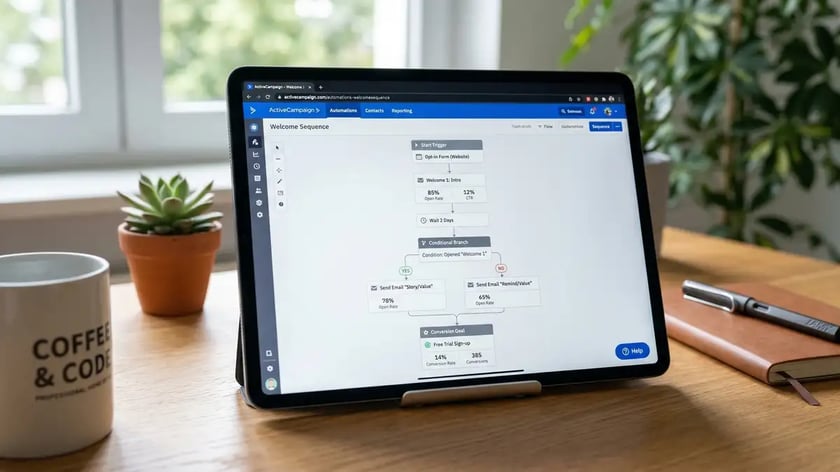
Traditional rules-based lead scoring — assigning static points for job title, company size, and email opens — produces 35-45% accuracy at best. AI-powered predictive lead scoring fundamentally changes this equation. Forrester's 2024 research shows that AI-driven scoring improves MQL-to-SQL conversion rates by 25-30%, while Gartner reports top-performing AI systems achieve 82-88% prediction accuracy at the 90-day forecast horizon.
The performance gap between scoring approaches is significant. Demographic-only scoring qualifies 40-50% of leads as MQLs but with only 35-45% accuracy — flooding sales with noise. Behavioral-only scoring narrows the MQL pool to 20-30% but achieves 55-65% accuracy. The hybrid model combining both with AI optimization delivers the optimal balance: 12-18% qualify as MQLs with 82-88% accuracy, meaning sales teams spend their time on prospects most likely to convert.
AI systems also identify 3-5× more actionable behavioral signals than rules-based systems. Klaviyo's data shows that AI-optimized send times alone increase open rates by 15-19% and click-through rates by 8-12%. Marketo's research confirms that dynamic content personalization powered by AI achieves a 20-28% conversion rate uplift — because the right message reaches the right prospect at the right moment in their buying journey.
Key Takeaway
The top quartile of B2B organizations achieves 30-45% MQL-to-SQL conversion rates versus the average of 15-20%. The differentiator is not more leads — it is smarter scoring. Companies in the top quartile spend 23% more on marketing automation tools but generate 3.5× higher conversion, making the incremental investment one of the highest-ROI decisions available to B2B founders.
What Are the 5 Steps to Building a Lead Nurturing Engine That Converts?
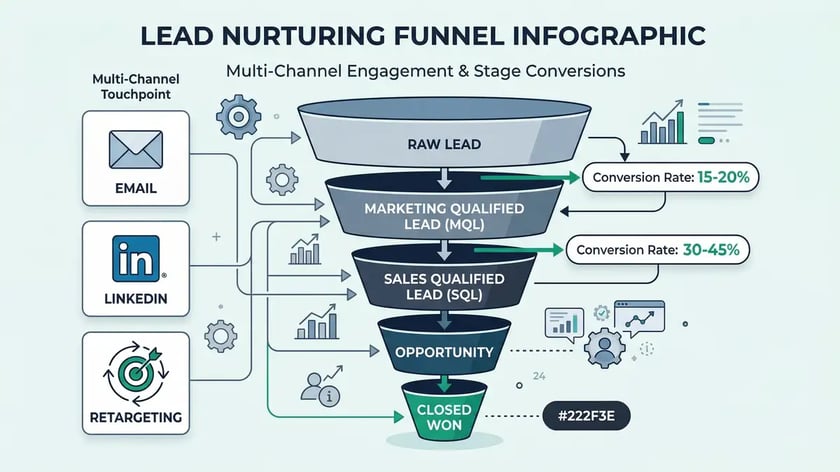
Building a lead nurturing engine that consistently converts requires a structured implementation approach. Based on the frameworks validated by Forrester, Demand Gen Report, and AI workflow automation best practices, the following 5-step architecture transforms ad-hoc follow-up into a systematic conversion machine.
Define Lead Stages and Scoring Model
Document explicit definitions for MQL, SQL, and SAL (Sales Accepted Lead). Build a hybrid scoring model weighting 35% demographic signals (company size, industry, job title) and 65% behavioral signals (email engagement, website visits, content downloads, pricing page views). Set the sales handoff threshold at 70+ points on a 100-point scale.
Map Content to Funnel Stages (TOFU/MOFU/BOFU)
Allocate 40-50% of nurture content budget to top-of-funnel educational assets (blog articles, industry reports, webinars), 35-45% to middle-of-funnel evaluation content (case studies, comparison guides, ROI calculators), and 10-15% to bottom-of-funnel decision content (proposals, implementation roadmaps, customer references). Each stage requires different messaging intensity and channel mix.
Build Multi-Channel Sequences with Behavioral Triggers
Design 5-7 email sequences per funnel stage with the 70/20/10 content ratio. Layer LinkedIn engagement (3-5× per week), display retargeting (continuous, frequency-capped), and direct mail (quarterly for strategic accounts). Set behavioral triggers: 3+ consecutive email opens increase touch frequency; 3+ website visits in 7 days activate direct sales outreach; pricing page visit plus lead score threshold triggers immediate handoff.
Implement the Sales-Marketing Feedback Loop
Establish weekly sales-marketing alignment syncs to review lead quality, adjust scoring thresholds, and route rejected leads back into nurture sequences. Demand Gen Report data shows that companies with formal sales-to-nurture return loops recover 15-22% additional conversions from initially rejected leads. Without this loop, 52% of programs see sales reject 60-70% of marketing-qualified leads.
Deploy AI Optimization and Continuous Calibration
Implement predictive lead scoring to replace rules-based models — 32% of B2B marketing teams now use AI as their primary qualification method, with adoption expected to reach 55-65% by end of 2026. A/B test email sequences quarterly (subject lines, send times, content types). Recalibrate scoring models every 90 days using actual conversion data. Consider agentic AI workflows for autonomous nurture orchestration as the technology matures.
What Lead Nurturing Mistakes Are Destroying Your Pipeline?
Understanding why lead nurturing fails is as important as knowing how to build it. Demand Gen Report's analysis of failed nurturing programs reveals 7 systematic failure patterns that account for the majority of the 79% non-conversion rate. Each is preventable with the right architecture.
Avoid This Mistake
The most destructive lead nurturing mistake is not poor content or wrong timing — it is mixing cold outreach with nurture sequences. Programs that combine cold prospecting and warm nurturing in the same workflows see 15-25% higher spam complaint rates, which damages sender reputation and reduces deliverability across all email programs. Separate your cold outreach infrastructure from your nurture infrastructure completely.
Insufficient touchpoints affect 55% of failed programs — teams assume interest after 1-3 contacts and abandon the sequence before the prospect enters consideration. Content irrelevance damages 42% — prospects receive wrong-stage messaging because content is not mapped to funnel position. Poor lead scoring undermines 38% — rules-based models route unqualified leads to sales prematurely, eroding trust between marketing and sales teams.
The operational failures are equally damaging. 52% of programs lack a formal sales feedback loop, meaning sales rejects 60-70% of leads with no mechanism to improve qualification. 48% use email-only approaches despite multi-channel sequences delivering 3-5× higher conversion. And 47% never recalibrate their lead scoring models, leading to score inflation that degrades prediction accuracy over time. Each of these is a systems architecture problem, not a content problem.
Key Takeaway
B2B lead nurturing delivers a 4.5-5.2× ROI multiple and generates 50% more sales-ready leads at 33% lower cost — but only when built as systematic infrastructure. The gap between top-quartile performers (30-45% MQL-to-SQL) and average (15-20%) comes down to three architectural decisions: multi-channel orchestration, AI-powered scoring, and a formal sales-marketing feedback loop. Deploy these three elements and you transform lead nurturing from a cost center into a revenue engine.
Ready to Architect Your Lead Nurturing Engine?
peppereffect installs systematic lead nurturing infrastructure for B2B founders — from lead scoring models and multi-channel sequences to AI-powered automation and revenue attribution. Stop losing 79% of your leads to inadequate follow-up.
Explore Sales AdministrationBook Your Growth Mapping Call →
Frequently Asked Questions
What is lead nurturing?
Lead nurturing is the process of building relationships with prospective buyers through targeted, multi-channel communication sequences designed to move them from initial awareness to purchase readiness. In B2B contexts, this typically involves automated email sequences, LinkedIn engagement, retargeting campaigns, and behavioral triggers that deliver the right content at the right time based on each prospect's position in the buying journey. According to Forrester, companies with systematic nurturing processes generate 50% more sales-ready leads at 33% lower cost.
What is the difference between lead generation and lead nurturing?
Lead generation focuses on acquiring new contact data and initial engagement — building the top of the funnel through paid advertising, content gating, and events. Lead nurturing converts those contacts into revenue by moving them through the buyer journey with personalized content and timed follow-up sequences. Lead generation drives volume (MQLs), while nurturing drives quality and conversion velocity (SQLs). Demand Gen Report data shows companies integrating both achieve 2.4× higher conversion rates than siloed approaches.
How many emails should a B2B nurture sequence have?
Research consistently shows that 5-7 email sequences outperform both shorter (3-email) and longer (10+ email) sequences by 18-23% in conversion rate. Gartner's data confirms that 79% of B2B prospects require at least 5 touchpoints before entering active consideration, with 55% requiring 7 or more. The optimal cadence starts with immediate delivery (Day 0-1), then spaces emails at 3-5 day intervals in the first two weeks, extending to weekly and bi-weekly for later-stage touches.
What lead nurturing software works best for B2B?
HubSpot leads mid-market B2B at 17.5% market share with pricing from $50-3,200 per month, offering an integrated CRM and ease of use. Marketo (Adobe) dominates enterprise at 12.8% market share with advanced personalization and 85% MQL-to-SQL prediction accuracy. Pardot serves Salesforce-native organizations at $1,250-5,000+ per month. ActiveCampaign offers the strongest value at $35-229 per month for mid-market teams prioritizing affordability without sacrificing marketing automation capabilities.
How does AI improve lead nurturing?
AI transforms lead nurturing in three critical areas. First, predictive lead scoring improves MQL-to-SQL conversion by 25-30% with 82-88% prediction accuracy versus 35-45% for rules-based models. Second, AI-optimized send timing increases email open rates by 15-19% and click-through rates by 8-12%. Third, dynamic content personalization driven by AI achieves 20-28% conversion uplift by matching the right message to each prospect's behavioral pattern and buying signals in real time.
What is a good MQL-to-SQL conversion rate for B2B?
The average MQL-to-SQL conversion rate across B2B organizations is 15-20%. Top-quartile performers achieve 30-45%, while best-in-class organizations with AI-driven scoring and sophisticated workflows reach 45-60%. The bottom quartile converts at just 5-8%, typically due to poor nurturing and sales misalignment. Forrester's research shows that top-quartile companies spend 23% more on automation tools but generate 3.5× higher conversion — making the incremental investment in systematic operations one of the highest-ROI decisions in B2B.
What are B2B lead nurturing best practices?
The five highest-impact best practices are: implement multi-channel sequences combining email, LinkedIn, and retargeting for 4.5-5.2× higher conversion versus single-channel; use the 70/20/10 content ratio (70% educational, 20% social proof, 10% direct CTA); deploy AI-powered lead scoring to replace rules-based models; establish a formal weekly sales-marketing feedback loop to recover 15-22% additional conversions from rejected leads; and recalibrate scoring models quarterly using actual conversion data to prevent score inflation.
Resources
- Demand Gen Report — 2024 B2B Lead Nurturing Study
- Gartner — Magic Quadrant for B2B Marketing Automation 2024
- Forrester — The State of B2B Lead Management 2024
- HubSpot — State of B2B Sales Report 2024
- Marketo (Adobe) — State of B2B Marketing 2024
- Klaviyo — B2B Engagement Benchmarks 2024
- Salesforce — State of Sales Report 2024
- LinkedIn Sales Navigator — B2B Multi-Channel Engagement Data 2024
cold email and LinkedIn outreach strategies
integrating your CRM with marketing automation
lead generation automation engine
marketing automation infrastructure
sales enablement content infrastructure revive ghosted B2B deals
systematic objection handling interlocking B2B lead generation systems
pipeline leakage points revenue per user expansion
SDR sequence architecture inbound marketing strategy four-quadrant lead scoring model B2B email marketing strategy time-to-value compression playbook