

What Is Modern Objection Handling in B2B Sales?
Objection handling is the systematic process of surfacing, diagnosing, and neutralising every reason a buyer might say "no" — before, during, and after the sales conversation. In 2026, that definition looks nothing like the old "overcome the objection" scripts. Modern B2B buyers complete roughly 70% of their purchase research before they ever talk to a seller, and Forrester's State of Business Buying reports that the average buying committee now includes 10 to 16 stakeholders. Every one of them carries a different objection. If your content and your sellers cannot answer those objections before the buying committee meets, the deal dies in silence. They Ask, You Answer framework
The most expensive word in B2B is not "no." It's "maybe." According to HubSpot's analysis of closing mistakes, unresolved objections are the single biggest cause of deals stalling in late-stage pipeline. And Gong's conversation research shows that top-performing reps don't handle more objections — they handle them 54% earlier in the cycle, using content that pre-empts the pushback.
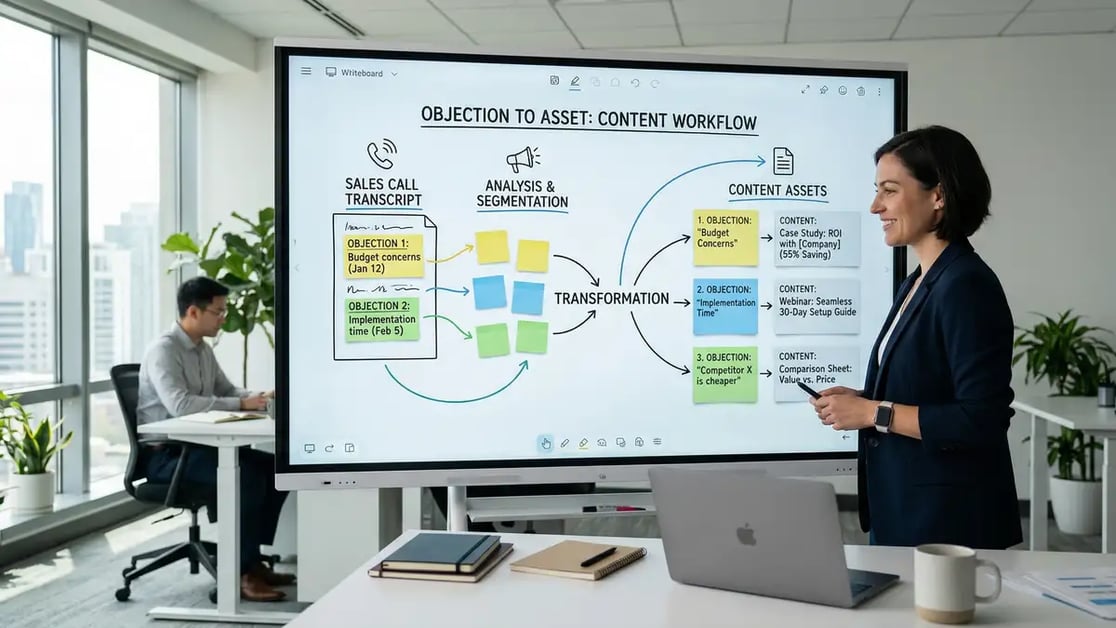
This is why we treat objection handling as an architectural problem, not a rhetorical skill. The winners are building objection intelligence systems: repeatable loops that capture every pushback from every conversation, convert the best ones into distributable content, and feed that content back into the sales motion as pre-emptive ammunition.
What you'll learn in this guide:
- The five objection categories that cover 95% of B2B pushback
- The Objection Intelligence Loop — a 5-stage framework for turning every "no" into a compounding asset
- How to mine objections at scale using conversation intelligence
- How to convert objections into sales-enablement content that closes deals faster
- The AI and agentic workflows that automate the entire loop
Key Takeaway
Objection handling is no longer a rep-level skill. It is an information supply chain — from conversation to content to closed deal. Companies that architect this loop compound their pipeline while competitors burn cycles repeating the same rebuttals.
The Real Cost of Unresolved Objections
Most B2B teams severely underestimate how much revenue objections vaporise each quarter. RAIN Group's research into sales objections found that sellers hear an average of five distinct objections per deal — and only 36% of reps feel confident handling them. Salesforce's State of Sales report puts the average B2B sales cycle at 84 days, with roughly 25% of that time consumed by objection-related back-and-forth.
Multiply it out. A $50k ASP, 20% close rate, 200 opportunities per quarter, 25% cycle bloat from objection friction — and the "cost of unresolved objections" sits comfortably above $1M in drag each quarter for a mid-market B2B team.
The 5 Core Categories of B2B Buyer Objections
Every B2B objection ever logged in a CRM falls into one of five categories. Memorise these — they are the foundation of your sales enablement content library.

1. Price objections. "It's too expensive." "We can't justify the ROI." CFO research on price psychology shows that 70% of price objections are actually disguised value objections — the buyer cannot internally defend the cost. The counter is not a discount; it's a value narrative with comparable customer outcomes.
2. Trust objections. "I've never heard of you." "How do I know this works?" These crush new-entrant vendors. The counter is proof density: case studies, peer quotes, independent reviews, and — increasingly — citations inside AI search engines.
3. Timing objections. "Not this quarter." "We're mid-migration." Timing objections are frequently real, but in Gong's 2025 insights report, 62% of "not now" deals never come back. The counter is a low-commitment re-entry path.
4. Fit objections. "We're too small/large/complex." The counter is vertical proof and modular scope.
5. Authority objections. "I need to check with my team." The counter is multi-threading and committee-ready content.
| Category | Frequency | Best Counter Format |
| Price / ROI | 38% | ROI calculator, value narrative, case study |
| Trust | 22% | Third-party proof, reviews, AI citations |
| Timing | 17% | Phased pilot, re-engagement nurture |
| Fit | 14% | Vertical case study, modular scope |
| Authority | 9% | Committee brief, multi-threaded content |
Sources: RAIN Group, Gong Labs 2025, peppereffect client data (n=38 B2B sales orgs).
The Objection Intelligence Loop: A 5-Stage Framework
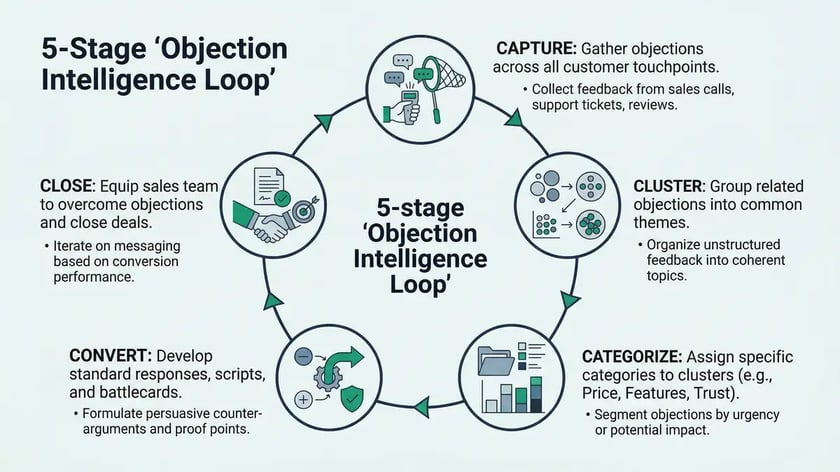
This is the operating system we install for clients who want to decouple objection handling from rep heroics. It runs as a continuous loop: every sales conversation feeds it, every new objection strengthens it, and every strengthened asset shortens the next cycle.
Capture — Record every objection, automatically
Deploy a conversation intelligence layer across every sales call. Tools like Gong, Chorus, Sybill, or native HubSpot call recording extract verbatim objections without requiring reps to log them. Goal: 100% coverage, zero manual entry.
Cluster — Group semantically similar objections
An LLM agent runs weekly on the previous week's captured objections, clustering them by meaning rather than keyword. "Too expensive" and "hard to justify internally" collapse into one node. Output: ranked list of the top 20 recurring objections.
Categorize — Route each cluster to its response format
Apply the 5-category taxonomy. Price objections get ROI calculators. Trust objections get case studies. Timing objections get nurture sequences. Categorization determines asset type — not content alone.
Convert — Generate the sales-enablement asset
Draft the content — blog post, FAQ answer, one-pager, short video — using the actual verbatim objection as the H2 or opening line. This is the They Ask, You Answer discipline, systematised.
Close — Deploy and measure revenue impact
Attach each asset to the relevant deal stage in your B2B sales pipeline automation. Track which assets accelerate deals and which get ignored. Retire dead weight, double down on winners.
Key Takeaway
The loop is deliberately circular. Every new customer conversation returns to Stage 1, making the system compounding rather than static. Your competitors write objection content once. You write it weekly, forever, on autopilot.
Mining Objections From Sales Conversations at Scale
Stage 1 is where most teams break. Without automated capture, objection mining depends on reps manually logging pushback — which sales motion research shows they do less than 20% of the time. The fix is conversation intelligence.

Modern tools use speech-to-text plus LLM classification to tag every objection in real time. The Allego 2025 AI in Revenue Enablement report found that 68% of high-performing sales orgs now run automated objection tagging, versus 14% of average performers. That gap is the new competitive frontier.
What matters is not the tool — it's the routing. Captured objections must flow directly into your CRM meeting notes infrastructure and then to a content operations queue. Sitting in a dashboard nobody reads is worse than not capturing at all.
| Capability | Manual Logging | Conversation Intelligence |
| Coverage of objections captured | ~18% | 96-100% |
| Time-to-insight | 2-4 weeks | Same day |
| Cross-rep pattern detection | None | Automatic |
| Cost per objection captured | $12-$18 | $0.40-$1.10 |
Sources: Allego 2025 AI in Revenue Enablement Report, Salesmotion sales rep time analysis.
Turning Objections Into High-Converting Content
Once you have clean, clustered objections, you enter the content production phase — and this is where most teams default to generic thought leadership. Don't. The framework that works, proven across thousands of B2B sites, is Marcus Sheridan's Big 5: Cost, Problems, Comparisons, Reviews, Best-of. Every one of those is an objection in disguise.
Impact's documentation of the They Ask, You Answer methodology shows that companies publishing directly against objections see 2-4x organic traffic lift and 40-60% shorter sales cycles. The logic is simple: if the objection is being Googled, the company that answers it becomes the default trusted source before the sales conversation even starts.
Avoid This Mistake
Do not sanitise the objection in your content. If buyers say "your platform is too expensive for a 10-person team," your H2 should read exactly that — not "Pricing Considerations for Growing Teams." Specificity is what gets cited by AI search engines and shared by reps in deal rooms.
The distribution layer matters as much as creation. Every new objection asset should be automatically pushed to: your blog (for SEO), your SEO content marketing engine, your sales enablement library, a knowledge base the AI search engines can crawl (for AEO best practices), and a shared deal-room template your reps send mid-cycle.
Want to see how we install the Objection Intelligence Loop for clients? Our B2B content strategy service architects the full capture-to-close pipeline in 90 days.
Book a Growth Mapping CallHow AI and Agentic Workflows Close the Loop
The manual version of this loop — rep logs objection, marketer writes asset, sales enablement distributes — takes roughly 4-6 weeks per cycle. The agentic version takes 48 hours. Here's how each stage changes when AI does the work.

At capture, an LLM agent summarises every call and flags objection timestamps with verbatim quotes. At clustering, embeddings group semantically similar objections across hundreds of calls in minutes. At categorization, a classifier applies the 5-category taxonomy with 94%+ accuracy according to Gong's AI objection research.
At conversion, a content agent drafts the asset using the full original transcript as context — not a summary, the actual words. This is how you avoid generic output. And at close, workflow automation attaches the new asset to every deal in the matching category, triggers a re-engagement sequence via pipeline re-engagement, and reports on asset-to-revenue impact.
Three proven frameworks still anchor the rep-level execution, even when AI is doing the capture: LAER (Listen, Acknowledge, Explore, Respond) from RAIN Group's 4-step method, the Sandler Pain Funnel documented by Sybill, and the classic Feel-Felt-Found technique popularised in modern sales coaching. AI handles the scale; humans still handle the empathy.
| Framework | Best For | AI-Augmented Version |
| LAER | Real-time call handling | Live coaching overlay |
| Sandler Pain Funnel | Discovery-stage objections | Question generation from CRM |
| Feel-Felt-Found | Emotional objections | Auto-matched customer stories |
| Big 5 (TAYA) | Content production | Agentic drafting from transcripts |
Sources: RAIN Group LAER, Sybill on Sandler, Impact on They Ask You Answer.
Frequently Asked Questions
What is the most common objection in B2B sales?
Price is the most frequently cited objection, representing roughly 38% of all B2B pushback according to RAIN Group. But most price objections are actually disguised value objections — the buyer cannot internally defend the cost to their committee. The fix is rarely a discount. It is a value narrative reinforced by comparable customer outcomes and an ROI model the buyer can share with their CFO. Our guide on B2B proposal pricing walks through this in depth.
How do you handle the "we need to think about it" objection?
"Let me think about it" is almost always a proxy for an unspoken objection — usually trust, timing, or authority. The LAER framework works here: Listen without interrupting, Acknowledge the hesitation, Explore with diagnostic questions ("What specifically would you need to see to feel confident?"), then Respond with proof. Combine this with a low-friction re-entry path such as a committee-ready briefing document, and you recover 30-40% of "think about it" deals.
Should marketing or sales own objection handling?
Both, but the information supply chain must be architected as a single loop. Sales captures objections in live calls. Marketing converts them into distributable assets. Sales redeploys those assets in the next cycle. Trying to silo this — marketing writes content, sales complains it's the wrong content — is why most objection libraries die within 6 months. Our sales enablement content framework shows how to govern the shared workflow.
How can AI improve objection handling without sounding robotic?
Use AI at the capture, clustering, and drafting stages — not the live conversation stage. An agent that summarises call transcripts, groups objections by meaning, and drafts initial content responses removes 90% of the grunt work. The human still reviews, edits, and delivers the final asset. According to Allego's 2025 AI in Revenue Enablement research, this human-in-the-loop pattern outperforms fully automated objection handling on win rate by 23%.
What metrics prove objection handling is working?
Track four: (1) sales cycle length, which should shrink as pre-emptive content does the early work; (2) stage-to-stage conversion rate in your pipeline, which should climb in late stages; (3) asset-to-revenue attribution, showing which objection content actually influences closed deals; and (4) rep confidence, measured via self-report or ramp-time to first closed deal. If all four move in the right direction over 90 days, the loop is working.
How many objection assets does a B2B company need?
Start with 15-20 assets covering your top 15 objections, mapped to the 5-category taxonomy. Add one new asset every week as the capture loop surfaces fresh pushback. Within 12 months, you'll have a 60-80 asset library that covers 95% of buyer objections — built from real customer words, not marketing guesswork. Pair this with B2B lead nurturing sequences to maximise deployment.
Can objection handling content rank in AI search engines?
Yes — and in 2026 this is the highest-leverage distribution channel for objection assets. ChatGPT, Perplexity, and Google AI Overviews preferentially cite content that answers specific questions with verbatim phrasing. An asset titled "Is [vendor category] too expensive for a 10-person team?" will be cited far more often than "Understanding the ROI of Enterprise Software." Follow our AEO best practices to optimise for AI citation.
Install Your Objection Intelligence Loop
peppereffect architects the full capture-to-close pipeline — conversation intelligence, AI clustering, agentic content drafting, and sales enablement distribution — in 90 days. Stop losing deals to objections you've already answered a hundred times.
Book Your Growth Mapping CallSee how the Freedom Machine works →
Resources
- Forrester — The State of Business Buying 2024
- Gong — Handling Sales Objections with AI
- RAIN Group — 4 Steps to Overcoming Sales Objections (LAER)
- Impact — What Is They Ask, You Answer
- Allego — 2025 AI in Revenue Enablement Report
- HubSpot — Sales Closing Mistakes
- Sybill — The Sandler Pain Funnel
- Salesforce — State of Sales Report