

What Is Dynamic Pricing in B2B Proposals?
Dynamic pricing in B2B proposals replaces gut-feel quoting with systems-dependent scoping — automated calculations that adjust pricing based on measurable project variables like complexity, timeline, resources, and client tier. Unlike static rate cards or one-size-fits-all pricing, dynamic pricing treats every proposal as a unique configuration of value delivered, ensuring that what the client pays reflects what they actually receive. pricing page conversion
The stakes are enormous. McKinsey research found that a 1% improvement in pricing yields an 11% increase in operating profits — more than any equivalent improvement in volume, cost reduction, or headcount efficiency. Yet most B2B companies still price proposals the same way they did a decade ago: a senior person reviews the scope, estimates hours, applies a markup, and sends a PDF. That process breaks the moment you try to scale it across teams, geographies, or service lines.
The shift toward systematic pricing is accelerating. The global Configure-Price-Quote (CPQ) software market reached $3.92 billion in 2026 and is projected to hit $10.84 billion by 2035 at a 16.5% CAGR — clear evidence that B2B organizations are investing heavily in pricing infrastructure.
In this article, you will learn how systems-dependent scoping works, why manual pricing fails at scale, what the research says about proposal conversion benchmarks, and how to architect a pricing engine that protects margins while accelerating deal velocity. Whether you run a B2B SaaS company, an executive search firm, or a high-ticket consulting practice, the principles are the same: replace individual discretion with transparent, auditable pricing logic.
Key Takeaway
Dynamic pricing in B2B proposals is not about charging different clients different amounts arbitrarily. It is about installing a pricing engine that calculates the right price for each engagement based on scope variables — and does so consistently across every proposal your team generates.

Why Does Manual Proposal Pricing Fail at Scale?
Manual pricing breaks for the same reason that founder-led sales breaks: it depends on one person's judgment, and judgment does not scale. In early-stage companies, the founder prices every deal because they understand cost structures, competitive positioning, and client value better than anyone. That works until the team grows to five salespeople operating across three markets — at which point pricing becomes fragmented, inconsistent, and unprotectable.
The data confirms what experienced operators already suspect. Ernst & Young research shows that pricing inefficiency reduces operating EBIT by 2–5% of sales revenue. For a $10 million B2B business, that translates to $200,000–$500,000 in annual profit evaporating through inconsistent quoting, unnecessary discounts, and scope-price mismatches. For a $50 million firm, the loss reaches $1–2.5 million annually.
Three specific failure patterns dominate manual pricing at scale:
| Failure Pattern | Root Cause | Financial Impact |
| Inconsistent discounting | No formalised discount governance; each rep applies different logic | Margin erosion of 5–15% per deal |
| Scope-price mismatch | Optimism bias in effort estimation (62% of project managers underestimate scope) | 27% average cost overrun from scope creep |
| Slow proposal turnaround | Manual assembly requires 20–60+ hours per RFP response | Lost deals: 35–50% of B2B sales go to the first responder |
Sources: Stop Scope Creep — Scope Creep Statistics 2026, Lift AI — First Responder Advantage
The inconsistency problem compounds when you consider that structured proposal processes achieve win rates 21% higher than ad hoc approaches. When one salesperson prices a $100,000 engagement at $85,000 (to win) while another prices an identical engagement at $110,000 (to protect margin), neither is optimizing — they are both guessing. A sales automation architecture eliminates this randomness by replacing individual judgment with evidence-based pricing rules.

The speed dimension deserves special attention. Research consistently shows that 35–50% of B2B sales go to the vendor that responds first. When your team needs days to build a proposal because pricing requires manual calculation, internal approvals, and scope negotiation, you are systematically losing to competitors who respond in hours. AI proposal generators compress this cycle from days to minutes — but only when they have a pricing engine to draw from.
How Does Systems-Dependent Scoping Actually Work?
Systems-dependent scoping embeds pricing logic into automated workflows that calculate proposal pricing from documented project variables. Instead of a senior partner reviewing each deal and making a judgment call, the system applies predetermined rules across four input categories: complexity, timeline, resources, and client tier.
Input Variables
Define the measurable parameters that drive pricing: project complexity score, delivery timeline, required specialist resources, client segment tier, geographic adjustments, and service inclusions/exclusions. These variables feed the pricing engine from your CRM and project management systems.
Pricing Engine
Logic gates and rules calculate the base price, then apply multipliers for complexity, urgency premiums for compressed timelines, and tier-based adjustments for enterprise versus mid-market clients. The engine produces a recommended price range, not a single number.
Tiered Output
Generate three proposal options (Essential, Professional, Enterprise) with clear scope boundaries and transparent pricing logic. Each tier maps to specific deliverables, eliminating ambiguity about what is included and what costs extra.
Governance & Feedback Loop
Approval workflows route deals exceeding discount thresholds through appropriate sign-off. Win/loss data feeds back into the pricing model, continuously refining accuracy. The system tracks which price points convert best by segment.
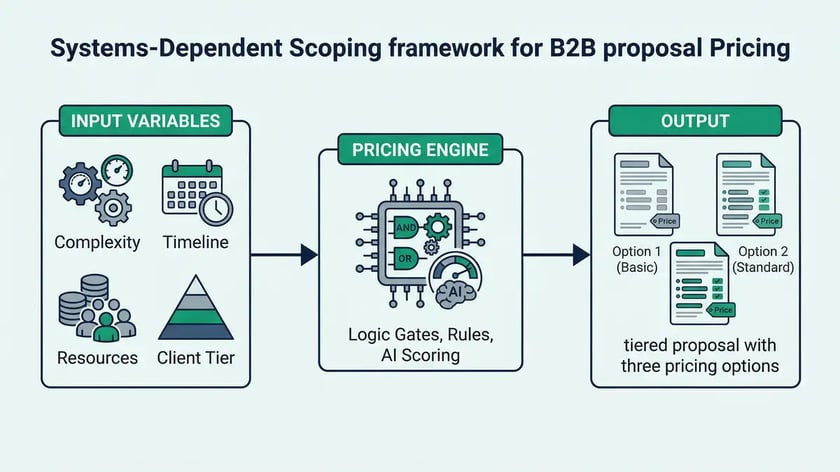
This architecture transforms pricing from an art practiced by experienced negotiators into a science governed by transparent, auditable rules. The critical distinction from static pricing models is that every variable is documented and adjustable. When market conditions shift, you update the pricing engine's parameters — not every individual salesperson's intuition.
Key Takeaway
Systems-dependent scoping works because it makes the invisible visible. When a client sees that adding a particular feature increases delivery effort by 60 hours and costs an additional $12,000, scope creep requests drop dramatically. Transparency protects margins on both sides of the table.
What Are the Most Effective B2B Pricing Models for Proposals?
The pricing model you choose determines how your revenue scales — and whether clients perceive your pricing as fair or arbitrary. Research from OpenView Partners shows that 86% of SaaS companies valued above $100 million now employ at least three dimensions in their pricing structure, combining seat-based, usage-based, and feature-tier components. The same multi-dimensional logic applies to services pricing.
| Pricing Model | Best For | Margin Protection | Client Perception |
| Cost-plus (markup on hours) | Simple, predictable engagements | Low — ignores value delivered | Commoditizing — clients compare hourly rates |
| Fixed price (per deliverable) | Clearly scoped projects | Medium — if scope is controlled | Positive — budget certainty |
| Value-based (tied to outcomes) | High-impact strategic engagements | High — price reflects impact | Excellent — aligned incentives |
| Tiered packages | Productized services at scale | High — pre-costed tiers | Clear — transparent upgrade paths |
| Hybrid (base + usage/outcome) | SaaS and recurring services | Highest — captures expansion | Growing preference — 61% adoption |
Sources: OpenView Partners — SaaS Pricing Insights, Monetizely — SaaS Pricing Benchmarks 2025
The most important trend for B2B service firms: hybrid pricing models grew from 49% to 61% adoption in a single year. This reflects a market-wide recognition that neither pure subscription nor pure project-based pricing captures value accurately. For consulting firms and agencies, hybrid models typically combine a base retainer (providing revenue predictability) with scope-dependent components (capturing upside when engagements expand).

For executive search firms, the pricing architecture is particularly nuanced. Retained search commands 25–35% of first-year compensation paid in thirds, while contingency models charge 20–30% on placement success only. Hybrid retained-contingency structures ($8,000–$20,000 upfront plus 5–25% placement fee) have emerged as the optimal balance for mid-level executive positions. Each model represents a different risk distribution — and a systems-dependent scoping engine can calculate which model to recommend based on role seniority, search complexity, and client relationship tier.
Avoid This Mistake
Do not default to cost-plus pricing because it feels "safe." Cost-plus systematically underprices complex engagements and overprices simple ones because it ignores value delivered. A project costing $10,000 to deliver might generate $100,000 in value for the client — pricing it at $15,000 (50% markup) leaves $85,000 of perceived value uncaptured.

How Does Scope Creep Destroy Proposal Profitability?
Scope creep is the silent margin killer that transforms profitable engagements into loss-making ones — and it affects 72% of content campaigns and 34% of all digital projects. According to project management research, scope creep adds an average of 27% to the original project budget. On a $100,000 engagement priced for 15% margin ($15,000 profit), uncontrolled scope creep transforms the project into a $127,000 delivery against a $100,000 contract — a $27,000 loss.
The root causes are systemic, not personal. PMI research identifies insufficient requirements analysis as the primary cause in 42% of cases, followed by inadequate change control processes and stakeholder misalignment. In 68% of examined digital project failures, scope creep was the primary driver of budget and timeline overruns.
Systems-dependent scoping functions as a scope creep prevention mechanism. When every deliverable maps to a specific price component, clients see the cost of "one small addition" in real time. Implementing a formal Change Control Board reduces project budget variance by 18–24% without compromising quality or functional scope. This is precisely why project profitability tracking must integrate directly with your proposal pricing infrastructure — the feedback loop between estimated and actual costs is what makes the pricing engine smarter over time.
| Scope Creep Metric | Benchmark | Prevention Method |
| Average budget overrun | 27% of original budget | Systems-dependent scoping with itemised deliverables |
| Projects affected | 52% experience scope creep (PMI) | Formal change control governance |
| Primary root cause | Insufficient requirements (42%) | Structured scoping workshops with sign-off |
| Budget variance reduction | 18–24% with Change Control Board | Automated change request routing and cost impact calculation |
Sources: Stop Scope Creep — Statistics 2026, PMI — Scope Patrol
Ready to protect your margins with systems-dependent pricing? Explore peppereffect's Sales Administration pillar — the architecture for proposals that close faster and protect profitability.
Explore Sales Administration →What Role Does AI Play in B2B Pricing Optimization?
AI transforms pricing from a static quarterly exercise into a continuously optimized system that learns from every deal. Companies deploying AI-powered pricing optimization report profit margin lifts averaging 10–13% and 15% improvements in pricing accuracy compared to manual approaches. These are not incremental gains — for a $20 million B2B company operating at 30% gross margin, a 10% margin improvement adds $600,000 to annual operating profit.
The operational implementation relies on three technical foundations. First, real-time data integration pulls live market signals, competitor pricing, internal cost data, and customer success metrics into the pricing engine. Second, predictive analytics forecast which pricing approaches convert best within specific customer segments — learning from every won and lost deal. Third, automated price generation enables sales teams to produce customer-specific quotes in minutes rather than requiring multi-day approval cycles.
This speed advantage connects directly to conversion. Proposal automation research shows that automated systems produce proposals in approximately 17 minutes compared to 20–60+ hours for manual processes. When combined with AI pricing, your team responds to RFPs with accurately priced, customer-specific proposals in hours — capturing the first-responder advantage that determines 35–50% of B2B sales outcomes.
The feedback loop is what makes AI pricing a compounding asset rather than a one-time improvement. Every proposal outcome — won, lost, renegotiated — trains the model. After 100 proposals, the engine knows which price points convert for enterprise SaaS buyers versus mid-market consulting clients versus executive search mandates. After 500 proposals, it can recommend pricing with higher confidence than your most experienced salesperson.
How Do You Implement Dynamic Pricing Without Disrupting Sales?
Implementation follows a structured three-phase approach spanning 6–12 weeks for modern platforms. The critical success factor is not technology selection — it is pricing logic documentation. Before evaluating any CPQ platform, your team must answer: How are prices currently set? What factors drive variation? What discount governance exists (if any)?
| Phase | Duration | Key Activities | Success Metric |
| 1. Assessment & Documentation | 2–3 weeks | Map current pricing logic, quantify pricing losses, document approval workflows | Pricing playbook drafted; financial case quantified |
| 2. Configuration & Integration | 3–5 weeks | Configure pricing rules in CPQ, integrate CRM + project management data, set approval thresholds | System generates accurate quotes matching manual pricing ±5% |
| 3. Deployment & Optimization | 2–4 weeks | Parallel run (old + new), train sales team, establish feedback loop, launch | Proposal cycle time reduced 50%+; win rate baseline established |
Sources: ServicePath — CPQ Trends 2026
The parallel run phase is non-negotiable. For 2–4 weeks, generate proposals through both manual and system-driven processes, comparing outputs to catch edge cases. This builds sales team confidence and ensures that pricing logic captures the nuances that experienced salespeople bring.
For organizations already running pipeline automation and document intelligence, the integration point is natural: CPQ systems connect to your CRM to pull client tier data, connect to workflow orchestration platforms like n8n or Make.com for approval routing, and feed pricing outcomes back into your sales pipeline for continuous optimization.
Key Takeaway
The biggest implementation risk is not technology — it is resistance from sales teams who view pricing systems as constraints rather than enablers. Address this by demonstrating that the system makes them faster (17-minute proposals instead of multi-day turnarounds) and more competitive (first-responder advantage on every deal).
Frequently Asked Questions
What is the difference between dynamic pricing and value-based pricing?
Dynamic pricing adjusts prices automatically based on measurable variables like project complexity, timeline, and client tier. Value-based pricing anchors price to the business outcome the client achieves. In practice, the most effective B2B pricing engines combine both: value-based principles determine the pricing philosophy (price reflects impact, not cost), while dynamic systems automate the calculation. A proposal automation system implements both simultaneously — calculating prices that reflect value delivered while adjusting dynamically for scope variables.
How much does a CPQ system cost to implement?
Modern CPQ platforms range from $50–$150 per user per month for mid-market solutions to $200+ per user for enterprise platforms with AI capabilities. Implementation costs vary from $10,000–$50,000 for straightforward deployments to $100,000+ for complex enterprise configurations requiring custom integrations. The ROI justification is clear: if pricing inefficiency costs 2–5% of sales revenue (EY research), even a modest improvement pays for the platform within the first quarter. Cloud-based CPQ solutions command 68% market share, reflecting preference for SaaS-delivered tools with continuous updates.
Can dynamic pricing work for consulting and coaching businesses?
Absolutely — and it is particularly valuable for businesses trapped in the Technician's Trap where the founder prices every deal personally. Consulting firms implement dynamic pricing through productized service tiers: an "Essential" tier at $10,000, "Professional" at $30,000, and "Enterprise" at $65,000, each with clearly defined deliverables. The pricing engine calculates which tier and price point to recommend based on engagement complexity and client profile. For coaching businesses, tiered program pricing with usage-based components (additional sessions, premium access) creates natural expansion paths.
What metrics should I track after implementing dynamic pricing?
Track five metrics relentlessly: win rate (target 30%+ for B2B proposals), proposal cycle time (automated systems should deliver under 24 hours), average contract value (should increase as pricing discipline eliminates unnecessary discounting), discount depth (monitor for consistency across sales team), and net revenue retention (leading SaaS companies achieve 115–125%). These metrics connect pricing execution directly to project profitability and overall business health.
How does dynamic pricing prevent scope creep?
Systems-dependent scoping makes every deliverable visible and priced. When a client requests a "small addition," the system instantly calculates the resource impact and cost — transforming vague requests into quantified decisions. Research shows that formal change control processes reduce budget variance by 18–24%. The pricing engine integrates with your project management system to detect when actual effort exceeds quoted scope, triggering change order workflows before margin erosion occurs.
Is dynamic pricing appropriate for executive search firms?
Executive search pricing is already inherently dynamic — retained search fees (25–35% of first-year compensation) vary by role level, search complexity, and market conditions. Systems-dependent scoping formalizes this by calculating recommended fee structures based on position seniority, geographic scope, industry specialization required, and candidate pool depth. For firms running AI-powered candidate screening, the pricing engine can also factor in automation savings that make certain searches more profitable, enabling competitive pricing on high-volume mandates while protecting margins on complex C-suite searches.
What is the average B2B proposal win rate?
The average B2B proposal win rate across industries is approximately 30%, though this varies significantly by sector. SaaS proposal win rates cluster between 18–36%, with enterprise deals trending lower due to multi-stakeholder buying committees. The critical finding: companies with structured proposal processes and pricing discipline achieve win rates up to 21% higher than those without systematic approaches. For a firm closing 100 proposals annually at $50,000 average value, this improvement represents $250,000+ in additional annual revenue with zero increase in proposal volume.
Stop Leaving Revenue on the Table
peppereffect architects systems-dependent pricing engines that protect your margins, accelerate proposal velocity, and scale across your entire sales organization. From CPQ configuration to AI-powered optimization — we install the infrastructure that turns pricing from a bottleneck into a competitive weapon.
Book Your Growth Mapping CallRead: B2B Proposal Automation →
Resources
- McKinsey — The Power of Pricing
- Custom Market Insights — CPQ Software Market Size Report 2035
- Zilliant — The Hidden Cost of Manual Pricing in B2B
- Stop Scope Creep — Scope Creep Statistics 2026
- Loopio — 38 Statistics on RFP Win Rates & Proposal Management
- OpenView Partners — Pricing Insights from 2,200 SaaS Companies
- Master of Code — Dynamic Pricing AI: Boost Profits and Sales
- Lift AI — 50% of Sales Go to the First Responder