

An executive search firm is a specialised professional services organisation that identifies, evaluates, and places senior leaders and board directors on a retained basis. Unlike contingency recruiters who post jobs and wait for applicants, an executive search firm proactively maps the global market for passive candidates, runs a rigorous multi-stage assessment process, and operates as a strategic advisor to the hiring board or CEO. The work is exclusive, confidential, and paid for whether or not a placement is made. The output is a placement guarantee, a credible candidate slate, and a process that protects the most consequential hiring decisions a company will ever make. executive search process retained vs contingency search how to start a recruitment agency recruitment firm business plan executive search methodology
If you are a board chair, CEO, CHRO, or private equity partner considering an engagement, this guide installs the operating knowledge you need before you sign a retainer. If you are a Managing Director benchmarking your own firm against the global standard, the same data points apply. The global executive search industry has grown to over $10 billion in annual fees, with the Hunt Scanlon Top 50 firms alone producing $6.041 billion in fees in 2025, a 6% rise year on year, per Hunt Scanlon Media's 2025 ranking. The five firms commonly referred to as the "Big 5" (Spencer Stuart, Heidrick & Struggles, Russell Reynolds Associates, Egon Zehnder, and Korn Ferry) together control roughly a third of that market.
What you will learn in this article:
- The precise definition of an executive search firm, and how it differs from a contingency recruiter or RPO
- The size and structure of the global executive search industry in 2026
- The "Big 5" firms, their revenue scale, and their distinct strengths
- The canonical 7-stage retained search process from intake to close
- The fee structure, retainer mechanics, and 12-month placement guarantee
- The role of AI in modern executive search, and what is still irreducibly human
- How to decide between a Big 5 firm and a boutique specialist
Key Takeaway
An executive search firm is not a recruiter. It is a retained strategic intermediary that takes ownership of a senior hiring outcome, bears commercial risk through a non-refundable retainer, and delivers a placement guarantee. The fee is the price of certainty. The choice of firm sets the ceiling on the quality of the slate.
What Is an Executive Search Firm? A Precise Definition
An executive search firm is a retained professional services organisation that identifies, qualifies, assesses, and places senior executives and board directors for client companies. The defining feature is the retained engagement model: the firm is paid a non-refundable retainer in tranches, regardless of whether a placement is made, in exchange for exclusive ownership of the search and a guarantee that the placed candidate will remain in role for a specified period, typically twelve months.
The industry's global standards body, the Association of Executive Search and Leadership Consultants (AESC), represents over 16,000 professionals across more than 80 countries and codifies the retained model as the discipline's gold standard. AESC members commit to a published Code of Professional Practice covering confidentiality, conflicts of interest, anti-discrimination, and assessment integrity. Firms that operate outside this framework on a "post-and-wait" or "contingency" basis are recruiters. They are not executive search firms in the technical sense, even when they place senior roles.
The work performed by an executive search consultant is closer to that of a strategic management consultant than a staffing agent. The mandate is to translate a board-level operating problem into a position specification, map the relevant talent market, approach passive candidates discreetly, often through a high-status LinkedIn network for executive search, run a structured assessment process, present a credible shortlist, and shepherd the offer and onboarding to a successful close. The premium pricing reflects the consequence of the decision: getting a CEO or CFO hire wrong costs the company multiples of the placement fee.

How Large Is the Global Executive Search Industry?
The global executive search industry generates over $10 billion in annual fee revenue, growing at a 4% to 6% CAGR through the 2024 to 2030 window. The Hunt Scanlon Top 50 firms in the Americas alone produced $6.041 billion in fees in 2025, a 6% rise year on year, with 59% of firms reporting positive growth, per Hunt Scanlon Media's 2025 Top 50 ranking. The biggest growth has come from search practices specialising in private equity, technology, healthcare, and financial services.
The two publicly listed Big 5 firms publish audited financial data that anchors the industry's size. Korn Ferry reported $2,762.7 million in fee revenue for fiscal year 2024, with adjusted EBITDA of $408.2 million at a 14.8% margin, per its SEC 10-K filing. Heidrick & Struggles delivered $1.1 billion in 2024 revenue, with approximately 75% of that figure attributable to its Executive Search segment, per its 2024 10-K filing. Both firms continued growth into 2025, with Heidrick posting 16% revenue growth in Q3 2025.
Estimates put the total number of executive search firms globally at 5,000 to 6,000, ranging from the global behemoths to single-partner boutiques operating in specific verticals. The Big 5 commands roughly a third of total industry revenue, with the remainder distributed across regional, sector-focused, and boutique firms. AESC's historic growth release documents the industry's expansion in 2024 to 2025 and its concentration in Anglo-Saxon financial hubs.
Who Are the "Big 5" Executive Search Firms?
The Big 5, sometimes referred to in industry shorthand as "SHREK" (Spencer Stuart, Heidrick & Struggles, Russell Reynolds, Egon Zehnder, Korn Ferry), are the firms with the global geographic footprint, brand recognition, and institutional resources to handle the most complex multi-country C-suite and board mandates. Hunt Scanlon publishes a dedicated "Big 5" tracker for industry watchers.
| Firm | Annual Revenue (latest) | Offices / Countries | Distinct Strength |
| Korn Ferry | $2.76B (FY2024) | 80+ offices, 50+ countries | Largest by revenue; broad consulting suite |
| Heidrick & Struggles | $1.1B (2024) | 63 offices, 30 countries | Pure retained search + leadership consulting |
| Russell Reynolds Associates | Private; ~$800M-$950M est. | 47 offices, 25 countries | Heavy PE and portfolio specialisation |
| Spencer Stuart | Private; ~$600M-$750M est. | 60+ offices, 30+ countries | Pure-play retained; board director and CHRO specialism |
| Egon Zehnder | Private; ~$600M-$700M est. | 60+ offices, 40+ countries | Independently held; Continental Europe strength |
Sources: Korn Ferry FY2024 10-K, Heidrick & Struggles 2024 10-K, Hunt Scanlon Big 5 tracker, Russell Reynolds office footprint, Spencer Stuart office footprint
Below the Big 5 sits a long tail of high-quality regional and sector-specialist firms. Hunt Scanlon's Select Guide to America's Top 250 catalogues the next tier, including firms like NU Advisory Partners, JM Search, BrainWorks, and Boyden, alongside vertical specialists such as WittKieffer in healthcare, Slone Partners in life sciences, and ON Partners in private equity.

What Is the Difference Between Retained, Contingency, and RPO?
The three engagement models that get conflated in industry conversation are technically distinct disciplines with different risk structures, fee economics, and use cases. Understanding the difference is the first thing to clarify before you engage any provider.
| Model | Fee Structure | Risk Allocation | Best For |
| Retained Executive Search | 25-33% of first-year cash comp; non-refundable retainer in 3 tranches | Search firm bears risk; 12-month placement guarantee | C-suite, board, VP roles; confidential; succession-critical |
| Contingency Search | 15-25% of first-year comp; paid only on placement | Search firm bears all risk | Mid-level roles; non-exclusive; volume hiring |
| RPO (Recruitment Process Outsourcing) | Cost-per-hire or managed service fee | Hybrid SLA-based | Outsourcing entire recruiting function for defined populations |
Sources: AESC Resources, Hunt Scanlon Select Guide
The defining commercial characteristic of retained search is exclusivity. When you engage a retained firm, you do so on an exclusive basis for that role for a defined search window. The firm has no incentive to rush an unsuitable candidate forward because it has already secured a substantial portion of the fee. Contingency recruiters, by contrast, run multiple competing searches simultaneously and are paid only on placement, which incentivises speed over fit. For the most consequential C-suite hires, particularly those with confidentiality requirements or where the company is replacing an incumbent, retained search is the only viable model. This is also why executive search automation has not commoditised the discipline at the top of the pyramid.
How Are Executive Search Firms Paid?
The standard retained fee is 25% to 33% of the first-year cash compensation package (base plus target bonus), paid in three equal tranches. The first tranche is billed on engagement signing, the second at 30 days, and the third on placement. US and London markets command the 33% rate; emerging markets typically run at 25% to 28%. Board director and non-executive director searches carry a premium of 35% to 40% because the work is more confidential and the candidate pool is smaller.

Worked example: a $400,000 base plus $200,000 target bonus CFO search at 33% means a fee of $198,000. That fee is split into three tranches of $66,000 each, with the second due at day 30 regardless of search progress. If the placed candidate departs within the 12-month guarantee window for performance reasons or voluntary resignation, the firm conducts a replacement search either at no additional fee or at a discounted 50% rate, depending on the contract.
Executive search firms also offer add-on services that are sometimes bundled into the engagement and sometimes priced separately. These include psychometric and behavioural assessments ($5,000 to $15,000 per candidate), structured reference checking, onboarding consulting, and post-placement coaching. Leadership consulting practices like Heidrick & Struggles' or Korn Ferry's also offer succession planning and CEO assessment work that sit upstream of the search itself, often priced as standalone engagements at $100,000 and up.
What Are the 7 Stages of a Retained Executive Search?
The canonical AESC-taught retained search process runs through seven sequential stages over 90 to 130 days. Each stage has its own deliverables, time investment, and quality gates. The work cannot be rushed without compromising the placement.
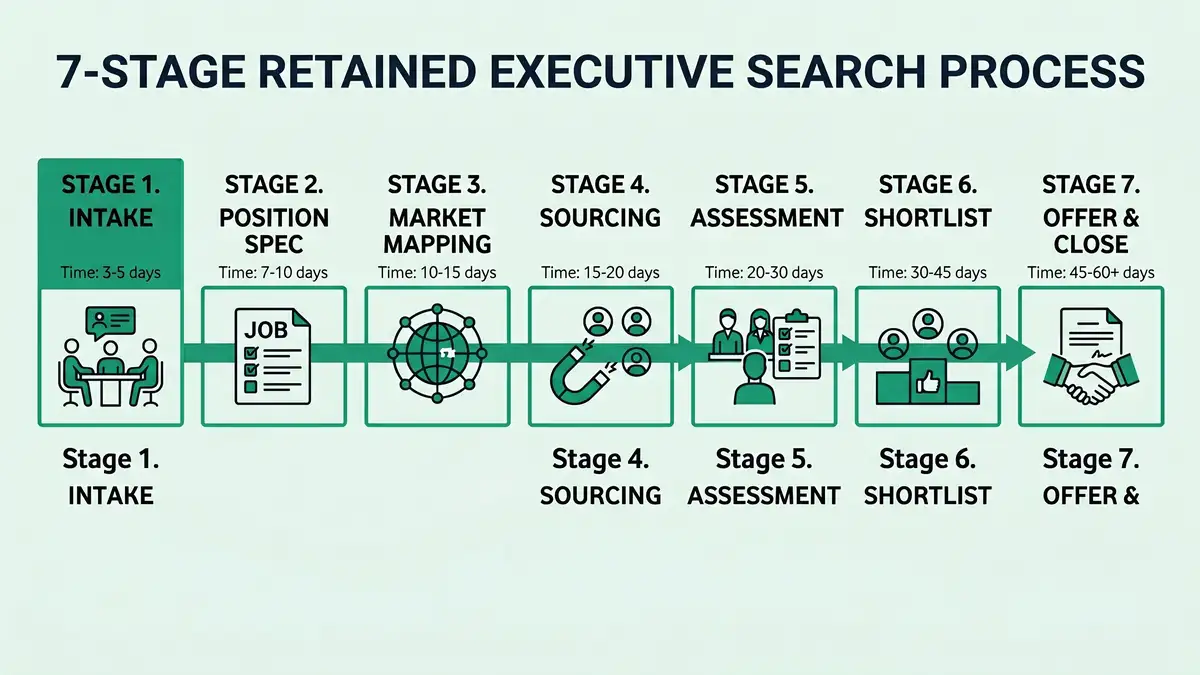
Intake and Engagement Initiation (5 to 10 days)
Stakeholder interviews with the board, CEO, and search sponsor. Definition of the role's strategic context, success criteria, and organisational fit requirements. Production of the engagement brief and signed retainer agreement.
Position Specification and Role Definition (10 to 15 days)
Detailed position spec covering responsibilities, experience requirements, competency frameworks, compensation benchmarking, and competitive landscape. The spec becomes the rubric against which all candidates are assessed.
Market Mapping and Network Research (15 to 25 days)
Identification of 30 to 100 candidate targets through proprietary database research, network outreach, and competitor analysis. The output is a structured map of who is in market, who is moveable, and who is best in class.
Sourcing and Candidate Approach (10 to 20 days)
Discreet outreach to mapped candidates, typically with a 15% to 25% interest conversion rate. Five to twenty-five candidates engage in initial conversations with the consultant.
Candidate Assessment and Detailed Evaluation (20 to 30 days)
Eight to fifteen long-form interviews (60 to 120 minutes each), psychometric assessment, leadership capability scoring, and structured reference checking. The most rigorous firms layer four or five distinct lenses on every shortlisted candidate.
Shortlist Creation and Client Presentation (10 to 15 days)
Three to five ranked finalists presented to the search committee with detailed dossiers, video summaries, and consultant recommendation. Multiple rounds of client interviews follow.
Offer, Closure, and Onboarding (5 to 15 days)
Compensation negotiation, offer construction, reference closure, and onboarding handoff. The consultant typically remains engaged through the first 100 days to monitor placement success.
Run a retained search inside a system that captures every signal across the candidate lifecycle. peppereffect installs the operating layer for elite search firms.
See the Freedom Machine Architecture →What Does a 12-Month Placement Guarantee Actually Cover?
The 12-month placement guarantee is the commercial backbone of the retained model. If the placed candidate separates from the role within twelve months, the firm conducts a replacement search either free of charge or at a discounted rate. The terms vary by contract, but the industry standard is that replacement searches typically complete in 60 to 75 days, faster than the original 90 to 120 because the consultant retains the candidate pool and assessment work from the original engagement.
The guarantee carries common exclusions. It does not apply when the company terminates the candidate for restructuring or M&A reasons unrelated to the candidate's performance. It does not apply when the role is materially changed post-placement, when the compensation or terms are unilaterally modified, or when the candidate is placed on a performance improvement plan with documented performance issues. Replacement searches occur in roughly 5% to 15% of placements at leading firms, with the best-in-class firms operating at the lower end of that range. This is the operational discipline that distinguishes a 90% placement-success firm from a 70% firm.

Heidrick & Struggles' Route to the Top 2024 report found that only 26% of organisations treat CEO succession planning as a top priority, which is a structural driver of placement failure. A firm that places into an environment without an active succession plan is more likely to see its placement separate within twelve to twenty-four months due to misalignment with the board, with the broader executive team, or with a strategic direction that was never fully resolved before the search began.
How Is AI Changing Executive Search in 2026?
AI in executive search has moved from prediction to augmentation across the discovery and assessment stages of the process. AESC's 2024 Top Trends in Executive Search Technology report documents the AI tools being adopted across the industry, including Eightfold, Clovers, HireVue, and Plum, alongside specialist platforms like Thrive that target the elite end of the search market. The work that AI is now doing well includes market mapping, candidate sourcing across LinkedIn and proprietary databases, natural language processing of credential matching, video interview analysis with sentiment scoring, and psychometric assessment automation.
The reported gains from a hybrid augmented-intelligence model are material: a 10 to 20 day reduction in time-to-fill, a 30% to 50% larger candidate pool, and a 1 to 3 percentage point improvement in placement success rate. The work that AI cannot yet do reliably is the human-judgment layer: cultural fit, executive presence, strategic communication style, board chemistry, and the deeply contextual conversations that distinguish a finalist from a placement. The leading firms are using AI to expand the top of the funnel and accelerate routine assessment while keeping the final 20% of the work, the strategic-judgment portion, fully human. peppereffect treats this hybrid as the defining shift in the industry and has documented it across the future of executive search, AI for executive search, and placement velocity systems that elite firms now deploy.
What Does a Bad Executive Hire Actually Cost?
The Department of Labor's baseline estimate is that a bad hire costs at least 30% of the employee's first-year earnings, and up to 50% for managerial roles, per SHRM's analysis. For executive hires the math is dramatically worse. Industry research synthesises the total cost of a failed C-suite placement at 3 to 5 times the candidate's annual compensation package, including search fees, severance, strategic disruption, team morale impact, opportunity cost, and the second search.
Worked example: a $400,000 base plus $200,000 bonus CFO who separates at 18 months represents a $600,000 to $3 million total economic cost, depending on the strategic decisions made during their tenure and the depth of the disruption. For CEO placements, the cost rises further. McKinsey and Heidrick research place a failed CEO placement at $2 million to $5 million and up, with cascading effects on the executive team, the board's credibility, and the company's share price for public companies. The fee paid to a retained firm is a small fraction of the cost of getting the placement wrong, which is why boards continue to pay it even in markets where contingency recruiters offer the same role at half the price. This is the same economic logic that governs hiring a VP of Sales or any consequential executive seat.
Avoid This Mistake
Do not engage a contingency recruiter for a CEO, CFO, or board director search. The economic incentive structure is wrong. Contingency recruiters are paid on placement, which incentivises closing the first plausible candidate rather than mapping the global market. The 12-month replacement risk is yours, not theirs. For any role above the VP level, retained search is the only model that aligns commercial incentives with placement success.
How Do You Choose Between a Big 5 Firm and a Boutique?
The decision turns on six factors. The Big 5 firms have the global geographic reach, technology platforms, brand recognition, and institutional resources to handle multi-country C-suite mandates and the most confidential succession work. Boutique firms have deeper sector specialisation, more flexible process, lower overheads, often higher success rates within their niche, and partner-level engagement on every search.
| Decision Factor | Lean Big 5 | Lean Boutique |
| Geographic scope | Multi-country, global pipeline | Single-country or regional |
| Role type | CEO, board director, multi-region C-suite | Sector-specific VP or C-suite |
| Industry depth needed | Generalist excellence | Healthcare, life sciences, PE, deep tech |
| Org sophistication | First-time search; structured process valued | Sophisticated buyer; partner relationship valued |
| Budget sensitivity | Standard premium pricing acceptable | Lower retainer / faster process needed |
| Existing relationships | Big 5 partner relationship exists | Boutique sector specialist relationship exists |
Sources: Hunt Scanlon Big 5, Hunt Scanlon Select Guide, AESC Resources
For private equity portfolio companies, the calculus tilts toward PE-specialist boutiques like ON Partners, BSP, and Genus Reserve Capital, which understand the operating-partner model and the accelerated 60 to 90 day timeline that PE typically requires. For healthcare, WittKieffer and Tyler & Company dominate. For technology, True Search and Riviera Partners are the named specialists alongside Heidrick's Technology Practice, and the strongest firms in this segment are now combining traditional sourcing with AI-augmented recruiting workflows that cut time-to-shortlist materially. The decision is not "Big 5 or boutique" in the abstract. It is "which Big 5 office or which sector boutique" for this specific search.
Key Takeaway
The Big 5 advantage is global reach and institutional scale. The boutique advantage is sector depth and partner attention. The mistake to avoid is choosing on brand recognition alone. Choose on the consultant, not the firm. The lead consultant on your search is the single biggest predictor of placement success, regardless of which logo is on the wall.
Frequently Asked Questions
What is an executive search firm in simple terms?
An executive search firm is a specialised retained recruiter that finds, evaluates, and places senior executives and board directors for client companies. The firm works on an exclusive engagement, takes a non-refundable retainer (typically 25% to 33% of the first-year compensation paid in three tranches), and offers a 12-month placement guarantee. It differs from a contingency recruiter, which is paid only on placement and works non-exclusively. Executive search firms operate at the C-suite and board level, where the cost of a bad hire is too high for the contingency model to be commercially appropriate.
Who are the Big 5 executive search firms?
The Big 5 (sometimes "SHREK") are Spencer Stuart, Heidrick & Struggles, Russell Reynolds Associates, Egon Zehnder, and Korn Ferry. Korn Ferry is the largest by revenue at $2.76 billion in fiscal year 2024 per its SEC 10-K. Heidrick & Struggles reported $1.1 billion in 2024 with approximately 75% of revenue from executive search. The other three (Russell Reynolds, Spencer Stuart, Egon Zehnder) are privately held, with estimated revenues in the $600 million to $950 million range. Together the Big 5 controls roughly a third of the $10 billion-plus global executive search market.
How much does it cost to hire an executive search firm?
The standard retained fee is 25% to 33% of the placed candidate's first-year cash compensation, including base salary plus target bonus. For a $400,000 base plus $200,000 bonus CFO role at 33%, the fee is $198,000, paid in three equal tranches of $66,000 each (signing, day 30, placement). Board director and non-executive director searches carry a premium of 35% to 40%. International searches and roles requiring relocation also typically carry a 35% to 40% premium. Add-on services like psychometric assessment, leadership consulting, or coaching are often priced separately at $5,000 to $15,000 per candidate or as standalone engagements.
What is the difference between retained and contingency search?
Retained search is exclusive and paid in advance via a non-refundable retainer; the firm bears commercial risk and provides a 12-month placement guarantee. Contingency search is non-exclusive and paid only on placement at a typically lower percentage (15% to 25% of first-year comp); the search firm bears all the risk and has no incentive to slow-roll the process. Retained is the appropriate model for C-suite, board, and any role where confidentiality, fit, and 12-month placement durability matter more than speed. Contingency is more appropriate for high-volume mid-level recruiting where the placement risk is lower.
How long does a typical executive search take?
The industry benchmark for a retained C-suite search is 90 to 120 days from engagement signing to placed candidate's start date. The work breaks down into seven stages: intake (5 to 10 days), position specification (10 to 15 days), market mapping (15 to 25 days), sourcing (10 to 20 days), assessment (20 to 30 days), shortlist and client interviews (10 to 15 days), and offer through close (5 to 15 days). CEO searches typically run longer at 120 to 150 days. London and Continental Europe searches run longer than US searches due to longer notice periods. Specialised emerging market searches can extend to 150 to 180 days.
What does the 12-month placement guarantee cover?
The 12-month guarantee covers replacement search at no cost (or at a discounted 50% rate, depending on the contract) if the placed candidate separates from the role for performance reasons or voluntary resignation within twelve months. Common exclusions include termination for restructuring or M&A reasons unrelated to the candidate's performance, material change in the role post-placement, and unilateral modification of compensation or terms. Replacement searches occur in roughly 5% to 15% of placements at leading firms and typically complete in 60 to 75 days because the consultant retains the candidate pool and assessment work from the original engagement.
How is AI changing executive search in 2026?
AI is augmenting rather than replacing executive search consultants in 2026. The work AI is doing well is market mapping, candidate sourcing, credential matching, video interview analysis, and psychometric scoring. Reported gains from hybrid augmented-intelligence models are 10 to 20 days reduction in time-to-fill, 30% to 50% larger candidate pools, and a 1 to 3 percentage point improvement in placement success. AI is not yet replacing the human judgment layer (cultural fit, board chemistry, strategic communication style, executive presence) that distinguishes a finalist from a placement. AESC's 2024 Top Trends report documents the platforms now in adoption, including Eightfold, Clovers, HireVue, and Plum.
Install the Operating System Your Executive Search Firm Needs to Scale
peppereffect installs the integrated growth architecture for elite global executive search firms: agentic sourcing infrastructure, candidate intelligence, placement-velocity systems, and the founder-led brand engine that wins mandates. The Freedom Machine for the Agentic Era.
Book Your Growth Mapping CallSee the 4 Pillars Architecture → executive search pricing models exclusive search mandate terms private equity executive search executive search industry market size and 2026 trends
Resources
- AESC: Association of Executive Search and Leadership Consultants
- AESC: Insights and Resources
- AESC: 2024 Top Trends in Executive Search Technology
- AESC: Historic Growth in Executive Search & Leadership Consulting
- Hunt Scanlon Media: Top 50 Executive Search Firms in the Americas
- Hunt Scanlon Media: The Big 5
- Hunt Scanlon Media: Select Guide to America's Top 250
- Korn Ferry: FY2024 10-K Annual Report (SEC)
- Heidrick & Struggles: 2024 10-K Annual Report (SEC)
- Heidrick & Struggles: Q3 2025 Revenue Press Release
- Heidrick & Struggles: Route to the Top 2024
- Heidrick & Struggles: Route to the Top 2025
- SHRM: The Cost of a Bad Hire Can Be Astronomical
- Statista: Top Executive Search Firms by Revenue (Americas)
- Spencer Stuart