

What Is AI for Recruiting and Why Should Executive Search Firms Deploy It Now?
AI for recruiting transforms how executive search firms source, screen, and place senior leadership talent — replacing manual candidate identification with intelligent matching systems that process thousands of profiles in minutes rather than weeks. For boutique search firms generating $5–20M in annual revenue, the question is no longer whether to adopt AI but how quickly you can deploy it before competitors capture the efficiency advantage.
The global executive search market reached $39.1 billion in 2024 and is projected to grow at 8.5% CAGR through 2030. Within this market, AI-enabled search tools represent the fastest-growing segment at 37.8% CAGR — nearly 4.5× the growth rate of traditional retained search. Yet only 31% of boutique executive search firms have implemented AI sourcing tools, despite 89% awareness of available solutions.
The math is stark: recruiters spend 35–42% of their working hours on manual sourcing activities — database searches, LinkedIn screening, candidate identification — while AI-augmented firms report reducing that allocation to 12–18%, freeing 20+ hours per week for the relationship building and candidate assessment work that actually drives placement success.
What you'll learn in this article:
- How AI reduces time-to-shortlist from 14 days to 4–5 days without compromising candidate quality
- The ROI framework for AI implementation in boutique executive search firms ($40K–$90K investment, 18–24 month payback)
- Why the hybrid human-AI model delivers 81–87% placement success rates versus 72–78% for traditional-only search
- How to navigate EU AI Act compliance and protect your firm from regulatory exposure
- The specific sourcing, screening, and matching workflows where AI creates the highest leverage
Key Takeaway
69% of boutique executive search firms have not yet deployed AI sourcing tools. Early movers capture a 2–3 year competitive advantage through faster shortlist delivery, higher placement rates, and margin expansion of 2–6 percentage points — all without increasing headcount or compromising the relationship-driven approach that defines elite search.

How Does AI Transform the Executive Search Sourcing Process?
The sourcing phase — identifying potential candidates who match specific criteria across professional databases, social networks, and proprietary databases — consumes the largest share of recruiter time in traditional executive search. Average time-to-fill for C-suite positions sits at 5.2 months, with the sourcing and shortlisting phase accounting for 30–40% of that total cycle. AI compresses this specific phase dramatically.

Firms deploying AI sourcing tools report time-to-shortlist reductions from 14 days to 4–5 days — a 64–68% compression. This acceleration comes from three capabilities: automated candidate identification across multiple databases simultaneously, intelligent skills and experience matching that eliminates manual resume screening, and predictive scoring that surfaces the most relevant candidates first. A mid-market UK firm with 12 consultants documented a 69% reduction in time-to-shortlist within six months of implementation, alongside a 40% reduction in candidates screened per placement (47 down to 28), meaning higher-quality targeting from the outset.
The efficiency gains extend beyond speed. AI-augmented firms report cost per C-suite placement dropping from £15K–£28K to £9K–£18K — a 35–45% reduction driven primarily by recruiter time savings. For a boutique firm running 48–60 placements annually, this translates to £240K–£480K in direct cost savings before accounting for the additional revenue from increased placement capacity.
| Metric | Manual Process | AI-Augmented | Improvement |
| Time-to-shortlist | 14 days | 4–5 days | 64–68% faster |
| C-suite time-to-fill | 5.2 months | 3.4 months | 35% faster |
| Candidates screened per placement | 35–55 | 20–32 | 40% fewer (better targeting) |
| Cost per C-suite placement | £15K–£28K | £9K–£18K | 35–45% lower |
| Placements per consultant/year | 4.2 | 5.6 | 33% increase |
Sources: Korn Ferry Talent Acquisition Trends 2026, SHRM 2025 Recruiting Benchmarking Report
What ROI Can Boutique Executive Search Firms Expect from AI Implementation?
The financial case for AI in executive search is measurable and fast-returning. Boutique firms ($5–20M revenue) achieve an 18–24 month payback period on AI implementation investments of £40K–£90K. The returns compound across multiple vectors: increased placement capacity, reduced cost per placement, improved consultant retention, and margin expansion.
Consider the documented trajectory of a US boutique firm with 18 consultants and £12M annual revenue. Within 12 months of AI deployment, manual sourcing hours dropped from 180 to 65 per week across the team — a 64% reduction. Failed placement rates halved from 8.2% to 4.1%. C-suite time-to-fill compressed from 5.3 months to 3.8 months. Perhaps most critically, consultant retention improved from 87% to 93%, directly addressing the recruitment firm's own talent retention challenge.
| Year | Technology Investment | Productivity Gains | Net Benefit | Cumulative ROI |
| Year 1 | £50K (initial + setup) | £65K–£85K | +£15K–£35K | 30–70% |
| Year 2 | £20K (maintenance) | £120K–£150K | +£100K–£130K | 200–260% |
| Year 3 | £20K (maintenance) | £150K–£180K | +£130K–£160K | 330–420% |
Sources: Recruiterflow AI for Executive Search, Korn Ferry Executive Search
The margin impact is equally compelling. Revenue per consultant grows from £92.4K under manual processes to £126K by Year 2 of AI implementation — a 36% increase driven by higher placement volume (5.6 vs. 4.2 placements annually) without headcount expansion. EBITDA margins expand 2–6 percentage points, translating to £90K–£150K additional profit for a £12M firm. This is the precise mechanism of decoupling revenue growth from headcount that defines the agentic era.
Key Takeaway
AI implementation in boutique executive search delivers 330–420% cumulative ROI by Year 3 on a £40K–£90K investment. The primary returns come from increased placement capacity (33% more placements per consultant), reduced failed placements (50% fewer), and consultant retention improvements that save £45K–£60K annually in replacement costs for a 12-person firm.

Why Does the Hybrid Human-AI Model Outperform Pure Automation in Executive Search?
AI excels at hard skills and experience matching — achieving 84–88% accuracy — but struggles with the soft dimensions critical to executive success. Cultural fit assessment, leadership presence evaluation, and board-level interpersonal skills remain domains where human expertise is irreplaceable. The data confirms this: AI matching accuracy for "executive presence/board readiness" sits at just 61–68%, compared to 85–90% for experienced human assessors.
This is why the hybrid model — AI scoring combined with human decision checkpoints — delivers the highest placement success rates at 81–87%, outperforming both traditional-only processes (72–78%) and fully autonomous AI models. Firms using the hybrid approach report 22% higher placement rates and 31% improvement in client satisfaction versus traditional search alone.

The three implementation models observed across the industry illustrate why hybrid wins. The AI-Assisted model (used by 70% of early adopters) has AI source and screen while humans conduct all interviews — scalability remains limited because humans review 100% of AI output. The AI-Autonomous model (20% of implementers) lets AI handle the full screening pipeline with humans reviewing only the top 3–5 candidates — scalable but quality risk increases. The Hybrid model (10% of implementers, emerging best practice) has AI score all candidates while humans review scores plus background context before jointly deciding the shortlist — this achieves the highest client satisfaction scores of 8.4–8.9/10 versus 7.2–7.8 for traditional processes.
As Egon Zehnder's CEO stated: "AI is not about replacing talent finders. It's about freeing them to do what humans do best: evaluate culture fit, relationship building, and subtle candidate motivations." This philosophy aligns precisely with how AI should be deployed across B2B operations — automate the repetitive, amplify the human.
| AI Matching Dimension | AI Accuracy | Human Accuracy | Human Review Needed |
| Skills/experience match | 84–88% | 87–91% | 8–12% |
| Cultural fit indicators | 71–76% | 79–85% | 20–30% |
| Compensation alignment | 82–86% | 89–93% | 15–20% |
| Executive presence/board readiness | 61–68% | 85–90% | 40–50% |
| Industry background relevance | 78–82% | 85–88% | 12–18% |
Sources: Lighthouse Research Talent Acquisition Study, HeroHunt AI Screening Guide 2025
Ready to architect AI-powered sourcing infrastructure for your executive search firm? Explore how peppereffect deploys autonomous lead generation systems that decouple growth from headcount.
Book Your Growth Mapping Call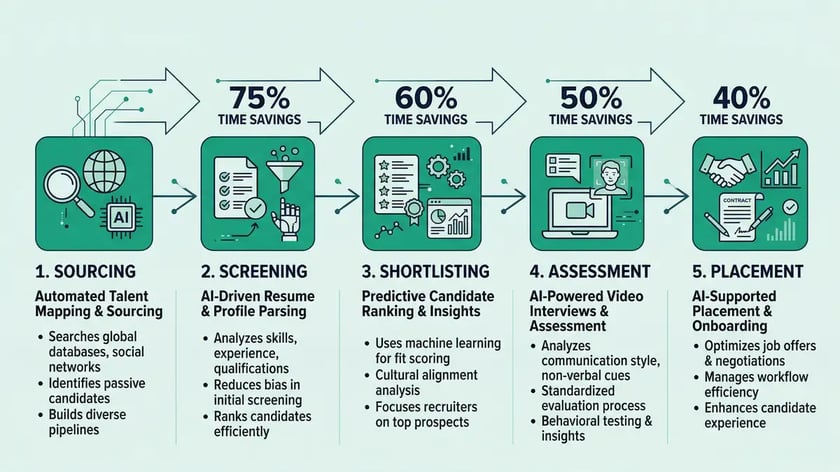
How Should Executive Search Firms Implement AI in 5 Steps?
Successful AI deployment in executive search follows a phased approach that balances speed with quality protection. The firms achieving the highest ROI share a common pattern: start narrow, prove value fast, then scale with confidence. Here is the 12-month implementation roadmap that the highest-performing boutique firms follow.
Discovery & Vendor Selection (Months 0–2)
Evaluate 3–5 AI sourcing tools against your specific executive search workflows. Prioritize platforms designed for retained search (Eightfold AI, SeekOut, Bullhorn) over general ATS systems that lack executive-level matching sophistication. Investment: £0–£5K. Define clear use cases: candidate identification, skills matching, or full pipeline automation.
Pilot Deployment (Months 2–4)
Deploy with 1–2 consultants across 2–3 active searches. Run AI and manual processes in parallel to establish baseline comparisons. Gather weekly feedback on match quality, false positive rates, and time savings. Investment: £15K–£30K. Success metric: 50%+ adoption among pilot users with measurable time-to-shortlist improvement.
Integration & Training (Months 4–6)
Connect AI tools with your existing CRM and candidate management systems. Migrate historical candidate data. Deliver 16–24 hours of team training focused on interpreting AI scores, identifying when to override recommendations, and maintaining quality standards. Investment: £10K–£25K.
Scaled Rollout (Months 6–9)
Firm-wide deployment with standardized processes. Establish client communication protocols — position as "AI-enhanced human expertise," not "AI-powered." Conduct initial bias audit. Investment: £5K–£15K. Target: 60%+ of active searches using AI sourcing with documented quality metrics.
Optimization & Governance (Months 9–12)
Implement quarterly bias audits, performance monitoring dashboards, and candidate screening quality reviews. Prepare EU AI Act compliance documentation. Integrate client feedback loops to continuously refine AI matching models. Investment: £10K–£20K. Target: 25–35% reduction in time-to-shortlist and 20%+ placement rate improvement.
Avoid This Mistake
Don't deploy AI as a cost-cutting measure and communicate it that way to consultants. The firms with the lowest adoption rates (under 30%) framed AI as replacing recruiter activities. The firms with the highest adoption (80%+) positioned AI as eliminating the repetitive sourcing work that recruiters dislike — freeing them for the high-value relationship and intelligence work that drives placement success and professional satisfaction.
How Do You Navigate EU AI Act and EEOC Compliance for AI Recruiting?
AI systems used in hiring decisions are classified as "high-risk" under the EU AI Act, with core compliance requirements enforceable from August 2, 2026. For executive search firms serving European clients — or placing candidates into EU-headquartered organizations — this creates specific obligations that must be addressed proactively rather than reactively.
The regulatory requirements include mandatory high-risk classification documentation, transparency obligations (informing candidates that AI participates in the screening process), annual bias testing and audits conducted by external firms, data quality standards ensuring training data is representative, and human review rights allowing candidates to request human assessment. Non-compliance penalties reach up to €30 million or 6% of global revenue — making this a board-level risk item, not an operational footnote.
In the US, the EEOC guidance on AI in employment decisions requires employers to demonstrate that AI tools do not create disparate impact on protected groups. The four-fifths rule applies: if AI-sourced candidate pools show selection rates below 80% of the rate for the most-selected group, the employer bears the burden of demonstrating non-discrimination. Historical class-action settlements for AI-related hiring discrimination range from $2M–$15M+.
| Compliance Requirement | EU AI Act | US (EEOC) | Action Required |
| System classification | High-risk mandatory | Recommended | Document AI role in decisions |
| Candidate disclosure | Required (Q1 2026+) | Best practice | Add AI disclosure to comms |
| Bias audit | Annual, external | Ongoing self-assessment | Engage audit firm |
| Human review right | Mandatory (Q3 2026) | Recommended | Build override process |
| Record-keeping | 7 years | Duration of employment + 1 year | Implement audit trail |
| Penalties | €30M or 6% revenue | $50K–$500K+ per case | Budget compliance costs |
Sources: Crowell & Moring EU AI Act HR Overview 2026, OutSolve EEOC AI Guidance
Key Takeaway
Only 22% of boutique executive search firms currently have EU AI Act compliance infrastructure in place. Firms that build compliance proactively gain a competitive advantage with clients in regulated industries (banking, pharma, public sector) who increasingly demand AI governance transparency. Budget £50K–£150K for initial compliance setup and £20K–£50K annually for ongoing audits and documentation.
Which Executive Search Firms Are Already Using AI — and How Should You Position Against Them?
The competitive landscape reveals a clear pattern: large global firms have moved first, while boutiques remain cautious — creating both urgency and opportunity. Heidrick & Struggles deployed proprietary AI-augmented candidate identification across 350+ consultants globally, reporting 25–30% reduction in time-to-shortlist and 18% improvement in placed-candidate longevity. Korn Ferry integrated AI-augmented search with their assessment practice. Egon Zehnder built a custom human-in-the-loop platform emphasizing quality over speed.
For boutique firms, the differentiation opportunity lies in combining AI efficiency with the personalized, relationship-driven approach that large firms struggle to maintain at scale. The most successful positioning strategies layer two or more approaches: quality assurance (placement guarantees backed by AI-improved matching), sector specialization (AI models trained on vertical-specific candidate data), speed-to-shortlist (4–5 days versus industry-standard 14), and transparency/governance (client-facing dashboards showing AI reasoning and bias audit results).
Client sentiment supports this approach. 81% of clients are aware AI could be used in executive search, and 72% prefer transparent disclosure. Trust in AI-assisted processes scores 7.0/10 versus 8.2/10 for traditional search — a gap that transparent reporting and human-in-the-loop positioning directly closes. Only 15% of clients explicitly reject AI involvement, meaning the vast majority represent an addressable market for AI-enhanced search services.
Frequently Asked Questions
How much does AI for recruiting cost for a boutique executive search firm?
Total 12-month implementation investment ranges from £40K–£90K plus 200–300 internal FTE hours. This includes vendor licensing (£15K–£30K/year for platforms like Eightfold AI or SeekOut), CRM integration (£10K–£25K), team training (16–24 hours), and compliance setup. The investment achieves 18–24 month payback, with cumulative ROI reaching 330–420% by Year 3 through increased placement capacity and reduced cost per placement.
Does AI for recruiting reduce placement quality in executive search?
Not when deployed correctly. The hybrid human-AI model achieves 81–87% placement success rates — higher than traditional-only processes (72–78%). AI excels at hard skills matching (84–88% accuracy) but requires human oversight for cultural fit (71–76% AI accuracy) and executive presence assessment (61–68%). The key is deploying AI for sourcing and initial screening while preserving human judgment for shortlist curation and final candidate assessment.
What are the best AI sourcing tools for executive search firms?
For retained executive search, the leading platforms are Eightfold AI (career path and skills-based matching, £40K–£150K/year), SeekOut (AI-native candidate intelligence, £60K–£160K/year), and Bullhorn (search-firm-specific CRM with AI, £8K–£40K/month). LinkedIn Recruiter (£1.8K–£4.5K/month) serves as the entry point for most boutiques. Avoid general ATS platforms like ZipRecruiter — they lack the executive-level matching sophistication required for retained search.
How does the EU AI Act affect executive search firms using AI?
AI systems used in hiring decisions are classified as "high-risk" under the EU AI Act, with core requirements enforceable from August 2, 2026. Firms must document system classification, disclose AI use to candidates, conduct annual external bias audits, ensure human review rights, and maintain 7-year audit trails. Non-compliance penalties reach €30 million or 6% of global revenue. Budget £50K–£150K for initial compliance and £20K–£50K annually.
Can AI help reduce bias in executive search?
AI can both reduce and amplify bias, depending on implementation. Without active mitigation, AI sourcing systems exhibit bias in 34–48% of cases — particularly against women (32–45% lower inclusion in initial shortlists) and candidates with non-traditional career paths. With proper safeguards — anonymization in initial screening, diverse training datasets, mandatory bias audits, and human override protocols — residual bias drops to 12–18%. The critical requirement is quarterly retraining with recruiter feedback and transparent decision documentation.
How should executive search firms communicate AI use to clients?
Lead with human value, not AI capability. The most effective positioning is "AI-enhanced human expertise" rather than "AI-powered search." Emphasize that AI handles sourcing and skills matching (the repetitive work) while senior consultants focus entirely on relationship building, cultural assessment, and stakeholder alignment. Offer transparency: show clients how AI reasoning works, share bias audit results, and provide the option of traditional-only service. Firms using this approach achieve 78%+ repeat client rates versus 70% industry average.
What is the difference between AI recruiting tools and traditional ATS systems?
Traditional applicant tracking systems (ATS) organize and filter candidates based on keyword matching and binary criteria — they process applications that come to you. AI recruiting tools actively source candidates across databases, social networks, and public sources, then apply intelligent matching that evaluates career trajectories, transferable skills, and predictive fit. For executive search specifically, AI platforms like Eightfold and SeekOut analyze career path patterns to identify candidates who may not appear through traditional keyword searches but match the strategic profile your client needs.
Deploy AI-Powered Sourcing Infrastructure That Scales Your Search Firm Without Adding Headcount
peppereffect architects autonomous operating systems for executive search firms — from AI sourcing pipelines to automated candidate engagement sequences. We install the infrastructure that lets your consultants focus on the C-suite relationships that drive placements, not the manual sourcing that burns them out.
Book Your Growth Mapping CallResources
- Business Research Insights — Executive Search Market Size & Growth Forecast 2034
- Recruiterflow — How AI for Executive Search Is Transforming Recruitment
- HeroHunt — Recruiting Under the EU AI Act: Full Impact Guide 2025
- Insight Global — 2025 AI in Hiring Survey Report
- Heidrick & Struggles — Insight Spotlight on Artificial Intelligence
- BCG — Are You Generating Value from AI? The Widening Gap
- Eightfold AI — AI-Based Job Matching: A Case Study
- Crowell & Moring — AI and Human Resources in the EU: 2026 Legal Overview
AI rewriting the executive search industry
board search practice expansion
international executive search practice the full recruitment automation playbook