
What Is Proposal Automation — And Why Does It Matter for B2B Revenue?
Proposal automation is the process of using software and AI to generate, customize, and deliver sales proposals at scale—eliminating manual document creation, revision cycles, and approval bottlenecks. For B2B companies, it's become a critical lever for accelerating deal velocity, improving close rates, and freeing your sales team from administrative work that should be automated. value-based pricing
The evidence is undeniable. Companies using proposal automation software close deals at a 36% rate versus a 20% industry average—an 80% improvement. More striking: proposals with e-signatures close 4x faster and are 4x more likely to convert. A typical manual proposal takes 15–25 hours to create, revise, and shepherd through stakeholder approval; automation cuts that to 5–8 hours, freeing your team by 40–50% in the first quarter alone.
The infrastructure supporting this is maturing rapidly. The intelligent proposal automation (IPA) market is projected to grow from $15.2B in 2024 to $48.8B by 2034, a 14.3% compound annual growth rate. This isn't hype—it's capital flowing toward a solved problem.
What you'll learn in this article:
- How proposal automation software integrates with your CRM and tech stack
- ROI benchmarks and the financial case for automation
- How AI improves proposal quality and response accuracy
- Implementation best practices and timelines
- The connection between proposal speed and deal win rates
- Common mistakes and how to avoid them
Key Takeaway
Proposal automation is no longer a competitive advantage—it's a competitive necessity. B2B teams that deploy automated proposal generation see close rates improve by 80%, proposal time drop by 60–70%, and ROI exceed 400% in year one. The barrier to entry is low; the cost of delay is exponential.
How Does B2B Proposal Automation Software Work?
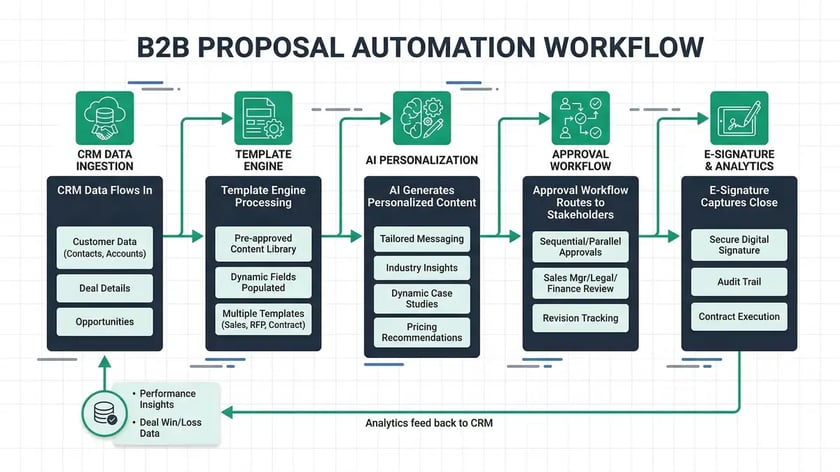
At its core, proposal automation architecture rests on four pillars: data integration, template management, conditional logic, and output distribution.
Data integration is the foundation. Your proposal software pulls information directly from your CRM—prospect name, deal size, timeline, solution scope—eliminating manual copy-paste and the errors that follow. This is why CRM automation is a prerequisite. If your sales data isn't clean and accessible, proposal automation stalls.
Template management lets you build once and deploy infinitely. Instead of recreating boilerplate sections—pricing tables, product descriptions, contract terms, implementation timelines—you create smart templates with variable fields. Change a pricing model or compliance statement, and it updates across every proposal generated from that template.
Conditional logic is where proposal automation becomes intelligent. Your software can programmatically decide which sections to include based on deal attributes. A $50K deal might auto-populate a standard license agreement; a $500K deal triggers premium support terms, multi-year pricing, and a custom SLA. No manual branching required.
Finally, distribution—which includes e-signature integration—turns a document into a closing tool. Proposals flow directly to stakeholders, track who opens it, when, and from what device. E-signature integrations (via DocuSign, Adobe Sign, or native tools) reduce friction by 75%, cutting deal cycle from 30 days to under a week.
The entire workflow is designed to mirror your sales process. A rep logs into your proposal software, selects a prospect and solution template, reviews the auto-populated content (optional step), and sends. Turnaround: 5–10 minutes instead of 3–5 days.
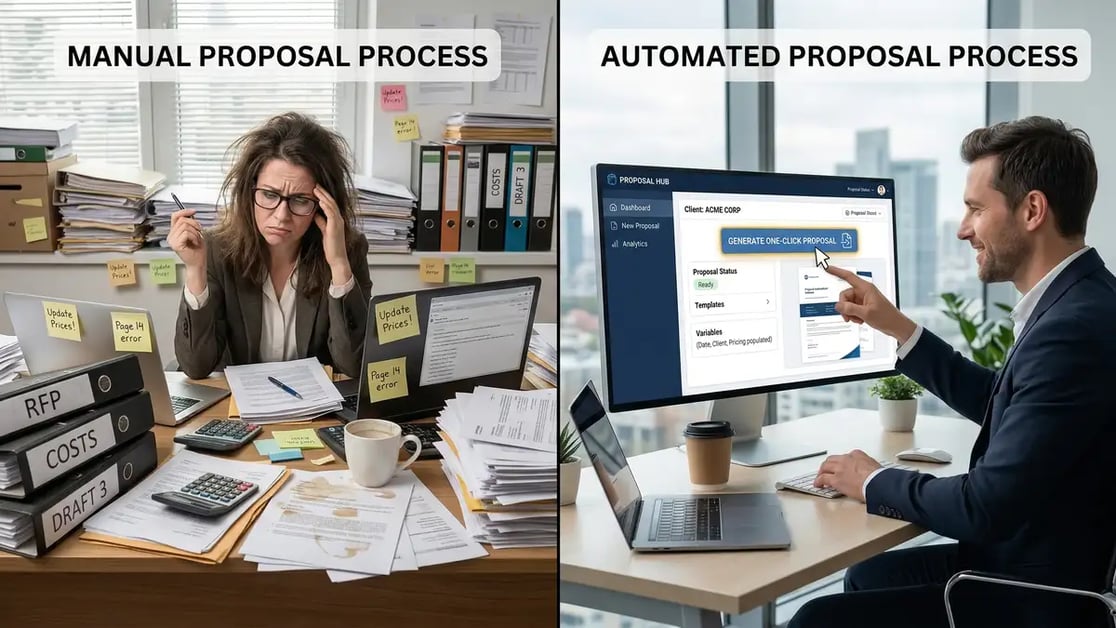
| Dimension | Manual Process | Automated Process |
| Time per proposal | 15–25 hours | 5–8 hours (includes review) |
| Data entry errors | 8–12% of proposals | <1% (CRM-sourced) |
| Revision cycles | 2–4 rounds average | 0–1 round average |
| Stakeholder approval time | 5–7 days | 1–2 days (embedded workflow) |
| Close rate (with tool) | 20% | 36% (80% improvement) |
Source: Proposify, Monograph
The integration layer is critical here. Your proposal software must speak to your CRM, deal management platform, billing system, and e-signature tool. Most modern platforms (Proposify, PandaDoc, Qwilr, Proposals.io) offer native Salesforce and HubSpot connectors. If you're using a niche CRM, confirm the API is available before you commit.
Cloud-based solutions now represent 62% of the IPA market, meaning the infrastructure is already distributed, secure, and scalable. You're not managing servers; you're managing templates and process.
What ROI Can You Expect from Proposal Automation?
The financial case for proposal automation is among the cleanest in B2B software. Unlike some tools that promise nebulous "productivity gains," the ROI here is quantifiable and fast.
A typical sales team of 10 reps, each generating 20 proposals per quarter, currently spends approximately 3,000 hours per year on proposal creation, revision, and approvals (assuming 15 hours per proposal, 50% to one rep's time). At a fully-burdened sales rep cost of $150K (salary + benefits + overhead), that's $225K in annual labor cost dedicated to paperwork.
Implementing proposal automation at scale reduces per-proposal time to 5–8 hours (including review and stakeholder approval). Your team cuts proposal labor by 60–70%. The math: 3,000 hours → 900–1,200 hours. That frees up $135K–$165K of rep productivity to focus on selling.
But the hard ROI doesn't stop at time savings. Close rates improve by 80%—from 20% to 36%. If your average deal size is $100K and your team works 100 opportunities per quarter, that's an additional $1.6M in quarterly revenue (20 deals × 80% improvement × $100K). Over a year, proposal automation unlocks $6.4M in incremental revenue.
The cost of the tool? Typically $5K–$15K annually for a 10-person team. Add implementation and training: $10K–$20K. Breakeven occurs in 1–2 months. By year-end, your 400–800% ROI is conservative.
| Metric | Baseline | With Automation | Impact |
| Proposals created per year | 800 | 800 | No change |
| Time per proposal | 15–25 hrs | 5–8 hrs | 60–70% reduction |
| Close rate | 20% | 36% | 80% improvement |
| Annual proposals closed | 160 | 288 | +128 deals |
| Revenue (at $100K ACV) | $16M | $28.8M | +$12.8M |
| Labor savings | — | — | $135K–$165K |
Source: Monograph, SystemSix, Proposify
Key Takeaway
Proposal automation delivers dual ROI: 60–70% in direct labor savings and 80% improvement in close rates. For a 10-person sales team, this translates to $6.4M–$12.8M in incremental annual revenue, with payback in 1–2 months. The bottleneck isn't affordability—it's adoption speed.
How Does AI Transform Proposal Generation?
AI doesn't replace proposal templates; it enhances them. Modern proposal automation platforms use AI to accomplish three critical tasks: content recommendation, accuracy validation, and dynamic personalization.
Content recommendation is the first layer. Your AI model analyzes historical proposals—what worked, what didn't, which language drove the highest close rates—and recommends sections, pricing structures, and messaging for each new opportunity. A SaaS company selling to mid-market retail can instantly surface language and pricing that previously closed similar deals. This is especially valuable for junior reps or new verticals.
Accuracy validation is where domain-specific AI shines. AI trained on your proposal archive and industry templates can flag inconsistencies: a pricing section that contradicts the contract terms, an implementation timeline that conflicts with resource availability, or compliance language that doesn't match your actual SLA. AI response accuracy in this domain reaches approximately 95% when trained on your data, meaning human review is still required but the error surface shrinks dramatically.
Dynamic personalization is the third application. Instead of a one-size-fits-all template, AI can generate unique narrative sections tailored to the prospect's industry, company size, and stated challenges. A proposal to a healthcare system emphasizes HIPAA compliance and risk mitigation; the same proposal to a SaaS startup emphasizes speed-to-market and integration breadth. Same core solution, radically different framing.
The business impact is tangible. An architecture and engineering firm using AI-assisted proposal generation saw its win rate climb from 34% to 78%—a 130% improvement. The AI didn't write the proposal; it condensed research, surfaced relevant case studies, and personalized the narrative to match the client's stated priorities.
For teams managing buying committees of 13+ stakeholders (the current average), AI helps address multi-threading challenges. Proposal software can generate executive summaries for the CFO, technical deep-dives for the CTO, and ROI projections for the procurement team—all from a single proposal template. Teams using this approach see 130% higher win rates.
How Do You Implement Proposal Automation Successfully?
Implementation is where most organizations stumble. You can have the best software, but without a structured approach, adoption stalls and value evaporates. The typical implementation timeline is 4–12 weeks, depending on complexity.
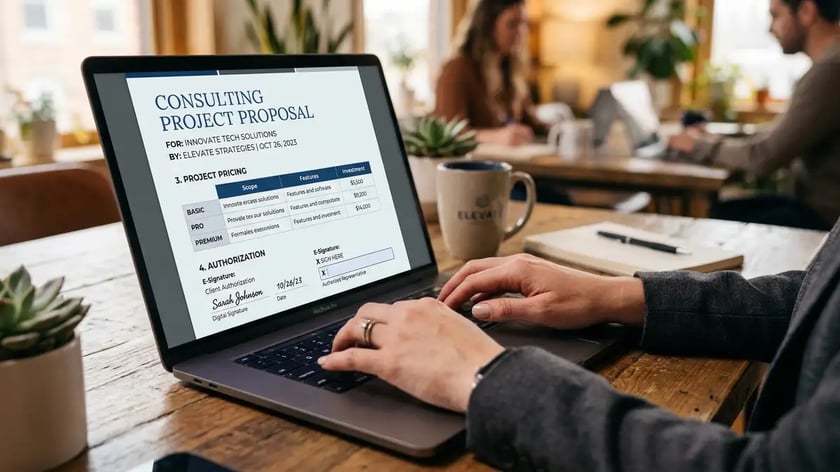
Start with an audit of your current proposal process. How many templates do you maintain? Who owns approvals? What's your standard revision cycle? What integrations are critical? This diagnostic phase typically takes 1–2 weeks and should involve sales ops, legal, and finance.
Next, architect your template library. Not every deal needs the same structure. Map your offerings, deal sizes, and use cases to distinct templates. A standard solution template might cover 80% of deals; premium or custom solutions get their own. Build 5–8 core templates before launch. You can add more later; starting with too many breeds confusion and underutilization.
Then integrate with your CRM. Work with your IT and CRM admin teams to map fields: opportunity name, prospect company, deal size, close date, solution type. Test the data flow. A broken integration is an adoption killer.
Run a pilot with a subset of your sales team—typically your top 20% performers and your skeptics, so you get feedback from both angles. A 4–6 week pilot reveals workflow friction, training gaps, and objections before full rollout.
Finally, measure adoption and iterate. Track proposal creation rates, approval turnaround, close rates, and rep sentiment. Identify laggards and remove friction through training, process adjustments, or template refinement.
Audit Your Current Process
Map templates, approval workflows, revision cycles, and integration touchpoints. Involve sales ops, legal, and finance to identify bottlenecks and non-negotiable requirements.
Architect Your Template Library
Build 5–8 core templates aligned to your offerings and deal types. Prioritize breadth over depth; you'll refine after launch based on real usage patterns.
Integrate with Your CRM
Map data fields, test API connectivity, and validate that prospect and opportunity data flows cleanly into your proposal tool. A broken integration derails adoption immediately.
Run a Pilot Program
Test with 3–5 top performers plus 2–3 skeptics over 4–6 weeks. Gather feedback, refine templates, and build a success narrative before company-wide rollout.
Launch, Measure, and Iterate
Track adoption rates, proposal creation velocity, close rates, and rep feedback. Address friction points monthly for the first quarter, then quarterly.
Avoid This Mistake
Building 50+ templates at launch. Teams often try to template every variant, solution, and edge case. Result: analysis paralysis, outdated templates, and rep confusion. Start with 5–8 templates covering 80% of deals. Add templates only after proving adoption and validating demand. This approach cuts implementation time by 40% and increases usage by 3x.

One critical consideration: proposal automation doesn't work in isolation. It thrives when paired with broader sales automation architecture. Your proposal tool should feed data back to your CRM to trigger automated workflows: e-signature completion updates deal stage, proposal creation logs pipeline activity, close rate data informs sales coaching. This feedback loop is where proposal automation becomes a force multiplier for your entire revenue organization.
Also consider agentic workflows that can autonomously manage proposal lifecycle. An AI agent can monitor proposal open rates, flag stalled opportunities, trigger follow-up outreach, and recommend negotiation adjustments based on stakeholder engagement patterns. This is emerging territory, but it's where the category is headed.
How Does Proposal Speed Affect Win Rates?
One of the most underestimated variables in B2B sales is deal velocity. There's a direct, measurable correlation between how fast you deliver a proposal and whether you close the deal.
Data from Outreach shows that deals closing in under 50 days have a 47% win rate, while deals extending beyond 50 days drop to 20%—a 2.35x differential. The longer a prospect sits with your proposal, the more their priorities shift, competitors surface, or internal consensus fractures.
E-signature integration amplifies this effect. Proposals with e-signature capability close 4x faster (median 10 days vs. 40 days) and are 4x more likely to convert. Why? Friction drops. Your prospect doesn't need to print, scan, route through legal, and send back via email. They sign in-app, in seconds, from any device. This frictionless path to signature is a category-level advantage.
Consider also the psychology of velocity. When a rep responds to an RFP in 24 hours with a personalized, accurate, professionally designed proposal, the prospect infers competence and responsiveness. Conversely, a 5-day turnaround signals bureaucracy and low priority. Automation lets you be fast and precise simultaneously.
| Deal Cycle | Win Rate | Average Close Time | E-Signature Impact |
| <30 days | 52% | 18 days | 4x faster, 4x higher conversion |
| 30–50 days | 47% | 38 days | 2x faster than manual |
| >50 days | 20% | 65+ days | Minimal impact (already stalled) |
Source: Outreach, Proposify
There's also the revision multiplier. Proposals requiring only one revision see a 37% higher close rate than unrevised proposals. Proposals with three or more revisions show 50% improvement over baseline—but they also miss 30% more deals because stakeholder consensus erodes during extended revision cycles. The sweet spot: zero revisions through AI-powered draft accuracy, or one revision maximum through rapid turnaround and stakeholder alignment upfront.
This is where client onboarding automation intersects with proposal workflow. Once a deal closes, automated onboarding—provisioning accounts, sending welcome sequences, scheduling kick-off calls—should fire immediately. The proposal isn't the end; it's the beginning of a relationship that must start with momentum.
Proposal speed is a competitive weapon that most organizations leave on the table. Pair proposal automation with AI workflow automation to create responsiveness that compounds over time.
Explore Sales Administration ServicesFrequently Asked Questions
What's the difference between proposal automation and proposal templates?
Templates are static documents; proposal automation is a process. A template might be a Word or PDF boilerplate that you manually customize. Proposal automation software pulls live data from your CRM, applies conditional logic to include or exclude sections based on deal attributes, manages version control and approvals, and enables e-signature—all without human intervention beyond initial review. It's the difference between a hammer and a nail gun. Both drive nails, but one transforms speed and consistency. B2B lead generation pipelines benefit dramatically from this automation because you can generate high-volume proposals without proportional labor cost.
Does proposal automation require IT involvement?
Yes, but minimally. You'll need IT support for CRM integration, data mapping, and security validation—typically a 1–2 week lift for a competent CRM admin. Most modern proposal tools offer native Salesforce and HubSpot connectors, eliminating custom API work. If you're on a niche CRM without API support, the conversation gets more complex. The key: include IT in your RFP and vendor evaluation process upfront, and don't commit to a tool without validating integration capability.
How do you prevent proposal templates from becoming outdated?
Assign ownership. Designate a sales ops lead or proposals manager as the template custodian. Run a quarterly review cycle (January, April, July, October) where you audit usage, gather rep feedback, validate pricing accuracy, and update boilerplate or compliance language. Use analytics to identify underutilized templates—if a template hasn't been used in 90 days, sunset it or refresh it. Most modern proposal software includes version control and usage analytics; leverage these tools to keep your library lean and current.
What happens to proposals when a deal is lost?
They become intelligence. Archive lost proposals and annotate them with the reason for loss. Over time, you'll see patterns: certain pricing points, solution bundlings, or messaging approaches correlate with higher loss rates. Use this data to refine templates and train reps. Better yet, use B2B lead nurturing automation to re-engage lost deals with refreshed messaging 6–12 months later. Circumstances change, and a lost deal from Q1 might become a win in Q4 if you've evolved your offering or their priorities have shifted.
How does proposal automation integrate with e-signature workflows?
Modern proposal software includes native e-signature integrations (DocuSign, Adobe Sign, or built-in tools). When a prospect views your proposal, they can sign directly within the document—no download, print, or manual routing required. The signature event triggers your CRM workflow: deal stage advances, internal stakeholders are notified, fulfillment workflows initiate. This frictionless path reduces deal cycle by 70% and accelerates cash collection. Pre-signed agreements—where certain sections are signed by your company before delivery—increase close rates by 33% because they signal commitment and reduce prospect friction.
Can proposal automation work for complex or custom deals?
Absolutely, but with discipline. Build templates that accommodate your highest-complexity use cases, then use conditional logic to strip away irrelevant sections for simpler deals. A $10M enterprise deal might involve 40 pages and 15 approval stakeholders; your template should accommodate this. A $50K mid-market deal uses the same template, but conditional logic hides custom SLA sections, enterprise-only pricing, and multi-year terms. You end up with one flexible template serving multiple use cases, rather than spawning custom proposals for every edge case. This approach cuts template management overhead by 60% while maintaining deal-specific accuracy.
What metrics should you track to measure proposal automation success?
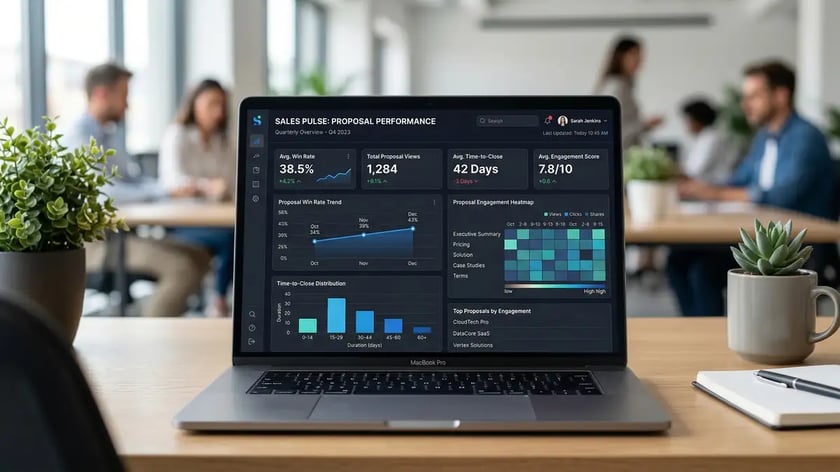
Track three categories: efficiency, quality, and outcome. Efficiency: proposals created per rep per month, average creation time, approval turnaround. Quality: proposal accuracy (flagged errors), revision cycles, e-signature completion rates. Outcome: close rate, deal cycle time, contract value, time-to-revenue. Use CRM automation to surface these metrics in your sales dashboard. Most importantly: compare pre- and post-implementation. If close rates don't improve by at least 20% in quarter one, or if reps aren't using the tool, you have a training or process problem that requires immediate attention.
Why do proposals fail to close even with automation?
The most common culprit is misalignment between your proposal and the prospect's actual buying committee. You might generate a beautiful, fast proposal addressing the stated needs of the procurement team, but the CTO has unstated concerns about integration, or the CFO is skeptical about ROI. Automation fixes the mechanics—speed, accuracy, professionalism—but not the diagnosis. Pair proposal automation with AI-driven deal analysis to surface stakeholder concerns and objections before you write the proposal. This is where strategic selling meets operational efficiency.
How do you handle proposal customization without losing automation benefits?
Use tiered templates. Tier 1 (80% of deals): fully automated, zero customization. Tier 2 (15% of deals): auto-populated base content with one review-and-edit cycle. Tier 3 (5% of deals): custom narrative sections, but boilerplate sections auto-populate. This approach keeps labor cost low while accommodating complex deals. Track which deals require customization and which land in Tier 1; over time, your Tier 1 percentage should climb as templates improve and you better qualify opportunities upfront.
What's the relationship between proposal automation and sales productivity?
Proposal automation is a multiplier on cold email outreach and lead nurturing velocity. If a rep spends 50% of their time on proposal creation, they have 50% available for prospecting, discovery, and relationship-building. Free them from proposals, and they can work more opportunities, deeper relationships, and stronger qualification conversations. But here's the catch: reps must redirect that time to higher-leverage activities. If you automate proposal creation and they use the freed time for emails and admin, you've optimized a low-impact activity. Pair proposal automation with rep coaching and activity tracking to ensure the productivity gains translate to revenue.
Ready to Transform Your Proposal Velocity?
Proposal automation isn't a project—it's a business transformation. From eliminating manual work to accelerating deal cycles and improving win rates, the compounding impact is significant. Our Sales Administration practice specializes in architecting proposal workflows that integrate with your entire revenue stack, ensuring adoption, adoption, and measurable ROI from day one.
Explore Sales Administration ServicesResources
- Proposify — Proposal software with e-signature integration and close rate benchmarking
- PipelineDeals — Proposal templates and CRM integration for small business
- Global Market Insights — Intelligent Proposal Automation market forecast 2024–2034
- Monograph — Project and proposal management for architecture and engineering firms
- Outreach — Deal intelligence and deal velocity analytics for sales teams
- PandaDoc — Document automation and e-signature platform
- Responsive — Project proposal automation for professional services
- HubSpot Content Hub — CMS platform for integrating proposals with marketing and sales workflows
dynamic pricing in B2B proposals
human-in-the-loop approval gates Grand Slam Offer framework for B2B services
AI across professional services delivery the tools that actually save time