

What Is an AI Sales Agency — and Why Does Every B2B Company Need One?
The term AI sales agency has exploded into B2B vocabulary, but most search results treat it as a synonym for "list of AI sales tools." That misses the point entirely. An AI sales agency is not a tool vendor. It is a strategic partner that audits your sales infrastructure, architects an integrated AI operating model, deploys autonomous agents across your pipeline, and optimizes continuously — so your revenue scales without proportional headcount growth. what an AI consultant does
The distinction matters because the market is moving fast. The global AI sales agent market is projected to grow from $4.27 billion in 2025 to $24.32 billion by 2034, according to Fortune Business Insights. Gartner predicts that 40% of enterprise applications will feature task-specific AI agents by the end of 2026, up from less than 5% in 2025 — an eightfold increase in a single year (Gartner). Yet 70-85% of AI projects still fail to deliver expected ROI — and the primary reason is not the technology. It is the absence of strategic architecture around it.
That gap between tool availability and successful implementation is exactly where an AI sales agency operates. Where a tool vendor gives you software, an AI sales agency gives you the sales automation architecture that makes the software produce measurable results.
What you will learn in this article:
- The precise definition of an AI sales agency and how it differs from AI tools, consultants, and in-house teams
- What an AI agency actually does across the five stages of B2B sales
- Hard ROI data: cost comparisons, pipeline impact, and cycle compression metrics
- Why DIY AI sales implementations fail at alarming rates — and the architectural fix
- How to evaluate whether your business needs an AI sales agency
Key Takeaway
An AI sales agency is not a tool. It is an operating system architect that integrates autonomous agents across your entire sales pipeline — from lead intelligence through close. The companies winning with AI in sales are not those buying the best tools; they are those building the best agentic workflows around them.

How Does an AI Sales Agent Actually Work Inside a B2B Pipeline?

An AI sales agent is an autonomous software system that executes specific sales tasks without human intervention — lead scoring, email sequencing, meeting scheduling conversation intelligence and meeting extraction, CRM updates, and deal health monitoring. Unlike traditional sales tools that require manual input at every step, AI agents observe, decide, and act based on data patterns and predefined logic.
According to Salesforce's 2026 State of Sales report, 54% of sellers have already used AI agents, and nearly 9 in 10 plan to by 2027. The report also found that 85% of sales reps with agents say AI frees them to focus on higher-value work — the kind of strategic selling that actually closes deals.
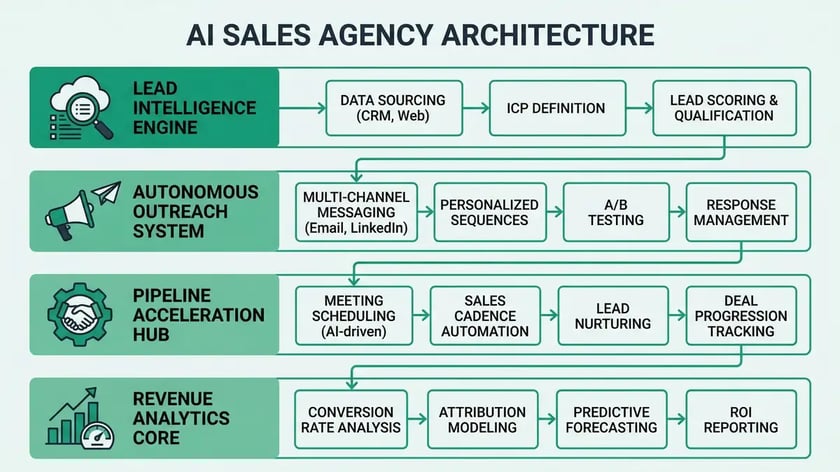
But here is the critical distinction: an individual AI sales agent handles one layer of your pipeline. An AI sales agency orchestrates multiple agents across every stage — creating a unified, autonomous sales operating system rather than a collection of disconnected point solutions. This is the difference between buying a CRM and building a CRM automation architecture.
Modern AI sales agents operate across five distinct tiers of capability, each building on the last:
| Capability Tier | What the Agent Does | Impact |
| Lead Intelligence | Predictive scoring, intent signal detection, ICP matching | 40-60% reduction in manual screening |
| Outreach Automation | Multi-channel sequencing (email, LinkedIn, calls), timing optimization | 25-40% higher response rates |
| Meeting Management | Autonomous scheduling, pre-meeting briefs, no-show reduction | 25-35% fewer no-shows |
| CRM Intelligence | Auto-updates, deal health scoring, next-best-action recommendations | 85-95% CRM hygiene vs 40-50% manual |
| Conversation Intelligence | Real-time call coaching, post-call insights, win/loss analysis | 20-30% improvement in call quality |
Sources: Salesforce Sales Statistics 2026, Cirrus Insight AI in Sales 2025
Key Takeaway
Individual AI agents handle single pipeline layers. An AI sales agency orchestrates all five tiers into one autonomous system — lead intelligence through conversation intelligence — creating compounding efficiency gains that isolated tools cannot achieve.
What Does the ROI Data Actually Show for AI Sales Automation?
The productivity impact is no longer theoretical. HubSpot's 2025 State of Sales found that sales professionals using AI daily are twice as likely to exceed their sales targets compared to non-users. Gartner's research goes further: sellers who effectively partner with AI tools are 3.7 times more likely to meet quota.
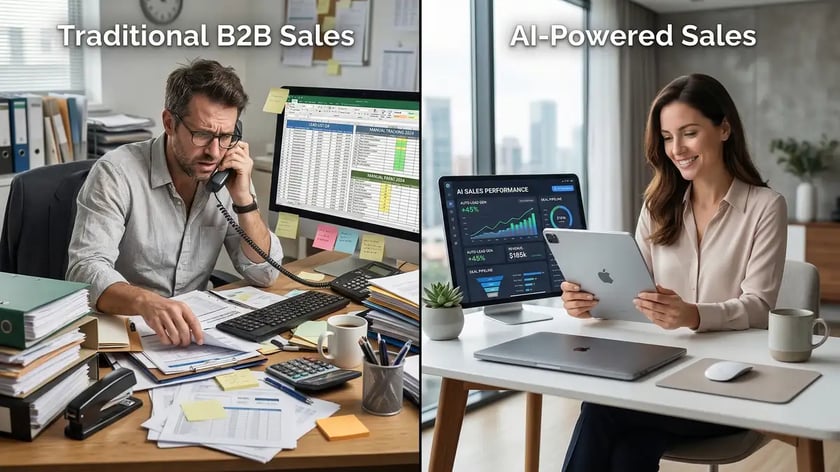
The time savings are equally measurable. Before AI implementation, the typical B2B sales rep spends 40-50% of their day on administrative tasks — CRM updates, email composition, scheduling, and data entry. After deploying an AI sales agent stack, admin time drops to 15-25%, while active selling time increases from 25-30% to 45-55%. That is not an incremental improvement. That is a fundamental restructuring of how sales capacity translates into revenue.
| Metric | Without AI | With AI Sales Agent | Improvement |
| Lead-to-opportunity conversion | 8-12% | 14-22% | +50-100% |
| Sales cycle length (SaaS SMB) | 35 days | 22 days | -37% |
| Pipeline forecast accuracy | 55-65% | 70-80% | +15pp |
| Rep quota attainment | 78% | 92% | +14pp |
| Cost per qualified lead | $40-80 | $15-35 | -56-63% |
| Win rate | 25-35% | 32-45% | +25-50% |
Sources: HubSpot State of Sales 2025, Salesforce State of Sales 2026, Cirrus Insight
These gains are not evenly distributed. According to McKinsey's B2B sales research, early adopters (deployed 12+ months) realize 20-35% revenue lift, while companies still in pilot stage show only 2-8% improvement. The gap is not about which tool they chose — it is about the operating model, data discipline, and strategy layer around the tool (McKinsey).
How Much Does an AI Sales Agent Cost Compared to a Human SDR?

The cost differential between human SDRs and AI sales agents is the most frequently cited justification for adoption — and the numbers are compelling. A fully-loaded human SDR costs $98,000 to $173,000 annually when you factor in base salary ($50-60K), variable commission ($20-30K), benefits and taxes (25-30%), management overhead ($10-25K in allocated manager time), training, and tech stack costs (SuperAGI).
An enterprise-grade AI SDR solution costs $15,000 to $35,000 annually — representing an 85% cost reduction per outreach function. At the lead level, AI SDRs average $39 per lead compared to $262 for human SDRs (SurFox). The ROI breakeven for AI SDR deployment averages 3.2 months compared to 8.7 months for a human SDR hire.
| Cost Component | Human SDR (Annual) | AI Sales Agent (Annual) |
| Base salary + commission | $70,000-$90,000 | — |
| Benefits & taxes (25-30%) | $15,000-$21,000 | — |
| Manager overhead | $10,000-$25,000 | — |
| Training (annual) | $2,000-$4,000 | — |
| Platform & tools | $3,000-$8,400 | $15,000-$35,000 |
| Implementation (one-time) | — | $0-$20,000 |
| Total fully-loaded | $98,000-$173,000 | $15,000-$35,000 |
Sources: SuperAGI Cost Analysis 2025, SurFox ROI Comparison 2026
The Replacement Trap
Cost savings alone do not justify full SDR replacement. Real-world experiments show human SDRs still generate 2.6x more revenue and achieve a 71% meeting show rate versus 52% for AI (UserGems). The winning model is hybrid: companies using AI to augment human SDRs see 2.8x more pipeline than those attempting full replacement (Leads at Scale). An AI sales agency designs this hybrid architecture — deploying agents for volume while preserving human expertise for high-value interactions.
Ready to architect your AI-powered sales operating system? peppereffect installs autonomous sales administration systems that decouple revenue from headcount — with measurable ROI from week one.
Book Your Sales Architecture AssessmentWhy Do 70% of DIY AI Sales Implementations Fail?
If the tools are available and the ROI data is clear, why do the majority of AI sales implementations underperform? An MIT report published by Fortune found that 95% of generative AI pilots at companies are failing. More specifically, 42% of companies now abandon the majority of their AI initiatives before reaching production — a dramatic increase from 17% the previous year.
The failure is not technological. It is architectural. Here are the root causes, ranked by prevalence:
Poor Data Quality (58% of organizations)
Years of manual CRM entry have created data foundations that AI amplifies rather than fixes. Without a pre-implementation audit and data remediation, AI agents cannot score or segment effectively — producing garbage outputs at machine speed.
No Strategic Intent (52% of organizations)
Tools deployed reactively — because a competitor did, or a vendor ran a compelling demo — without clear hypotheses about which pipeline stage to fix first. The result is expensive shelfware.
Integration Architecture Debt (45%)
AI tools that cannot communicate with the existing CRM, workflow orchestration platform, or marketing stack create manual data bridges that negate the automation promise. Fragmented tech stacks kill agentic value.
Tool Sprawl (44%)
Reps use only one of three purchased tools. Learning curves stack, and without a vendor consolidation strategy, the sales team's cognitive load increases rather than decreases.
No Ongoing Optimization (42%)
Deployed and abandoned. No tuning of models, workflows, or prompts. AI systems require continuous optimization — exactly what an automated fulfillment system provides as an operating principle.
Gartner's own prediction reinforces this: over 40% of agentic AI projects will be canceled by the end of 2027 due to escalating costs, unclear business value, or inadequate risk controls (Gartner). The problem is not the technology — it is the absence of a strategic implementation partner.
What Makes an AI Sales Agency Different from Tools, Consultants, and In-House Teams?
The market offers four approaches to AI-powered sales: buy tools directly, hire a traditional consultant, build an in-house team, or engage an AI sales agency. Each serves different maturity levels and produces different outcomes.
| Dimension | Tool Vendor | Sales Consultant | AI Sales Agency | In-House Team |
| Speed-to-value | 3-6 months | 2-4 months | 4-8 weeks | 3-9 months |
| Ongoing optimization | Vendor roadmap (generic) | Project-based (ends) | Continuous retainer | Reactive, under-resourced |
| Integration architecture | Own APIs only | Multi-vendor coordination | Multi-vendor orchestration | Ad-hoc, technical debt |
| Custom model tuning | Limited | Not typical | Deep customization | Rarely done |
| Monthly cost | $500-$10K | $50-150K project | $3-15K retainer | $80-150K/yr headcount |
| User adoption support | Self-serve docs | Training workshops | Structured rollout + coaching | Limited unless well-staffed |
Sources: Salesmate AI Agent Adoption Statistics 2026, McKinsey Gen AI in B2B Sales
The core differentiator is the operating model. A tool vendor sells software. A consultant delivers a strategy deck and leaves. An in-house team is constrained by its own expertise ceiling. An AI sales agency operates as a continuous optimization engine — it audits, designs, deploys, and iterates. The research supports this: companies deploying AI through a structured agency model achieve 3-5x faster time-to-value and 40-60% higher sustained ROI compared to DIY approaches.
Key Takeaway
The difference between companies realizing 20%+ ROI versus less than 5% is not the tool — it is the operating model, data discipline, and strategy layer around the tool. An AI sales agency provides all three as a managed service, closing the implementation gap that causes 70-85% of DIY projects to fail.
How Should B2B Companies Evaluate Whether They Need an AI Sales Agency?
Not every B2B company needs an external AI sales agency. Early-stage startups with fewer than 10 sales reps may be able to manage a single AI tool themselves. But for companies in the $5M-$200M revenue range with 15-200 sales reps, the complexity of multi-tool integration, data governance, and change management almost always exceeds internal capacity.
Salesforce reports that 53% of organizations cite poor data quality as the top barrier to agentic AI adoption (Salesforce 2026). That single statistic reveals why agency expertise matters: data remediation is not a one-time project but an ongoing discipline that requires external accountability.
Consider engaging an AI sales agency when your organization exhibits three or more of these signals: your B2B lead generation relies on manual processes, your CRM data quality is inconsistent, your sales cycle exceeds industry benchmarks by 20%+, your reps spend more time on admin than selling, your tech stack has 3+ disconnected tools, or you have tried and failed to implement AI sales tools independently.
For SaaS companies specifically, the benchmark is clear: AI-enabled sales teams compress SMB sales cycles from 35 days to 22 days and lift SQL-to-customer conversion rates from 12-15% to 22-28%. If your metrics trail these benchmarks, an AI sales agency can close the gap systematically — through cold email outreach automation, LinkedIn lead generation systems, and proposal automation.
For executive search firms, the impact is even more pronounced: AI sourcing automation reduces cost-per-placement from $4-8K to $2-3.5K and compresses time-to-placement from 22 days to 12 days. The recruiting vertical shows the strongest ROI because AI directly addresses the sourcing bottleneck that caps firm growth.
Frequently Asked Questions
What is an AI sales agency?
An AI sales agency is a strategic B2B service provider that audits your existing sales infrastructure, designs a custom AI-powered operating model, deploys and integrates autonomous sales agents across your pipeline, and provides ongoing optimization. Unlike tool vendors that sell software or consultants that deliver strategy decks, an AI sales agency operates as a continuous implementation and optimization partner — managing the entire lifecycle from data remediation through workflow orchestration to sales automation performance monitoring.
How does an AI sales agent differ from traditional sales tools?
Traditional sales tools require manual input at every step — a rep must trigger actions, update records, and make decisions. An AI sales agent observes data patterns, makes autonomous decisions, and executes actions without human intervention. For example, an AI agent can score inbound leads, personalize outreach sequences, schedule meetings, update CRM records, and flag at-risk deals — all while the human rep focuses on the high-value conversations that require empathy, negotiation, and relationship building.
How much does an AI sales agency cost?
Most AI sales agencies operate on monthly retainers ranging from $3,000 to $15,000, depending on scope and company size. This compares favorably to in-house alternatives: a dedicated sales ops hire costs $80,000-$150,000 annually, plus management overhead, and consultant projects typically run $50,000-$150,000 as one-time engagements. The agency model provides continuous optimization at a fraction of in-house cost, with typical ROI breakeven achieved within 2-4 months of engagement.
Can AI sales agents replace human sales reps?
The evidence says no — and attempting full replacement actually reduces revenue. Real-world experiments show human SDRs generate 2.6x more revenue and achieve 71% meeting show rates compared to AI's 52%. However, the hybrid model is transformative: companies using AI to augment rather than replace human SDRs see 2.8x more pipeline than replacement-only approaches. Gartner predicts AI agents will outnumber sellers 10x by 2028, but they will function as agentic workflow assistants, not replacements.
What ROI should B2B companies expect from AI sales automation?
McKinsey research shows early adopters (deployed 12+ months) realize 20-35% revenue lift, while pilot-stage companies show only 2-8%. Specific metrics include: 50-100% improvement in lead-to-opportunity conversion, 25-37% reduction in sales cycle length, 14 percentage point improvement in quota attainment, and 56-63% reduction in cost per qualified lead. The critical variable is not which tool you deploy — it is whether you have the strategic lead nurturing and optimization architecture to sustain those gains.
Why do most AI sales implementations fail?
MIT research found that 95% of generative AI pilots fail, and Gartner predicts 40%+ of agentic AI projects will be canceled by end 2027. The root causes are architectural, not technological: poor CRM data quality (58% of organizations), no strategic intent (52%), integration debt with existing tech stacks (45%), tool sprawl (44%), and no ongoing optimization (42%). An AI sales agency directly addresses each failure mode through pre-deployment audits, structured onboarding, integration orchestration, and continuous performance monitoring.
How long does it take to see results from an AI sales agency?
With agency-backed implementation, companies typically see first qualified leads within 4-8 weeks and material revenue lift within 3-4 months. This compares to 3-9 months for DIY implementations, with the critical difference being sustained performance: agency-managed deployments achieve 70-90% of expected outcomes, while poorly executed DIY approaches typically deliver less than 50% of projected ROI. The acceleration comes from proven integration playbooks, pre-built workflow templates, and data governance frameworks that eliminate the trial-and-error cycle.
Install Your AI Sales Operating System
peppereffect architects autonomous sales systems that decouple revenue from headcount. From lead intelligence through close, we deploy the AI agents, integration architecture, and optimization workflows that turn your pipeline into a Freedom Machine.
Book Your Growth Architecture CallResources
- Fortune Business Insights — AI SDR Market Size, Share & Trends Report 2025-2034
- Salesforce — State of Sales Report 2026: AI Adoption and Agent Usage
- HubSpot — 2025 State of Sales Report: AI Productivity and Adoption Data
- Gartner — 40% of Enterprise Apps Will Feature AI Agents by 2026
- McKinsey — Unlocking Profitable B2B Growth Through Gen AI
- Fortune — MIT Report: 95% of Generative AI Pilots at Companies Are Failing
- SuperAGI — AI vs Human SDRs: Comparative Cost and Productivity Analysis 2025
- Gartner — By 2028 AI Agents Will Outnumber Sellers by 10x
automation agency infrastructure
AI consulting versus traditional agencies