

An automated fulfillment system uses technology to handle service delivery tasks — order process automating your core business processesing, resource allocation, client communication, and quality verification — without requiring proportional increases in staff. For B2B service business automating core business processeses, this means scaling from 20 to 200 clients Scaling Up methodology while your operations team stays lean. The intelligent process automation market reached USD 14.55 billion in 2024 and is projected to hit USD 44.74 billion by 2030, reflecting how seriously organisations are investing in delivery automation. automating service delivery document-heavy operations
This guide covers the complete landscape: what automated fulfillment actually looks like for service businesses, how to build a system that scales, the ROI you can realistically expect, and the implementation framework that separates successful deployments from expensive failures.

What Is Automated Fulfillment for B2B Service Delivery?
When most people hear "automated fulfillment," they think of warehouse robots picking products off shelves. For B2B service businesses — agencies, consultancies, SaaS companies AI for SaaS companies, and professional services firms AI for professional services — fulfillment means something different. It is the entire chain of delivering what you promised: onboarding new clients, allocating resources, executing projects, tracking progress, invoicing, and managing ongoing communication.

Automated fulfillment for services replaces the manual handoffs and spreadsheet tracking that break down at scale. Instead of a project manager manually creating tasks, sending onboarding emails, updating status reports, and chasing approvals, an automated fulfillment system triggers each step based on the previous one completing. A signed contract automatically creates the project workspace, assigns team members based on skill and availability, sends the client their welcome sequence, and schedules the kickoff call — all without anyone touching a keyboard.
This distinction matters because B2B service fulfillment involves longer engagement cycles, complex pricing structures, and ongoing relationship management that product-based fulfillment does not. Nearly 46 percent of customer success professionals cite tracking tasks, owners, and deadlines as their biggest onboarding challenge, while 45 percent point to information asymmetry between teams. These are coordination problems that automation solves directly.
Key Distinction
Service delivery automation is not about replacing your team with robots. It is about eliminating the administrative overhead — status updates, data entry, handoff coordination — so your team spends 80 percent of their time on the billable, relationship-building work that actually drives revenue and retention.
Why Manual Fulfillment Breaks at Scale
Key Takeaway
Automated fulfillment is not a warehouse optimization project — it is a revenue infrastructure upgrade. Companies that connect order processing, inventory management, and shipping into a single automated system reduce fulfillment costs by 25–40% while improving delivery speed and customer satisfaction simultaneously.
Manual processes feel efficient when you are managing five clients. By twenty, the cracks appear. By fifty, operations consume more time than delivery itself. The failure pattern is predictable and well-documented across B2B service organisations.
The first breakdown is context switching. An organisation with 5,000 information workers can save over USD 3.1 million per year just by reducing context and application switching through better interoperability. Even at modest scale, a team member losing 15 minutes per hour to switching between project management, CRM, email, and spreadsheets is losing 25 percent of productive capacity.

The second breakdown is tribal knowledge. What starts as a few processes documented in shared drives turns into lost context between sales and delivery about what was actually promised, manual copy-paste work to update multiple systems, and a knowledge system that lives in people's heads rather than in repeatable workflows. When someone leaves or goes on holiday, critical process knowledge walks out the door with them.
The third breakdown is error multiplication. Each manual handoff introduces error potential. At five handoffs per client engagement with ten active clients, you have 50 potential failure points. At fifty clients, you have 250. Manual processes do not scale linearly — error rates compound because oversight becomes impossible at volume.
The Hidden Cost of "Good Enough" Processes
Organisations that attempt to automate broken processes consistently see disappointing returns. Research shows that 70 percent of automation failures trace to inadequate data governance data governance and AI controls and system connectivity rather than technology limitations. Fix your processes first, then automate what works.
The Five Components of an Automated Fulfillment System
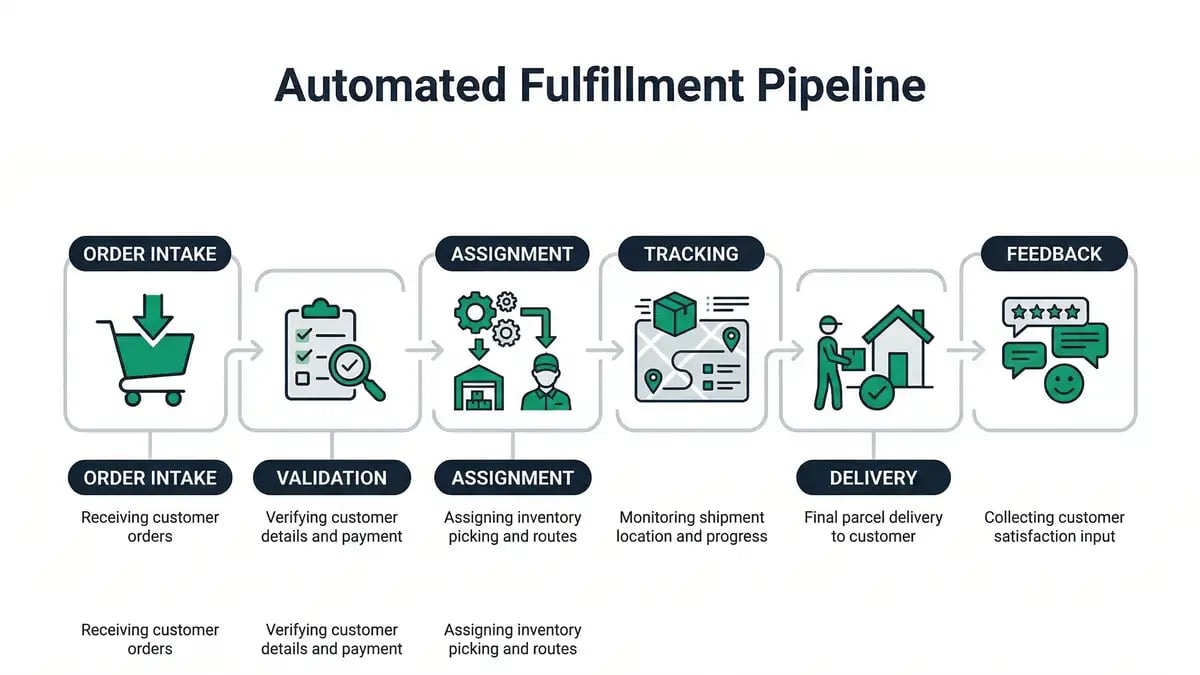
A complete automated fulfillment system for B2B services is built from five interconnected components. Each can be implemented independently, but the compounding value comes from connecting them into a unified pipeline.
1. Automated Intake and Onboarding
The moment a deal closes, the automated fulfillment system takes over. Contract signature triggers project creation, client welcome sequences, access provisioning, and kickoff scheduling. No one needs to remember to create a Slack channel or send the onboarding questionnaire — it happens automatically based on the engagement type and scope. This eliminates the "dead zone" between sales handoff and delivery kickoff where client enthusiasm dies and churn risk spikes.
2. Intelligent Resource Allocation
Rather than a manager scanning availability spreadsheets, AI-powered workflow automation analyses team capacity, skill matching, and workload balance to assign the right people to the right projects. Platforms like Epicflow use AI-based capacity planning to suggest optimum resource allocation across multiple projects, preventing burnout and bottlenecks while maximising billable utilisation. For a professional services firm, moving from 65 percent to 80 percent billable utilisation through better allocation represents a significant revenue increase without adding a single hire.
3. Workflow Orchestration and Task Routing
This is the engine room. Workflow orchestration tools connect your systems — CRM, project management, communication platforms, accounting software — and automate the data flow and task sequencing between them. When a project milestone completes, the system automatically updates the client, triggers the next phase, adjusts timelines, and flags any dependency risks. Modern platforms connect thousands of applications and can automate advanced workflows including exception handling and conditional logic, making what was previously a chain of manual tasks into a self-operating pipeline.
4. Automated Quality Verification
Automated processes can execute at superhuman speed and consistency, but they can also systematically amplify errors if poorly configured. Quality gates embedded within your fulfillment system catch problems before they reach clients. This includes automated deliverable checks against scope requirements, client satisfaction pulse surveys triggered at key milestones, and anomaly detection that flags when metrics deviate from expected ranges. The goal is not eliminating human review but focusing it on the exceptions that actually need judgment.
5. Automated Reporting and Client Communication
Status updates, progress reports, and performance dashboards generate and distribute themselves. Clients get real-time visibility into their engagement without your team spending hours assembling PowerPoint updates. CRM automation connects client communication history with project data, ensuring every touchpoint is informed and personalised. This component alone can recover 10 to 15 hours per project manager per week.
Pepper Effect Approach
We implement automated fulfillment systems using a phased methodology — starting with the highest-friction process (usually onboarding or reporting), proving ROI within 60 days, then systematically connecting additional components. This approach avoids the "big bang" failures that plague 50 percent of large-scale automation projects.
Avoid This Mistake
Automating fulfillment without first standardizing your data and process flows. The most common implementation failure is deploying automation on top of inconsistent SKU data, fragmented inventory records, and manual exception handling. Clean data first, automate second AI-generated executive summaries — organizations that skip this step report 3× higher implementation failure rates.
Implementation Framework: From Manual to Automated in Four Phases
The organisations that succeed with automated fulfillment follow a structured progression rather than attempting to automate everything at once. The Operational Maturity Model provides a proven framework for staging this transformation.
Audit and Document (Weeks 1–2)
Map every step in your current fulfillment process. Identify the manual handoffs, decision points, and data entry tasks that consume the most time. Conduct a data quality audit — this single factor determines whether automation will succeed or fail. Organisations with clean, consistent data across systems are significantly more likely to achieve positive automation outcomes.
Automate the Foundation (Weeks 3–6)
Start with out-of-the-box functionality rather than waiting for every integration integrated systems that share data. Connect your core systems — CRM, project management, and communication platform — with standard workflow automations. Focus on the three to five highest-volume, most repetitive tasks. This early deployment means your team starts gaining value while you plan deeper customisation.
Add Intelligence (Weeks 7–12)
Layer AI-powered decision-making onto your automated workflows. This includes intelligent task routing based on skills and capacity, predictive alerts for at-risk projects, and automated exception handling for common edge cases. Build human-in-the-loop checkpoints for decisions that require judgment — not every automation needs to be fully autonomous.
Optimise and Scale (Ongoing)
Use performance data from your automated systems to continuously refine. Track deployment frequency, lead time for changes, and error rates. High-maturity organisations deploy process improvements daily with lead times measured in hours rather than weeks. Each cycle makes your fulfillment system faster, more accurate, and more capable of handling volume without additional staff.
Ready to automate your fulfillment operations and reduce costs by 25–40%? See how peppereffect architects intelligent fulfillment systems.
View Operations ServicesCalculating ROI: What Automated Fulfillment Actually Saves
The return on automated fulfillment is quantifiable across multiple dimensions. Organisations implementing automation tools report an average return of USD 5.44 for every dollar spent, with 75 percent of organisations reporting payback within the first year of deployment.

| ROI Category | Typical Savings | How It Compounds |
| Labour cost reduction | 30–60% on automated tasks | Frees staff for billable work instead of admin |
| Error reduction | 75–90% fewer manual errors | Eliminates rework, chargebacks, and client complaints |
| Capacity expansion | 2–3x client volume per team member | Revenue grows without proportional hiring |
| Client retention | Up to 30% churn reduction | Consistent delivery builds long-term contracts |
| Faster delivery cycles | 40–60% shorter lead times | Competitive advantage and pricing power |
Sources: Moveworks, Grand View Research
For a concrete example, consider a B2B service firm with 20 employees spending an average of 12 hours per week each on administrative fulfillment tasks. At a fully-loaded cost of $50 per hour, that is $624,000 per year in non-billable overhead. An automated fulfillment system that eliminates 60 percent of that overhead saves $374,400 annually. Against a typical implementation investment of $80,000 to $150,000, the payback period is three to five months.
The calculation becomes even more compelling when you factor in sales automation integration. Connecting your sales pipeline directly to your fulfillment system eliminates the handoff gap, reduces time-to-value for new clients, and creates a seamless revenue engine from first contact through ongoing delivery.
Common Mistakes That Derail Automated Fulfillment Projects
Research shows that approximately 50 percent of automation implementation projects fail. The failure patterns are consistent and avoidable.
Automating broken processes. The most common and most expensive mistake. If your current process requires three people to manually reconcile data between two systems, automating that reconciliation without fixing the underlying data architecture just creates faster garbage. Always optimise the process before automating it.
Ignoring change management. Up to 70 percent of change programmes fail because of employee resistance. Teams that feel automation is being done to them rather than for them will find ways to work around the system. Successful implementations position automation as eliminating the parts of the job that people like least, while expanding their capacity for the work they find meaningful.
Over-automating too quickly. A manufacturing company invested USD 890,000 over 18 months in aggressive automation, initially achieving a 94 percent success rate. By month twelve, maintenance overhead consumed 67 hours per week, the success rate had dropped to 71 percent, and total costs including hidden infrastructure expenses reached USD 2.3 million with negative ROI. Start small, validate, then expand.
Neglecting the human-in-the-loop. Fully automated systems with zero human oversight create systematic blind spots. The most effective automated fulfillment systems maintain human checkpoints at high-impact decision points — such as client escalations, scope changes, and quality sign-offs — while automating everything else.
Ready to Build Your Automated Fulfillment System?
Pepper Effect designs and implements automated fulfillment pipelines for B2B service businesses. We start with an operations audit to identify your highest-impact automation opportunities.
Book Your Operations AuditFrequently Asked Questions About Automated Fulfillment
How much does an automated fulfillment system cost for a small B2B business coaching business automation framework?
Implementation costs typically range from $30,000 to $150,000 depending on complexity. SaaS-based platforms with monthly subscriptions have made automation accessible to businesses that cannot justify large capital expenditure. Most small B2B firms see payback within three to six months through labour savings and capacity expansion alone.
Can we automate fulfillment without replacing our existing tools?
Yes. Modern workflow automation platforms connect with thousands of existing applications through native integrations and APIs. The strategy is to orchestrate your current tools rather than replace them. Integration platforms act as middleware connecting your CRM, project management, accounting, and communication systems into a unified automated pipeline.
How do we maintain client relationships when delivery is automated?
The most successful agencies automate operational tasks — onboarding administration, status reporting, invoicing, and task routing — while preserving human engagement for strategy, creative problem-solving, and relationship building. Automation handles the repetitive coordination work, giving your team more time for the high-value interactions that clients actually care about.
What is the biggest risk with automated fulfillment?
Data quality. Seventy percent of automation failures trace to inadequate data governance and system connectivity. Before implementing automation, audit your data for completeness, consistency, and accuracy across systems. Organisations with clean data and well-documented processes achieve dramatically better outcomes than those attempting automation as a quick fix.
How does automated fulfillment differ from operations automation?
Operations automation is the broad category covering any business process improvement through technology. Automated fulfillment is a specific application focused on the delivery pipeline — everything that happens between a client saying "yes" and the work being completed, invoiced, and reviewed. Fulfillment automation is one component of a comprehensive operations automation strategy.
Resources
- Grand View Research — Intelligent Process Automation Market Size Report, 2030
- McKinsey — Agentic and Gen AI in Operations
- Moveworks — Enterprise Automation ROI Guide
- IBM — AI Agents: Expectations vs. Reality
Scale Your Delivery Without Scaling Your Team
Pepper Effect builds automated fulfillment systems that let B2B service businesses handle 3x the client volume with the same team. From operations audit through implementation, we design the pipeline that fits your delivery model.
Get Your Free Operations Auditscale service capacity without hiring
franchise prototype methodology
AI-powered business operations
consulting business model transition playbook deciding whether to automate or hire automate instead of outsourcing
systems architecture that scales a virtual assistant and automation stack systematized project delivery audit how your time is spent