

The recruiter's pipeline leak is the demand that AI answer engines intercept before it ever reaches your firm. Hiring leaders now ask ChatGPT "which retained search firms specialise in CFO hires" and act on a shortlist of three to five named firms. If you are not on it, you lose the mandate without ever knowing you were considered, and nothing in your analytics records the loss.
Every managing partner watches the metrics that are easy to count: placements, fees, time-to-fill. The leak nobody is measuring sits upstream of all of them, in the AI research a client or candidate does before a single conversation. As that research moves into answer engines, a growing share of your future mandates is being shortlisted, compared, and decided without your firm in the room. This is the recruiting edge of the traffic collapse, and for a boutique whose economics rest on a few high-value relationships, it is the most expensive leak you have.
Sources: G2, 2026; SparkToro, 2026.
How do clients now find and shortlist recruiters?

Increasingly, they ask an AI before they ask a colleague. G2's 2026 research found that 51% of B2B buyers now start their research with an AI chatbot more often than Google, up from 29% just eleven months earlier. Forrester reports that 89% of B2B buyers use generative AI somewhere in their purchase, and Gartner finds buyers now consult an average of seven sources, with AI doing much of the early shortlisting. The behaviour is the same whether the purchase is enterprise software or a retained search partner: the buyer forms a mental model from the AI's answer before visiting a single website.
The consequences for shortlist formation are stark. In the G2 data, 69% of buyers chose a different vendor than they had originally planned based on chatbot guidance, and 33% bought from a vendor they had never previously heard of. AI does not just confirm the firms a client already knows; it introduces new ones and quietly drops others. For a hiring executive typing "best boutique headhunters for a VP Sales role in B2B SaaS," the answer that comes back is now the consideration set, and being absent from it means never reaching the pitch.
What is the pipeline leak, and why does no one measure it?
The leak is the gap between the demand for your services and the demand that actually reaches you, opened up by AI answering on your behalf. It goes unmeasured because it leaves no trace. SparkToro found that 68% of Google searches now end without a click, and Pew found that when an AI summary appears, users click a normal result only 8% of the time, versus 15% without, and click a link inside the AI box just 1% of the time. A hiring leader can read an AI's summary of how retained search works, absorb a shortlist of firms, and act on it, all without a session ever landing in your analytics.
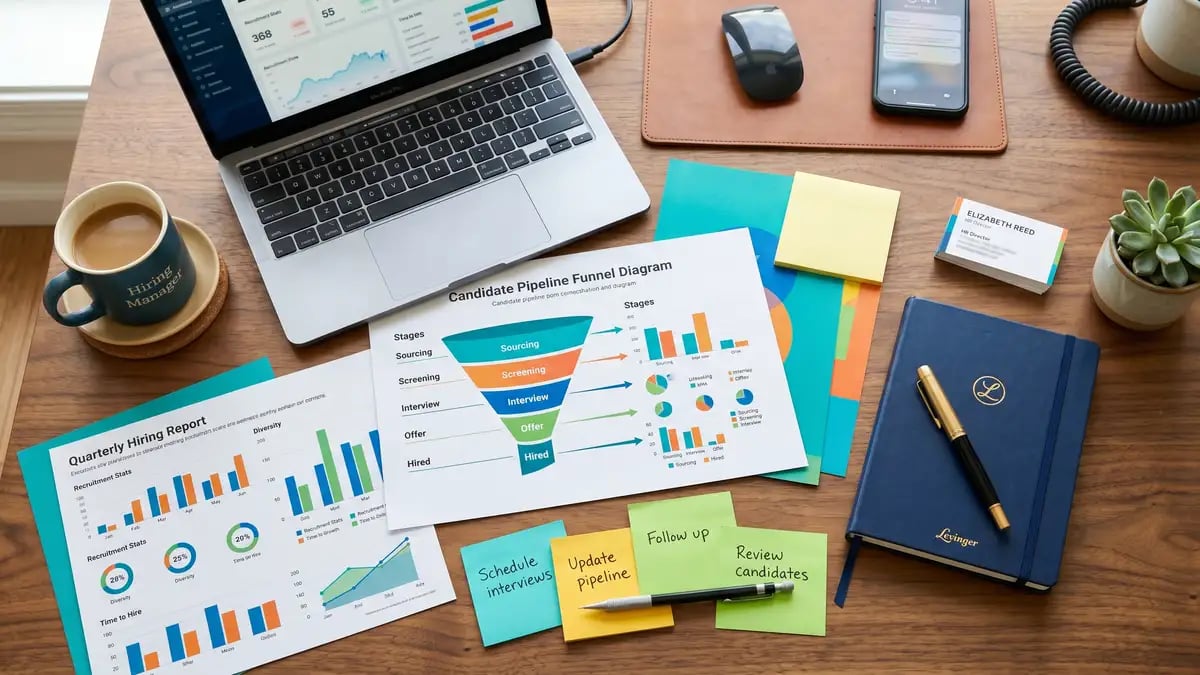
That is why the leak hides. Your website traffic can look stable while the demand behind it quietly reroutes through AI. It is the same decoupling that drives whether AI is eating your traffic, applied to a service where a single missed relationship is worth far more than a single missed click. You cannot fix a leak you cannot see, which is why the first move is to measure your presence in the answers themselves.
Key Takeaway
Your placement numbers measure the deals that reached you. They cannot measure the mandates an AI shortlist quietly sent elsewhere. For a boutique firm, the invisible loss at the top of the funnel is the one that caps growth.

Do candidates use AI to find recruiters too?
Yes, and the leak runs on both sides of your business. iHire's 2025 survey found that 40.7% of job seekers have used AI tools like ChatGPT, Perplexity, or Gemini in their search, with 11.6% using them specifically to research potential employers. The platforms candidates live on are becoming AI-mediated too: LinkedIn now offers conversational AI job search and a People Search that surfaces relevant connections by intent rather than keyword, changing how senior candidates navigate toward firms and opportunities.
For an executive search firm, this matters because your reputation with candidates is your product. If a sought-after candidate asks an AI which recruiters lead in their function and your firm is not named, you lose access to the very talent your clients pay you to reach. The "Top 5%" positioning that justifies your fees has to exist in the AI's answer, not just in your own marketing, or it does not protect you where the decision now starts.
How do AI engines decide which recruiters to recommend?

They assemble the answer from the sources they trust across the web, not from your site alone. As covered in our piece on how LLMs decide what to cite, answer engines lean heavily on authoritative and community sources. Pew found that Wikipedia, YouTube, and Reddit alone make up 15% of cited sources, and RAB2B reports that over 93% of links in Google AI Overviews come from outside the top ten organic results. For recruiting specifically, the signals that matter are your partners' LinkedIn presence and thought leadership, your reviews on directories like Clutch and Google, your coverage in trade and business press, and clear, structured content about your specialisms, process, and fees.

This reframes marketing for a search firm. The work that gets you named by AI is not generic SEO; it is being widely and consistently discussed across the surfaces these models read. That is the practical meaning of Share of Model, the metric that measures how often the engines name you in your category. A boutique firm with deep niche authority can win here precisely because AI rewards specificity: being the obviously cited expert for "fintech CFO search in Europe" beats being a faint generalist for "executive search."
Want to see whether AI names your firm when clients ask for recruiters in your niche?
Run the free AI Visibility CheckWhy is this leak so expensive for a boutique search firm?
Because your revenue rests on a small number of high-value relationships, so each one lost upstream is disproportionately costly. Cowen Partners notes that retained executive search fees typically run 30 to 35% of first-year salary, with contingency around 20 to 30%. A single retained C-suite mandate can be worth tens of thousands to hundreds of thousands in fees. A SaaS company can lose a few low-value clicks and barely notice; a search firm that drops off three AI shortlists a quarter can lose a material share of its pipeline without a single line in a report to explain why.
The leak also compounds an existing constraint. Recruiters already spend the bulk of their time on manual sourcing and filtering, and SelectPrism reports that while 86% of recruiters say AI makes hiring faster, 70% of firms have not adopted it. So the firm loses inbound at the top of the funnel to AI invisibility while its capacity to convert what remains is throttled by manual work. Fix only one and the other still caps growth. This is the recruiting version of the problem B2B SaaS firms face with AI visibility: the cheapest source of qualified demand is being routed to whoever the model names.
Watch Out
Do not assume your reputation protects you. AI does not weigh decades of relationships; it weighs what it can read across the web right now. A respected firm with a thin digital footprint can be invisible to the model while a younger, louder competitor is named in its place.
How do search firms fix the leak?
You make your firm the one the model names, then make sure you have the capacity to convert the demand it returns. The two have to move together.
Measure your Share of Model first
Run the prompts your clients and candidates actually ask across ChatGPT, Perplexity, and Gemini, and record where you are named and where a competitor is. You cannot fix a leak you have not located.
Build authority on the sources AI reads
Invest in partner-led LinkedIn thought leadership, reviews on directories, and trade-press coverage. AI names firms it sees discussed widely, not firms with the quietest, most polished site.
Publish answer-first content on your niche
State clearly, in extractable form, the sectors and roles you own, how your retained process works, and your fee model. Give the model clean, accurate passages to quote about your specialism.
Win the niche, not the category
You will not outrank the global firms for "executive search." You can own "climate-tech VP Engineering search," where specificity makes you the obvious, citable answer.
Automate sourcing so capacity is not the cap
Reclaim the time lost to manual filtering so that when AI visibility returns inbound to the top of the funnel, your consultants can convert it into placements rather than drowning in it.
Run as a connected system rather than scattered tactics, this is the recruiting application of answer engine optimization and the shift from SEO to AEO. The goal is not vanity visibility but a defensible position in the answers your clients and candidates trust, backed by the capacity to act on the mandates it brings back.
Find out if AI is sending your mandates to a competitor
The leak is invisible until you measure it. The free AI Visibility Check shows whether ChatGPT, Perplexity, and Google name your firm when clients and candidates ask for recruiters in your niche, where competitors are being named instead, and what to build to win the shortlist.
Run the free AI Visibility CheckFrequently asked questions about AI search for recruiters
How do clients use AI to find recruiters?
They ask AI chatbots category questions like "best retained search firms for CFO roles" and receive a shortlist of three to five named firms before contacting anyone. G2 found 51% of B2B buyers now start research with an AI chatbot more than Google, and 33% bought from a vendor they had never heard of, on AI's recommendation.
What is the recruiter's pipeline leak?
It is the demand for your services that AI answer engines intercept and shortlist before it reaches your firm. Because users rarely click through from AI answers, the loss leaves no trace in your website analytics, so you lose mandates without ever knowing you were considered.
Do candidates use AI to research recruiters and jobs?
Yes. iHire found 40.7% of job seekers have used AI tools in their search, including to research employers, and platforms like LinkedIn now offer conversational AI job search. If AI does not name your firm to candidates, you lose access to the talent your clients pay you to reach.
How do AI engines decide which recruiting firms to recommend?
They draw on the sources they trust across the web: partner LinkedIn presence and thought leadership, reviews on directories, trade-press coverage, and clear content about your specialisms. Over 93% of AI Overview links come from outside the top ten organic results, so wide brand presence matters more than narrow SEO.
Why does AI invisibility cost search firms more than other businesses?
Because their revenue depends on a small number of high-value mandates. With retained fees at 30 to 35% of first-year salary, a single missed C-suite relationship is worth tens of thousands. Losing a few AI shortlists a quarter can erase a material share of pipeline with no visible cause.
How can a search firm improve its AI visibility?
Measure your Share of Model on the prompts clients and candidates ask, build authority on the sources AI reads, publish answer-first content on your niche, focus on a specific specialism rather than the broad category, and automate sourcing so capacity can convert the inbound. Start with a free AI Visibility Check.
Search and advisory firms sit inside the wider professional services category, and the cross-sector numbers are in our playbook on answer engine optimization for B2B service firms.
Resources
- G2: Half of B2B buyers now start research with AI chatbots (2026)
- Forrester: The future of B2B buying will come slowly and then all at once
- SparkToro: Less than one third of Google searches still send a click (2026)
- Pew Research Center: Do people click links in Google AI summaries? (2025)
- iHire: 40.7% of candidates have used AI in their job search (2025)
- Cowen Partners: Executive search firm fee structures
- SelectPrism: AI recruitment adoption statistics
AI visibility for coaches and consultants automate sourcing and screening