

What Is Coaching Business Automation process automation for expert-led firms — and Why Does Every Seven-Figure Coach Need It?
Coaching business automation is the systematic deployment of technology, workflows, and autonomous agents to handle the operational functions of a coaching practice — scheduling, onboarding, content delivery content repurposing system, lead nurturing, payment processing, and fulfillment — without requiring the founder's direct involvement. It is the architectural shift that separates six-figure practitioners trapped in the Technician's Trap from seven-figure founders who have built what we call a Freedom Machine.
The coaching industry generated $5.34 billion in global revenue during 2025, according to the International Coaching Federation's 2025 Global Coaching Study, with 122,974 certified practitioners operating worldwide — a 15% increase from 2023. The online coaching segment alone is projected to reach $11.7 billion by 2032, growing at a 14% compound annual growth rate, according to Luisa Zhou's market analysis. Yet despite this explosive growth, most coaching founders remain operationally stuck: spending 36% of every working week on administrative tasks that generate zero coaching revenue, according to McKinsey productivity research cited by Business Coach VAs.
The question is no longer whether to automate your coaching business. The question is how fast you can architect the systems that decouple your revenue from your personal calendar.
What you'll learn in this article:
- Why most coaching founders hit a revenue ceiling — and how to break through it architecturally
- The five operational systems every coaching business should automate first
- How one mindset coach grew revenue 84% while reclaiming 30+ hours per week
- The role of agentic AI workflows in building a coaching Freedom Machine
- A step-by-step implementation sequence from founder-dependent to autonomous
Key Takeaway
Coaching business automation is not about replacing the coach. It is about eliminating the 36% of every week consumed by admin, scheduling, onboarding, and fulfillment — so the founder can focus exclusively on coaching, strategy, and scaling one-page strategic plan for scaling. The result: seven-figure revenue with less than 10 hours per week of personal involvement.
Why Do Most Coaching Businesses Hit a Revenue Ceiling?
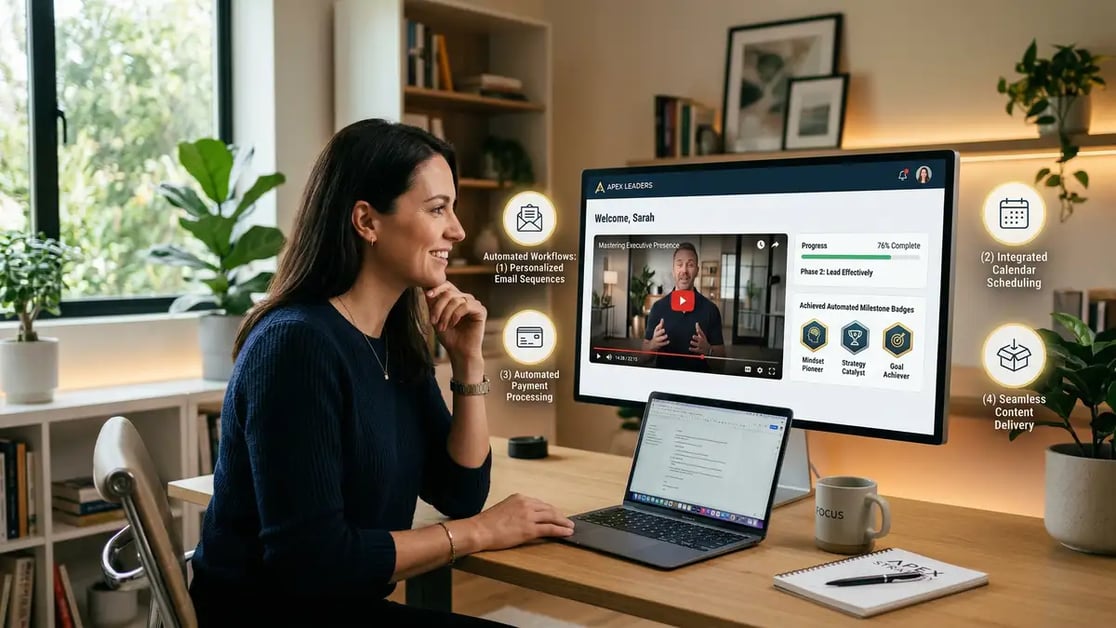
The coaching industry has a structural problem that no amount of marketing can solve. CEO Coaching International calls it the "founder's bottleneck" — a condition where the company's growth potential gets squeezed by the founder's personal capacity, decision-making bandwidth, and unwillingness to relinquish control over critical functions. In coaching, this bottleneck is particularly acute because the founder is the product.
The bottleneck operates through three mechanisms. First, personal knowledge becomes both the company's greatest asset and its greatest limitation. The founder holds all the IP, all the client relationships, and all the delivery capability in their head. Second, fear of dilution — the belief that only the founder can maintain quality — prevents delegation or systemization. Third, hero syndrome — the operational pattern where every decision flows through one person — reinforces the belief that the founder is irreplaceable.
The financial consequence is severe. Before systematization, a six-figure mindset coaching business with 50,000 Instagram followers was managing leads through DMs and Google Sheets, conducting untracked sales calls, and spending 40 hours per week exclusively on sales administration, according to a case study by Omar MD Growth. Revenue had plateaued because operational friction directly limited client acquisition — despite substantial market attention.
According to Financial Models Lab, coaching founders typically begin with income around $82,000 annually after accounting for initial operational losses, with a 9-month break-even period. What separates stagnant practices from those that scale is not raw revenue but operational leverage — the ratio of revenue generated per hour of founder involvement. A coaching business generating $500,000 annually while demanding 50+ hours weekly represents substantially lower per-hour earnings than one generating $1.2 million while requiring 5-10 hours weekly.
The proof this architecture works? Graham Cochrane, a seven-figure coaching business operator, documented that his business runs on 5-10 hours per week of founder involvement through systematic elimination of non-essential tasks, automation of critical workflows, and delegation to two part-time assistants. The difference is not marginal optimization. It is architectural.
| Metric | Founder-Dependent Model | Automated Freedom Machine |
| Founder hours/week | 45-60 hours | 5-10 hours |
| Revenue ceiling | $150K-$300K | $1M-$5M+ |
| Lead response time | 1+ hour | Under 5 minutes |
| Client onboarding time | 3-5 hours manual | 15 minutes automated |
| Revenue per founder-hour | $70-$140 | $500-$2,000+ |
Sources: Omar MD Growth, Graham Cochrane, Financial Models Lab
What Should a Coaching Business Automate First?
The implementation sequence matters. Automating in the wrong order creates technical debt and integration headaches. Based on proven implementation patterns from coaching businesses that successfully scaled, here is the optimal automation sequence — ordered by ROI impact and implementation speed, as recommended by Chris Wray Consulting.
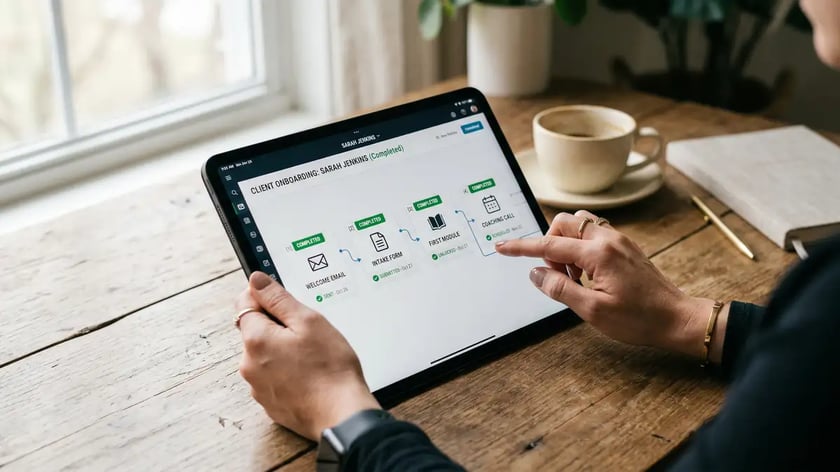
Replace scattered email threads and manual document exchanges with a cohesive automated workflow. When a prospect converts, the system triggers agreement signing, payment processing, welcome instructions, dynamic intake forms intake forms, and first-session preparation — all without founder involvement. According to Kroolo, automation eliminates up to 80% of the time and effort required for client onboarding.
Scheduling and Calendar Management
Self-service booking removes the single most time-consuming operational friction point. Clients book directly into available slots, receive automated confirmations and reminders, and the system handles rescheduling without founder involvement. This alone recovers 3-5 hours weekly for most coaching practices.
Email Marketing and Lead Nurture Sequences
Email marketing delivers a 36:1 ROI for coaching businesses, substantially outperforming social media, SEO, or paid advertising, according to Beehiiv. Automated lead nurture sequences deliver value-driven content, qualify prospects, and move them toward a sales conversation — 24/7, without manual follow-up.
CRM and Pipeline Management
Replace spreadsheet-based client tracking with a structured CRM system that automates lead tagging, follow-up sequences, re-engagement workflows, and pipeline visibility. The mindset coach case study saw lead-to-close rates more than double — from 8% to 21% — after implementing CRM automation.
Content Delivery and Course Platform
Shift educational delivery from live-only sessions to a hybrid model: pre-recorded curriculum modules for foundational content, live coaching for breakthroughs and Q&A, and automated accountability systems for engagement. This enables one founder to serve 100+ group program participants with just 2 hours of live interaction weekly.
Key Takeaway
The typical implementation cycle for steps 1-5 takes 8-12 weeks and recovers 10-15 hours weekly. Start with onboarding automation — it delivers the fastest ROI and creates the foundation for every subsequent system. Do not try to automate everything simultaneously. Sequential implementation with verification at each stage produces dramatically better results than parallel deployment.
How Does Automation Actually Impact Coaching Revenue?

The most documented case study in coaching business automation comes from a six-figure mindset coach who, within six weeks of implementing automated sales backend systems, achieved results that would be difficult to believe without the data. According to Omar MD Growth, the transformation included:
| Metric | Before Automation | After Automation | Change |
| Revenue growth | Plateaued | +84% | ↑ 84% |
| Lead-to-close rate | 8% | 21% | ↑ 163% |
| Average deal size | $2,900 | $3,500 | ↑ 21% |
| Lead response time | 1 hour | 5 minutes | ↓ 92% |
| Hours on sales admin/week | 40 hours | ~9 hours | ↓ 30+ hours |
Source: Omar MD Growth — Mindset Coach Sales Automation Case Study
The compounding effect deserves attention. The automation didn't just save time — it structurally transformed how the business acquired and converted clients. AI systems summarized objections from sales calls, identified buyer intent, and flagged follow-up requirements. A CRM replaced spreadsheet tracking. Automated sequences handled lead nurturing, re-engagement, and sentiment analysis. The founder shifted from bottleneck to architect.
Time savings from specific automation categories compound across the business. Client onboarding automation reduces total onboarding time by up to 70%, according to LSEG Risk Intelligence. Session documentation automation recovers 2-4 hours weekly. Email batching and automation cuts communication overhead by 30-50%. The cumulative recovery across all categories reaches 15-20 hours weekly for a typical coaching practice.
Ready to architect your coaching Freedom Machine? Discover how peppereffect builds autonomous lead generation engines for high-ticket coaching businesses.
Book Your Growth Mapping CallHow Can AI and Agentic Workflows Scale a Coaching Business?
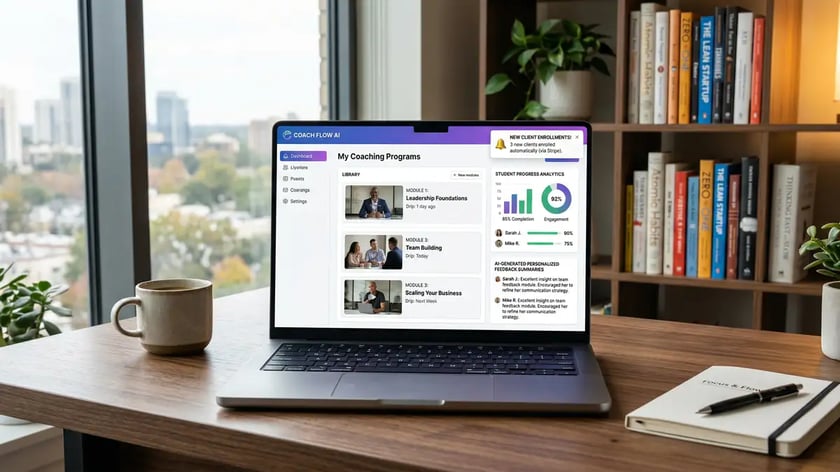
The next frontier of coaching business automation moves beyond simple workflow tools into agentic AI systems — autonomous agents that handle multi-step client workflows with minimal human intervention. This is not speculative: 90% of companies are either implementing or planning to implement AI, according to Highspot's 2025 State of Sales Enablement Report, and 82% of executives plan to adopt AI agents within three years, per Torch.
Yet only 45% of coaches currently use AI tools in any capacity, according to Paperbell. This adoption gap creates a 24-36 month first-mover advantage for coaching founders who integrate AI now, before it becomes industry standard.
The practical applications of AI workflow automation in coaching fall into three tiers:
| AI Tier | Applications | Business Impact |
| Tier 1: Task Automation | Session note transcription, email drafting, calendar optimization, invoice generation | 5-8 hours/week recovered |
| Tier 2: Workflow Intelligence | Lead scoring, client progress tracking, content personalization, sales call analysis | 20-35% conversion improvement |
| Tier 3: Agentic Systems | Autonomous onboarding journeys, adaptive content delivery, multi-step nurture orchestration | True founder liberation — sub-10 hours/week |
Sources: Highspot, Torch, Paperbell
The AI coaching market itself was valued at $1.2 billion in 2023 and is projected to reach $5.8 billion by 2030 — a 25% compound annual growth rate that far exceeds the overall coaching market's 8.53%, according to Paperbell's 2026 industry analysis. Companies using AI in coaching are 20% more likely to improve revenue outcomes and 35% more likely to increase average deal size, per Highspot.
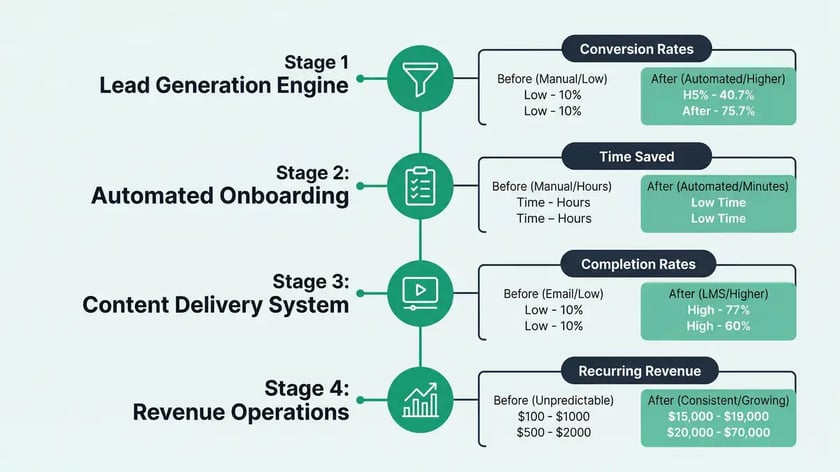
Avoid This Mistake
Do not start with Tier 3 agentic systems before implementing Tier 1 fundamentals. Coaching founders who jump to AI agents without first automating scheduling, onboarding, and email sequences create fragile systems built on broken foundations. Install the operational infrastructure first — scheduling, CRM, email automation — then layer AI intelligence on top. The most common automation failure pattern is technology enthusiasm without sequential implementation discipline.
How Do You Scale a Coaching Business Without Adding Headcount?
The fundamental value proposition of coaching business automation is enabling founders to scale delivery without scaling headcount — the Freedom Machine model where seven-figure revenue runs on minimal operational staff. This requires understanding the economics of revenue-per-employee in professional services AI-driven delivery across professional services.
According to Deliberate Directions, the typical professional services progression looks like this: a solo practitioner earns $150,000, a small team generates $500,000, then hits a painful plateau around $1-2 million where adding more people actually decreases profitability. This happens because each team addition increases complexity and overhead faster than it increases revenue — unless the business has been systematized first.
The counter-example is powerful. The most successful professional services firm in their research bills $2.4 million annually with just three employees, while the owner spends six months per year traveling. For coaching, Financial Models Lab projects that a coaching business can scale from $82,000 in Year 1 to potential owner income exceeding $22 million by Year 5 — but only with architectural transformation that shifts revenue mix toward high-leverage group programs and corporate contracts.
The median revenue per employee for private SaaS companies — the benchmark for systematized service delivery — is $129,724 as of 2025, according to SaaS Capital. Bootstrapped companies consistently outperform equity-backed companies on this metric because they operate with tighter efficiency. For coaching businesses operating as systematized platforms, revenue-per-employee should exceed $200,000+ by Year 2-3.
| Business Model | Annual Revenue | Team Size | Revenue/Person | Founder Hours/Week |
| Solo practitioner (manual) | $150K | 1 | $150K | 50+ |
| Small team (unstructured) | $500K | 5 | $100K | 55+ |
| Systematized coaching practice | $1.2M | 3 | $400K | 10-15 |
| Freedom Machine (fully automated) | $2.4M+ | 3 | $800K+ | 5-10 |
Sources: Deliberate Directions, SaaS Capital, Financial Models Lab
What Lead Generation Channels Work Best for Automated Coaching Businesses?
Once the operational foundation is automated, the next leverage point is building predictable lead generation that feeds the system without founder involvement. Three channels consistently outperform for high-ticket coaching businesses:
Email marketing remains the highest-ROI channel. A copywriting coach built a $100,000 coaching business in just 14 months with fewer than 10,000 social media followers and only 3,200 email subscribers, according to Beehiiv. The strategy relied on multiple high-value lead magnets, daily email outreach, and strategic monetization across 1:1 coaching, group coaching, and self-paced courses. Email volume and consistency outweigh audience size in coaching lead conversion.
LinkedIn outreach delivers strong results when personalized. Manual LinkedIn outreach achieves response rates of 15-25% and connection acceptance of 40-60% when properly researched, according to FameLab. Intelligent automation preserves authentic personalization while enabling volume that manual outreach cannot match.
Automated webinar funnels convert at scale. Traditional webinars achieve 35-45% attendance rates, but automated funnel systems offering multiple daily showings boost attendance to 60-70%, according to Easy Webinar. Among attendees, 20-40% become qualified leads. An evergreen automated webinar running daily delivers predictable lead generation that a founder-dependent approach cannot replicate.
Paid challenges delivered via native messaging platforms represent an emerging high-conversion channel. According to CommuniPass research, challenges delivered through WhatsApp, Telegram, or Discord achieve 70-80% completion rates, dramatically outperforming the 10-15% completion rates of self-paced courses. A 5-21 day paid challenge functions as both revenue generator and qualification mechanism for ongoing coaching programs.
Key Takeaway
The highest-leverage lead generation strategy for automated coaching businesses combines email nurture (36:1 ROI) with automated webinar funnels (60-70% attendance) and paid challenges (70-80% completion). Each channel feeds the next, creating a self-reinforcing pipeline that operates without founder involvement. Build the email engine first — it is the foundation of every other channel's conversion.
What Does a Fully Automated Coaching Business Look Like?
The architectural redesign from founder-dependent to Freedom Machine follows a specific pattern identified by CEO Coaching International. Founders must first recognize they are the bottleneck, then redesign their role from operator to architect. The founder's personal time gets reserved exclusively for the five irreplaceable functions: vision, cash, people, key relationships, and learning. Everything else gets systematized or delegated.
Graham Cochrane's implementation demonstrates this in practice. His seven-figure coaching business runs on the 80/20 principle applied systematically: eliminate four-fifths of non-essential tasks, automate the critical workflows that remain, and delegate final execution to two part-time assistants working 5-10 hours weekly. The founder's scarcity becomes an asset — premium positioning based on expertise — rather than a constraint on growth.
The content delivery architecture is equally critical. The global eLearning market reached $203.81 billion in 2025 with 8.2% annual growth, according to eLearning Industry. For coaching businesses, the strategic model combines live coaching for breakthrough moments with pre-recorded curriculum for foundational content and automated accountability for ongoing engagement. One founder can serve 100+ group participants by combining 2 hours of weekly live interaction with evergreen recorded content and automated daily touchpoints.
Research on work-life balance validates this architecture from the human side. People working more than 55 hours weekly are 1.66 times more likely to experience depression and 1.74 times more likely to suffer anxiety, according to Runn. Counter-intuitively, businesses that implemented four-day workweeks saw nearly 70% of workers report reduced burnout while revenue and profitability improved, per Entrepreneur.com. Time freedom is not a luxury that reduces performance — it is a catalyst for improved performance.
Stop Trading Hours for Income. Architect Your Freedom Machine.
peppereffect installs AI-powered operating systems for coaching businesses — from lead generation to sales automation to operational fulfillment. We decouple your revenue from your calendar.
Book Your Growth Mapping CallLearn what an AI agency actually does →
Frequently Asked Questions
How do I automate my coaching business without losing the personal touch?
Automation handles the operational infrastructure — scheduling, onboarding, payment processing, email sequences, content delivery — while the founder focuses exclusively on the irreplaceable human elements: coaching sessions, strategic relationships, and breakthrough moments. The personal touch actually improves with automation because the founder is no longer exhausted from 36% of their week consumed by admin tasks. Clients experience faster response times, smoother onboarding, and more consistent follow-up — all of which feel more professional, not less personal. The automated onboarding process itself creates a premium first impression that manual processes cannot match.
What are the first processes a coaching business should automate?
Start with client onboarding — it delivers the fastest ROI and creates the data foundation for every subsequent system. According to Kroolo, onboarding automation eliminates up to 80% of manual effort. Follow with scheduling (self-service booking), then email nurture sequences (36:1 ROI), then CRM pipeline management, then content delivery. This five-step sequence takes 8-12 weeks and typically recovers 10-15 hours per week. Do not skip steps or implement out of order — each system feeds the next.
How much time can coaching business automation actually save?
The cumulative time recovery across all automation categories — scheduling, onboarding, email management, session documentation, payment processing, and follow-up sequences — reaches 15-20 hours weekly for a typical coaching practice. The mindset coach case study documented by Omar MD Growth recovered over 30 hours per week while simultaneously growing revenue 84%. For a founder working 45 hours weekly, this represents reducing to a 25-30 hour operational week while maintaining or increasing output.
Can I scale a coaching business to seven figures with less than five hours per week?
Yes — but the 5 hours represent pure coaching, strategy, and high-value relationship management. Graham Cochrane operates a seven-figure coaching business on 5-10 hours of founder involvement weekly. The architecture requires: systematic elimination of non-essential tasks (80/20 applied rigorously), automation of critical workflows, delegation to 1-2 part-time assistants, and a hybrid content delivery model combining pre-recorded curriculum with limited live interaction. The path typically takes 12-18 months of systematic implementation.
What tools do I need to automate a coaching business?
The core technology stack includes: a scheduling platform (Calendly or similar), an email marketing system with automation capabilities, a CRM for pipeline management, a content delivery platform (Kajabi, Teachable, or Mighty Networks), payment processing automation, and optionally AI tools for session notes, content generation, and lead scoring. The critical principle is integration — tools must connect through workflow orchestration platforms like n8n or Make.com rather than operating as isolated point solutions.
How do I automate client onboarding for my coaching program?
Build a sequential automated workflow triggered by client conversion: (1) automated agreement and payment processing, (2) welcome email with clear next steps, (3) intake form for goals and context, (4) first session booking via self-service calendar, (5) pre-session preparation materials, (6) weekly accountability check-in automation. According to ANHCO's research on coaching automation, implementing automated weekly check-in forms catches client disengagement early and turns automation into a retention tool. More than 80% of businesses report that their onboarding strategy is a key driver of client lifetime value.
Resources
- ICF 2025 Global Coaching Study — $5.34 Billion Global Revenue
- Luisa Zhou — Coaching Industry Market Size 2025-26
- Omar MD Growth — 84% Revenue Growth With Sales Automation Case Study
- CEO Coaching International — Admit It: You're the Bottleneck
- Graham Cochrane — Running a 7-Figure Coaching Business in 20 Hours/Week
- Kroolo — How to Automate Client Onboarding With AI
- Torch — What AI Coaching Actually Means
- Deliberate Directions — How to Scale Professional Services Beyond $1M
scaling a service business without headcount
outreach automation on LinkedIn
profitability tracking infrastructure
automation platform comparison
choosing between n8n and Make.com
AI onboarding for online courses Acquisition.com offer principles applied to high-ticket services
the E-Myth applied to modern B2B
building a systems-dependent operation 7-figure revenue on 5 hours per week
scalable consulting revenue model
AI visibility for coaches and consultants what to outsource to a virtual assistant