

What Is Client Onboarding for High-Ticket Consultants?
Client onboarding for high-ticket consultants is the systematic process of transitioning a new client from signed contract to fully engaged partnership — with clear milestones, defined expectations, and demonstrated value within the first 30 days. Unlike transactional onboarding (send a welcome email, share a Google Drive folder, hope for the best), white-glove onboarding architects every touchpoint to reinforce the client's decision, accelerate time-to-value, and establish the relationship infrastructure that drives retention, referrals, and expansion revenue.
The stakes are not theoretical. Research from First Page Sage shows that business consulting firms achieve 85% annual client retention rates — but the dispersion between top-quartile and bottom-quartile firms is enormous. Top performers sustain 90%+ retention through deliberate onboarding systems, while firms treating onboarding as an afterthought operate at 60-70% retention. For a consulting practice with $5M annual revenue and $50K average client value, that 20-point retention gap represents $1M+ in annual revenue at risk.
The global consulting market reached $1.06 trillion in 2025 and is projected to hit $1.32 trillion by 2029, growing at 6.2% CAGR according to Expert Network Calls. Strategy consulting is outpacing this trend at 9.9% annual growth. Within this expanding market, onboarding quality is the single variable that determines whether a firm captures expansion revenue or bleeds clients to competitors who deliver a superior first-90-day experience.
What you'll learn in this guide:
- Why 75% of consulting client churn happens in the first 90 days — and exactly how to prevent it
- The five-phase white-glove onboarding system that top consultants deploy
- How structured onboarding reduces client loss by 40% and increases expansion revenue by 30%
- The complete 30-60-90 day framework with milestones, templates, and automation triggers
- How to build onboarding infrastructure that scales without adding headcount
Key Takeaway
Client onboarding is not an administrative task — it is the highest-leverage revenue protection system in your consulting practice. Structured onboarding reduces first-90-day client loss by 40% and creates the foundation for expansion revenue that top-performing firms rely on for over 50% of new annual recurring revenue.
Why Does Client Onboarding Matter for High-Ticket Consulting?

The first 90 days of a consulting engagement determine whether the relationship becomes a multi-year partnership or an expensive regret. Research confirms that 75% of clients who ultimately churn do so within their first 90 days, primarily due to unmet expectations, unclear value delivery, or poor communication (SaaSFactor). For high-ticket engagements where individual client value ranges from $10,000 to $500,000+, this concentration of early churn risk demands extraordinary focus on first impressions and rapid value demonstration.
The financial mathematics are unforgiving. Acquiring a new consulting client costs 5 to 25 times more than retaining an existing one (Consulting NWA). Furthermore, a 5% improvement in client retention can yield 25-95% profit growth for professional services firms. When you operate in the high-ticket space — where each client represents $50K-$200K in annual value — the ROI on onboarding infrastructure is not incremental. It is transformational.

Beyond retention, onboarding quality directly determines expansion revenue. B2B retention research shows that top-performing consulting firms generate over 50% of new ARR from existing clients through expansion, whereas firms with poor onboarding rarely exceed 20-30% expansion revenue. Clients who experience seamless onboarding — personalized welcome sequences, clear success metrics, rapid time-to-value — reach the "this was the right decision" moment faster and become receptive to expanded engagements within months. The client onboarding automation infrastructure you install determines this trajectory.
The referral impact may exceed the direct retention impact. Research on coaching practices demonstrates that clients refer consultants who make them feel valued continuously, not just during sessions (Business Coach VAs). The onboarding experience contributes as much to referral likelihood as the core consulting work itself. For coaching business owners and mastermind leaders, this means the white-glove treatment during weeks 1-4 creates the referral momentum that compounds for years.
| Onboarding Quality | Retention Rate | Expansion Revenue | Referral Rate |
| No formal onboarding | 55-65% | 10-20% of ARR | Low |
| Basic onboarding (welcome email + kickoff call) | 70-78% | 20-30% of ARR | Moderate |
| Structured white-glove onboarding | 88-92% | 50%+ of ARR | High (3-5× referrals) |
Sources: First Page Sage, SERPsculpt
What Are the Five Phases of White-Glove Client Onboarding?
White-glove onboarding is not a single event — it is a five-phase system that spans from contract signature through the first 90 days. Each phase addresses a specific risk point in the client relationship and builds on the previous one to create compounding trust and demonstrated value. This is the architecture that separates consultants who retain 90%+ of clients from those who lose a third of their book every year.
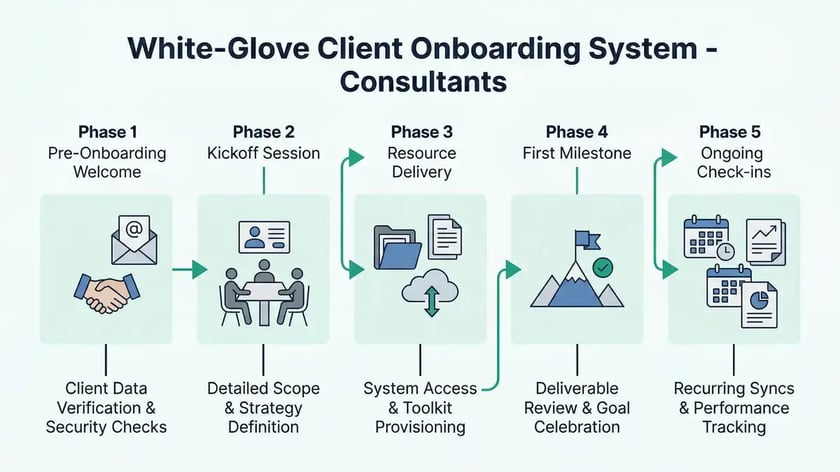
Pre-Onboarding Welcome (Days -7 to 0)
Before the engagement officially begins, deploy a personalized welcome sequence: branded welcome packet, handwritten note (physical or premium digital), pre-engagement questionnaire capturing goals and success definitions, and calendar invitations for the first 30 days of touchpoints. This phase addresses the buyer's remorse window — the 48-72 hours after signing where doubt is highest. Every touchpoint reinforces the decision and builds anticipation.
Strategic Kickoff Session (Days 1-3)
A structured 60-90 minute session that reconfirms goals, introduces team members, establishes communication norms, and produces a written success plan. Best-practice agenda: alignment and introductions (10 min), success plan co-creation (20 min), platform and resource orientation (15 min), first milestone definition (10 min), and next steps with clear owners (5 min). The kickoff is not a pitch — it is an alignment exercise that produces a tangible artifact: the shared success plan that will govern the engagement.
Resource Delivery and Quick Win (Days 4-14)
Deliver the first tangible value within two weeks. This means a preliminary diagnostic, initial recommendations, or completion of a defined phase that provides actionable insight. Simultaneously, provide access to all engagement resources: client portal, shared workspace, communication channels, and documentation. The objective is to move the client from "I hope this was a good investment" to "I can already see how this works" before their first invoice arrives.
First Milestone Review (Days 15-30)
A formal checkpoint that reviews progress against the success plan, documents early wins, identifies course corrections, and reconfirms the 60-day objectives. This meeting produces a written progress report with measurable outcomes. For high-ticket engagements, this is where you demonstrate ROI with data — hours saved, pipeline generated, process improvements quantified. Clients who see documented progress at day 30 are 80% more likely to become long-term partners (Monetizely).
Deepening and Expansion (Days 31-90)
Regular bi-weekly check-ins following a consistent structure: progress review, issue identification, next priorities, and upcoming milestones. Transparent progress reporting via shared dashboards ensures continuous visibility. By day 60, introduce expansion conversations naturally — adjacent services, extended engagements, additional team members. By day 90, conduct a formal engagement review that documents cumulative value and establishes the renewal trajectory.
Key Takeaway
The five-phase white-glove system is not about adding complexity — it is about eliminating the gaps where clients disengage. Each phase addresses a specific failure point: buyer's remorse (Phase 1), misalignment (Phase 2), delayed value (Phase 3), invisible progress (Phase 4), and relationship decay (Phase 5). Install all five phases and you close the exits.
How Do You Build a Client Onboarding Checklist That Scales?
A scalable onboarding checklist transforms white-glove service from founder-dependent heroics into a repeatable system. The difference between consultants trapped in the Technician's Trap and those running a Freedom Machine is whether onboarding exists in the founder's head or in a documented, automated system that anyone on the team can execute with identical quality.

The checklist below is the operational backbone of the five-phase system. Each item has a clear owner, timeline, and completion trigger. When combined with AI workflow automation, most of these items execute autonomously — welcome sequences fire on contract signature, questionnaires route to the right team member, calendar invitations deploy automatically, and progress dashboards update in real time.
| Phase | Checklist Item | Timeline | Automation Potential |
| Pre-Onboarding | Welcome email with branded packet | Within 24 hours of signature | Full (CRM trigger) |
| Pre-Onboarding | Pre-engagement questionnaire sent | Within 24 hours | Full (form automation) |
| Pre-Onboarding | Kickoff call scheduled | Within 48 hours | Full (scheduling link) |
| Kickoff | Success plan co-created and shared | Day 1-3 | Partial (template + AI draft) |
| Kickoff | Client portal access provisioned | Day 1 | Full (automated provisioning) |
| Quick Win | First deliverable or diagnostic completed | Day 7-14 | Partial (AI-assisted analysis) |
| Quick Win | Resource library shared | Day 7 | Full (portal auto-provision) |
| Milestone | 30-day progress report delivered | Day 28-30 | Partial (dashboard + narrative) |
| Expansion | Bi-weekly check-in cadence established | Day 31+ | Full (recurring calendar) |
| Expansion | 90-day engagement review completed | Day 85-90 | Partial (template + data) |
The automation column is critical. Consultants who build automated fulfillment systems can execute 60-70% of onboarding touchpoints without manual intervention. The remaining 30-40% — the strategic kickoff, the personalized diagnostic, the expansion conversation — are where your expertise creates irreplaceable value. Automation handles the logistics; you deliver the insight. This is how a solo consultant or small team delivers white-glove service to 20-30 concurrent clients without burning out.
Ready to architect a client onboarding system that scales your consulting practice without scaling your hours?
Explore Our Operations ArchitectureWhat Does the 30-60-90 Day Client Onboarding Framework Look Like?
The 30-60-90 day framework is the industry standard for structuring high-ticket consulting engagements — and for good reason. It creates natural checkpoint opportunities, prevents the "set it and forget it" trap, and ensures onboarding continues through the critical early phases rather than ending after a single kickoff call. Research from CSMIS confirms this structured approach drives measurably higher retention across consulting, coaching, and professional services.

Days 1-30: Foundation and Quick Win. The first month focuses on establishing the working relationship, conducting detailed assessment, and achieving a quick win that demonstrates value. The kickoff call within the first week reconfirms goals, introduces team members, establishes communication norms, and identifies immediate priorities. By day 30, clients should have experienced their first meaningful result — a preliminary diagnosis, initial recommendations, or completion of a phase that provides immediate actionable insight. This is the "aha moment" that transforms skepticism into conviction.
Days 31-60: Deepening and Momentum. The second month deepens the engagement and builds trust through consistent execution. Regular check-in calls follow a consistent structure: progress review, issue identification, next priorities, and upcoming milestones. Transparent progress reporting — whether through a shared project management dashboard, written summary, or presentation — ensures clients maintain clear visibility into value delivery. This is where CRM automation proves its worth, triggering satisfaction surveys, progress updates, and stakeholder reports on schedule.
Days 61-90: Expansion and Renewal. The final phase demonstrates cumulative value, identifies expansion opportunities, and plans renewal. By day 90, conduct a formal engagement review documenting ROI achieved, lessons learned, and future opportunities. This review becomes your strongest proposal asset for renewal conversations — real data showing measured outcomes versus initial goals.
| Phase | Objective | Key Deliverables | Success Metric |
| Days 1-30 | Foundation + Quick Win | Success plan, first diagnostic, resource access | Client confirms "I see value" |
| Days 31-60 | Deepening + Momentum | Progress reports, bi-weekly cadence, stakeholder alignment | NPS ≥ 8, engagement hours on track |
| Days 61-90 | Expansion + Renewal | ROI report, renewal proposal, expansion recommendations | Renewal commitment or scope expansion |
Sources: CSMIS, Monetizely
Avoid This Mistake
The most expensive onboarding error is treating the kickoff call as the entirety of onboarding. A single 60-minute call cannot establish working norms, demonstrate value, and align multiple stakeholders. The kickoff is Phase 2 of five. If your onboarding ends after the kickoff, you are leaving the remaining 80% of the retention opportunity on the table — and 75% of your churn risk unaddressed.
How Do You Measure Client Onboarding Success?
What you measure in onboarding determines what you improve. High-ticket consultants who track onboarding metrics systematically identify failure points before they become churn events. The metrics below are drawn from Docebo and HPT by DTS research on onboarding effectiveness across professional services.
| Metric | Benchmark | Why It Matters |
| Time-to-First-Value (TTFV) | ≤ 14 days | Clients who see value within 2 weeks retain at 2× the rate of those waiting 30+ days |
| Onboarding Completion Rate | ≥ 85% | Clients who complete all onboarding steps are 80% more likely to become long-term partners |
| 30-Day NPS Score | ≥ 50 (promoter) | Early satisfaction predicts renewal probability and referral likelihood |
| Kickoff-to-First-Deliverable | ≤ 10 business days | Speed of first output signals competence and commitment |
| Stakeholder Engagement Rate | ≥ 70% attendance | Multi-stakeholder alignment prevents "silent objector" churn |
| 90-Day Retention Rate | ≥ 90% | The critical survival milestone — clients who make it past 90 days retain at 95%+ annually |
Sources: Docebo, HPT by DTS, Agolix
These metrics should feed into a centralized sales intelligence dashboard. When onboarding completion drops below 85%, investigate immediately — it signals a process failure, not a client failure. When TTFV exceeds 14 days, redesign the quick-win phase. When 30-day NPS drops below 50, conduct intervention conversations before the client mentally disengages. The system alerts you before the problem becomes irreversible.
Key Takeaway
Client onboarding measurement is not a reporting exercise — it is an early warning system. The six metrics above — TTFV, completion rate, NPS, first-deliverable speed, stakeholder engagement, and 90-day retention — give you a 30-day head start on identifying at-risk clients before they become lost revenue. Track them weekly, not quarterly.
How Do You Automate White-Glove Onboarding Without Losing the Personal Touch?
The paradox of white-glove onboarding is that automation makes it more personal, not less. When agentic workflows handle the logistics — welcome sequences, questionnaire routing, portal provisioning, calendar scheduling, progress tracking — you reclaim the hours needed for the high-value human touches that define premium service. The research on onboarding automation from Braze confirms that automated sequences with personalized triggers outperform manual processes on every retention metric.
The automation architecture for consulting onboarding follows a clear hierarchy. Automate 100% of scheduling, reminders, resource delivery, portal provisioning, and progress data collection. Automate 70% of communication touchpoints using templated but personalized messages triggered by client actions (questionnaire completed, milestone reached, check-in attended). Keep 100% human the strategic kickoff, diagnostic conversations, milestone reviews, and expansion discussions.
This architecture is the same principle behind the capacity expansion blueprint — you are not replacing human judgment with automation. You are eliminating the administrative overhead that prevents human judgment from being deployed where it creates the most value. A consultant who spends 3 hours per client on manual onboarding logistics can serve 10 clients simultaneously. A consultant who automates those logistics and spends the same 3 hours on strategic touchpoints serves 30 clients with a better experience.
The technology stack is straightforward. Your CRM serves as the orchestration hub, triggering workflow sequences in n8n or Make.com when deal stages change. Client portal software (the market reached $1.77 billion in 2023 and is projected to hit $7.34 billion by 2032, according to SNS Insider) provides the self-service layer. And AI agent workflows handle the intelligence layer — analyzing questionnaire responses to pre-populate success plans, monitoring engagement patterns to flag at-risk clients, and generating personalized progress reports from raw data.
Frequently Asked Questions
What is client onboarding in consulting?
Client onboarding in consulting is the systematic process of transitioning a signed client from contract execution to full engagement, with defined milestones, clear expectations, and demonstrated value within the first 30 days. For high-ticket consultants, this means a structured sequence of welcome touchpoints, a strategic kickoff session, rapid delivery of initial value, and ongoing checkpoints through the critical first 90 days. Effective onboarding reduces early churn by 40% and establishes the foundation for long-term client relationships that generate expansion revenue and referrals.
What does white-glove onboarding mean?
White-glove onboarding refers to a fully personalized, high-touch client onboarding experience that goes substantially beyond basic orientation. It typically includes dedicated success management, custom implementation plans, regular check-ins, branded welcome materials, and proactive communication throughout the first 90 days. For high-ticket consultants and coaches, white-glove onboarding is the operational expression of premium positioning — it signals that the client's investment is being protected with the same level of care they expect from a $50K-$200K engagement.
How long should client onboarding take for consulting engagements?
The standard framework for high-ticket consulting onboarding spans 90 days, structured as three 30-day phases: Foundation and Quick Win (days 1-30), Deepening and Momentum (days 31-60), and Expansion and Renewal (days 61-90). The most critical period is the first 14 days, where time-to-first-value determines long-term retention probability. However, the onboarding system should produce its first tangible deliverable within the first week to establish momentum and credibility.
What should be included in a client onboarding checklist?
A comprehensive consulting onboarding checklist includes pre-engagement items (welcome sequence, questionnaire, calendar scheduling), kickoff items (success plan, portal access, communication norms), quick-win items (first diagnostic, resource library, initial deliverable), milestone items (30-day progress report, satisfaction survey), and expansion items (bi-weekly cadence, 90-day review, renewal proposal). The most effective checklists specify clear owners, timelines, and automation triggers for each item.
How can I automate client onboarding without losing the personal touch?
Automate logistics (scheduling, reminders, resource delivery, portal provisioning, progress tracking) while keeping strategic touchpoints human (kickoff sessions, diagnostic conversations, milestone reviews, expansion discussions). This division typically means automating 60-70% of onboarding tasks while preserving the 30-40% that require your expertise and personal attention. The result is better service at higher capacity — a Freedom Machine approach that lets you serve 3× more clients with a superior experience.
What are the most important client onboarding metrics to track?
The six critical onboarding metrics are Time-to-First-Value (target: ≤14 days), Onboarding Completion Rate (target: ≥85%), 30-Day NPS Score (target: ≥50), Kickoff-to-First-Deliverable (target: ≤10 business days), Stakeholder Engagement Rate (target: ≥70%), and 90-Day Retention Rate (target: ≥90%). Track these weekly rather than quarterly — they function as an early warning system that identifies at-risk clients 30-60 days before churn becomes visible in revenue numbers.
Ready to Architect Your White-Glove Client Onboarding System?
peppereffect installs autonomous onboarding infrastructure for high-ticket consultants and coaches — the kind that delivers white-glove experiences at scale without adding headcount. From CRM automation to client portals to AI-powered progress tracking, we architect the system so you can focus on what you do best: transforming your clients' businesses.
Book Your Growth Mapping CallSee how automated fulfillment systems work →
Resources
- First Page Sage — Customer Retention Rates by Industry: 2026 Report
- Expert Network Calls — Consulting Industry Trends and Outlook for 2025
- SERPsculpt — B2B Customer Retention Statistics 2025
- OnRamp — The Complete Guide to B2B Customer Onboarding
- Docebo — 10 Customer Onboarding Metrics and KPIs to Track in 2025
- Pipedrive — The SMB Guide to White Glove Customer Service
- Braze — Master Customer Onboarding Automation
high-ticket consulting automation
AI onboarding agents for course-based programs
autonomous onboarding workflows founder freedom architecture