

AI workflow automation transforms manual, repetitive business business process automation services processes into intelligent systems that perceive context, make decisions, and execute tasks autonomously. Unlike rule-based robotic process automation that follows rigid scripts, AI-native workflow automation combines machine learning, natural language processing, and agentic reasoning to handle the 80% of business processes that involve unstructured data and judgment calls. For B2B organisations, this capability shift represents a fundamental infrastructure upgrade — one that peppereffect's clients deploy to decouple revenue growth from headcount expansion. executive search workflow automation workflow orchestration with n8n and Make.com orchestration layer
According to Grand View Research, the global AI automation market reached $129.92 billion in 2025 and is projected to hit $169.46 billion in 2026, with a 31.4% CAGR through 2033. Yet only 33% of organisations have successfully scaled their AI programs beyond initial pilots. The gap between adoption and execution is where competitive advantage lives — and where most B2B companies stall.
$129.9B
AI Automation Market (2025)
Grand View Research, 2025
60%
Positive ROI Within 12 Months
Arcade.dev Enterprise Survey
3.2X
Revenue Growth at AI Maturity
Advanced vs. early-stage organisations
33%
Successfully Scaled Beyond Pilots
Deloitte State of AI, 2026
What Is AI Workflow Automation and Why Does It Matter for B2B?
AI workflow automation is the application of artificial intelligence — including machine learning, natural language processing, and autonomous agents — to design, execute, and continuously optimise business processes without manual intervention. It matters for B2B organisations because it addresses the core scaling bottleneck scaling up business operations: operational complexity that grows linearly with revenue when humans remain in every process loop.
Traditional automation (RPA) handles structured, repetitive tasks by mimicking human clicks through software interfaces. According to SheetFlash's RPA analysis, rule-based systems work well for invoice processing, data migration, and order entry — but they break when processes involve variable data, contextual decisions, or exceptions. AI-native workflow automation eliminates this ceiling by learning from execution data, adapting to changing conditions, and making autonomous decisions within defined guardrails.
The distinction matters financially. Organisations at advanced AI maturity stages report 3.2X higher revenue growth, 2.8X greater cost efficiencies, and 2.1X greater improvements in customer experience compared to early-stage organisations, according to Arcade.dev's workflow automation research. Data quality and employee adoption correlate with 2.1X and 2.6X higher ROI respectively — underscoring that organisational readiness precedes technological capability.
peppereffect's 4 Pillars methodology 4 Pillars framework treats AI workflow automation as operational infrastructure, not a technology experiment. Within the Sales Administration and Lead Generation pillars, automated workflows handle everything automated fulfillment systems from automated fulfillment prospect qualification to proposal generation proposal generation engine — eliminating the manual bottlenecks that prevent B2B founders from scaling without proportional headcount increases.
Key Takeaway
AI workflow automation is not a faster version of RPA — it is a fundamentally different capability that handles unstructured data, contextual decisions, and adaptive processes. B2B organisations that treat it as infrastructure rather than a point solution report 3.2X higher revenue growth.
AI Workflow Automation Tools: Comparing Platforms by Maturity Level
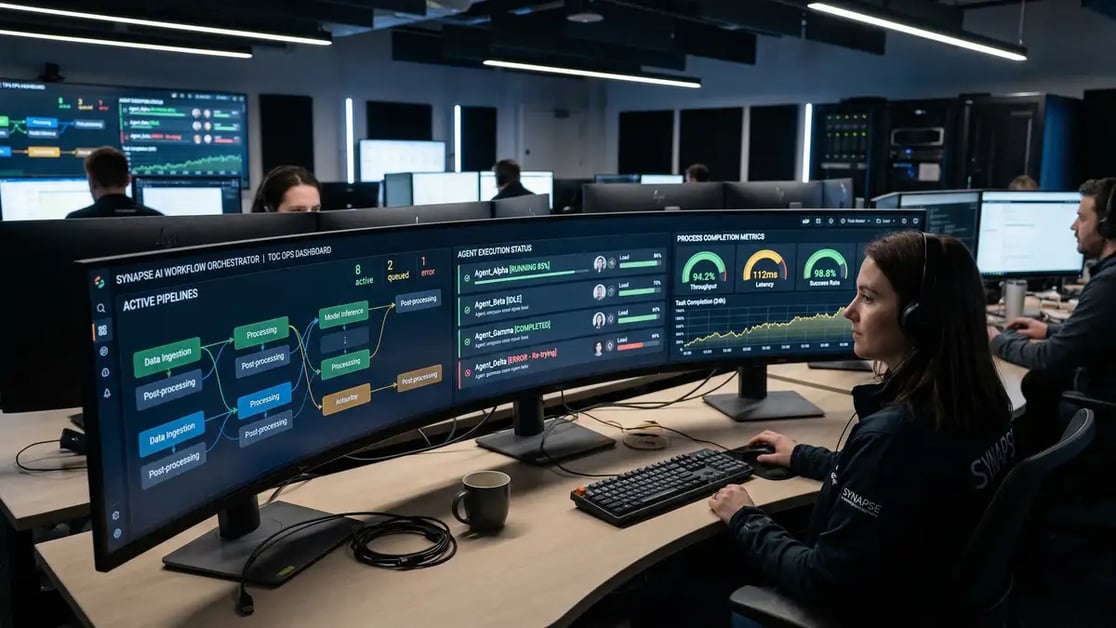
The best AI workflow automation tools match your organisation's technical maturity, not the vendor's feature list. The automation workflow software landscape splits into three tiers: no-code platforms for citizen developers, low-code platforms for technical teams with limited engineering capacity, and code-first frameworks for organisations building proprietary automation architectures.
No-code platforms like Zapier the best Zapier alternatives choosing between n8n and Zapier, Make (formerly Integromat), and Diaflow enable non-technical teams to build automated workflows through visual interfaces. According to UseAIForBusiness research, 93% of SMBs are expected to implement AI in at least one business function by 2027, driven largely by the accessibility of these platforms. They work well for connecting SaaS tools AI-powered SaaS growth, triggering notifications, and automating data entry — but they hit capacity limits when workflows require multi-step reasoning, custom model deployment, or enterprise-grade governance enterprise-grade AI governance.
| Platform Tier | Best For | Limitations | Examples |
| No-Code | SMBs, citizen developers, simple integrations | Limited AI reasoning, no custom models | Zapier, Make, Diaflow |
| Low-Code | Mid-market, technical teams, moderate complexity | Vendor lock-in risk, governance gaps | Microsoft Power Automate, UiPath |
| Code-First / AI-Native | Enterprises, proprietary workflows, agentic AI | Higher implementation cost, requires engineering | AWS Bedrock, Vellum AI, LangChain |
Sources: Grand View Research, Mordor Intelligence
Mid-market organisations with growing technical teams typically find the strongest ROI in low-code AI workflow automation platforms. Microsoft Power Automate and UiPath combine visual workflow builders with AI capabilities — including document understanding, sentiment analysis, and predictive triggers. The intelligent process automation market that encompasses these tools reached $15.2 billion in 2024, growing at 14.3% CAGR toward $48.8 billion by 2034, according to GM Insights.
For B2B organisations building competitive moats through automation, code-first AI workflow automation software provides the deepest capabilities. These frameworks enable custom agent orchestration agent handoff infrastructure, proprietary model fine-tuning, and enterprise governance controls that no-code tools cannot replicate. The trade-off is implementation complexity — but peppereffect's experience deploying agentic workflow architectures shows that phased approaches deliver 3.5X higher ROI than big-bang enterprise deployments.
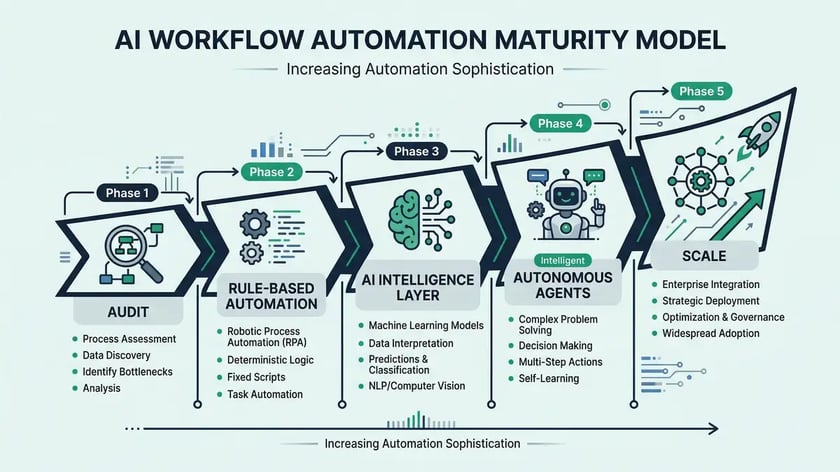
How to Build Agentic Workflows: The 5-Phase Implementation Framework

Building agentic workflows requires a phased implementation approach that progressively builds capability while managing risk. According to research from HypeStudio, organisations using structured implementation frameworks report dramatically better outcomes than those attempting enterprise-wide deployments simultaneously.
Audit and Map Current Processes (Weeks 1–3)
Identify the 5–10 workflows consuming the most manual hours. Map each process step, decision point, exception path, and data dependency. Prioritise workflows where automation delivers measurable time or cost savings within 90 days. peppereffect's CRM automation methodology begins here — mapping the full lead-to-close workflow before deploying any technology.
Deploy Rule-Based Automation for Quick Wins (Weeks 4–8)
Start with structured, repetitive tasks that follow clear decision trees. Data entry, invoice matching, appointment scheduling, and notification triggers deliver immediate ROI while building organisational confidence. According to Formstack, 32% of companies experienced measurable reduction in human error after adopting basic workflow automation.
Layer AI Intelligence for Complex Decisions (Months 3–6)
Introduce machine learning models for document understanding, sentiment analysis, predictive scoring, and natural language processing. This is where ai process automation diverges from traditional RPA — handling the unstructured data and contextual decisions that rule-based systems cannot. Healthcare organisations at this stage report 30% reductions in documentation time through AI-generated clinical summaries.
Orchestrate Autonomous Agents (Months 6–12)
Deploy agentic workflow automation where AI systems perceive, decide, act, and adapt independently within defined guardrails. According to MIT Sloan, agentic AI enables systems to execute multi-step plans involving multiple tools and systems — but requires robust governance frameworks to ensure alignment with human-centred decision processes.
Scale and Optimise Across Functions (Year 1+)
Expand automation from initial departments to cross-functional workflows. Organisations at this stage report 3.2X higher revenue growth attributed to AI. The key is maintaining phased discipline — only 33% of organisations successfully scale beyond pilots, and the primary failure mode is attempting too much scope before governance and data quality foundations are solid.
Sources: HypeStudio AI Agent Implementation Guide, Deloitte State of AI in the Enterprise 2026
Ready to map your automation architecture? Explore peppereffect's end-to-end approach to AI-powered business infrastructure.
Measuring AI Workflow Automation ROI: The Metrics That Matter

AI workflow automation ROI follows a multi-phase accumulation pattern — not a single payback event. According to DX's enterprise ROI framework, Phase 1 (months 1–6) delivers 23% ROI through planning and architecture improvements, Phase 2 (months 6–18) delivers cumulative 187% ROI through automation acceleration, and Phase 3 (years 2–5) reaches 340% total ROI as compounding effects take hold.
Leading organisations measure across four value categories rather than focusing narrowly on cost reduction. According to Moveworks' enterprise automation research, the most successful deployments track cost savings, productivity gains, risk mitigation, and transformation growth as distinct ROI dimensions.
| ROI Dimension | Key Metrics | Typical Impact |
| Cost Savings | Manual task reduction, infrastructure costs, error remediation | 50–80% infrastructure reduction, $200K+ annual savings |
| Productivity Gains | Time reclaimed, throughput increase, context-switching reduction | 23% productive time increase, 40% less context switching |
| Risk Mitigation | Compliance adherence, audit trail coverage, error rates | 32% less human error, continuous compliance monitoring |
| Transformation Growth | Revenue per employee, CAC reduction, customer experience scores | 3.2X revenue growth at maturity, 85% booking rate increase |
Sources: Moveworks, GroovyWeb AI ROI Case Studies, CreativeBits
The productivity data is particularly compelling for B2B founders evaluating AI-powered workflow automation. According to CreativeBits research, managers spend an average of 8 hours per week on manual data tasks — with 25% spending 20+ hours weekly. Workflow automation reduces context switching by 40% and increases productive time by 23% within six months. These are hours directly reclaimed for revenue-generating activities like client strategy, deal closing, and relationship building.
Key Takeaway
Measure AI workflow automation ROI across four dimensions — cost savings, productivity gains, risk mitigation, and transformation growth. Organisations that track all four report sustainable value creation, while those focused only on cost reduction undervalue their automation investment by 60% or more.
Avoid This Mistake
Attempting enterprise-wide AI automation deployment simultaneously. Organisations using phased approaches report 3.5× higher ROI than big-bang deployments. Start with one department, prove measurable wins, then expand — only 33% of organisations successfully scale beyond initial pilots.
AI Business Process Automation: Real-World Case Studies
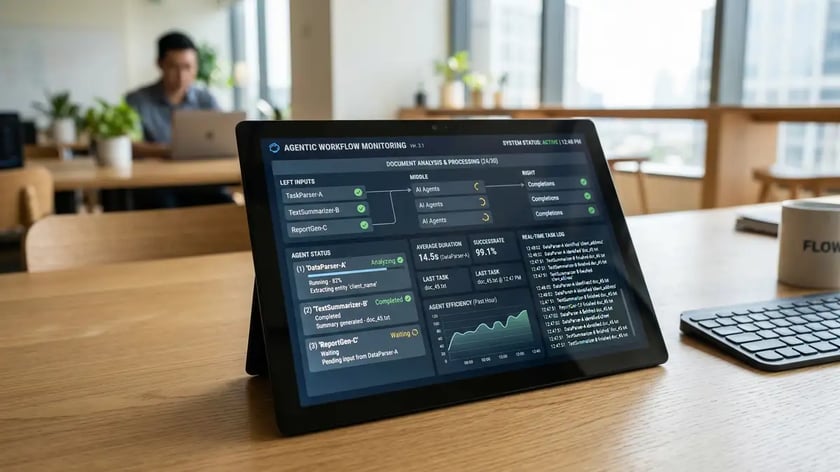
AI business process automation delivers measurable outcomes across industries when implemented with the phased discipline outlined above. The following case studies demonstrate the range of ROI achievable from healthcare to financial services to retail operations.
In healthcare, Intelliswift documented a client that automated insurance verification and authorisation processes, reducing manual effort by 95% and generating $200,000 in annual operational cost savings. The automation handled unstructured insurance documents, cross-referenced policy databases, and flagged exceptions for human review — exactly the kind of contextual decision-making that rule-based RPA cannot replicate.
In financial services, Querio AI reported that a firm saved $45,000 per year by deploying AI-powered business intelligence that empowered non-technical teams to handle data analysis — eliminating the bottleneck of routing every analytics request through a dedicated data team. In customer-facing operations, an Agentra case study showed a luxury real estate group generating $2 million in additional revenue through AI agents that handled property inquiries 24/7, scheduled viewings automatically, and qualified prospects before human agent handoff.
$2 million in additional revenue — generated by a luxury real estate group deploying AI agents for 24/7 prospect qualification, automated scheduling, and intelligent handoff to human agents. — Agentra Case Studies
These results align with peppereffect's experience deploying client onboarding automation and sales automation architectures for B2B organisations. The pattern is consistent: the highest ROI comes not from replacing headcount but from liberating skilled resources to focus on high-value work while AI handles the cognitive burden of repetitive decision-making.
Ready to map your AI workflow automation architecture? Discover how peppereffect engineers intelligent process systems for B2B founders.
View Automation ServicesAgentic Workflow Automation: The Next Capability Frontier
Agentic workflow automation represents the most significant capability leap in enterprise automation since the introduction of cloud-based RPA. Unlike traditional AI automation that processes individual tasks, agentic AI systems perceive their environment, reason about multi-step objectives, take autonomous action, and learn from outcomes — all without step-by-step human instruction.
According to MIT Sloan, agentic AI fundamentally differs from conventional AI because it operates with genuine autonomy within defined boundaries. Research from SuperAGI shows that organisations scaling agentic AI achieve 20–30% reductions in operational costs and 10–20% productivity increases beyond what traditional automation delivers.
Governance Gap Alert
Only 16% of AI systems deployed across major industries include built-in explainability or traceable decision chains. Over 68% of organisations experimenting with multi-agent AI face critical reliability breakdowns due to logic abstraction debt. Deploy governance before deploying agents.
The governance challenge is real. According to Deloitte's 2026 State of AI report, only 23% of organisations are actively scaling agentic AI, and only one in five has a mature governance model for autonomous agents. peppereffect addresses this through embedded guardrails — confidence thresholds, audit trails, and human oversight triggers built directly into the agentic workflow architecture rather than bolted on as compliance afterthoughts.
For B2B organisations evaluating ai agent workflow automation, the strategic question is timing. The capability is proven, the ROI is documented, and early movers are capturing disproportionate competitive advantage. But deploying agents without governance infrastructure creates operational fragility that compounds over time. The organisations winning this race are those moving quickly on deployment while investing equally in the governance frameworks that make autonomous execution sustainable.
Key Takeaway
Agentic workflow automation extends AI from task execution to autonomous multi-step reasoning. But only 23% of organisations are scaling it successfully — the differentiator is governance embedded into workflows, not governance documented in policy manuals.
Common Mistakes in AI Process Automation (And How to Avoid Them)
The 67% failure rate in scaling AI automation programs traces to predictable implementation mistakes, not technology limitations. Understanding these patterns prevents the most expensive errors B2B organisations make when deploying ai-powered workflow automation.
- Big-bang deployments over phased rollouts. Organisations attempting enterprise-wide automation in a single initiative report 3.5X lower ROI than those using phased approaches. Start with one department, prove ROI, then expand systematically.
- Ignoring data quality foundations. Organisations with high data quality report 2.1X higher automation ROI. If source systems contain duplicate records, inconsistent formatting, or missing fields, automation will amplify these problems at machine speed.
- Measuring only cost reduction. Narrow ROI measurement undervalues automation by 60% or more. Track productivity gains, risk mitigation, and transformation growth alongside cost savings to build accurate business cases for expansion.
- Deploying agents without governance. Only 16% of deployed AI systems include explainability or audit trails. Without governance infrastructure, autonomous agents create operational risk that compounds silently until a critical failure surfaces.
- Choosing platforms based on features, not maturity fit. Enterprise-grade code-first frameworks deployed in organisations without engineering capacity produce negative ROI. Match platform tier to your team's current capabilities, then upgrade as maturity grows.
| Mistake | Impact | Prevention |
| Big-bang deployment | 3.5X lower ROI vs. phased | Start with 1 department, prove ROI, expand |
| Poor data quality | 2.1X lower ROI | Audit and clean data before automating |
| No governance framework | 68% face critical breakdowns | Embed guardrails, audit trails, human triggers |
| Narrow ROI measurement | Undervalues investment by 60%+ | Track 4 dimensions: cost, productivity, risk, growth |
| Platform-maturity mismatch | Negative ROI from underutilisation | Match platform tier to team capability |
Sources: Arcade.dev, Deloitte
Frequently Asked Questions About AI Workflow Automation
What is AI workflow automation?
AI workflow automation is the use of artificial intelligence technologies — including machine learning, natural language processing, and autonomous agents — to design, execute, and optimise business processes without continuous manual intervention. Unlike traditional rule-based automation (RPA) that follows fixed scripts, AI workflow automation handles unstructured data, makes contextual decisions, and improves over time through learning. The global market reached $129.92 billion in 2025 and is growing at 31.4% annually.
What is the difference between RPA and AI workflow automation?
RPA automates structured, repetitive tasks by mimicking human interactions with software — clicking buttons, copying data, and following predefined rules. AI workflow automation extends this by adding cognitive capabilities: understanding unstructured documents, making judgment-based decisions, adapting to exceptions, and learning from execution data. RPA handles approximately 20% of business processes (highly structured, low-exception); AI automation addresses the remaining 80% involving variability and contextual reasoning.
What is an agentic framework for workflow automation?
An agentic framework is an AI architecture where autonomous agents perceive their environment, reason about multi-step objectives, take independent action, and learn from outcomes without step-by-step human instruction. According to MIT Sloan, agentic AI represents a fundamental shift from task execution to autonomous decision-making. Organisations deploying agentic frameworks report 20–30% reductions in operational costs beyond what traditional automation delivers, but require embedded governance to maintain reliability.
How much does AI workflow automation cost?
Costs vary significantly by platform tier and deployment scope. No-code platforms start at $20–100/month for SMBs. Low-code enterprise platforms (Microsoft Power Automate, UiPath) range from $500–5,000/month depending on user count and features. Code-first enterprise deployments typically require $50,000–500,000+ in initial implementation investment. However, 60% of organisations achieve positive ROI within 12 months, with documented case studies showing 300–500% ROI within the first year.
How to build agentic workflows for B2B operations?
Start with a 5-phase approach: (1) audit and map current processes to identify high-impact automation candidates, (2) deploy rule-based automation for structured quick wins, (3) layer AI intelligence for complex decisions involving unstructured data, (4) orchestrate autonomous agents with embedded governance guardrails, and (5) scale across functions while maintaining phased discipline. Organisations using this structured approach report 3.5X higher ROI than those attempting enterprise-wide deployments simultaneously.
What are the best workflow automation software options for B2B?
The best workflow automation software depends on your organisation's technical maturity. For SMBs and citizen developers: Zapier, Make, and Diaflow offer accessible no-code automation. For mid-market teams: Microsoft Power Automate and UiPath provide low-code AI capabilities with enterprise features. For organisations building competitive moats: AWS Bedrock, Vellum AI, and LangChain enable custom agentic architectures. Match the platform to your team's current capability level rather than buying ahead of your maturity.
Ready to Architect Your AI Automation Infrastructure?
peppereffect helps B2B founders install AI operating systems that decouple revenue from headcount decoupling revenue from headcount. From workflow mapping to agentic deployment, we engineer the automation architecture that scales with your business.
Build the automation stack: related systems
Platforms and tools: compare the options in n8n vs Make vs Claude Cowork, quantify the upside with the automation ROI calculator, and see the model in what an AI automation agency does.
Deploy by function: proposal automation, client onboarding automation, automated fulfillment, and AI project management across the delivery lifecycle.
Install it in your business: our AI operations systems put this stack into production. Book a Growth Mapping Call.
Resources
- Grand View Research: AI Automation Market Size & Share Report, 2033
- Deloitte: The State of AI in the Enterprise 2026
- MIT Sloan: Agentic AI, Explained
- GM Insights: Intelligent Process Automation Market Forecasts 2025–2034
- Arcade.dev: Workflow Automation Trends & Enterprise ROI Insights
- Moveworks: Enterprise Automation ROI Guide
- Formstack: Workflow Automation Statistics
specialist AI automation agency
automation platform decision framework
ChatGPT vs Claude vs Gemini vs Perplexity comparison
agency vs in-house deployment costs
multi-agent AI orchestration frameworks
organisational readiness framework
AI automation metrics that actually matter
AI for business operations Intelligence-First approach productivity per employee
AI automation services why AI automation projects fail
real n8n workflows you can build
intelligent automation choosing an agentic automation platform