

What Is the n8n what n8n costs at scale vs Make Debate Really About?
The n8n vs Make comparison has become the defining automation platform decision for B2B teams in 2026. Both platforms sit at the centre of a rapidly expanding market — the integration platform-as-a-service (iPaaS) sector was valued at USD 13.29 billion in 2024 and is projected to reach USD 71.35 billion by 2030, growing at approximately 32% CAGR according to Grand View Research. But the decision is no longer binary. A third paradigm — agentic AI automation — has entered the stack, and it fundamentally changes how B2B companies should evaluate their automation infrastructure. a plain-language guide to n8n
The robotic process automation (RPA) market expanded from USD 5.67 billion in 2025 to USD 8.12 billion in 2026, with cloud-based deployments growing at a 29.03% CAGR as enterprises accelerate replatforming initiatives. Meanwhile, the enterprise AI agent workflows market is growing at 47.4% CAGR through 2030, reflecting the recognition that rule-based orchestration alone cannot address unstructured, reasoning-intensive tasks. For B2B decision-makers evaluating AI workflow automation platforms, the question is no longer "n8n or Make?" — it's "which combination of deterministic orchestration and agentic intelligence matches my operational reality?"
This article delivers the data, pricing breakdowns, and architectural analysis you need to make that decision — grounded in 2026 market evidence, not vendor marketing. We compare n8n's execution-based pricing model, Make.com's credit-based ecosystem, and Claude Cowork's agentic AI paradigm across cost, capability, compliance, and scaling characteristics specific to B2B operations.
What you'll learn in this article:
- How n8n's per-execution pricing creates 60-95% cost advantages over Make.com at scale
- When Make.com's 3,000+ integrations justify the higher per-operation cost
- Where Claude Cowork fits — and where it doesn't — in B2B automation stacks
- The compliance and governance trade-offs between self-hosted, managed SaaS, and agentic models
- A decision framework mapping platform choice to your team's technical capability and execution volume
Key Takeaway
The n8n vs Make decision hinges on workflow complexity and execution volume. n8n wins on cost at scale (especially self-hosted), Make.com wins on time-to-value and integration breadth, and Claude Cowork fills a different niche entirely — agentic reasoning for unstructured tasks that rule-based platforms cannot address. Most B2B teams need at least two of these three.

How Does n8n Pricing Compare to Make.com at Scale?
Pricing model architecture is the single biggest differentiator between n8n and Make.com, and it becomes increasingly significant as your automation volume grows. n8n charges per execution — one complete workflow run regardless of the number of steps or nodes. Make.com charges per operation (credit) — each module action in a workflow scenario consumes one or more credits. This architectural difference creates dramatically different cost curves at scale.
n8n's cloud pricing starts at USD 20/month for 2,500 executions (Starter), with Professional at USD 50/month for 10,000 executions, and Business at USD 667/month for 40,000 executions. Annual billing saves approximately 17%. Make.com offers a genuinely useful free tier (1,000 credits/month indefinitely), with Core at USD 9/month for 10,000 credits, Pro at USD 16/month, and Teams at USD 29/month. The difference becomes clear when you map these to real-world B2B workflows.
| Monthly Executions | Workflow Steps | n8n Cloud Cost | Make.com Est. Cost | Annual Savings |
| 5,000 | 4 steps | $20/mo | ~$120/mo | ~$1,200 |
| 10,000 | 6 steps | $50/mo | ~$300/mo | ~$3,000 |
| 50,000 | 10 steps | $50/mo | ~$800+/mo | ~$9,000 |
| 100,000 | 10 steps | $120/mo | $2,000+/mo | $22,000+ |
Sources: n8n Pricing, Make.com Pricing
The self-hosted option is where n8n's economics become transformative. n8n's free Community Edition, deployed on a USD 20-30/month virtual private server, can handle one million workflow executions monthly — creating potential annual savings exceeding USD 22,000 compared to enterprise-tier Make.com pricing for equivalent volume. This is what platform advocates call eliminating the "Success Tax" — the phenomenon where scaling your business on per-operation platforms means paying proportionally more as your automation sophistication increases.

The critical caveat: Make.com's credit-based model introduces cost unpredictability. Operations consuming variable credits based on data bundle quantity and AI feature usage make monthly forecasting difficult. A workflow processing multiple data bundles may consume substantially more credits than equivalent single-bundle processing. This unpredictability is particularly acute for seasonal businesses or organisations experiencing growth, where credit consumption can spike unexpectedly. Additional credits beyond plan allocation cost 25% more than the per-credit rate, making tier upgrades mathematically preferable to supplementary credit purchases.
For B2B teams running complex, multi-step CRM automation workflows, sales automation sequences, or multi-channel lead generation systems, the pricing model choice directly impacts operational margin. A 50-step workflow on n8n costs the same as a 5-step workflow — one execution. On Make.com, that same 50-step workflow consumes 50+ credits per run.
Avoid This Mistake
Don't compare n8n and Make.com on sticker price alone. A USD 9/month Make.com Core plan looks cheaper than n8n's USD 20/month Starter — but once your workflows exceed 4-5 steps or you process data bundles, Make's per-operation billing escalates rapidly. Always model your actual workflow complexity and execution volume before committing.

Want to know exactly which of these levers would reclaim the most hours in your business? Take the 4-minute Technician's Trap Scorecard.
Get My Personalised ReportWhat Makes n8n the Better Choice for Technical Teams?
n8n is purpose-built for developer-centric organisations that prioritise control, customisation, and cost optimisation over implementation speed. The platform provides over 1,200 pre-built integrations — fewer than Make.com's 3,000+ — but compensates through a robust HTTP Request node that allows connection to virtually any service with an API, even without a pre-built integration. For organisations with proprietary systems or niche software requirements, n8n supports custom node development, allowing technical teams to build, use, and publish their own integrations.
n8n 2.0, released in early 2026, repositioned the platform as an AI Agent Orchestrator. It includes nearly 70 dedicated AI nodes for multi-step AI agent workflow automation without custom code, native LangChain integration with first-class nodes for Chains, Agents, Memory, and Vector Stores, and support for multiple LLM providers including OpenAI, Anthropic (Claude), Google Gemini, and Mistral. Any n8n workflow can be designated as a "Tool" for AI agents — meaning an agent can autonomously invoke pre-built sub-workflows when it determines they're needed, as documented on the n8n blog.
Enterprise features include Git-based workflows, environment management, SSO authentication, and queue-mode scaling, supporting software development best practices across development, staging, and production environments. The platform holds SOC 2 Part II and GDPR certifications for cloud hosting, with servers in Frankfurt, Germany. Self-hosted deployments place full compliance implementation responsibility on the organisation — a significant consideration for regulated industries.
The real-world impact? Nutrition brand Huel saved over 1,000 hours of manual work and cancelled approximately GBP 100,000 in annual software licences within nine months of deploying n8n, replacing multiple SaaS tools with custom-built workflows including AI assistants in Slack, automated data analysis pipelines, and a suite of custom internal tools built on n8n and Airtable.
Key Takeaway
n8n is the right choice when your team has DevOps capability and values cost control over convenience. Self-hosting delivers one million executions/month for USD 20-30 in infrastructure. But this comes with operational trade-offs: server provisioning, security patching, monitoring, backup, and capacity planning are entirely your team's responsibility. Queue mode consumes approximately 2x baseline RAM even when idle — plan infrastructure accordingly.
You benchmark your revenue metrics. Benchmark your AI visibility too. Our free 3-minute AI Visibility Check measures how often the four AI engines cite you when buyers ask.
Run my free AI Visibility Check →When Should You Choose Make.com Over n8n?
Make.com wins when implementation speed and integration breadth matter more than per-operation cost. The platform's 3,000+ company-maintained pre-built integrations — spanning Salesforce, HubSpot, Google Workspace, NetSuite, Stripe, and hundreds of other tools — create a time-to-value advantage that n8n cannot match for non-technical teams. Each integration comes with pre-configured triggers and actions, requiring no API understanding. Authentication is simplified through a "Create Connection" workflow where users sign into services directly rather than managing OAuth flows and client secrets.

Make's enterprise compliance framework is substantially more comprehensive than n8n's cloud offering. Make maintains SOC 3, SOC 2 Type II, ISO 27001, and GDPR certifications, with infrastructure deployed across multiple Amazon AWS zones. Enterprise customers receive SSO via OAuth2 or SAML2, role-based access controls, on-premises agents for secure local network access, comprehensive audit logs, and 24/7 priority support with defined SLAs, as detailed in the Make.com pricing page.
Make Grid, the platform's visual orchestration feature, automatically generates a real-time map of your entire automation landscape — displaying relationships between scenarios, data flows, and dependencies. For organisations managing dozens or hundreds of scenarios and multi-agent workflows across multiple teams, this observability is operationally critical. It enables quick identification of bottlenecks and troubleshooting across complex environments.
AI capabilities have expanded significantly in 2025-2026. Make AI Agents (currently in beta) enable autonomous agents that execute real workflows in response to conditions. The platform provides built-in AI tools at every plan level, including Make AI Content Extractor, Make AI Web Search, and 350+ native AI app integrations. A critical cost optimisation: since November 2025, all paid plan users can connect their own AI provider keys and pay providers directly, eliminating platform markup on AI operations.
The community infrastructure reinforces the speed advantage: 7,900+ pre-built scenario templates, 36 Make Academy interactive courses, over 500 certified solution partners, and a user base exceeding 350,000 generating substantial third-party tutorial content. For a coaching business automating operations or a mid-market team building their first marketing automation platform, this ecosystem dramatically reduces the learning curve.
Ready to architect the right automation stack for your B2B operations? Let's map your workflow requirements to the platform that fits.
Book a Growth Mapping CallWhere Does Claude Cowork Fit in the B2B Automation Stack?
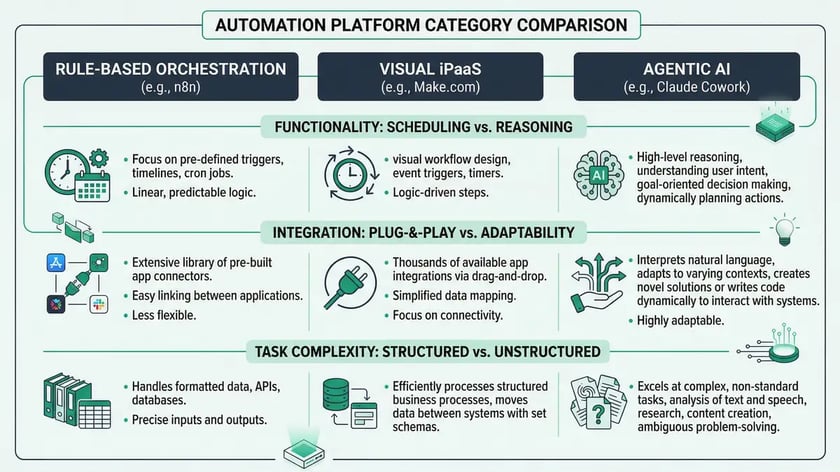
Claude Cowork represents a fundamentally different approach to automation — one grounded in reasoning, adaptation, and natural language direction rather than predefined workflows. Rather than building "if-then" logic chains, you describe what you want done in plain English, and an autonomous agent executes it. This is not a competing platform to n8n or Make.com — it's a complementary paradigm addressing tasks that rule-based orchestration structurally cannot handle.
Cowork operates as a desktop application that reads, writes, and organises files within a designated folder while executing a plan. Its core capabilities include Skills (markdown workflow templates), Commands (slash-command shortcuts), Plugins (bundled skill collections), 37 native OAuth connectors (Gmail, Google Calendar, Slack, Notion, HubSpot, GitHub, Asana, Linear), and Scheduled Tasks for time-based automation. Browser automation enables describing what you want done in a browser, though execution typically takes 2-5 minutes per task — unsuitable for high-volume requirements.
The architectural foundation is Anthropic's Claude Agent SDK, which handles the agent loop automatically — including automatic context compaction when conversations approach token limits. The SDK's subagent orchestration allows specialised agents to be spawned for subtasks: a main agent can determine that security, test coverage, and performance reviews are needed, then spawn three parallel subagents — each with restricted tool access and specialised system prompts — without explicit orchestration code. This is documented in the Claude Agent SDK guide.
Claude Opus 4.6 pricing — USD 5 input / USD 25 output per million tokens — represents a 67% cost reduction from Opus 4.1, with the full 1 million token context window at standard pricing (no premium surcharge). Prompt caching provides up to 90% savings on repeated context, and batch API offers 50% discounts for non-time-sensitive processing. Combined, these optimisations can reduce agentic AI costs by up to 95% compared to baseline pricing, according to the Opus 4.6 announcement.
The Model Context Protocol (MCP) — Anthropic's open standard for AI-to-tool communication, now governed by the Linux Foundation — eliminates the integration multiplication problem. Build an MCP server once, and every MCP-compatible client (Claude, ChatGPT, Gemini, Cursor, VS Code, custom agents) can use it. This network effect is fundamentally different from platform-locked integration ecosystems.
| Capability | n8n | Make.com | Claude Cowork |
| Pricing Model | Per execution | Per operation (credit) | Per token (API) |
| Entry Price | $20/mo (cloud) or free (self-hosted) | Free (1,000 credits) or $9/mo | $20/mo Pro subscription |
| Integrations | 1,200+ pre-built | 3,000+ pre-built | 37 native + MCP ecosystem |
| AI Capabilities | 70 AI nodes, LangChain native | 350+ AI app integrations | Native reasoning, subagents |
| Self-Hosting | Yes (free Community Edition) | No (cloud only) | Desktop app (device-dependent) |
| Compliance | SOC 2, GDPR (cloud) | SOC 2/3, ISO 27001, GDPR | Anthropic API terms |
| 24/7 Execution | Yes (cloud or self-hosted) | Yes (cloud) | No (requires desktop running) |
| Best For | Technical teams, high volume | Non-technical teams, speed | Unstructured reasoning tasks |
Sources: n8n Pricing, Make.com Pricing, Claude Cowork
Critical Limitation
Claude Cowork's Scheduled Tasks require the desktop application to remain running — closing your laptop or shutting down your computer prevents scheduled tasks from executing. For organisations requiring reliable, uninterrupted workflow orchestration across distributed teams, this device-dependent execution model is a dealbreaker for production automation. Use Cowork for reasoning-heavy individual tasks; use n8n or Make.com for always-on operational workflows.
How Do You Choose the Right Platform for Your B2B Operations?
Platform selection maps directly to three variables: technical capability, execution volume, and task structure. The evidence from 2026 market data, SMB adoption surveys, and real-world deployments points to a clear decision framework — not a single "best" platform, but a systematic matching of platform strengths to operational requirements.
Assess Your Workflow Complexity and Volume
Count your monthly workflow executions and average steps per workflow. Below 5,000 executions with simple workflows (3-5 steps), Make.com's free or Core plan delivers the best economics. Above 10,000 executions with complex workflows (6+ steps), n8n's execution-based pricing generates USD 3,000-22,000+ annual savings. Map your actual numbers before evaluating platforms.
Evaluate Your Team's Technical Capability
If your team includes developers comfortable with APIs, Docker, and server administration, n8n self-hosting unlocks maximum cost efficiency. If your team is primarily non-technical marketers, operations managers, or founders, Make.com's visual builder and 3,000+ pre-built integrations reduce implementation time from weeks to days. Be honest about this assessment — a platform requiring DevOps capability without a DevOps team creates operational risk.
Identify Unstructured vs Deterministic Tasks
Rule-based platforms (n8n, Make.com) excel at deterministic workflows — data moves from A to B under known conditions. Claude Cowork excels at unstructured tasks requiring reasoning: email triage, meeting preparation, content drafting, AI-assisted project management. Most B2B operations include both. The question isn't "which one" — it's "which combination."
Match Compliance Requirements to Platform Architecture
Regulated industries (healthcare, finance, legal) require SOC 2/3, ISO 27001, and comprehensive audit trails. Make.com provides these as managed certifications. n8n cloud offers SOC 2 and GDPR; self-hosted places full compliance burden on your organisation. Claude Cowork operates under Anthropic's API terms — suitable for individual productivity, not yet for regulated enterprise workflows.
The optimal approach for most B2B companies is a hybrid deployment model: Make.com for rapid, managed-infrastructure automation with broad integration needs; n8n (self-hosted or cloud) for high-volume, cost-optimised workflows requiring developer customisation; and Claude Cowork for individual knowledge worker productivity and reasoning-intensive tasks. SMBs reporting 32% average reductions in routine administrative work and 28% increases in pipeline sourced through automation adoption, according to AutomationFlow, provide clear ROI justification for deploying the right platform — or combination — now.
| B2B Profile | Recommended Primary | Recommended Secondary | Rationale |
| Early-stage SaaS ($1-5M ARR) | Make.com Core/Pro | Claude Cowork | Speed-to-value, limited DevOps |
| Mid-market SaaS ($10-40M ARR) | n8n Cloud or self-hosted | Make.com for non-tech teams | Volume economics, developer capability |
| Boutique recruiting firm | Make.com Pro/Teams | Claude Cowork for sourcing | Integration breadth, compliance |
| High-ticket consultant/coach | Claude Cowork | Make.com Free/Core | Freedom Machine for solopreneurs |
| Enterprise (regulated industry) | Make.com Enterprise | n8n self-hosted (data sovereignty) | Compliance certifications, SLAs |
Sources: Softailed n8n vs Make 2026, Make.com Comparison
Key Takeaway
The n8n vs Make debate is a false binary. 40% of enterprise applications already incorporate agentic AI capability as of 2026, and organisations that refused automation adoption in 2025 experienced twice as many CRM data errors, 33% slower follow-up times, and 21% lower win rates. The real question is how quickly you can deploy the right combination of deterministic orchestration and agentic intelligence for your specific B2B growth architecture.
Stop Comparing Platforms. Start Architecting Your Automation Stack.
peppereffect installs AI-powered operating systems for B2B companies — integrating workflow orchestration, agentic automation, and CRM intelligence into a single growth architecture. Book a Growth Mapping Call to identify the exact automation combination that fits your operations.
Book Your Growth Mapping CallSee how automated fulfillment systems scale delivery without headcount →
Frequently Asked Questions
Is n8n really free?
n8n's Community Edition is genuinely free for self-hosted deployments — you can run unlimited workflow executions on your own server infrastructure. The trade-off is that you assume full responsibility for server provisioning, security updates, monitoring, and backups. n8n's cloud-hosted plans start at USD 20/month for 2,500 executions. For B2B teams without DevOps capability, the cloud option eliminates infrastructure burden while maintaining n8n's execution-based pricing advantage over per-operation models. Self-hosting typically costs USD 20-30/month for VPS infrastructure capable of handling one million monthly executions.
Can Make.com handle enterprise-level compliance requirements?
Yes. Make.com maintains SOC 3, SOC 2 Type II, ISO 27001, and GDPR compliance certifications with infrastructure on Amazon AWS. Enterprise plans include SSO (OAuth2/SAML2), role-based access controls, on-premises agents for secure local network access, comprehensive audit logs, and 24/7 priority support with defined SLAs. This compliance framework directly supports regulated industries including healthcare, financial services, and government — a significant advantage over n8n's more limited cloud certifications or Claude Cowork's API-based model.
What is Claude Cowork and how does it differ from n8n and Make?
Claude Cowork is an agentic AI desktop application that automates tasks through natural language reasoning rather than predefined workflow logic. Unlike n8n and Make.com, which execute deterministic "if-then" workflows, Cowork interprets intent, reasons through tasks, and determines the best action autonomously. It connects to 37 native apps and can leverage the Model Context Protocol (MCP) for broader tool access. The key limitation: it requires your desktop to remain running for scheduled tasks, making it unsuitable as a primary 24/7 automation platform for B2B operations.
Which platform is best for B2B lead generation automation?
For B2B lead generation, Make.com typically provides the fastest path to production due to pre-built integrations with CRMs (HubSpot, Salesforce), email platforms, and enrichment tools. For high-volume teams running 10,000+ monthly lead processing workflows, n8n's execution-based pricing delivers significant cost savings. Claude Cowork can supplement either platform by handling unstructured tasks like prospect research, personalised email drafting, and meeting preparation that rule-based workflows cannot address.
How does MCP change the automation platform landscape?
The Model Context Protocol (MCP) is an open standard — now governed by the Linux Foundation — that standardises how AI models connect to external tools and data sources. Rather than building custom integrations between each AI platform and each tool (an N×M scaling problem), MCP defines a single protocol usable by any AI application. Build an MCP server once, and Claude, ChatGPT, Gemini, and thousands of custom agents can use it. This fundamentally shifts the integration calculus: platform-locked ecosystems lose their moat as MCP-compatible tools become universally accessible across AI platforms.
Can I use n8n and Make.com together?
Yes, and many mature B2B operations do exactly this. A common architecture uses Make.com for rapid, non-technical team automations (marketing workflows, simple CRM triggers) and n8n for high-volume, developer-built pipelines (data processing, complex multi-step AI workflows, self-hosted cost optimisation). The platforms can even trigger each other via webhooks, enabling a best-of-both approach that matches platform strengths to specific workflow requirements without forcing a single-vendor decision. n8n workflow templates the full field of automation tools n8n limitations three-way cost comparison with Zapier
Keep architecting: related reading and systems
Go deeper: see the AI workflow automation framework and the agentic workflows playbook for how these platforms fit an autonomous stack.
Install the systems: whichever platform you choose, the ROI is in what you build on it. Deploy AI operations and workflow orchestration, AI lead generation systems, and sales administration automation.
Resources
- n8n Pricing — Official pricing page with execution-based plan comparison
- Make.com Pricing — Credit-based plans from Free to Enterprise
- Grand View Research — iPaaS Market Analysis and Growth Projections
- Anthropic — Building Agents with the Claude Agent SDK
- Model Context Protocol — Official specification and introduction
- Softailed — n8n vs Make.com Comprehensive Comparison 2026
- Grand View Research — RPA Market Size and Growth Analysis
- AutomationFlow — n8n vs Make.com for B2B Operations