

What Is a Marketing Automation Platform and Why Do 73% of B2B Implementations Fail to Deliver?
A marketing automation platform is an integrated software system that executes, measures, and optimizes multi-channel marketing campaigns — email sequences, lead scoring, nurture workflows, landing pages, and attribution reporting — without requiring manual intervention at each step. For B2B SaaS companies scaling from $10M to $40M ARR, the right marketing automation platform is the infrastructure that decouples pipeline growth from headcount. The wrong one becomes a $50,000+ annual cost center that actively degrades marketing performance. According to MarketsandMarkets 2025 analysis, the global marketing automation market reached $47.02 billion in 2025 and is projected to hit $81.01 billion by 2030 at an 11.5% CAGR — confirming this is no longer an optional technology layer but the operational backbone of modern B2B growth.
The problem is not adoption — it's execution. HelloRoketto's implementation analysis found that approximately 73% of marketing automation implementations fail or underperform, with only 10% of organizations achieving fully automated customer journeys. EmailVendorSelection's 2026 benchmark data confirms that just 29% of B2B marketers describe their marketing automation as "very successful," while 65% call it "somewhat helpful" — a polite way of saying the platform isn't generating the ROI that justified the purchase. For a mid-market SaaS CEO evaluating platforms, the decision isn't which software has the most features. It's which marketing automation architecture will actually execute against your growth targets without requiring a dedicated operations team to babysit it.
What you'll learn in this article:
- Why 73% of marketing automation implementations underperform and how to avoid the same fate
- The measurable ROI benchmarks B2B companies report — from 30x email revenue per recipient to 14.5% sales productivity gains
- How to evaluate the five leading mid-market platforms (HubSpot, Marketo, Salesforce, ActiveCampaign, and emerging agentic alternatives automation tools beyond Zapier the right workflow automation tool)
- A 5-step evaluation framework for selecting the right marketing automation platform for your growth stage
- How AI-powered agentic platforms are redefining what marketing automation can do — and when the upgrade makes sense
Key Takeaway
The marketing automation platform market is massive ($47B+) and growing rapidly, yet 73% of implementations fail to deliver expected results. The gap between platform capability and realized value is not a technology problem — it's an architecture and execution problem. Companies that treat platform selection as an IT procurement decision rather than a strategic growth architecture decision consistently underperform. The 29% who succeed share a common trait: they invest in integration depth, data quality, and workflow design before evaluating feature lists.

What ROI Do B2B Companies Actually Report From Marketing Automation?
The headline statistics are compelling but require careful decomposition. MarketingLTB's 2025 automation benchmark reports that 80% of marketers using automation report increased leads and 77% report higher conversion rates. But the delta between top performers and average implementations is enormous — and that delta determines whether your platform investment drives growth or becomes an expensive email-sending tool.

EmailVendorSelection's 2026 research reveals the performance gap most clearly: the top 10% of email automation workflows generate $16.96 revenue per recipient compared to $1.94 average — an 8.7x performance multiplier. Abandoned cart workflows reach $28.89 per recipient for top performers versus $3.65 average. Welcome flows hit $21.18 versus $2.65. These aren't marginal differences. They represent fundamentally different approaches to workflow design, segmentation, and pipeline architecture.
The productivity impact extends beyond marketing into sales operations. Marketing automation integrated with CRM systems delivers approximately 14.5% uplift in sales productivity through automated lead routing, consistent follow-up sequencing, and reduced administrative burden on SDRs. Overall marketing operational overhead drops by approximately 12.2% through task automation and workflow optimization. For a $20M ARR SaaS company with a 15-person marketing and sales team, these efficiency gains translate to $300,000-$500,000 in annual capacity recovery — the equivalent of 2-3 additional FTEs without additional headcount.
Customer acquisition cost dynamics add further urgency. Genesys Growth's CAC benchmark analysis shows that CAC has increased 60% over the past five years industry-wide, yet sophisticated automation implementations offset this trend through superior targeting — advanced personalization alone can reduce CAC by up to 50% while simultaneously driving 10-15% revenue increases. The median new customer acquisition cost ratio reached $2.00 in 2024, making CAC management the primary financial lever for capital-efficient B2B growth.
| Metric | Average Performance | Top 10% Performance | Multiplier |
| Email automation revenue/recipient | $1.94 | $16.96 | 8.7x |
| Welcome flow revenue/recipient | $2.65 | $21.18 | 8.0x |
| Abandoned cart revenue/recipient | $3.65 | $28.89 | 7.9x |
| Automated vs. traditional campaign ROI | — | — | 30x per recipient |
| Sales productivity uplift (with CRM) | 14.5% | — | — |
| Marketing overhead reduction | 12.2% | 35%+ (22% of users) | — |
Sources: EmailVendorSelection 2026, MarketingLTB 2025
How Do the Leading B2B Marketing Automation Platforms Compare for Mid-Market SaaS?
For mid-market B2B SaaS companies ($10M-$40M ARR, 50-200 employees), the platform landscape consolidates around five realistic options — each with distinct strengths, limitations, and total cost profiles. The Digital Bloom's Q4 2025 martech stack analysis shows HubSpot and Salesforce dominating B2B martech penetration at 45.8% and 50% respectively. Both HubSpot and Adobe Marketo earned Leader status in the 2025 Gartner Magic Quadrant for B2B Marketing Automation Platforms, confirming their enterprise-readiness while maintaining mid-market accessibility.

HubSpot Marketing Hub ($10,680-$50,000/year at Pro/Enterprise tiers) offers the strongest native CRM integration in the mid-market. The platform's competitive advantage is its unified data model — marketing, sales, and service operate on the same contact record, eliminating the synchronization failures that plague multi-tool stacks. HubSpot Breeze, the platform's AI layer, introduces predictive lead scoring, dynamic nurture sequences, and automated content optimization. For companies already using HubSpot CRM, the marginal cost of adding Marketing Hub is substantially lower than implementing a separate platform requiring CRM integration. The limitation: enterprise customization flexibility lags behind Marketo for complex multi-brand, multi-territory architectures.
Adobe Marketo Engage ($15,000-$60,000/year plus $10,000-$50,000 implementation) is the established enterprise choice for organizations requiring sophisticated lead scoring models, account-based marketing orchestration, and complex multi-touch attribution. Marketo's 2025 Gartner Leader positioning reflects its depth in B2B-specific workflows. The trade-off: higher total cost of ownership ($35,000-$145,000 first-year TCO), steeper learning curves, and per-contact pricing that penalizes large databases with low engagement rates.
Salesforce Marketing Cloud ($50,000-$150,000/year) targets organizations deeply embedded in the Salesforce ecosystem. Its Einstein AI layer offers predictive journey orchestration across email, web, and advertising channels with cross-cloud integration capabilities. The investment level and complexity make it best suited for companies already running Salesforce CRM and Sales Cloud, where the integration depth justifies the premium pricing.
ActiveCampaign ($5,000-$20,000/year) represents the cost-effective mid-market alternative with surprisingly robust automation capabilities. For B2B SaaS companies in the $5M-$15M ARR range preparing to scale, ActiveCampaign delivers 80% of HubSpot's automation functionality at 20-40% of the cost, though it lacks the CRM depth and AI-powered sales tools that larger organizations require.
| Platform | Annual Cost (Mid-Market) | Best For | Primary Limitation |
| HubSpot Marketing Hub | $10,680–$50,000 | Unified CRM + marketing stack | Enterprise customization flexibility |
| Adobe Marketo Engage | $15,000–$60,000 | Complex ABM + multi-touch attribution | TCO + learning curve |
| Salesforce Marketing Cloud | $50,000–$150,000 | Salesforce-native organizations | Cost + complexity for non-SF shops |
| ActiveCampaign | $5,000–$20,000 | Cost-effective scaling (pre-$15M ARR) | CRM depth + AI capabilities |
| Brevo (formerly Sendinblue) | $1,000–$12,000 | Email-first automation (early stage) | B2B workflow sophistication |
Sources: Etropo 2026, HubSpot/Gartner 2025
Key Takeaway
Platform selection is not a feature-comparison exercise — it's a total cost of ownership and integration architecture decision. Etropo's 2026 pricing analysis shows first-year TCO ranging from $20,000 to $150,000 depending on platform, implementation complexity, and integration scope. The 73% failure rate maps directly to organizations that optimize for feature breadth rather than integration depth with their existing operational workflows. A $15,000/year platform perfectly integrated with your CRM will outperform a $60,000/year platform running as a disconnected silo.

Why Do 73% of Marketing Automation Implementations Fail and How Do You Avoid It?
The 73% failure rate is not a platform problem — it's a deployment architecture problem. HelloRoketto's analysis identifies five systemic failure modes that recur across platforms regardless of vendor: data quality degradation, inadequate integration architecture, absence of workflow strategy, insufficient change management, and unrealistic timeline expectations.
Data quality is the foundational failure. Marketing automation amplifies whatever data enters it. If contact records contain duplicate entries, outdated attributes, and inconsistent field mappings, automation workflows execute against corrupted inputs — sending wrong content to wrong segments, scoring leads on incomplete behavioral data, and generating attribution reports that actively mislead decision-making. Organizations that skip data cleansing and governance before platform deployment experience the highest failure rates because every subsequent workflow inherits the foundational data corruption.
Integration architecture failures compound the data problem. The Digital Bloom's martech research shows the average B2B company runs 9-12 marketing tools. When the marketing automation platform fails to synchronize bidirectionally with CRM, sales engagement tools, and analytics platforms, teams operate on conflicting data — marketing reports pipeline contributions that sales doesn't recognize, and lead handoff processes break at the integration boundary.
The timeline trap is equally destructive. 63% of companies expect automation benefits within six months, but only 44% achieve positive returns in that timeframe. MarketingGuys' implementation timeline research shows that mid-market CRM and marketing automation deployments typically require 60-90 days for initial configuration, with 6-12 months to reach operational maturity. Companies that attempt to compress this timeline by skipping data migration quality checks and workflow testing consistently underperform those that invest in disciplined, phased deployment.
Avoid This Mistake
Don't evaluate marketing automation platforms based on demo environments with perfect data. The EmailVendorSelection research showing only 10% of organizations achieving fully automated customer journeys reveals that the gap between platform capability and organizational readiness is the primary performance bottleneck. Before any platform evaluation, audit your current data quality (duplicate rate, field completion rate, segmentation accuracy) and integration architecture (sync frequency, field mapping consistency, data flow direction). These factors determine platform ROI more than any feature comparison.
Need help designing a marketing automation architecture that actually delivers? Explore peppereffect's Marketing Infrastructure systems built for B2B scale.
Book a Growth Architecture Call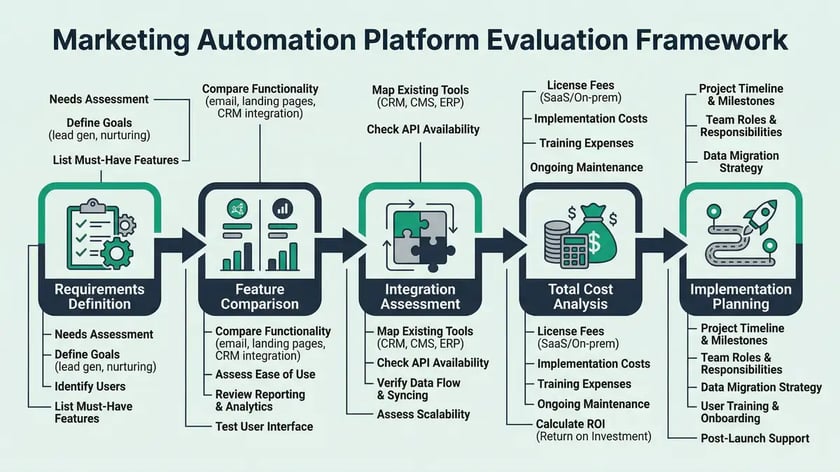
How Do You Evaluate and Select a Marketing Automation Platform in 5 Steps?
The companies that land in the successful 27% — those reporting their marketing automation as "very successful" — follow a structured evaluation process that prioritizes integration architecture and operational fit over feature checklists. Here is the 5-step framework that prevents the most common selection mistakes.
Map Your Revenue Architecture Before Evaluating Platforms
Document every touchpoint in your current lead-to-revenue process: lead sources, qualification criteria, nurture sequences, handoff triggers, deal stages, and attribution model. This map reveals which automation capabilities are critical versus nice-to-have. A company with a 90-day enterprise sales cycle needs sophisticated multi-touch attribution and lead scoring — features that justify Marketo's premium. A product-led growth company with a 14-day trial-to-paid cycle needs speed and simplicity — where HubSpot or ActiveCampaign excels.
Audit Integration Requirements Against Your Existing Stack
List every tool that must exchange data with the marketing automation platform: CRM, sales engagement, customer success, analytics, advertising platforms, and content management. Score each platform on native integration depth (bidirectional sync, real-time vs. batch, field mapping flexibility) rather than counting integration logos. A platform with 500 integrations but shallow CRM sync will underperform one with 50 integrations and deep, real-time CRM bidirectional data flow.
Calculate Total Cost of Ownership Across 3 Years
Platform subscription is typically 40-60% of total cost. Add: implementation ($10,000-$50,000), training ($2,000-$10,000), integration development ($5,000-$20,000), ongoing optimization ($5,000-$15,000/year), and contact/usage growth projections. Etropo's pricing analysis shows first-year TCO ranging from $20,000 (ActiveCampaign) to $150,000+ (Salesforce Marketing Cloud). Model your 3-year TCO at current growth rate and at 2x contact volume to avoid pricing cliffs that force migration mid-scale.
Run a Proof-of-Concept Against Your Actual Data
Never evaluate platforms on demo data. Import your real contact database, build one complete lead nurture workflow, connect your actual CRM, and measure: sync reliability, workflow execution accuracy, reporting fidelity, and user adoption friction. This proof-of-concept eliminates 80% of post-purchase surprises because it exposes integration gaps, data quality issues, and usability barriers that demos conceal.
Evaluate AI and Agentic Readiness for the Next 3 Years
The marketing automation category is undergoing a fundamental shift from rule-based workflows to AI-powered agentic systems. Glean's 2025 research shows the AI agent market growing at 40.8% CAGR to $50.31B by 2030, with 66% of companies deploying AI agents reporting increased productivity. Evaluate each platform's AI roadmap: predictive lead scoring, autonomous campaign optimization, AI content generation, and agentic workflow capabilities. Choose a platform that won't require replacement as AI capabilities mature.
How Are AI-Powered Agentic Platforms Redefining Marketing Automation in 2026?
The distinction between traditional marketing automation and agentic AI is the difference between executing predefined rules and deploying autonomous intelligence. Conventional platforms follow if-then logic — if a contact opens an email, send a follow-up in 3 days. Agentic systems analyze behavioral patterns across channels, predict buyer intent, dynamically adjust engagement strategies, and continuously optimize performance without human intervention. According to Glean's autonomous AI research, the global AI agent market reached $5.40 billion in 2024 and is projected to hit $50.31 billion by 2030 — a 40.8% CAGR that signals marketing automation's fundamental architectural evolution.
The measurable impact is already visible. Companies deploying AI agents report 66% increased productivity, 57% cost savings, 55% faster decision-making, and 54% improved customer experience. Daily AI users are 3x more likely to save 4+ hours weekly (33.5%) compared to weekly users (11.5%). Netcore Cloud's agentic platform analysis shows brands achieving 30%+ conversion lifts after migrating to agentic marketing stacks — driven by autonomous audience discovery, real-time optimization, and self-learning campaign orchestration.
For mid-market B2B SaaS, the practical question is timing. HubSpot Breeze introduces agentic capabilities within the familiar HubSpot ecosystem — AI-based lead scoring, dynamic nurture sequences, and automated content optimization. Salesforce Einstein powers predictive journey orchestration with cross-cloud integration. These aren't experimental features; they're production-ready capabilities that the leading AI agencies are already deploying for their clients. The evaluation framework in Step 5 above applies: choose a platform whose AI capabilities align with your current data maturity and 3-year growth trajectory, not one that requires capabilities you won't be ready to leverage for 18 months.
Key Takeaway
Agentic AI is not a future consideration — it's a current platform differentiator. Organizations implementing marketing automation with AI agent components report $5.44 return for every $1 invested (544% ROI over 3 years). The shift from rule-based automation to autonomous intelligence represents the same magnitude of change as the original shift from manual marketing to automation. Companies selecting a marketing automation platform today without evaluating AI roadmaps are making a 2015 decision with a 2026 budget. The Freedom Machine philosophy applies directly: choose infrastructure that scales autonomously rather than requiring proportional human input as volume grows.
Frequently Asked Questions
What are marketing automation platforms used for?
Marketing automation platforms execute multi-channel campaigns — email sequences, lead scoring, nurture workflows, landing pages, social scheduling, and attribution reporting — without manual intervention at each step. For B2B companies, the primary use cases are lead generation workflow automation, MQL-to-SQL qualification scoring, pipeline nurture sequences, and campaign performance attribution. MarketingLTB research shows 80% of marketers report increased lead volume and 77% report higher conversion rates after implementing automation, though success depends heavily on integration quality and workflow design rather than platform features alone.
How much does a marketing automation platform cost for B2B?
Mid-market B2B costs range from $5,000 to $150,000+ annually depending on platform and scope. ActiveCampaign runs $5,000-$20,000/year as the cost-effective option. HubSpot Marketing Hub Pro/Enterprise costs $10,680-$50,000/year. Adobe Marketo ranges $15,000-$60,000/year plus $10,000-$50,000 implementation. Salesforce Marketing Cloud runs $50,000-$150,000/year. Etropo's analysis shows first-year total cost of ownership — including implementation, integration, and training — typically ranges $20,000-$150,000. Always calculate 3-year TCO including contact volume growth projections.
What is the best marketing automation platform for B2B SaaS?
There is no universal "best" — optimal selection depends on your existing technology stack, growth stage, and budget. HubSpot Marketing Hub leads for companies wanting unified CRM and marketing on one platform with strong mid-market accessibility. Adobe Marketo excels for complex ABM, multi-touch attribution, and enterprise-scale sales orchestration. ActiveCampaign offers the best value for pre-$15M ARR companies. Both HubSpot and Marketo hold Leader positions in the 2025 Gartner Magic Quadrant. The decision should be driven by integration architecture fit, not feature comparison.
Why do marketing automation implementations fail?
Approximately 73% of implementations fail or underperform due to five systemic causes: poor data quality (duplicate contacts, incomplete fields, inconsistent mappings), inadequate CRM integration (one-way sync, batch delays, field mismatches), absence of workflow strategy (building automation before defining the lead-to-revenue process), insufficient change management (teams reverting to manual processes), and unrealistic timelines (expecting results in weeks when maturity requires 6-12 months). Only 10% of organizations achieve fully automated customer journeys, confirming that technology deployment without operational readiness guarantees underperformance.
How does marketing automation improve MQL-to-SQL conversion?
First Page Sage 2026 data shows average MQL-to-SQL conversion at 13% in B2B SaaS. Marketing automation improves this through behavioral lead scoring (identifying purchase intent signals beyond form fills), AI-powered scoring models that predict conversion likelihood, automated nurture sequences that accelerate qualification, and real-time lead routing that eliminates handoff delays. Organizations implementing comprehensive attribution through integrated martech stacks increase conversion rates by 20-35% through optimized targeting and messaging refinement.
What is the difference between marketing automation and CRM?
CRM (Customer Relationship Management) manages contact records, deal pipelines, and customer interactions — it's the system of record for relationships. Marketing automation executes campaigns against those records — email sequences, lead scoring, content delivery, and attribution tracking. The two systems are complementary: CRM provides the data foundation, marketing automation provides the execution engine. The critical integration point is bidirectional sync — when marketing automation and CRM share real-time data, lead scoring reflects sales interactions, nurture sequences adapt to deal stage changes, and attribution reporting captures the full buyer journey.
When should a B2B company upgrade to agentic marketing automation?
Upgrade when you have clean data, mature workflows, and volume that justifies AI optimization. Companies with fewer than 5,000 contacts or immature lead scoring should focus on foundational automation first. Organizations processing 10,000+ leads monthly with established nurture workflows and attribution models gain the most from agentic capabilities — predictive scoring, autonomous campaign optimization, and dynamic content personalization. The 544% ROI reported for AI agent implementations concentrates among organizations with strong data foundations, making data maturity the prerequisite for agentic platform value.
Architect a Marketing Automation System That Scales With Your Revenue
peppereffect designs and deploys marketing automation infrastructure for B2B SaaS companies — from platform selection and integration architecture to workflow design and AI-powered optimization. Stop paying for platforms that underperform. Start building the growth engine your ARR targets demand.
Book Your Growth Architecture CallResources
- MarketsandMarkets — Marketing Automation Software Market Report 2025-2030
- EmailVendorSelection — Marketing Automation Statistics 2026
- MarketingLTB — Marketing Automation Statistics and Benchmarks 2025
- Etropo — Marketing Automation Platform Pricing Comparison 2026
- HubSpot — 2025 Gartner Magic Quadrant for B2B Marketing Automation
- Glean — How Autonomous AI Agents Enhance Campaign Planning 2025
- HelloRoketto — Why Marketing Automation Implementations Fail
- Genesys Growth — Customer Acquisition Cost Benchmarks 2025