What Is B2B Landing Page Optimization — And Why Do Most Companies Get It Wrong?
Most B2B companies treat landing pages as digital brochures. A logo, a paragraph of corporate-speak, a form with 15 fields, and a "Submit" button. Then they wonder why 97% of their paid traffic bounces without converting.
The engineering approach to B2B landing page optimization treats every element on the page as a variable in a conversion equation. Headlines, form fields, social proof placement, page speed, CTA copy — each one is measurable, testable, and improvable. The difference between a 2.1% conversion rate and a 5.2% conversion rate is not creative genius. It is systematic optimization applied over 12 months.
According to the Unbounce Conversion Benchmark Report, the median B2B SaaS landing page converts at 3.8%, while bottom-quartile pages languish below 1.5%. Top performers reach 8-12%. That gap — a 5-8x multiplier — is entirely engineered, not accidental.
What you'll learn in this guide:
- The exact conversion rate benchmarks for B2B landing pages by industry — and where your pages likely fall
- How above-the-fold engineering (headline, value proposition, CTA placement) drives 45-65% conversion lift
- Why reducing form fields from 10 to 5 can increase conversions by 95% — and how progressive profiling maintains data quality
- The social proof hierarchy: which trust elements deliver 8-84% conversion lift and in what order
- How systematic A/B testing programs compound to 50-85% annual conversion improvement
- AI-powered personalization tactics generating 15-35% lift on B2B landing pages right now
Key Takeaway
B2B landing page optimization is not a creative exercise — it is an engineering discipline. Every element is a measurable variable. Systematic testing compounds over 12 months to deliver 50-150% cumulative conversion lift, turning the same traffic into 2-3x more qualified pipeline.
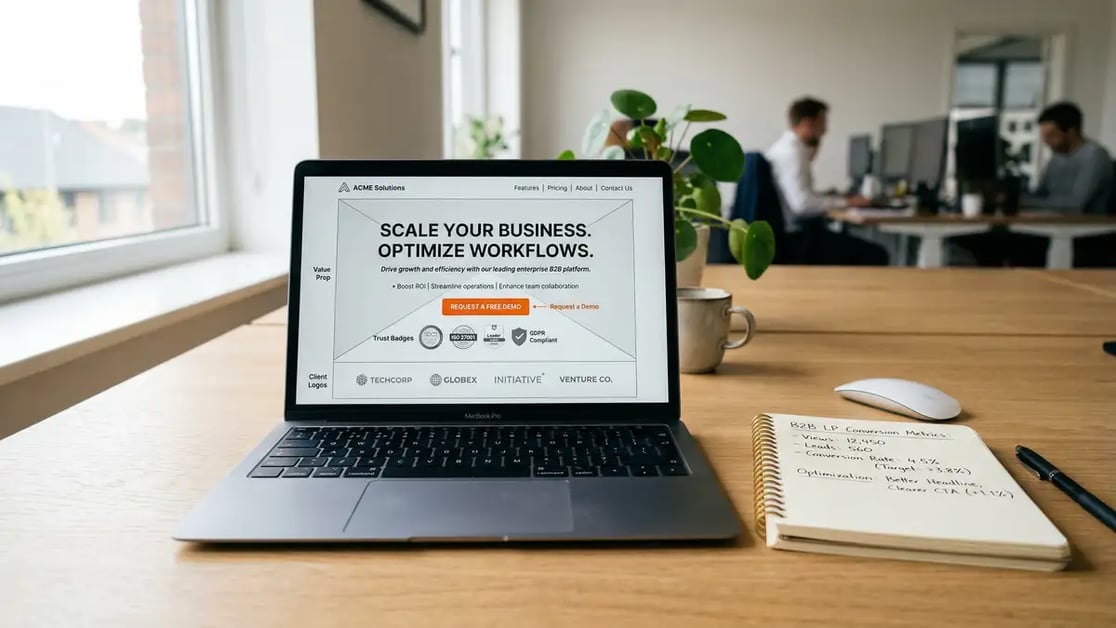
What Are Good Conversion Rate Benchmarks for B2B Landing Pages?
Before you optimize, you need a baseline. The Unbounce B2B conversion rate analysis provides the most comprehensive benchmark data available, drawn from over 41,000 landing pages and 464 million visits.
| Industry | Average CR | Top Quartile | Bottom Quartile |
| SaaS | 3.2-3.8% | 8-12% | <1.5% |
| Professional Services | 2.1% | 5-7% | <1% |
| Consulting | 1.9% | 4-6% | <0.8% |
| Recruiting / HR Tech | 2.8% | 6-9% | <1.2% |
| B2B Marketing Tech | 3.5% | 9-14% | <1.8% |
Sources: Unbounce Conversion Benchmark Report 2024, HubSpot B2B CRO Guide
The critical insight: top-quartile pages convert 3-5x higher than the median. This is not a marginal improvement. If your B2B lead generation engine drives 10,000 monthly visitors to a landing page converting at 2%, you generate 200 leads. At 6%, you generate 600 leads — from the same traffic spend. That is the power of conversion rate engineering.
Mobile versus desktop performance reveals another optimization gap. Desktop B2B pages convert at 2.8-3.4%, while mobile converts at just 1.8-2.2% — a 32-35% underperformance margin. Yet mobile represents 55-65% of B2B landing page traffic. Companies that close this gap through mobile-first optimization reduce the deficit to 8-12%, unlocking substantial hidden pipeline.

How Does Form Engineering Drive B2B Landing Page Conversions?
The form is where conversion lives or dies. Every additional field is friction. Every friction point is a lost lead. The HubSpot Form Optimization Study quantified this with precision: reducing form fields from 10 to 3 increases conversion by 156%.
| Form Fields | Expected Conversion Rate | Lift vs. 10-Field Form |
| 3 fields | 7.2% | +156% |
| 5 fields | 5.4% | +95% |
| 7 fields | 3.8% | +37% |
| 10 fields | 2.8% | Baseline |
| 15 fields | 1.2% | -57% |
Source: HubSpot Form Optimization Study 2024
But fewer fields means less data — which is where progressive profiling changes the equation. Instead of requesting all information upfront, progressive forms collect incrementally across multiple interactions. First visit: email and company name. Second visit: job title and company size. Third visit: budget range and timeline.
The results are dramatic. According to Marketo's progressive profiling documentation, this approach increases form completion by 38-60% while maintaining 85-90% data quality for progressive fields. You collect more data over time without sacrificing first-touch conversion.
Multi-step forms represent another high-leverage tactic. Breaking a single form into two or three steps reduces perceived friction and creates micro-commitment momentum. Two-step forms convert 27-44% higher than single-step equivalents. The key: step one asks only for minimal information (email and company name), letting prospects self-select interest before asking for more.
Smart forms with conditional logic push this further. Forms that dynamically show or hide fields based on previous answers achieve 41-74% conversion improvement over static forms. For example, hiding the "Budget" field for companies under 100 employees increased form completion by 31% in one B2B case study, while maintaining data quality for larger enterprise prospects.
Key Takeaway
Form optimization is the highest-ROI lever on any B2B landing page. Combine field reduction (5-7 fields maximum), progressive profiling (38-60% lift), and multi-step structure (27-44% lift) to engineer a lead capture system that maximizes both conversion volume and data quality.
How Does Above-the-Fold Engineering Affect B2B Conversion Rates?
The first 600 pixels of viewport real estate determine whether a visitor engages or bounces. Above-the-fold engineering is where the highest-impact variables live: headline, value proposition, hero section, and primary CTA.
Headline clarity is the single most impactful above-the-fold element. Specific value propositions in headlines — those that directly address a quantified business outcome — increase B2B landing page conversion by 45-65% compared to generic feature-first headlines. A headline like "Cut Your Sales Cycle by 40% With Automated Proposal Generation" outperforms "Advanced Proposal Software for Teams" by a factor of two or more.
| Headline Type | Average Conversion | Lift vs. Generic |
| Specific Value Proposition | 3.8-4.2% | +45-65% |
| Problem-First (above-fold) | 3.2-3.6% | +25-40% |
| Benefit-Driven | 2.8-3.2% | +15-25% |
| Generic / Feature-First | 2.0-2.4% | Baseline |
Sources: CXL Landing Page Optimization Guide, Unbounce Testing Database 2024
Value proposition placement compounds the headline effect. Placing your value proposition within the H1 headline (first 100 words) delivers a 3.6-4.2% conversion rate. Delaying it below the fold drops conversion to 2.1-2.4% — a 35-42% reduction. B2B buyers need immediate comprehension of business value. They will not scroll to discover what you do.
CTA button optimization follows a clear hierarchy. The critical finding: CTA copy matters far more than CTA color. Specific, value-driven copy like "See ROI Calculator" converts at 3.8-4.4%, a 65-72% lift over the generic "Submit" button at 2.1-2.5%. First-person language ("Get My Free Audit") adds an additional 3-7% lift. Color differences, by contrast, produce only 2-8% variance — essentially noise.
Strategic CTA placement also drives measurable results. B2B landing pages with 2-4 strategically positioned CTAs — one above-fold, one after the value prop section, one at page bottom — achieve 18-32% higher conversion than single-CTA pages. Multiple entry points capture prospects at different stages of their decision process.
Which Social Proof Elements Drive the Highest B2B Conversion Lift?

Social proof is not a nice-to-have decoration. In B2B, where purchase decisions involve multiple stakeholders and six-figure budgets, proof elements are conversion infrastructure. The hierarchy of impact is clear, and the data is specific.
Video testimonials dominate. According to the Wistia State of Video Report, video testimonials generate a 68-84% conversion lift compared to pages without social proof. The video medium itself adds 34-42% incremental lift over text-only testimonials. Optimal length: 30-90 seconds. Video testimonials featuring the customer's executive (not a generic employee) add another 18-24% lift.
Client logos hit a sweet spot at 3-5 recognizable brands. This delivers 8-15% conversion lift. Adding "Trusted by" language alongside logos pushes the effect to 12-18%. Beyond 6 logos, diminishing returns set in — more logos do not mean more trust. Industry certifications (SOC 2, ISO, HIPAA) deliver 5-12% lift in regulated verticals, while generic security badges now produce minimal impact (2-7%) because they have become baseline expectations.
Case study placement matters as much as case study quality. Positioning a case study above the fold as social proof in the hero or value proposition section converts at 3.6-4.2%, while burying case studies below the fold as optional reading drops conversion to 2.4-2.8% — a 37-51% differential. Integrate your proof into your persuasion architecture, do not relegate it to an afterthought section.
Common Mistake: The Social Proof Graveyard
Many B2B companies create a dedicated "Testimonials" page and link to it from the landing page. This fragments the conversion path. Social proof must live on the landing page itself, positioned strategically between the value proposition and the form. Every click away from the conversion page is a leak in your pipeline.
How Does Page Speed Impact B2B Landing Page Conversions?
Page speed is not a technical detail — it is a conversion variable with precise, measurable impact. Akamai's research quantified the relationship: each additional second of load time results in 7-12% conversion loss. At 5 seconds, you have lost 42-52% of your potential conversions compared to a 1-second baseline.
| Load Time | Avg. Conversion Rate | Loss vs. 1-Second |
| 1 second | 3.2-3.8% | Baseline |
| 2 seconds | 2.9-3.4% | -7-12% |
| 3 seconds | 2.5-2.9% | -18-26% |
| 4 seconds | 2.1-2.5% | -31-40% |
| 5 seconds | 1.8-2.2% | -42-52% |
Source: Akamai Technologies — Website Loading Speed
Core Web Vitals provide the engineering framework. According to Google's Core Web Vitals business impact studies, pages with good LCP (Largest Contentful Paint under 2.5 seconds) achieve 15-22% higher conversion than pages with poor scores. Good CLS (Cumulative Layout Shift under 0.1) adds another 12-18% lift. Vodafone improved LCP by 31% and achieved 8% more sales. Rakuten 24 improved CWV and saw a 33% increase in conversion rate.
For B2B companies running on platforms like HubSpot CMS, the technical foundation — CDN, image optimization, lazy loading — is largely handled. The leverage points are image compression, removing render-blocking JavaScript, and minimizing third-party scripts. Every script you add is a conversion tax.
Ready to engineer your B2B landing pages for maximum conversion? Explore peppereffect's Lead Generation systems — built on the same systematic optimization framework described in this guide.
See Lead Generation ArchitectureHow Do You Build a Systematic A/B Testing Program for B2B?
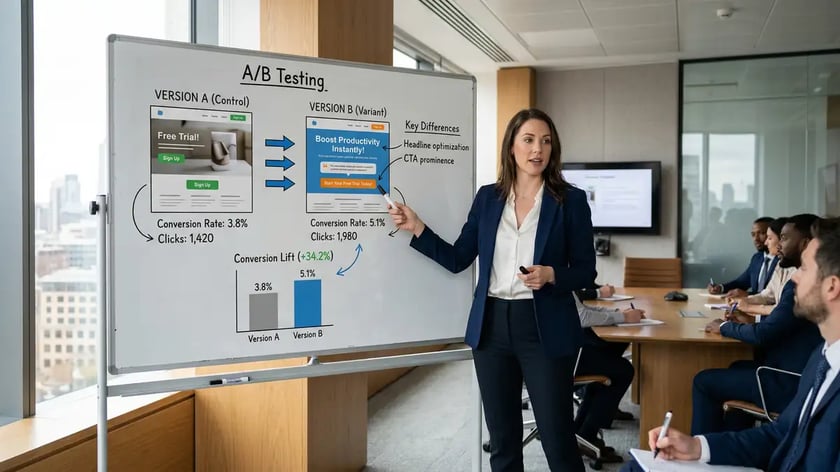
Ad-hoc testing produces ad-hoc results. The VWO experimentation data shows the relationship between testing maturity and annual conversion lift is nearly linear. Companies running 1-2 tests monthly see 5-12% annual lift. Systematic programs running 8-12 tests monthly achieve 35-55% annual lift. Advanced programs with multivariate testing reach 50-85%.
Prioritize by Expected Lift
Test CTA copy and form fields first — they deliver 15-50% lift with the smallest sample sizes. Then headlines and value propositions (15-65% lift). Save color and layout tests for last (2-20% lift). This prioritization framework, validated by CXL's B2B conversion optimization research, maximizes ROI per test cycle.
Engineer for Statistical Significance
B2B landing pages require longer test windows than B2C. At a 2.5% baseline conversion rate with 20% minimum detectable effect, you need 1,200-1,600 visitors per variation — typically 2-4 weeks for most B2B sites. Run tests for a minimum of 2 full weeks to capture weekday and weekend variation patterns.
Compound Through Iteration
Each winning test raises the baseline for the next. At 2 tests per month with an average 10% lift, compounding produces a 2.5% baseline rising to 5.2-5.8% within 12 months — a 108-132% cumulative improvement. This is the engineering approach to pipeline growth: systematic, measurable, compounding.
| Testing Maturity | Tests/Month | Annual Conversion Lift |
| Ad-hoc | 1-2 | 5-12% |
| Structured | 4-6 | 18-28% |
| Systematic | 8-12 | 35-55% |
| Advanced (multivariate) | 15+ | 50-85% |
Sources: VWO A/B Testing Guide 2024, CXL B2B Conversion Optimization
How Is AI Changing B2B Landing Page Optimization?
AI-powered personalization has moved from experimental to essential. The data is unambiguous: AI personalization drives 15-35% conversion lift on B2B landing pages, with combined personalization stacks reaching 30-45%.
The implementation ladder is clear. Dynamic headlines based on traffic source (visitor from LinkedIn sees a different headline than visitor from Google Ads) deliver 12-18% lift. Dynamic CTAs based on visitor profile push this to 15-22%. Personalized value propositions using machine learning segmentation — showing industry-specific messaging to different visitors — achieve 18-28% improvement. Full-page AI personalization, where multiple elements adapt simultaneously, reaches 22-38% lift.
Smart CTAs illustrate the compounding effect. A generic "Get Started" converts at 2.6%. A visitor-source smart CTA like "Schedule SaaS Demo" converts at 3.1% (+19%). An industry-plus-stage CTA like "See ROI for [Your Industry]" reaches 3.7% (+42%). AI-predictive CTAs personalized to buyer intent stage hit 4.4% — a 69% lift over the generic version.
Agentic workflows for automated testing represent the next frontier. These systems run 10-15 test iterations per week autonomously versus 2-4 with manual management. While the category is still emerging, early implementations show 45-75% annual conversion improvement and reach statistical significance 40-60% faster than human-managed programs. For B2B companies with agentic workflow infrastructure already in place, extending those systems to CRO is a natural next step.
Predictive analytics add another layer. Predictive lead scoring now achieves 85-92% accuracy in identifying which leads will convert on first touch. Pairing predictive segmentation with dynamic landing page content yields 22-32% conversion improvement — because you are showing the right message to the right prospect before they even tell you what they need.
Key Takeaway
AI personalization is not a future capability — it is a current competitive advantage. Companies deploying dynamic headlines, smart CTAs, and predictive segmentation on their B2B landing pages are achieving 30-45% conversion lift over static pages. The gap between personalized and static experiences will only widen as AI models improve.
What Does a 12-Month B2B Landing Page Optimization Roadmap Look Like?
Conversion rate optimization is not a project — it is an operating system. The following roadmap sequences quick wins (Month 1) through advanced AI-powered optimization (Months 7-12), with each phase building on the previous baseline.
Months 1-2: Foundation and Quick Wins (Expected Lift: 12-25%)
Reduce form fields to 5-7 maximum. Implement a specific value proposition in the H1 headline. Add above-fold CTA with value-driven copy. Display 3-5 client logos with "Trusted by" language. Optimize page speed to under 3 seconds. These five actions alone — each validated by the benchmarks above — can lift conversion by 12-25% from baseline. For companies running lead generation automation, these form and CTA improvements directly increase the volume of leads entering your nurture sequences.
Months 3-4: Advanced Optimization (Expected Lift: 15-30%)
Launch A/B testing on 3-4 headline variations. Implement progressive profiling on forms. Test multi-step form implementation. Add video testimonials. Deploy mobile-specific design optimizations. Each of these tactics has documented lift ranges in the 15-44% band, and testing them systematically compounds the gains from Month 1.
Months 5-8: Personalization and Automation (Expected Lift: 20-40%)
Deploy dynamic headlines by traffic source. Implement smart CTAs by visitor segment. Set up predictive lead scoring. Establish a systematic A/B testing cadence of 4-6 tests monthly. Optimize Core Web Vitals to "Good" thresholds. This is where CRM automation integration becomes critical — dynamic landing pages must feed into automated lead routing and nurture sequences to capture the full conversion lift.
Months 9-12: Advanced AI and Compounding (Expected Lift: 35-75% cumulative)
Deploy full-page AI personalization. Implement agentic A/B testing workflows. Build predictive personalization stack. Scale systematic testing to 8-12 tests per month. Develop industry-specific landing page variants for each ICP. At this stage, the compounding effect of 12 months of systematic optimization delivers the 50-150% cumulative lift that separates top-quartile performers from everyone else.
Frequently Asked Questions
What is a good conversion rate for B2B landing pages?
A good B2B landing page conversion rate depends on your industry. SaaS landing pages average 3.2-3.8%, while professional services average 2.1% and consulting averages 1.9%. Top-quartile performers across all B2B verticals reach 5-12%. If your pages convert below 2%, there are likely quick wins in headline clarity, form length, and CTA optimization that can deliver significant improvement within 30 days. The Unbounce Conversion Benchmark Report analyzed 41,000+ landing pages to establish these industry-specific benchmarks.
How many form fields should a B2B landing page have?
The optimal range is 3-7 form fields for initial lead capture. HubSpot's research shows reducing from 10 fields to 5 increases conversion by 95%, while dropping to 3 fields delivers 156% improvement. The solution for companies needing more data is progressive profiling — collecting additional fields across subsequent interactions. This approach maintains a 38-60% conversion lift on first touch while achieving 85-90% data completeness over time. Multi-step forms with 2-3 stages add another 27-44% lift.
How to increase conversion rate on B2B landing pages?
Start with the highest-impact variables: CTA copy (15-45% lift), form field reduction (20-50% lift), and headline clarity (15-65% lift). These three elements — tested systematically — can improve conversion by 30-50% within 60 days. Next, add social proof (video testimonials deliver 68-84% lift), optimize page speed below 3 seconds (avoiding 18-26% conversion loss), and implement AI-powered personalization (15-35% lift). The compounding effect of systematic A/B testing programs delivers 50-85% annual improvement.
What is a good lead conversion rate for B2B?
Beyond the landing page, B2B lead-to-opportunity conversion rates typically range from 13-25%, and opportunity-to-close rates from 15-30%, depending on deal complexity and price point. High-ticket services ($50K+) tend toward the lower end of these ranges but compensate with higher contract values. The full funnel matters: a landing page converting at 5% feeding into a proposal automation system with a 20% close rate produces very different unit economics than a 2% landing page with manual follow-up.
Does page speed really affect B2B conversions?
Unequivocally yes. Each additional second of page load time costs 7-12% conversion loss. At 3 seconds, you have lost 18-26% of potential conversions versus a 1-second baseline. Core Web Vitals matter equally: pages with good LCP (under 2.5 seconds) achieve 15-22% higher conversion than pages with poor scores. For B2B companies, where each lead may be worth $1,000-$10,000 in pipeline value, a 20% conversion loss from slow page speed translates directly to substantial revenue impact.
How does AI personalization improve B2B landing page performance?
AI-powered personalization delivers 15-35% conversion lift through dynamic content adaptation. The simplest implementation — dynamic headlines based on traffic source — produces 12-18% lift. Smart CTAs personalized to visitor segment add 15-22%. Full-page AI personalization, where headline, CTA, value proposition, and social proof all adapt simultaneously, achieves 22-38% lift. Predictive analytics that score visitor intent in real-time reach 25-35% improvement. Companies with existing AI workflow automation infrastructure can extend these capabilities to landing page optimization with minimal additional investment.
What should I A/B test first on a B2B landing page?
Test CTA copy and placement first (15-45% expected lift, fastest to validate). Then form field count and structure (20-50% lift). Then headline and value proposition (15-65% lift, but requires larger sample sizes). Save design elements like color scheme and layout for later — they produce only 2-20% lift and require the longest test windows. B2B sites typically need 1,200-1,600 visitors per variation for statistical significance at 95% confidence, so prioritize high-impact tests that will show results within your traffic constraints.
Engineer Your Landing Pages for Maximum Conversion
peppereffect architects high-performance B2B growth systems — from landing page conversion engineering to full-funnel automation. Stop guessing. Start engineering.
Book Your Growth Mapping CallRead: B2B Website Architecture Guide → B2B conversion rate optimization
Resources
- Unbounce Conversion Benchmark Report — Industry-specific conversion rate data from 41,000+ landing pages
- HubSpot Form Optimization Guide — Form field impact on conversion rates with 40,000+ page analysis
- CXL B2B Conversion Optimization — Testing frameworks and prioritization for B2B landing pages
- Google Core Web Vitals Business Impact — Case studies linking page performance to conversion outcomes
- VWO A/B Testing Guide — Comprehensive experimentation methodology and sample size calculations
- Wistia State of Video Report — Video testimonial engagement data and B2B conversion impact
- CXL Landing Page Optimization Process — Above-the-fold testing and headline optimization research
- HubSpot CRO Strategy Guide 2026 — Complete conversion rate optimization framework for B2B