

What Is Lead Generation Automation — and Why Does Pipeline Still Depend on Headcount?
Lead generation automation is the systematic deployment of software, AI agents, and logic-gated workflows to identify, engage, and qualify potential buyers — without proportional increases in headcount. For B2B companies scaling past $10M ARR, it represents the single highest-leverage investment available: replacing manual prospecting hours with autonomous systems that run 24/7 across email, LinkedIn, and web channels.
The numbers back this up. The global marketing automation market reached $7.23 billion in 2025 and is projected to hit $8.14 billion in 2026, growing at a 12% CAGR. B2B companies represent roughly 68% of that spend, according to HubSpot's State of Marketing report. Yet most mid-market B2B teams still rely on manual prospecting for the majority of their pipeline — a structural bottleneck that caps growth at the speed of individual effort.
The real question is not whether to automate B2B lead generation — it is how to architect automation that maintains lead quality while decoupling pipeline volume from headcount. That is what this guide architects for you.
What you will learn in this guide:
- How lead generation automation works across the five core pipeline stages
- The channel-specific benchmarks for email, LinkedIn, and multi-channel sequences
- How AI and agentic workflows are transforming prospecting in 2026
- A step-by-step framework for building your automated lead generation engine
- The cost-per-lead economics that make automation non-negotiable for scaling B2B companies
Key Takeaway
Lead generation automation is not about replacing your sales team — it is about eliminating the 70% of their time consumed by manual prospecting, data entry, and follow-up administration. Companies that deploy systematic automation achieve 76% positive ROI within the first year and reduce cost-per-lead by 30-50%.

How Does Lead Generation Automation Actually Work?
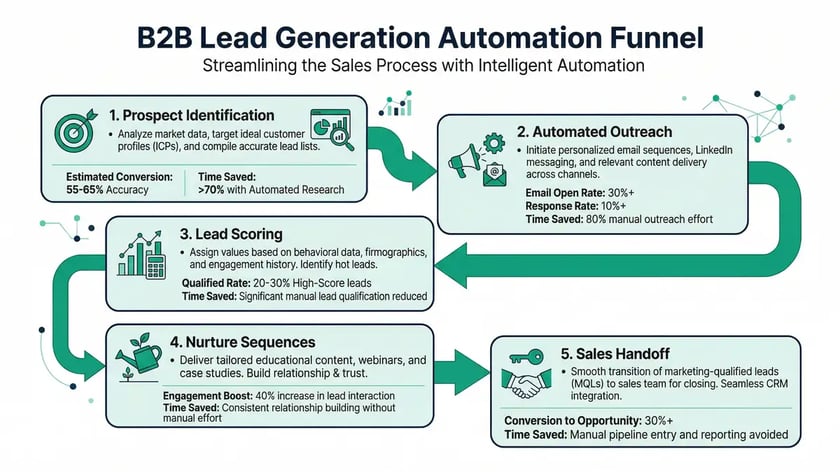
Lead generation automation operates across five interconnected stages, each replacing a manual bottleneck with systematic execution. The architecture mirrors what we call the Lead Generation Engine — a logic-gated system where each stage feeds the next without human intervention for routine decisions.
At its core, the system works like this: automated tools identify prospects matching your ideal customer profile (ICP), deploy personalized outreach sequences across multiple channels, score and qualify responses using behavioral signals, nurture leads through value-driven content, and hand off sales-ready opportunities to your team with full context. The key distinction from traditional marketing automation is that modern agentic workflows make autonomous decisions at each stage — they do not simply follow pre-built if-then rules.

According to Salesforce's State of Sales research, sales reps spend only 28-30% of their time actually selling, with 70% consumed by administrative tasks, data entry, and follow-ups. Lead generation automation reclaims that 70% by systematizing the repetitive work — list building, initial outreach, follow-up cadences, lead scoring, and CRM updates.
The financial impact is measurable: 83% of teams using automation experience positive growth, compared to 66% of manual-only teams. And companies using marketing automation generate $5.44 for every $1 spent — a 544% average return.
What Are the Channel-Specific Benchmarks for Automated Lead Generation?
Not every channel performs equally under automation. Understanding the benchmarks for each channel is critical for architecting a system that maximizes pipeline velocity while maintaining acceptable lead quality. The data reveals a consistent pattern: automation dramatically reduces cost-per-touch but produces lower per-touch engagement than manual effort. The economics, however, overwhelmingly favor automation at scale.
| Channel | Response Rate | Cost per Touch | Volume per Rep/Month | Best For |
| Email Automation | 4-5% | $0.02-0.05 | 8,000-12,000 | Scale + qualification |
| LinkedIn DM (Manual) | 10.3% | $1.50-3.00 | 400-600 | High-intent targeting |
| LinkedIn Automation | 2-4% | $0.10-0.30 | 2,000-4,000 | Connection building |
| Multi-Channel (Email + LinkedIn + Phone) | 9-14% | $0.50-1.50 | 3,000-5,000 | Maximum conversion |
Sources: Belkins B2B Cold Email Study 2025, Belkins LinkedIn Outreach Study 2025, Landbase Multi-Channel Statistics
The critical insight here is that multi-channel automated sequences deliver 287% higher conversion rates than single-channel approaches, according to Landbase's research. This is why modern lead generation automation must orchestrate across channels — email for volume, LinkedIn for relationship building, and phone for high-intent conversion.
For cold email outreach, the 2025 benchmarks show average reply rates of 4-5.1%, with top-quartile performers achieving 15-25% through aggressive personalization and follow-up optimization. LinkedIn outreach automation delivers 2-4% response rates on automated sequences versus 10.3% on manually sent DMs — but at a fraction of the cost per touch.
How Does AI Transform Lead Generation Automation in 2026?
The shift from rule-based automation to AI-powered agentic systems represents the most significant transformation in B2B pipeline generation since the introduction of CRM. According to Gartner's research, 40% of enterprise applications will feature task-specific AI agents by the end of 2026, up from less than 5% in 2025. In lead generation specifically, this means autonomous prospecting, qualification, and follow-up at a scale previously impossible.

Here is what AI workflow automation enables that traditional rule-based systems cannot:
| Capability | Rule-Based Automation | AI-Powered Automation | Impact on Pipeline |
| Prospect Identification | Static ICP filters | Dynamic ICP learning from win/loss data | 2-3x qualified prospect volume |
| Email Personalization | Name + company merge fields | Contextual messaging based on prospect activity | 3-4x response rate lift |
| Lead Scoring | Point-based rules | Predictive scoring from behavioral patterns | 18-22% higher MQL-to-SQL conversion |
| Follow-Up Timing | Fixed day intervals | Optimal send-time prediction per prospect | 15-25% engagement increase |
| Channel Selection | Pre-set sequence order | Dynamic channel routing based on prospect preference | 40-60% higher meeting rates |
Sources: Gartner AI in Sales 2025, HubSpot Marketing Statistics 2026
Gartner further predicts that by 2028, AI agents will outnumber human sellers by 10x. The implication for B2B companies is clear: those who build AI agent workflow infrastructure now will have a compounding advantage over competitors still relying on manual SDR models.
Key Takeaway
The shift from rule-based to AI-powered lead generation is not incremental — it is architectural. AI-powered personalization delivers a 3-4x response rate lift over generic templates, while agentic workflows enable autonomous qualification and follow-up that would require 5-10x more headcount to replicate manually.

How Do You Build an Automated Lead Generation Engine Step by Step?
Building an automated lead generation engine requires a systematic, phased approach. Attempting to automate everything at once is the primary reason 12-18% of automation implementations fail entirely, according to research from Cirrus Insight. The framework below follows the architecture we deploy for B2B companies scaling from $5M to $50M ARR.
Architect Your ICP and Data Foundation
Define your ideal customer profile with precision — firmographics, technographics, buying signals, and disqualification criteria. Integrate your CRM automation to centralize all prospect data with automatic enrichment. Without clean data, every downstream automation produces garbage output. This is the #1 failure point: 32% of failed implementations cite poor data quality as the root cause.
Deploy Multi-Channel Outreach Sequences
Build coordinated sequences across automated email, LinkedIn, and phone. Structure a 14-21 day cadence with 8-12 touches: email on days 1, 4, 7; LinkedIn connection on day 2 and message on day 5; phone attempts on days 8 and 12. Multi-channel sequences deliver 287% higher purchase rates than single-channel approaches.
Implement AI-Powered Lead Scoring
Replace static point-based scoring with predictive models trained on your actual win/loss data. Connect behavioral signals — email opens, LinkedIn engagement, website visits, content downloads — to a unified scoring model. This increases MQL-to-SQL conversion by 18-22% compared to rule-based scoring.
Build Automated Nurture Infrastructure
Deploy lead nurturing sequences that activate based on scoring thresholds and behavioral triggers. Hot leads (score 80+) route directly to sales. Warm leads (50-79) enter a 30-day nurture cadence with value-driven content. Cold leads (below 50) receive monthly thought leadership until they re-engage.
Orchestrate with Workflow Automation Platforms
Connect all tools through workflow orchestration platforms like n8n or Make.com. These platforms serve as the central nervous system, triggering actions across your CRM, email platform, LinkedIn tools, and analytics dashboards without manual coordination. The goal: zero manual handoffs between stages.
Ready to architect your automated lead generation engine? Explore peppereffect's Lead Generation systems and see how we deploy this exact framework for B2B companies.
Book Your Growth Mapping CallWhat Does Lead Generation Automation Cost — and What ROI Should You Expect?
The cost-per-lead economics of automation make the investment case straightforward. According to First Page Sage's 2026 benchmarks, the average B2B cost-per-lead is $84 across all channels. But the spread between automated and manual approaches is dramatic — and widens as you scale.
| Industry | Automated CPL | Manual CPL | Savings |
| B2B SaaS | $8-22 | $120-180 | 85-93% |
| Professional Services | $15-35 | $180-280 | 88-92% |
| Executive Search | $20-45 | $200-350 | 87-90% |
| Financial Services | $25-55 | $250-400 | 86-90% |
Sources: First Page Sage 2026, Sopro B2B CPL Benchmarks 2025
The ROI timeline is equally compelling. 76% of companies achieve positive ROI from marketing automation within the first year, with 12% seeing returns in under one month. For B2B companies spending $3,000-$8,000 per month on automation tooling, the typical return is $5.44 per dollar invested — far exceeding the ROI of adding headcount.
To quantify your specific automation opportunity, use our Automation ROI Calculator — it models the financial impact based on your current pipeline metrics, team size, and growth targets.
Avoid This Mistake
Do not automate broken processes. If your ICP definition is vague, your messaging does not resonate, or your CRM data is dirty, automation will amplify those problems at scale. 32% of failed automation implementations cite poor data quality as the root cause. Fix the foundation first — then automate. Deploying automation on top of a broken sales process is like installing a turbocharger on an engine with no oil.
What Are the Biggest Mistakes in Lead Generation Automation?
Understanding why automation fails is as important as knowing how to deploy it. Research from Cirrus Insight and HubSpot reveals that 12-18% of implementations fail entirely, with a further 18-24% only achieving partial results beyond 12 months. Here are the structural failures to avoid:
| Mistake | % Cited | Root Cause | Solution |
| Poor data quality | 32% | Dirty CRM, outdated lists | Data enrichment + hygiene protocols before automation |
| Sales-marketing misalignment | 28% | No shared ICP or handoff criteria | Unified scoring model + SLA between teams |
| Insufficient training | 24% | Teams revert to manual habits | Phased rollout with dedicated enablement |
| Over-automation without review | 16% | No human checkpoints | Hybrid model: automate 80%, review 20% |
| Compliance violations | 14% | GDPR/CAN-SPAM non-compliance | Legal review + opt-out infrastructure |
Sources: HubSpot State of Marketing 2025, Cirrus Insight Sales Automation Statistics 2025
The most dangerous mistake is treating automation as a "set it and forget it" solution. The companies seeing 300-480% ROI are those running hybrid models — automation handles the volume plays (initial outreach, follow-up sequences, data enrichment, CRM updates), while humans focus on the high-value activities (discovery calls, proposal customization, relationship building). This is the architecture that lets you scale 3-5x without proportional hiring.
How Do You Measure Lead Generation Automation Performance?
Effective measurement requires tracking both efficiency metrics (speed and cost) and quality metrics (conversion and revenue). Too many B2B teams focus exclusively on volume — leads generated, emails sent, connections made — without connecting those activities to revenue outcomes. Here is the measurement framework that matters:
| Metric Category | Key Metric | Automated Benchmark | Manual Benchmark |
| Speed | Time to first contact | 1-2 days | 7-12 days |
| Speed | Time to SQL qualification | 8-12 days | 18-25 days |
| Cost | Cost per qualified meeting | $12-28 | $120-180 |
| Quality | MQL-to-SQL conversion | 18-22% | 24-28% |
| Quality | Win rate | 22-26% | 24-30% |
| Volume | Leads per rep per month | 3,000-5,000 | 400-600 |
| Revenue | Sales cycle length | 32-38 days | 52-68 days |
Sources: Salesforce State of Sales 2026, HubSpot Marketing Statistics 2026
Notice the quality trade-off: automated sequences produce slightly lower MQL-to-SQL conversion (18-22% vs 24-28%) and win rates (22-26% vs 24-30%). This is expected — automation trades per-lead quality for volume and speed. The key insight from using AI in sales is that hybrid models mitigate this by routing high-scoring leads to human follow-up while automation handles the rest.
Key Takeaway
The most important metric is not leads generated — it is cost per qualified meeting. Automated systems deliver meetings at $12-28 each, versus $120-180 for manual outreach. Even with a slight quality trade-off, the economics are decisive: automation produces 5-10x the pipeline per dollar invested.
Frequently Asked Questions
How to generate leads in sales using automation?
Generating leads through automation starts with defining your ideal customer profile, then deploying multi-channel sequences across cold email, LinkedIn, and phone. Build automated workflows that identify prospects matching your ICP, send personalized outreach sequences with 8-12 touches over 14-21 days, score responses based on engagement signals, and route qualified leads to your sales team. Companies using multi-channel automation see 287% higher conversion rates than single-channel approaches, making coordinated sequences the most effective strategy for automated pipeline generation.
What is the average cost of automated lead generation for B2B?
The average cost-per-lead for automated B2B lead generation ranges from $8-55 depending on your industry and channel mix. B2B SaaS companies typically see CPLs of $8-22 with automation versus $120-180 for manual outreach — a reduction of 85-93%. The total investment for a mid-market automation stack (email platform, LinkedIn tools, CRM, workflow orchestration) runs $3,000-$8,000 per month, with 76% of companies achieving positive ROI within 12 months and average returns of $5.44 per dollar spent.
What tools do you need for lead generation automation?
A complete lead generation automation stack requires five core components: a CRM platform (HubSpot or Salesforce) for centralized data management, a sales engagement platform (Apollo, Instantly, or Outreach) for multi-channel sequences, a LinkedIn automation tool for connection and messaging workflows, a workflow orchestration platform (n8n or Make.com) to connect all tools, and an AI-powered enrichment service (Clay or similar) for dynamic prospect data. The specific combination depends on your company size, budget, and primary outreach channels.
How long does it take to see results from lead generation automation?
Most B2B companies see initial results from lead generation automation within 4-6 weeks for basic email sequences, with full-stack automation delivering measurable pipeline impact within 3-6 months. Quick wins — like automated follow-up sequences that recapture the 48% of prospects who never receive a second message — often produce results within the first month. The key variable is data quality: companies with clean CRM data and well-defined ICPs see faster time-to-value than those starting with poor data hygiene.
Is automated outreach less effective than manual prospecting?
On a per-touch basis, yes — manual outreach produces higher response rates (10-14% vs 4-5% for email, 10.3% vs 2-4% for LinkedIn). But the economics overwhelmingly favor automation: automated outreach costs $0.02-0.05 per touch versus $0.80-1.50 for manual effort, enabling 20-40x the volume per rep. The highest-performing B2B teams use a hybrid approach: automation for initial outreach and follow-up at scale, manual effort for high-value accounts and sales intelligence-driven personalization.
What is agentic lead generation and how does it differ from traditional automation?
Agentic lead generation uses AI agents that make autonomous decisions — selecting which prospects to target, choosing the optimal channel and timing, personalizing messaging based on real-time signals, and qualifying leads without human intervention. Unlike traditional automation that follows pre-built if-then rules, agentic workflows learn and adapt from outcomes. Gartner predicts 40% of enterprise applications will feature task-specific AI agents by the end of 2026, up from less than 5% in 2025 — making this the fastest-growing category in B2B sales technology.
How do you maintain lead quality with automated outreach?
Maintaining lead quality in automated systems requires three safeguards: first, invest heavily in ICP definition and data enrichment so automation targets the right prospects from the start. Second, implement AI-powered lead scoring that evaluates behavioral signals — not just demographic fit — to prioritize high-intent leads for human follow-up. Third, build feedback loops where sales team input on lead quality continuously refines your scoring model and targeting criteria. The goal is not to automate everything — it is to automate the 80% that is repetitive while keeping humans focused on the 20% that requires judgment.
Stop Trading Hours for Pipeline
peppereffect architects automated lead generation systems that decouple your pipeline from headcount. Our 4 Pillars methodology installs the infrastructure your B2B company needs to scale pipeline 3-5x without proportional hiring.
Book Your Growth Mapping CallResources
- HubSpot State of Marketing Report 2025 — Automation adoption, ROI metrics, and channel benchmarks
- Salesforce State of Sales Statistics 2026 — Sales productivity and automation impact data
- Gartner AI Agents Prediction — 40% of enterprise apps with AI agents by 2026
- Fortune Business Insights Marketing Automation Market Report — Market size and growth projections
- First Page Sage Cost Per Lead Benchmarks 2026 — Industry-specific CPL data
- Belkins B2B Cold Email Response Rate Study 2025 — Email outreach benchmarks
- Landbase Multi-Channel Outreach Statistics — Cross-channel engagement data
- Digital Silk Marketing Automation Statistics 2026 — ROI and adoption metrics
email deliverability architecture
AI marketing automation B2B lead generation architecture account-based marketing playbook