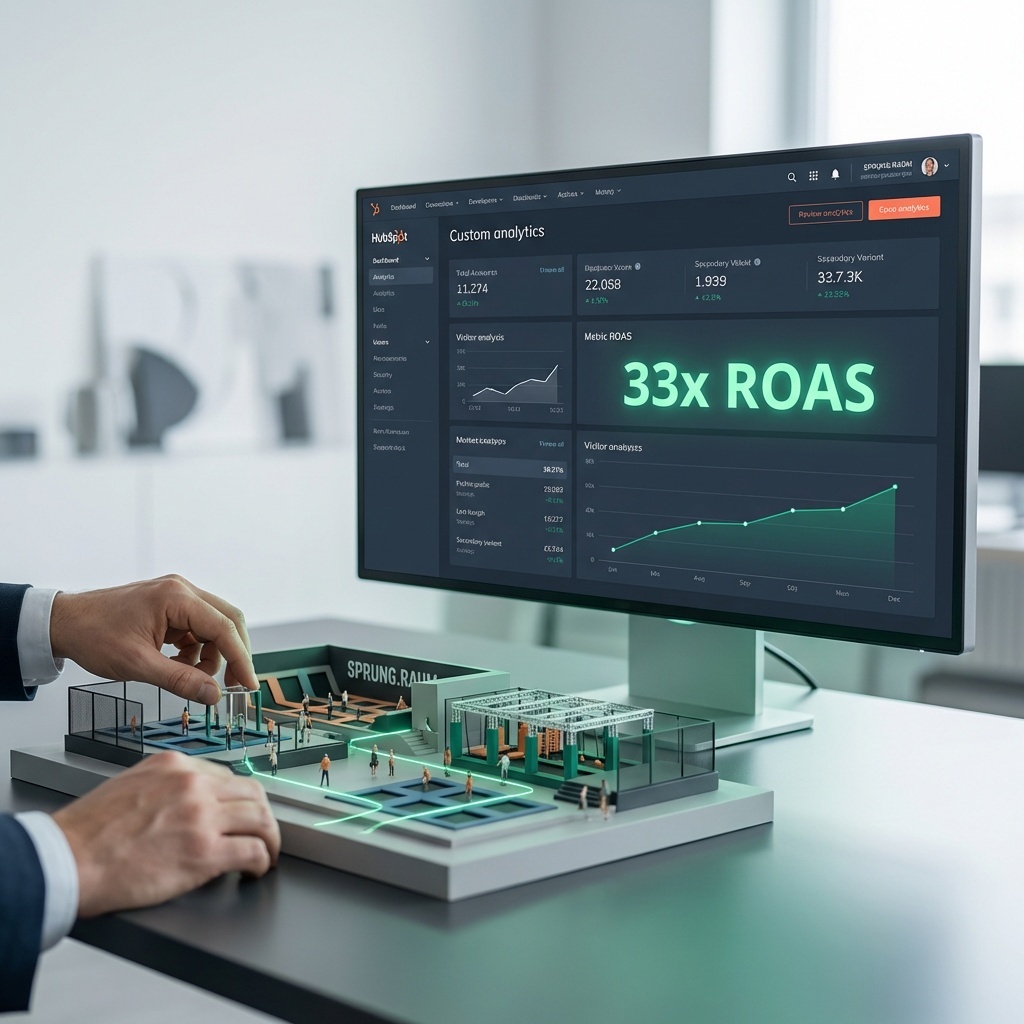
AI Marketing Agent: How Autonomous Systems Are Replacing Manual Campaign Management
What Is an AI Marketing Agent and Why Does It Matter for B2B?
An AI marketing agent is an autonomous software system that plans, executes, and optimizes marketing campaigns with minimal human intervention. Unlike traditional marketing automation — which follows pre-defined if/then rules — an AI marketing agent operates on goal-driven logic: you define the objective (reduce CAC by 20%, increase qualified leads by 30%), and the agent continuously adapts tactics to reach that target. For B2B companies scaling past $10M ARR, this distinction represents the difference between incremental efficiency and systemic operational leverage.
The shift is happening fast. According to HubSpot's 2026 State of Marketing report, over 64% of organizations now use AI in marketing, with 19% already leveraging AI agents to automate entire marketing workflows end-to-end. Meanwhile, Gartner forecasts that 60% of brands will use agentic AI to deliver streamlined one-to-one interactions by 2028 — up from less than 5% deploying embedded AI agents in applications in early 2025.
The global marketing automation market reflects this acceleration. Grand View Research values the market at $6.65 billion in 2024, projecting $15.58 billion by 2030 at a 15.3% CAGR — with AI-powered agent capabilities driving the fastest-growing subsegment.
64%
AI Adoption
Organizations using AI in marketing
$15.6B
Market by 2030
Marketing automation TAM
60%
Brands by 2028
Using agentic AI (Gartner)
19%
End-to-End Agents
Already automating full workflows
What you'll learn in this guide:
- How AI marketing agents differ from traditional marketing automation — and why the distinction drives 3-5x better campaign performance
- The five core capabilities every AI marketing agent must deliver for B2B pipeline acceleration
- Real-world ROI benchmarks: conversion rate lifts, CAC reductions, and labor savings from enterprise deployments
- How to evaluate and deploy an AI marketing agent without a 12-month integration nightmare
- Where human oversight remains non-negotiable — and where full autonomy is already standard
Key Takeaway
An AI marketing agent is not a chatbot, not a content generator, and not a dashboard. It is an autonomous system that ingests data, makes decisions, executes campaigns, and self-optimizes toward measurable business outcomes — operating across your entire marketing stack simultaneously.
How Do AI Marketing Agents Differ from Traditional Marketing Automation?
Traditional marketing automation platforms execute what you tell them: if lead score exceeds 80, send email sequence B; if email opens, wait 3 days, then send follow-up. These rules are brittle. Market conditions shift, buyer behavior evolves, and your static workflows keep executing yesterday's logic. The result: declining engagement, wasted spend, and marketing teams trapped in perpetual configuration mode.
AI marketing agents operate on an entirely different architecture. Instead of conditional rules, they use goal-state optimization — reinforcement learning models that continuously experiment, measure, and adapt. A goal-driven agent told to "maximize qualified leads while maintaining CAC under $180" will autonomously test subject lines, adjust send times, reallocate ad spend, and shift audience segments — all without manual intervention.
According to McKinsey's State of AI report, marketing and sales saw the biggest AI adoption surge — more than doubling from 2023 — yet over 80% of organizations still aren't seeing tangible enterprise-level EBIT impact. The gap isn't adoption. It's architecture. Companies using rule-based automation are automating manual processes. Companies deploying AI marketing agents are building agentic workflows that compound performance over time.
| Capability | Traditional Automation | AI Marketing Agent |
| Decision logic | Static if/then rules | Goal-driven optimization |
| Campaign adaptation | Manual rule updates | Continuous self-optimization |
| Personalization | Segment-based (5-10 groups) | Individual-level (thousands of variants) |
| Cross-channel coordination | Siloed per channel | Unified orchestration layer |
| Learning capability | None — repeats same logic | Improves with every interaction |
| Human involvement | High (constant configuration) | Strategic oversight only |
Sources: McKinsey State of AI 2025, Gartner Marketing Trends 2026
What Are the Five Core Capabilities of an AI Marketing Agent?
Not all platforms claiming "AI marketing" deliver true agent capabilities. Here are the five non-negotiable functions that separate genuine AI marketing automation from rebranded rule engines. Each capability builds on the others — deploy them as an integrated system, not as isolated point solutions.
Autonomous Lead Scoring and Segmentation
The agent continuously re-ranks lead quality using gradient boosting models enriched by LLM reasoning — factoring recent company news, intent signals, website behavior, and email engagement. Unlike static lead scores that decay within weeks, an AI agent's scoring model retrains on fresh data, maintaining accuracy. Salesforce reports that marketing teams with unified data are 60% more likely to use AI agents to scale their efforts effectively.
Dynamic Content Generation and Personalization
LLM-powered content agents generate personalized email subject lines, ad copy, and landing page variants at scale — constrained by brand guidelines and compliance rules. The agent tests thousands of variants simultaneously using multi-armed bandit algorithms, converging on top performers far faster than manual A/B testing. This is where AI workflow automation meets creative execution.
Cross-Channel Campaign Orchestration
A true AI marketing agent doesn't just optimize email. It coordinates email, LinkedIn, paid search, programmatic display, and website personalization through a unified orchestration layer. Each channel's agent shares data with the central orchestrator, which maintains the goal state and redistributes effort based on real-time performance.
Predictive Budget Allocation
The allocation agent monitors cost-per-acquisition, conversion rates, and ROAS across every channel — rebalancing spend hourly based on predicted future performance using reinforcement learning. It identifies channel saturation before budget is wasted and redirects investment to higher-yield opportunities automatically.
Multi-Touch Attribution and ROI Measurement
The attribution agent calculates the influence of each touchpoint on deal progression using Markov chain or graph-based models — replacing the last-touch attribution that distorts most B2B marketing measurement. This feeds directly into the allocation agent, creating a closed-loop system that compounds AI automation ROI over time.
Key Takeaway
The five capabilities — scoring, content, orchestration, allocation, and attribution — form a closed-loop system. Deploy them as isolated tools and you get incremental improvement. Deploy them as an integrated agent architecture and you get compounding returns that decouple revenue from headcount.
What ROI Can You Expect from AI Marketing Agents?
The performance data from enterprise and mid-market deployments is now substantial enough to benchmark with confidence. The numbers below draw from analyst research covering hundreds of AI marketing implementations across B2B organizations.
HubSpot's marketing data shows that AI tools save marketing teams 10-14 hours per week for nearly a third of respondents, while 42% report moderately increased productivity. But the real leverage isn't time savings — it's what that reclaimed time enables: faster campaign iteration, deeper personalization, and systematic pipeline acceleration.
Salesforce's Agentic Enterprise Index reports 119% growth in AI agent adoption in the first half of 2025 alone, with Agentforce surpassing $500 million in ARR — a 330% year-over-year increase. That level of enterprise investment only sustains when measurable ROI follows deployment.
The conversion data is equally compelling. Gartner research indicates that customers engaged through AI-driven personalization are 2.3 times more likely to complete a purchase. When applied to B2B nurture sequences — where deal cycles stretch 60-90 days — that multiplier translates directly into pipeline velocity and deal size expansion.
| Metric | Benchmark | Timeframe |
| Campaign conversion rate lift | +25-40% | Months 1-3 |
| Marketing ops labor reduction | 10-14 hours/week saved | Immediate |
| Cost-per-acquisition reduction | -22-31% | Months 2-4 |
| Campaign cycle time reduction | -75-85% | Immediate |
| AI agent ARR growth (Salesforce) | +330% YoY | 2025 |
| Enterprise AI agent adoption growth | +119% H1 2025 | 6 months |
Sources: HubSpot State of Marketing 2026, Salesforce Agentic Enterprise Index 2025, Gartner 2026
Ready to deploy AI marketing agents across your B2B growth engine? Explore peppereffect's Lead Generation systems — built on agentic architecture.
See Our Lead Generation SystemsHow Do Leading Platforms Build AI Marketing Agent Capabilities?
The technology landscape for AI-powered marketing automation is consolidating around three major platform architectures, each with distinct strengths for B2B deployment. Understanding these differences matters because your platform choice determines the ceiling of what your AI marketing agent can achieve.
Salesforce Agentforce represents the enterprise-grade approach. Built on the Einstein Agent framework, it provides autonomous lead scoring using recurrent neural networks combined with LLM reasoning, dynamic content personalization, and predictive lead routing to sales. With 18,500 Agentforce deals closed in 2025 and 3.2 trillion tokens processed, Salesforce has established the largest enterprise footprint for agentic marketing. However, implementation costs typically range $150K-$400K for mid-market, with 3-4 month timelines.
HubSpot Breeze takes a more accessible approach for mid-market B2B companies. Its transformer-based models handle email subject line generation, send-time optimization, audience lookalike creation, and content quality scoring. The advantage for companies already on HubSpot's CRM and marketing automation stack is near-instant deployment — no integration project required.
Custom orchestration platforms using API-first tools like n8n, Make.com, and direct LLM APIs (OpenAI, Anthropic) offer maximum flexibility for companies willing to invest in technical architecture. This is the approach peppereffect deploys for clients who need bespoke agentic workflow architectures that integrate deeply with existing tech stacks — without vendor lock-in to a single marketing cloud.
| Platform Model | Best For | Typical Investment | Time to Value |
| Full-stack marketing cloud (Salesforce, HubSpot, Adobe) | Enterprise + mid-market with existing ecosystem | $50K-$400K/year | 2-4 months |
| Best-of-breed point solutions (Jasper, Seventh Sense) | Specific function optimization | $12K-$60K/year | 2-4 weeks |
| Custom orchestration (n8n, Make + LLM APIs) | Bespoke B2B architectures, no vendor lock-in | $30K-$150K build + $5K-$20K/year | 4-8 weeks |
Sources: Salesforce AI Agent Statistics 2025, Gartner Marketing Trends 2026
Where Do AI Marketing Agents Still Need Human Oversight?
The gap between marketing fiction ("fully autonomous AI that runs everything") and operational reality is significant — and understanding it protects both your brand and your budget. Human-in-the-loop AI isn't a limitation. It's a design principle that separates sustainable deployments from expensive failures.
Salesforce's research found that 75% of marketers have adopted AI yet still use it to send one-way, generic campaigns — evidence that adoption without architectural thinking produces minimal returns. The problem isn't the technology. It's deploying agents without clear goal-state definition, data quality remediation, and governance frameworks.
Critical Implementation Risk
According to McKinsey, over 80% of organizations are NOT seeing tangible enterprise-level EBIT impact from AI — despite widespread adoption. The root cause: deploying AI tools without clean, unified data and clear outcome targets. Fix your CRM data infrastructure before activating agents.
| Decision Type | AI Autonomy Level | Human Role |
| Lead scoring and qualification | 85-95% autonomous | Monthly audit, override authority |
| Email subject lines and copy | 60-75% autonomous | Brand guideline review before launch |
| Audience segmentation | 80-90% autonomous | Quarterly validation, bias audit |
| Ad spend allocation | 75-85% autonomous | Weekly budget limits, guardrails |
| Campaign strategy shifts | 30-50% autonomous | CMO approval required |
| Account disqualification | 10-30% autonomous | Always human-driven |
Sources: Gartner CMO Priorities 2026, Forrester State of AI 2025
How to Deploy an AI Marketing Agent in Your B2B Organization
Deploying an AI marketing agent is not a tool purchase — it's an infrastructure project. The companies that extract maximum value follow a phased approach that addresses data quality, integration architecture, and change management before activating autonomous capabilities. Here's the deployment framework we architect for B2B clients at peppereffect.
Audit Your Data Infrastructure (Weeks 1-4)
AI agents are only as good as the data they ingest. Audit your CRM for duplicate records, missing firmographic attributes, and stale lead data. Most mid-market organizations need 60-90 days of data remediation before agent deployment delivers reliable results. Start with your CRM automation layer — clean data in, clean decisions out.
Define Clear Goal States (Week 2)
Vague goals ("improve marketing efficiency") produce diffuse agent strategies. Define precise targets: "Increase qualified lead volume 25% in Q3 while maintaining CAC under $180." Goal-state clarity gives the agent a measurable objective to optimize against — and gives you a clear success criterion.
Start With a Single High-Impact Use Case (Weeks 4-8)
Don't try to automate everything at once. Choose one use case with clear data availability and measurable outcomes — lead nurturing email optimization is the most common starting point because data is rich and results are fast. Expand after proving ROI.
Build the Orchestration Layer (Weeks 8-16)
Once the first use case delivers results, expand to 2-3 additional capabilities: lead generation automation, ad spend optimization, and content personalization. Connect them through a central orchestrator that maintains your goal state across all channels.
Establish Governance and Monitoring (Ongoing)
Set guardrails: budget limits, send frequency caps, brand guideline constraints. Monitor model performance monthly. Lead scoring models degrade within 6 months without retraining. Build a governance framework that includes compliance audits, bias reviews, and escalation protocols for edge cases.
Key Takeaway
The companies that extract maximum ROI from AI marketing agents invest 20% of budget in data strategy and 15% in governance — before touching the agent platform itself. Skip data remediation and you're optimizing on noise. Skip governance and you're automating compliance risk.
Frequently Asked Questions
What is an AI marketing agent?
An AI marketing agent is an autonomous software system that plans, executes, and optimizes marketing campaigns based on goal-driven objectives rather than static rules. It uses machine learning, LLMs, and reinforcement learning to continuously adapt email campaigns, ad spend allocation, lead scoring, and content personalization — all while operating across multiple channels simultaneously. Unlike traditional marketing automation platforms, an AI agent learns from every interaction and compounds performance over time.
How do AI marketing agents differ from marketing automation?
Traditional marketing automation executes pre-defined conditional logic (if lead score exceeds 80, send email B). AI marketing agents operate on goal states — you define the target outcome (reduce CAC by 20%) and the agent autonomously experiments with tactics to achieve it. The agent adapts in real-time, testing thousands of content variants, adjusting send times, and reallocating budgets. Marketing automation repeats the same playbook. An AI agent writes a new playbook every day based on what's actually working.
What tasks can AI marketing agents handle autonomously?
Current enterprise deployments show AI agents handling email campaign optimization (subject lines, send times, content variants), autonomous lead scoring and segmentation, predictive ad spend allocation, multi-channel campaign orchestration, A/B testing at scale, and multi-touch attribution. The highest autonomy levels (85-95%) apply to lead scoring and segmentation. The lowest (10-30%) apply to strategic decisions like account disqualification, which still require human-in-the-loop oversight.
How much does it cost to deploy an AI marketing agent for B2B?
Costs vary significantly by approach. Full-stack marketing cloud solutions (Salesforce Agentforce, HubSpot Breeze) run $50K-$400K annually for mid-market companies. Custom orchestration platforms using n8n, Make.com, and LLM APIs typically require $30K-$150K for initial build plus $5K-$20K per year in ongoing costs. The critical variable isn't platform cost — it's data remediation and integration, which add $50K-$200K and 2-4 months to timelines for most organizations.
What ROI should I expect from an AI marketing agent?
Enterprise and mid-market benchmarks show 25-40% improvement in campaign conversion rates, 22-31% reduction in cost-per-acquisition, and 10-14 hours per week saved in marketing operations labor per team member. Sales automation integrations amplify these results further. Most organizations achieve ROI breakeven within 4-7 months of deployment, with compound returns accelerating through month 12 as models mature on richer data.
Is an AI marketing agent safe from a compliance perspective?
Compliance readiness varies by platform. Enterprise-grade solutions now embed GDPR consent management, CAN-SPAM compliance templates, and audit trails for agent decisions. However, mid-market organizations should invest in governance frameworks before deployment — including data retention policies, bias audits, and automated decision-making disclosures. The EU AI Act implementation (2025-2026) will add additional requirements. Build compliance into the architecture from day one rather than retrofitting after deployment.
Can small B2B companies benefit from AI marketing agents?
Yes, but the entry point differs. Companies under $5M ARR should start with platform-native capabilities (HubSpot Breeze, built-in AI features) rather than custom deployments. The key requirement isn't company size — it's data quality. If your CRM has clean contact records, behavioral data from email and website interactions, and consistent lead scoring criteria, an AI agent can deliver meaningful results at any scale. The Freedom Machine philosophy applies here: start with one autonomous system, prove ROI, then expand.
Deploy Your AI Marketing Agent Architecture
peppereffect architects AI-powered marketing systems that generate pipeline autonomously — replacing manual campaign management with goal-driven agent infrastructure. Book your Growth Mapping Call to identify where AI marketing agents will deliver the fastest ROI for your B2B business.
Book Your Growth Mapping CallResources
- HubSpot State of Marketing 2026 — AI adoption, productivity metrics, and agent workflow data
- McKinsey State of AI 2025 — Global adoption statistics, marketing ROI data, and scaling challenges
- Salesforce State of Marketing 2026 — AI personalization, data unification, and agent adoption trends
- Salesforce Agentic Enterprise Index H1 2025 — Agent growth metrics and enterprise deployment data
- Grand View Research Marketing Automation Market Report — Market size, CAGR, and segment forecasts
- Gartner Agentic AI Prediction — 60% of brands using agentic AI by 2028
- Gartner Future of Marketing — Technology adoption trends and AI readiness benchmarks