

Account Based Marketing is not a campaign. It is the operating layer that turns the demand-gen-vs-lead-gen distinction into account-level execution — concentrating marketing and sales force on a finite list of high-fit accounts rather than spraying generic outreach across the entire B2B database. 87% of marketers report ABM delivers higher ROI than other tactics, 76% of ABM-using companies report measurably better revenue outcomes, and ABM-led deals close 30-50% faster than traditional pipelines, per ITSMA, Forrester, and Demandbase research. Yet most mid-market B2B SaaS companies confuse ABM with "personalised outbound" and miss the architectural shift entirely.
This is the implementation guide: precise definition, the three ABM tiers (1:1, 1:few, 1:many), the platform landscape (Demandbase, 6sense, Terminus, RollWorks), the ABM tech stack in the agentic AI era, the 2024-2026 ROI benchmarks, the five common implementation mistakes that compound silently, and the 90-day rollout playbook. Built for the Sarah Chen whose CMO has requested $500K-$1M to "do ABM properly" and whose board needs a board-grade architecture, not a slide deck.
What Account Based Marketing Actually Is

ABM is a B2B GTM strategy in which marketing and sales agree on a finite list of named target accounts and orchestrate marketing, sales, customer success, and product motion at the account level — not the lead level. The target account is the unit of work. The ICP fit, intent signal, engagement score, and pipeline stage are tracked per account. Outreach across email, LinkedIn, display, direct mail, SDR sequences, executive engagement, and content distribution is coordinated to the same account list, with messaging tailored to the account's specific situation, role mix, and buying-committee composition.
This is the architectural distinction from demand gen and lead gen: demand gen builds the future market across the 95%; lead gen captures the 5% in-market today; ABM is the account-level execution layer that runs inside both — concentrating force on the 50-500 accounts that represent 60-80% of your future pipeline. Done well, ABM is not "extra marketing." It is the operating discipline that makes every other channel investment more efficient because resources concentrate on accounts that actually matter — the same architectural shift you applied to expansion revenue and Net Dollar Retention, now applied to new-logo acquisition.
The Architectural Shift
ABM moves the unit of revenue work from "lead" to "account." A lead-centric org chases volume; an account-centric org chases penetration of a finite, deliberately-chosen set. The metric that follows is account-level engagement, opportunity creation, and pipeline contribution — not raw MQL count. Marqeu's ABM analytics framework documents the measurement architecture every implementation needs.
The Three ABM Tiers
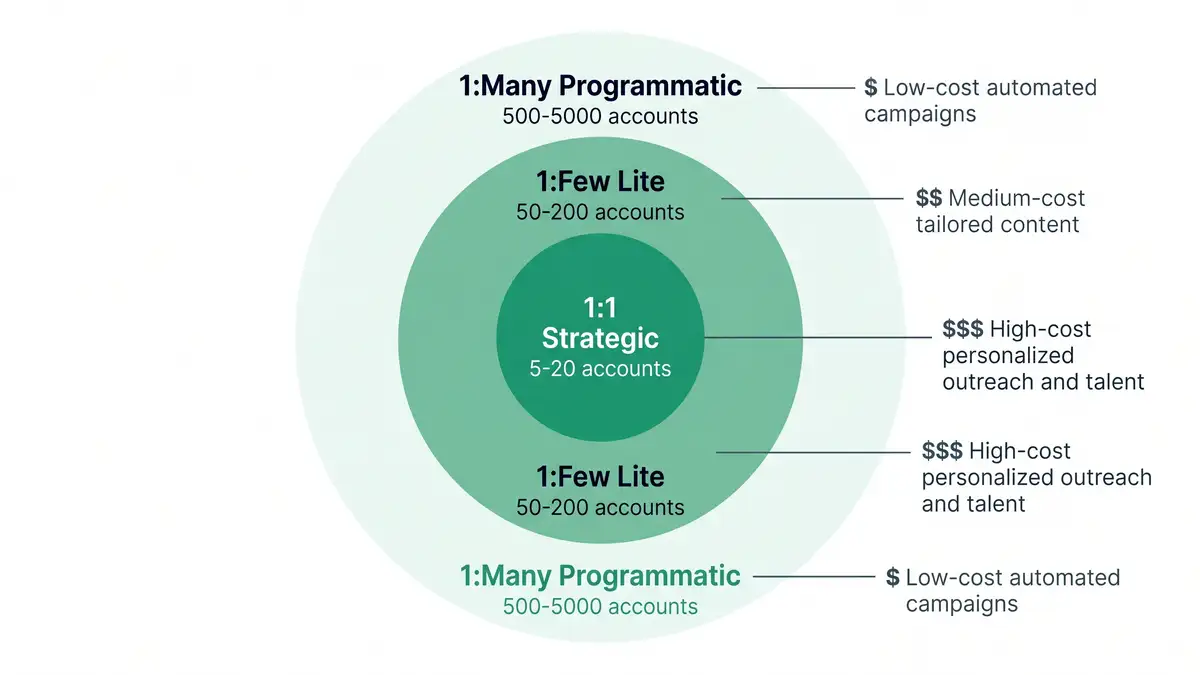
The ITSMA tier framework, validated and refined by Forrester and Demandbase across hundreds of B2B implementations, is deterministic. The tier you run determines the cost structure, team model, and expected pipeline outcome.
| Tier | Account Count | Cost per Account | Expected Pipeline Contribution |
| 1:1 Strategic | 5-20 | $10K-$50K | Top-5 enterprise deals; multi-year |
| 1:Few Lite | 50-200 | $2K-$8K | Mid-market enterprise; 6-18 month cycle |
| 1:Many Programmatic | 500-5,000 | $50-$500 | Mid-market scale; AI-orchestrated |
Sources: Insights ABM 2026 Statistics, Landbase Mid-Market ABM 2026, Only-B2B ABM for SaaS Playbook.
Most $10M-$40M ARR B2B SaaS companies should run a hybrid: 10-20 1:1 Strategic accounts (top-5 future enterprise deals) plus 100-150 1:Few Lite accounts (mid-market expansion targets). The 1:Many Programmatic tier is rapidly becoming agentic-AI-orchestrated in 2026 — replacing the historic limitation that "1:many isn't really ABM, it's just better targeting" with genuine per-account personalization at scale. Demandbase's 2026 AI-in-ABM analysis documents the shift.
The ABM Platform Landscape (2026)

The platform layer is consolidating around two leaders, with strong tier-2 alternatives. Both Demandbase and 6sense are named Leaders in the 2026 Forrester B2B Revenue Marketing Platforms Wave and the Gartner Magic Quadrant for ABM Platforms. They differ architecturally: 6sense leads with predictive intent and account identification; Demandbase leads with account-level advertising and website personalization.
| Platform | Core Strength | Median Pricing (Mid-Market) |
| 6sense | Predictive intent + AI-driven account scoring | ~$58K/year (Vendr median) |
| Demandbase | Account-level advertising + website personalization | ~$66K/year (Vendr median) |
| RollWorks | Mid-market entry; LinkedIn-native | $30K-$60K/year |
| Terminus | Multi-channel orchestration | $40K-$80K/year |
| Madison Logic | Content syndication + ABM | Custom enterprise |
Sources: Prospeo — Demandbase vs 6sense 2026, GrowthTech Spotlight — 6sense vs Demandbase 2026, Pipelineroad — 6sense vs Demandbase vs RollWorks vs Terminus 2026, Directive Consulting ABM Tools Compared, ZoomInfo Top 15 ABM Platforms 2026.
For a $10M-$40M ARR mid-market SaaS, the platform decision flows from your dominant motion: if your bet is identifying in-market accounts before they raise their hand, 6sense's predictive intent is the architectural fit. If your bet is coordinating multi-channel advertising at the account level, Demandbase's account-targeting infrastructure is the fit. Both routinely return 5-10x ROI over 18-month deployments — but only when wired into a coordinated team and tech stack, not bought as a tool to "do ABM." The CAC implications matter: a properly-deployed ABM program compresses the customer acquisition cost on enterprise deals 30-40% relative to broad lead-gen approaches.
Account-Level Engagement Benchmarks
The metric that distinguishes a working ABM program from a failing one is account-level engagement — measured continuously, not at MQL milestones. The 2026 benchmark is unambiguous: 15-20% account engagement in the first month signals working targeting. Below 10% means the list or messaging needs adjustment. ZenABM's LinkedIn ABM Benchmarks 2026 documents the dataset-wide median: $6.89 of pipeline per $1 spent, $95.6K median influenced pipeline per program, 3.47x median ROAS. Companies above $50M run efficiency higher; companies below $10M ARR routinely run 2-3x lower until the operating model matures.
This translates to a mid-market diagnostic. If you are running ABM and seeing <10% account engagement at month 1, your ICP is too broad or your messaging is generic. If you are running 1:Many ABM and seeing $1-3 of pipeline per $1 spent, your orchestration layer is broken. If you are above 20% engagement and 5x+ ROAS, you are in top-quartile territory — and the lever now is widening the account list, not deepening the same accounts. The natural cluster expansion is to layer ABM into the broader B2B lead generation architecture, treating ABM as the high-fidelity lane within the larger acquisition system. TheCMO's 30 ABM statistics analysis validates the pattern across hundreds of B2B implementations.
Diagnose whether your ABM program is hitting the 15-20% account engagement floor — or quietly leaking budget on a list that doesn't match your ICP.
Book an ABM Diagnostic CallThe ABM Tech Stack in the Agentic AI Era

The 2026 ABM tech stack has five layers, each with platform-class incumbents and an emergent agentic-AI tier compressing them. The architecture matters: a $1M ABM platform spend without the upstream data infrastructure or the downstream agentic execution layer produces dashboards that nobody acts on. Cognism's 2026 ABM tech-stack guide documents the layer dependencies.
Data Layer — ICP & Account Database
ZoomInfo, Apollo.io, Clay, Cognism, LinkedIn Sales Navigator. Defines the ICP, populates the target account list with firmographic, technographic, and contact data. Garbage in here means garbage out everywhere downstream.
Intent Layer — Buyer Signal
Bombora, 6sense intent, Demandbase intent, G2 buyer intent. Detects when a target account enters the in-market state — the moment that triggers the entire ABM motion. Without this layer, ABM is reactive; with it, the motion fires within hours of signal.
Orchestration Layer — ABM Platform
Demandbase, 6sense, Terminus, RollWorks. The unifying layer that coordinates ad targeting, website personalization, content delivery, and CRM updates across the account list. Where tier-1 ABM platforms earn their fee.
Execution Layer — Channel Activation
LinkedIn Account Targeting, programmatic display (DV360), email (HubSpot, Outreach, Salesloft), direct mail (Sendoso, Reachdesk), agentic SDR (11x.ai, Default, Distill, Apollo). The hands that execute the orchestration layer's plan.
Measurement Layer — Account Analytics
Native ABM platform analytics + a CRM-anchored truth source. Marqeu argues — correctly — that ABM platforms are excellent execution tools but are not the authoritative source of ABM performance data. The CRM (HubSpot, Salesforce) plus a BI layer is the truth source.
Agentic AI is collapsing layers 2-4 in 2026. Tools like Clay, 11x.ai, Default, and Apollo.io's autonomous SDR run intent detection → routing → personalised outreach as a single agentic loop, firing within hours of in-market signal rather than the historic 5-10 day lag. The strategic implication: smaller mid-market SaaS companies that historically could not afford full-tier ABM platforms can now run effective programmatic ABM with an agentic stack at 20-30% the cost. Your agentic workflow architecture plus sales automation infrastructure wired to a CRM automation spine is the modern alternative to a six-figure platform bet.
Five Failure Modes That Kill ABM Implementations

Failure 1 — Picking Too Many Target Accounts
The most common mistake. CMOs anchor on "we'll do ABM with 1,000 accounts" because they cannot let go of the volume mindset. With 1,000 accounts, no team can deliver per-account personalization, and the program defaults to lightly-targeted lead gen. Start with 50-150 accounts maximum for the first 6 months. Top-quartile programs at $20M ARR run with fewer than 200 named accounts.
Failure 2 — No Sales-Marketing Alignment
If marketing builds the account list and sales never validates or commits to it, the program is dead before launch. The list must be co-built, co-owned, and co-measured. Insights ABM data shows companies with formal sales-marketing alignment achieve 2.5x higher ABM goal attainment than those without.
Failure 3 — Treating ABM as a Campaign, Not a System
"Q2 ABM campaign" is the tell. ABM is an operating model, not a discrete project. The account list, intent monitoring, orchestration, and measurement run continuously — every quarter, every account, every signal. Companies that treat ABM as campaigns get campaign-grade ROI; companies that treat ABM as a system get architectural ROI.
Failure 4 — No Tech Stack — or Wrong Stack
Buying a 6sense or Demandbase license without the data, execution, or measurement layers wired to it produces an expensive dashboard. Conversely, trying to run ABM with HubSpot alone misses the intent and orchestration layers. The five-layer stack is non-negotiable; the tier of platform within each layer scales with company size.
Failure 5 — No Executive Sponsorship
ABM crosses marketing, sales, customer success, and finance. Without a CEO or CRO sponsor empowered to override turf, the implementation stalls in cross-functional alignment debates. Top-quartile ABM programs are CEO-sponsored, not CMO-led — because the budget, headcount, and account-list governance decisions land at the CEO desk regardless.
The 90-Day ABM Implementation Roadmap
Days 1-30: ICP Definition & Account List
Define the 4-vector ICP (firmographic + technographic + intentographic + behavioural). Co-build the target account list with sales — typically 10-20 1:1 Strategic + 100-150 1:Few Lite. Validate with closed-won/closed-lost analysis from the past 18 months. Lock the list. The list is the program; everything else is execution.
Days 31-60: Tech Stack & Intent Layer
Deploy intent-data (Bombora, 6sense, or Demandbase). Wire intent signals into your CRM as account-level scoring. Stand up account-engagement tracking across LinkedIn, email, web, content. Configure routing rules that fire personalised outreach within 24 hours of in-market signal.
Days 61-90: Multi-Channel Orchestration
Launch coordinated motion across LinkedIn (account targeting + Sales Navigator), email (personalised SDR sequences), display (programmatic account ads), and content (account-named landing pages, custom assets for top-20 strategic accounts). Run weekly account-engagement reviews with marketing+sales pod. Optimize the bridge between intent → outreach → meeting booked.
Bottom Line
Account Based Marketing is the operating layer that turns finite, deliberately-chosen target accounts into the unit of revenue work for marketing, sales, and customer success simultaneously. The three-tier architecture (1:1 / 1:few / 1:many) is deterministic. The platform decision (Demandbase vs 6sense, with Terminus and RollWorks as tier-2) flows from your dominant motion. The five-layer tech stack is non-negotiable. The 87% ROI premium, 208% revenue uplift, and 30-50% sales-cycle compression that ITSMA and Forrester document are real — but only when ABM is installed as a system, not run as a campaign. The CEO's job is not to fund "ABM" as a marketing line item. It is to install the architecture that concentrates revenue force on the 50-150 accounts that represent 60-80% of your future pipeline — and to do so as a CEO-sponsored, system-level program rather than a CMO project.
Install the Account-Based Marketing Operating System
peppereffect runs the 90-day ABM implementation for $10M-$40M ARR B2B SaaS — ICP definition, account list construction, intent-data deployment, multi-channel orchestration, agentic execution layer, and the measurement architecture wired to your CRM. Architectural, not advisory. Outcome target: 15-20% account engagement in month 1, $5+ pipeline per $1 spent by month 6, 30-50% sales-cycle compression on ABM-led opportunities.
Book Your Growth Mapping CallSee the Demand Gen vs Lead Gen architecture →
Frequently Asked Questions
What is Account Based Marketing (ABM)?
ABM is a B2B GTM strategy in which marketing and sales agree on a finite list of named target accounts and orchestrate marketing, sales, customer success, and product motion at the account level — not the lead level. The target account is the unit of work. ICP fit, intent signal, engagement score, and pipeline stage are tracked per account. Outreach is coordinated across channels with messaging tailored to each account's specific situation.
What are the three ABM tiers?
1:1 Strategic ABM (5-20 ultra-high-value accounts at $10K-$50K cost-per-account, top-tier enterprise deals). 1:Few Lite ABM (50-200 mid-market accounts at $2K-$8K cost-per-account, balancing personalization and scale). 1:Many Programmatic ABM (500-5,000 accounts at $50-$500 per account, AI-orchestrated for mid-market scale). Most $10M-$40M ARR SaaS run a hybrid 1:1 + 1:Few program.
What's the difference between ABM and demand generation?
Demand generation builds awareness and mental availability across the broad market — including the 95% of buyers not yet in-market. ABM concentrates marketing and sales force on a finite list of named target accounts. ABM is the account-level execution layer that runs inside both demand gen and lead gen — the disciplined targeting that makes both more efficient by focusing resources on accounts that actually represent future pipeline.
What's a good ABM ROI benchmark?
The 2026 ZenABM dataset-wide LinkedIn ABM median is $6.89 of pipeline per $1 spent, with a $95.6K median influenced pipeline and 3.47x median ROAS. ITSMA reports 87% of marketers achieve higher ROI from ABM than other tactics, and 208% revenue uplift vs non-ABM programs. A 5-10x ROI on 18-month deployments is typical for well-implemented programs.
How many target accounts should we start with?
For a $10M-$40M ARR mid-market B2B SaaS, start with 10-20 1:1 Strategic accounts plus 100-150 1:Few Lite accounts — a total target list of 110-170 named accounts in the first 6 months. The most common implementation mistake is picking too many accounts; with 1,000+ accounts, no team can deliver per-account personalization and the program defaults to lightly-targeted lead gen.
What ABM platform should we choose — 6sense or Demandbase?
Both are 2026 Forrester Wave and Gartner Magic Quadrant Leaders. 6sense leads with predictive intent and AI-driven account scoring (~$58K/year median mid-market). Demandbase leads with account-level advertising and website personalization (~$66K/year median). Choose based on your dominant motion: predictive identification vs coordinated multi-channel advertising. Mid-market alternatives include Terminus, RollWorks (typically $30K-$80K/year).
How long does ABM take to show ROI?
Time-to-measurable-ROI is 6-12 months; time to top-quartile outcomes is 12-18 months. ABM is not a campaign and does not produce campaign-grade ROI on a quarterly horizon. The architectural ROI accrues as account engagement compounds, the buying committee deepens its relationship with your brand, and the orchestrated motion converts higher-intent signals at higher rates than broad lead gen. MQL vs MQA architecture five-stage buyer journey architecture B2B demand generation strategy demand generation vs lead generation
Resources
- Insights ABM — Account-Based Marketing Stats 2026
- TheCMO — 30 Eye-Opening ABM Statistics
- G2 — 60+ Account-Based Marketing Statistics
- Marketing LTB — ABM Statistics 2026
- Mailmodo — 15 ABM Statistics 2026
- ZenABM — LinkedIn ABM Performance Benchmarks 2026
- Demandbase — AI in ABM Complete Guide 2026
- Cognism — Ultimate ABM Tech Stack 2026
- ZoomInfo — Top 15 ABM Software Platforms 2026
- Prospeo — Demandbase vs 6sense 2026
- GrowthTech Spotlight — 6sense vs Demandbase 2026
- Pipelineroad — 6sense vs Demandbase vs RollWorks vs Terminus 2026
- Directive Consulting — B2B ABM Tools Compared
- Landbase — ABM for Mid-Market 2026
- Only-B2B — ABM for SaaS Companies 2026 Playbook
- Prospeo — ABM for SaaS 2026 Playbook
- RevNew — ABM KPIs to Track for ROI 2026
- Marqeu — ABM Execution and Analytics Frameworks