
What Is Cold Email Automation and Why Do AI Agents Change Everything?
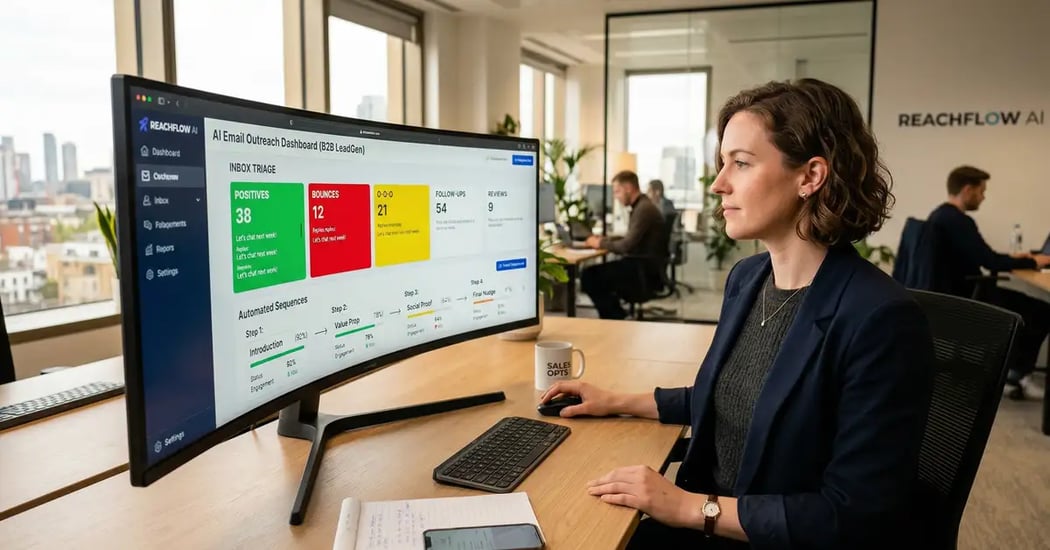
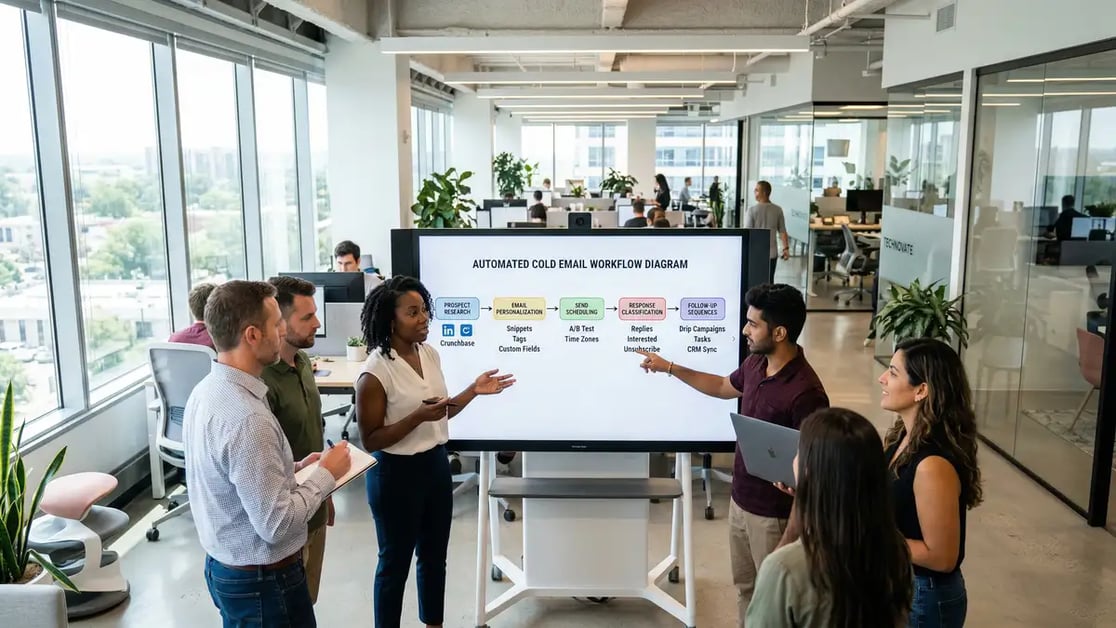
Cold email automation is the systematic deployment of software and agentic workflows to research prospects, personalize messages, schedule sends, classify responses, and orchestrate follow-up sequences — without manual intervention at each step. In 2026, the critical shift is from rule-based sequences to AI agents that handle inbox triage autonomously, categorizing every reply (positive, negative, out-of-office, bounce, referral) and routing each to the correct next action. AI email assistant
The numbers make the case. Instantly's 2026 Benchmark Report — analyzing billions of cold emails — puts the platform-wide average reply rate at 3.43%, with top performers exceeding 10%. Advanced AI personalization pushes reply rates to 18% versus 9% for generic templates, a 142% increase that compounds across every campaign you run. Meanwhile, B2B email deliverability benchmarks show average open rates of 27.7% with bounce rates around 7.5% — numbers that only improve when AI agents manage domain warming, authentication, and send timing.
For B2B founders trapped in the Technician's Trap, cold email automation represents one of the highest-leverage lead generation systems available: $36–$42 return for every $1 spent, outperforming paid ads, social selling, and content marketing on pure cost-per-lead.
What you'll learn in this article:
- How AI agents handle inbox triage — classifying responses, routing actions, and eliminating manual review
- The cold email automation tech stack that separates high-performers from the 3.43% average
- Deliverability architecture: SPF, DKIM, DMARC compliance and domain warming protocols
- A 5-step framework for deploying cold email automation that generates pipeline, not spam complaints
- Compliance requirements (CAN-SPAM, GDPR) and the penalties for getting them wrong
Key Takeaway
Cold email automation is no longer about sending more emails faster. It's about deploying AI agents that handle the entire inbox lifecycle — from prospect intelligence through response classification to follow-up orchestration — so your sales team only engages with qualified, interested buyers. The 142% reply rate advantage of AI-personalized emails over templates is the minimum baseline for any serious B2B outreach operation.
How Do AI Agents Handle Inbox Triage in Cold Email Campaigns?
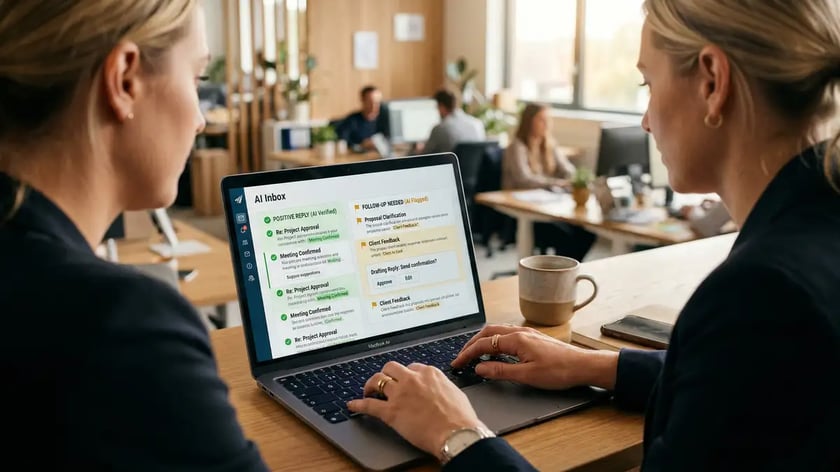
Inbox triage is where most cold email operations break down. A sales rep sending 200 emails per day receives a mix of positive replies, objections, out-of-office responses, bounces, unsubscribes, and referrals. Manual classification costs 2–3 hours daily — time stolen directly from closing deals. AI agents eliminate this bottleneck by classifying every incoming response in real-time and routing it to the appropriate workflow.
Modern AI workflow automation platforms achieve over 84% alignment with human coding accuracy when categorizing nonstandard phrasing, multilingual responses, and ambiguous replies. The classification categories typically include: positive interest (route to sales), objection (trigger objection-handling sequence), referral (create new prospect record), not-now (add to nurture cadence), out-of-office (reschedule follow-up), unsubscribe (immediate removal), and bounce (flag for list hygiene).
The operational impact is measurable. When AI agents handle triage, response time drops from hours to minutes. Research from The Digital Bloom's 2025 benchmark analysis shows that top-quartile performers achieve 15–25% reply rates through optimized hooks, targeting, and follow-up sequences — capabilities that depend on fast, accurate response classification. The 3-7-7 follow-up cadence (contact on Day 1, follow up on Days 3, 10, and 17) captures 93% of all replies by Day 10, but only works when the system can distinguish between "interested but busy" and "not interested" at scale.
Tools like Instantly's Unibox provide unified inbox management across multiple sending accounts, with AI-powered classification that supports team-wide SLA reporting. Autobound's AI sequences score each email on personalization quality, length, and spam triggers — emails scoring 90+ achieve 2.3x higher reply rates than sequences generated from basic LinkedIn data alone.
| Response Category | AI Action | Time Saved vs Manual |
| Positive Interest | Route to sales rep + CRM update | 15 min/reply |
| Objection | Trigger objection-handling sequence | 20 min/reply |
| Referral | Create new prospect + thank-you email | 25 min/reply |
| Not Now | Add to nurture cadence (90-day) | 10 min/reply |
| Out-of-Office | Reschedule follow-up to return date | 5 min/reply |
| Bounce | Flag for list hygiene + domain check | 8 min/reply |
Sources: Instantly Benchmarks 2026, The Digital Bloom Reply Rate Benchmarks
What Does the Cold Email Automation Tech Stack Look Like?
The technology powering cold email AI has matured from simple mail-merge tools into integrated platforms that handle the full outreach lifecycle. The stack divides into five layers: prospect intelligence, personalization engine, deliverability infrastructure, inbox triage, and CRM automation for pipeline handoff.
At the prospect intelligence layer, platforms like Apollo, ZoomInfo, and Clay aggregate firmographic and technographic data to build targeted lists. The personalization engine — where AI for SaaS companies creates the largest advantage — uses this data to generate subject lines, opening hooks, and value propositions tailored to each recipient's role, industry, and recent business activity. The impact is documented: referencing specific company news delivers a 20–30% reply lift, acknowledging particular business challenges adds 25–35%, and custom case study comparisons produce 35–50% lifts.
| Stack Layer | Function | Key Platforms |
| Prospect Intelligence | List building, enrichment, ICP scoring | Apollo, ZoomInfo, Clay |
| AI Personalization | Subject lines, hooks, body copy generation | Autobound, Lavender, Instantly AI |
| Deliverability | Domain warming, rotation, authentication | Instantly, Smartlead, Mailreach |
| Inbox Triage | Response classification, routing, SLA tracking | Instantly Unibox, Smartlead |
| CRM Handoff | Pipeline sync, lead scoring, task creation | HubSpot, Salesforce, Pipedrive |
Sources: Martal Cold Email Statistics 2026, Autobound AI Drip Email Tools 2026
Key Takeaway
The technology stack test for any cold email automation platform is simple: does it handle all five layers (intelligence, personalization, deliverability, triage, CRM handoff) in a single workflow, or does it force you to duct-tape point solutions together? Segmentation into cohorts of 50 or fewer contacts increases reply rates by 2.76x compared to 1,000+ recipient blasts — a capability that requires integrated intelligence and personalization layers working in concert.
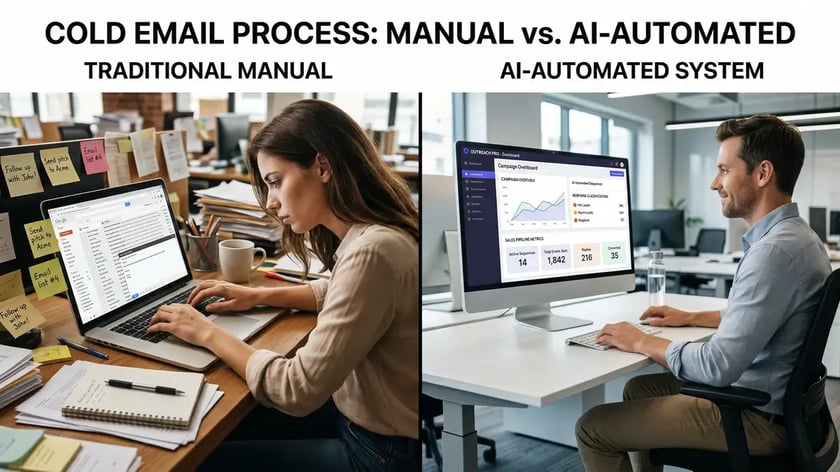
How Do You Architect Deliverability for Cold Email at Scale?
Deliverability is the infrastructure layer that determines whether your emails reach the inbox or die in spam. In 2026, with Google and Yahoo enforcing stricter sender rules, the technical requirements are non-negotiable. PowerDMARC reports that a good deliverability rate falls between 95% and 99%, with anything below 94% signaling sender reputation damage.
The authentication stack — SPF, DKIM, and DMARC — forms the foundation. Among Fortune 100 companies in 2026, Dmarcian found an 89% increase in DMARC policies set to p=reject and a 68% decrease in p=none policies, reflecting enterprise-wide recognition that authentication is mandatory. Globally, only 18% of top 10 million domains have valid DMARC records, and just 4% enforce p=reject — which means properly authenticated cold email domains gain a significant deliverability advantage over the majority.
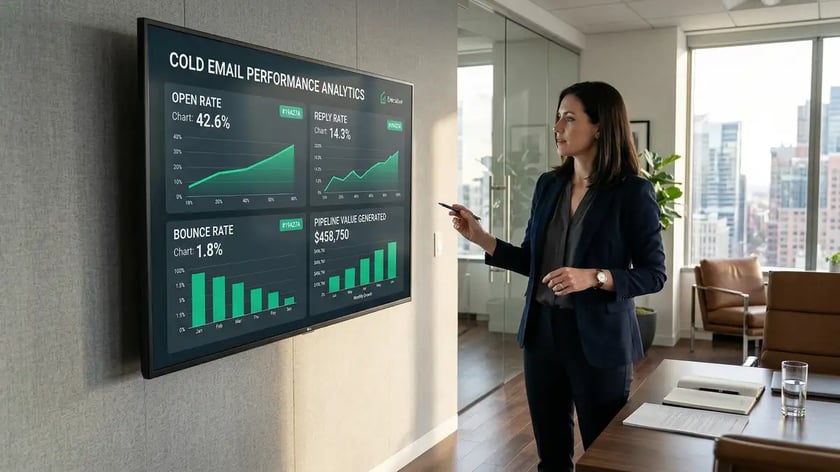
The practical deliverability architecture for B2B lead generation via cold email requires: dedicated sending domains (never your primary corporate domain), gradual domain warming over 2–4 weeks, email verification to keep bounce rates below 2%, and complaint rates under 0.1%. EmailToolTester's 2026 analysis across 15 ESPs found an average inbox placement rate of 83.1%, with Google at 89.8% and Microsoft at 77.4% — a 12-point gap that underscores the importance of provider-specific optimization.
Post-2024 Gmail rules mandate that bulk senders must keep spam complaints below 0.3%, support one-click unsubscribe, and align SPF/DKIM/DMARC. The consequence of non-compliance is immediate: Google reported a 65% reduction in unauthenticated email after enforcing these requirements.
| Deliverability Metric | Target | Risk Threshold |
| Inbox Placement Rate | 95–99% | Below 94% |
| Bounce Rate | Below 2% | Above 3% |
| Spam Complaint Rate | Below 0.1% | Above 0.3% |
| SPF/DKIM/DMARC | All aligned, p=reject | p=none or missing |
| Domain Warming Period | 2–4 weeks gradual ramp | Immediate high volume |
Sources: PowerDMARC Deliverability Rate 2026, EmailToolTester Deliverability Statistics 2026
Ready to architect a cold email system that generates pipeline without deliverability risk? Explore peppereffect's Lead Generation infrastructure.
Book a Growth Mapping CallWhat Are the 5 Steps to Deploy Cold Email Automation That Generates Pipeline?
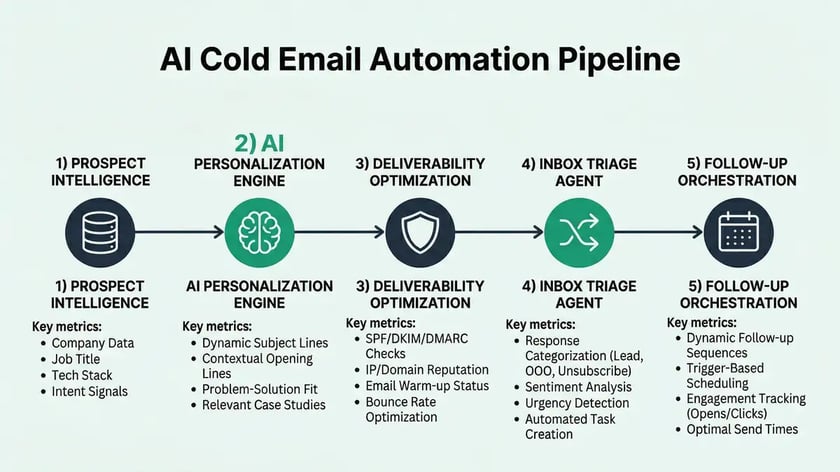
Build Your Prospect Intelligence Layer
Deploy enrichment tools (Apollo, Clay, ZoomInfo) to build ICP-matched lists with firmographic, technographic, and intent data. Segment into cohorts of 50 or fewer contacts — this single tactic increases reply rates by 2.76x versus mass blasts. Verify every email address before import to maintain bounce rates below 2%.
Configure Your Deliverability Infrastructure
Set up dedicated sending domains with SPF, DKIM, and DMARC (p=reject). Warm each domain gradually over 2–4 weeks before running campaigns. Configure workflow orchestration to rotate across multiple sending accounts, keeping each below daily volume thresholds. Target inbox placement above 95%.
Deploy AI Personalization at Scale
Use AI to generate subject lines, opening hooks, and value propositions tailored to each prospect's context. Keep email body length between 50–125 words (optimal for highest reply rates). Reference specific company news (+20–30% lift), business challenges (+25–35% lift), or custom case studies (+35–50% lift). Only 5% of senders personalize fully — this is your competitive advantage.
Install AI Inbox Triage Agents
Configure automated response classification across all sending accounts. Map each category (positive, objection, referral, not-now, OOO, bounce, unsubscribe) to specific sales automation workflows. Set SLAs: positive replies routed to sales within 5 minutes, bounces flagged immediately, objections entering handling sequences within 1 hour.
Orchestrate Follow-Up Sequences
Deploy the 3-7-7 cadence: initial email, follow-up Day 3, Day 10, Day 17. This captures 93% of replies by Day 10. Multi-channel integration (email + LinkedIn outreach) lifts reply rates from 4–6% to 8–12%. Track cost-per-meeting and cost-per-opportunity as primary KPIs, not just open rates.
Avoid This Mistake
The most expensive cold email automation mistake is optimizing for volume instead of deliverability. Sending 10,000 emails from a fresh domain without warming will destroy your sender reputation within days. Gmail's spam complaint threshold is 0.1% — exceeding it triggers throttling that can take weeks to recover from. Build infrastructure first, then scale volume gradually. The teams hitting 15%+ reply rates are sending fewer, better-targeted emails — not more.
What Are the Compliance Requirements for Cold Email Automation?
Cold email compliance is not optional, and the penalties have real teeth. Under CAN-SPAM, each non-compliant email carries a penalty of up to $53,088 — with no maximum cap. A campaign of 1,000 non-compliant emails could theoretically trigger over $53 million in fines. Usercentrics documents that the FTC actively enforces these rules: security firm Verkada faced a record $2.95 million fine for failing to include opt-out mechanisms.
The requirements for compliant cold email outreach under CAN-SPAM include: accurate "From" and "Reply-To" information, non-misleading subject lines, a valid physical postal address in every email, and a functional opt-out mechanism honored within 10 business days. GDPR adds additional requirements for EU recipients — penalties based on global company revenue can reach millions, and legitimate interest must be documented as the legal basis for B2B outreach.
| Regulation | Key Requirement | Maximum Penalty |
| CAN-SPAM (US) | Opt-out mechanism, physical address, honest headers | $53,088 per email |
| GDPR (EU) | Legitimate interest basis, data subject rights | 4% global revenue or €20M |
| CASL (Canada) | Express or implied consent required | $10M per violation |
| Gmail/Yahoo 2024+ Rules | SPF/DKIM/DMARC, one-click unsubscribe, <0.3% complaints | Deliverability throttling |
Sources: Usercentrics CAN-SPAM Compliance Guide, PowerDMARC Email Security Statistics 2026
Key Takeaway
Compliance is not a constraint on cold email automation — it's a competitive filter. The teams that build proper authentication, maintain clean lists, and honor opt-outs earn better deliverability, higher inbox placement, and stronger sender reputations. The $53,088-per-email CAN-SPAM penalty ensures that non-compliant competitors eventually exit the channel, leaving more inbox space for operators who architect their systems correctly.
How Do You Measure Cold Email Automation Performance?
Vanity metrics kill cold email programs. Open rates — the most commonly tracked metric — are increasingly unreliable due to privacy features like Apple Mail Protection that auto-load tracking pixels. The metrics that matter connect directly to sales intelligence and pipeline revenue.
According to LevelUpLeads' 2025 benchmarks, the realistic cold email funnel looks like this: ~42% open rate → ~3% reply rate → ~2% positive response → ~1% meetings booked. At scale, this means approximately 1 meeting per 100 delivered emails for well-executed campaigns. Conversion from meeting to deal closes at 20–30% for high-ticket B2B, yielding roughly 1 deal per 300–500 emails.
The performance levers that separate top performers from the average are well-documented: timeline-based hooks generate 9.91–10.67% reply rates versus 3.90–4.77% for problem-statement hooks. Multi-channel outreach (email + LinkedIn) achieves 8–12% reply rates versus email-only at 4–6%. And lead nurturing sequences for "not-now" responses extend the value of every campaign by re-engaging prospects when timing improves.
| Metric | Average | Top Performer |
| Open Rate | 27.7% | 35–45% |
| Reply Rate | 3.43% | 15–25% |
| Positive Response Rate | ~2% | 5–10% |
| Meeting Booked Rate | ~1% | 3–4% |
| Email ROI | $36 per $1 | $42+ per $1 |
| Optimal Email Length | 100–200 words | 50–125 words |
Sources: LevelUpLeads Cold Email Benchmarks 2025, Instantly Cold Email Benchmark Report 2026
Frequently Asked Questions
What is cold email automation and how does it differ from email marketing?
Cold email automation targets prospects who have not opted in to your communications, using personalized one-to-one messaging designed to start sales conversations. Email marketing sends to opted-in subscribers at scale with newsletters, promotions, and nurture content. The key technical difference is deliverability architecture: cold email requires dedicated sending domains, domain warming, and strict compliance infrastructure that marketing email platforms like Mailchimp don't provide. Cold email tools (Instantly, Smartlead, Apollo) are purpose-built for outbound prospecting with features like inbox rotation, response classification, and follow-up sequencing.
How many cold emails should you send per day per domain?
Start with 10–20 emails per day per sending domain during the warming period (first 2–4 weeks), then gradually increase to 50–100 per day once sender reputation stabilizes. Never exceed the volume where your bounce rate exceeds 2% or spam complaints exceed 0.1%. Most high-performing teams use multiple sending domains and rotate across them to maintain volume without triggering deliverability penalties. Teams sending under 10,000 emails per month typically achieve 50–60% open rates versus 30–40% for larger-volume operations.
What reply rate should you expect from AI-personalized cold emails?
AI-personalized cold emails achieve 18% average reply rates versus 9% for template-based approaches — a 142% improvement. However, this varies significantly by execution quality. Top performers using deep personalization (company news references, challenge acknowledgment, custom case studies) achieve 15–25% reply rates. The baseline platform average in 2026 is 3.43% according to Instantly's benchmark report. The gap between average and top performance comes from prospect intelligence quality, segmentation discipline (cohorts under 50), and follow-up cadence execution.
Is cold email automation legal under CAN-SPAM and GDPR?
Cold email is legal under CAN-SPAM when you include accurate sender information, non-misleading subject lines, a physical postal address, and a functional opt-out mechanism honored within 10 business days. Under GDPR, B2B cold email requires a documented legitimate interest basis — you must demonstrate that the recipient's business role makes them a reasonable prospect for your offering. Penalties are severe: up to $53,088 per non-compliant email under CAN-SPAM, and up to 4% of global revenue under GDPR. Building compliance into your automation architecture from day one eliminates risk.
What is the best follow-up cadence for cold email sequences?
The research-backed optimal cadence is 3-7-7: initial email, first follow-up on Day 3, second on Day 10, final on Day 17. This captures 93% of all replies by Day 10. Each follow-up should add new value — not just "checking in." Proposal automation links, relevant case studies, or industry-specific data points give recipients a reason to engage. Follow-ups increase overall campaign performance significantly, with emailing multiple contacts per company boosting reply rates by 93%.
How do you maintain email deliverability when scaling cold outreach?
Deliverability at scale requires four architectural pillars: authentication (SPF, DKIM, DMARC at p=reject on every sending domain), list hygiene (verify every address, keep bounces below 2%), volume management (rotate across multiple warmed domains, never spike volume), and engagement optimization (keep spam complaints below 0.1%, use one-click unsubscribe). The average inbox placement rate across major providers is 83.1%, with Google at 89.8% and Microsoft at 77.4% — optimizing for each provider's specific requirements is essential.
Ready to Deploy AI-Powered Cold Email Automation?
peppereffect architects complete cold email automation systems — from prospect intelligence through AI inbox triage to CRM pipeline handoff. We deploy the deliverability infrastructure, personalization engines, and response classification agents that turn cold outreach into a predictable revenue machine.
Explore Lead Generation SystemsResources
- Instantly — Cold Email Benchmark Report 2026
- Martal — B2B Cold Email Statistics and Benchmarks 2026
- The Digital Bloom — B2B Email Deliverability Benchmarks 2025
- LevelUpLeads — Cold Email Benchmarks 2025
- Dmarcian — Fortune 100 DMARC Adoption 2026
- Usercentrics — CAN-SPAM Compliance Guide
- Autobound — Best AI Drip Email Writers 2026
- EmailToolTester — Email Deliverability Statistics 2026
domain architecture for deliverability cold email deliverability architecture personalized email outreach